Introduction:
P20 stands as the industry-standard chromium-molybdenum tool steel (AISI P20). You use it specifically for plastic injection molding and die-casting. It comes pre-hardened (28-32 HRC). So, you machine it immediately. This avoids the risk of heat-treatment distortion.
This data sheet gives engineers the specs they need. Use it to validate if the material fits your job. We list precise chemical composition and thermal conductivity rates. You also get machinability metrics. The data shows P20 fits mold bases, compression molds, and medium-volume production runs.
Chemical Composition
Core Alloying Elements:
| Element | C | Cr | Mo | Mn | Ni | Si | P & S |
|---|---|---|---|---|---|---|---|
| Content (%) | 0.28 – 0.40 | 1.40 – 2.50 | 0.30 – 1.00 | 0.20 – 1.60 | 0.90 – 1.50 | 0.10 – 0.80 | ≤ 0.030 |
Strict Impurity Limits:
Phosphorus and sulfur stay at ≤0.030% maximum. This tight control stops brittleness and hot cracking. Extra phosphorus weakens grain boundaries. Too much sulfur creates sulfide spots that destroy toughness. These spots also create weak areas where corrosion starts.
P20+Ni variants push nickel to 0.9-1.6% for extra toughness in large molds. NAK80 uses higher carbon (~0.4-0.5%) plus aluminum to reach 40 HRC pre-hardened. This gives you mirror-finish polishing ability.
International Equivalents
| Region / Standard | Grade Designation |
|---|---|
| USA (AISI / ASTM) | P20 |
| Germany (DIN / W.Nr.) | 1.2311 |
| China (GB) | 3Cr2Mo |
| Sweden (SS) | 2242 |
| France (AFNOR) | 40 CMD 8 |
Key Characteristics
| Characteristic | Operational Benefit |
|---|---|
| Pre-hardened Delivery | Supplied at 28–32 HRC. Eliminates the need for post-machining heat treatment, avoiding quenching risks and distortion |
| Uniform Homogeneity | Consistent hardness from surface to core, even in large blocks (up to 500 mm thick). Prevents “soft spots” during molding |
| Excellent Machinability | Despite being pre-hardened, it cuts cleanly with standard HSS or carbide tools, extending tool life compared to harder grades |
| Superior Polishability | High purity allows for mirror finishes (SPI A2) and photo-etching texturing without inclusion defects |
| Dimensional Stability | Low internal stress helps the mold maintain tight tolerances during machining and long production cycles |
| Weldability | Can be repaired via welding (with correct pre-heat) if the mold is damaged, offering good color matching after re-polishing |
Physical and Thermal Properties
Physical Specs
| Property | Metric | Imperial |
|---|---|---|
| Density | 7.85 g/cm³ | 0.284 lb/in³ |
| Elastic Modulus | 205 GPa | 29,700 ksi |
| Thermal Conductivity | 29–34.5 W/(m·K) | 201–236 BTU·in/(hr·ft²·°F) |
| Specific Heat Capacity | 433–460 J/(kg·K) | — |
Thermal Expansion Rates (P20 PH)
| Temperature Range | Coefficient (10⁻⁶ m/(m·K)) |
|---|---|
| 20 – 100°C (68 – 212°F) | 11.1 |
| 20 – 200°C (68 – 392°F) | 12.9 |
| 20 – 300°C (68 – 572°F) | 13.4 |
| 20 – 500°C (68 – 932°F) | 14.6 |
| 20 – 700°C (68 – 1292°F) | 14.9 |
Performance Impact
These data points show you how P20 behaves in production:
- Dimensional Stability: Low thermal expansion rates keep your mold stable. It won’t grow much when heated. You need this to hold tight tolerances. The cavity shape stays true, even during long, hot production runs.
- Cycle Time Efficiency: Thermal conductivity hits 34.5 W/(m·K). P20 pulls heat away from the plastic fast. You avoid “hot spots” in the mold. Cooling cycles get shorter, and your production speed goes up.
- Structural Integrity: An elastic modulus of 205 GPa proves its stiffness. It handles injection pressures near 30,000 psi. Mold wall deflection stays minimal, which protects core pins and keeps parts flash-free.
Mechanical Properties
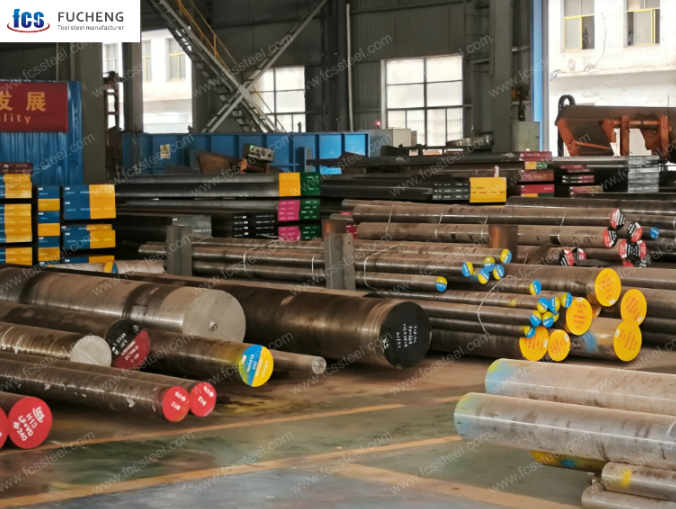
P20 steel is typically supplied in a pre-hardened condition suitable for immediate machining. The following data represents typical values for material tested at room temperature.
1. Hardness Data
| Condition | HRC Range | Brinell (HB) | Characteristics |
|---|---|---|---|
| Pre-hardened (Standard) | 28–34 | 285–330 | Uniformity ±1.5 HRC surface-to-core |
| Quenched & Tempered | 28–32 | 273–319 | Typical delivery state for massive blocks |
| Surface Hardened | 50–55 | — | Achieved via flame or induction hardening |
2. Strength Metrics
| Property | Metric | Imperial | Significance |
|---|---|---|---|
| Tensile Strength (UTS) | 965–1030 MPa | 140–150 ksi | Max load before failure |
| Yield Strength (0.2%) | 827–862 MPa | 87–116 ksi | Resists permanent deformation |
| Compressive Strength | ~862 MPa | ~125 ksi | Supports vertical clamping force |
| Elongation | 10–20% | — | Ductility against cracking |
| Impact Energy (Charpy V) | 27–34 J | 20–25 ft-lbs | Shock resistance at room temperature |
In Short:P20 proves its versatility here. The high tensile strength ensures cores won’t deform under clamping pressure, while reasonable impact energy prevents catastrophic cracking. It offers a “safe” balance—tough enough for production, yet ductile enough to avoid brittle failure.
Machinability Guide
P20 steel gives you 65% machinability compared to 1% carbon tool steel. Standard tooling cuts pre-hardened material (28-32 HRC) easily. This means you skip heat treatment steps after machining.
Optimal Cutting Speeds (Pre-hardened)
| Operation | Speed (Metric) m/min | Speed (Imperial) SFM | Recommended Tooling |
|---|---|---|---|
| Turning | 100–240 | 330–790 | Carbide inserts / Diamond-tipped |
| Milling | 65–150 | 210–490 | Coated carbide |
| Drilling | 40–95 | 130–310 | High-speed steel (HSS) / Carbide |
| Grooving | 55–135 | 180–440 | — |
| Parting | 50–115 | 160–380 | — |
Surface Capabilities
| Process | Achievable Finish (Ra) | Key Control Factor |
|---|---|---|
| Precision Turning | 0.288–0.296 μm | Feed rate (main factor) |
| Mirror Polishing | Total mirror (SPI A2 / A3) | Material purity & pre-hardening |
| Tufftriding (Hardening) | 700 HV (surface) | Time / temperature (2 h @ 570 °C) |
In Short: P20 machines 35% slower than standard carbon steel but cuts cleanly. To avoid work hardening, maintain constant feed rates—never dwell. For mirror finishes, ensure your raw block is quality-certified to avoid inclusion-related polishing defects.
Heat Treatment Data
Most P20 arrives pre-hardened (28-32 HRC), allowing you to skip straight to machining. However, specific applications require custom heat treatment cycles for stress relief or surface hardening.
Process Benefits
| Process | Why Do It? (The Benefit) |
|---|---|
| Annealing | Softens the steel structure to maximize machinability and remove internal forging stresses |
| Stress Relieving | Critical after rough machining; releases internal tension to prevent warping during final finishing or use |
| Hardening | Transforms the microstructure (austenite → martensite) to achieve maximum core strength and wear resistance |
| Tempering | Reduces brittleness after hardening, trading a small amount of hardness for significant gains in toughness |
Critical Temperature & Hardness Data
| Step | Temperature Range | Result / Target Hardness |
|---|---|---|
| Annealing | 760 – 788°C (1400 – 1450°F) | Soft < 250 HB |
| Stress Relief | 482°C (900°F) | No Hardness Change |
| Hardening | 843°C (1550°F) | 50 – 54 HRC (As Quenched) |
| Tempering | 482 – 593°C (900 – 1100°F) | 28 – 32 HRC (Standard) Up to 50 HRC (Low Temp) |
| Nitriding | 482 – 621°C (900 – 1150°F) | ~65 HRC (Surface Only) |
Wear Resistance & Durability
P20 steel earns a 3/6 wear resistance rating among tool steels. This puts it in the moderate range, at the lower end compared to premium grades like D2 or M2. P20 was designed for general plastic injection molds, not extreme wear jobs. You get decent wear protection for medium production runs. High-abrasive materials or glass-filled resins wear down P20 faster than harder tool steels.
Hardness Impact on Wear Life
Pre-hardened P20 arrives at 31-32 HRC (285-340 HB). This hardness level gives you great wear resistance for most plastic molding work. The uniform hardness of 310 HB goes deep across thick sections. No soft spots that wear faster. Your mold wears evenly during production.
Processing can push maximum hardness to 50-60 HRC. Heat treatment, nitriding, or flame hardening get you there. Surface hardening adds years to mold life in high-wear zones. The base material stays tough. The wear surfaces get hard.
Repairability Extending Service Life
P20 allows for reliable weld repairs, unlike more brittle high-carbon steels. If accidental damage occurs or gates wash out, you can rebuild surfaces using TIG welding (with proper pre-heating). The welded area maintains consistent hardness with the base metal, letting you re-machine and polish the mold back to original specs rather than scrapping it.
Corrosion Resistance
P20 steel rates fair to poor for corrosion resistance. The chromium content sits at just 1.8-2.1%. True stainless grades need at least 10.5% chromium. This low alloy mix means P20 rusts in wet conditions. Most working environments need protective measures.
Protection Strategies
Surface treatments aren’t optional with P20. You need them. Chrome plating adds wear resistance. It also protects mold surfaces from corrosion. Nickel plating boosts humidity resistance. Surface passivation strengthens the oxide layer during dry storage.
Basic maintenance keeps corrosion controlled:
1. Store molds in dry environments
2. Oil coatings go on right after each production run
3. Preheat material before any welding work
Marine climates need stainless alternatives like 420 or 440C. Chemical processing with acids calls for 316 stainless or Hastelloy. P20 works fine for injection molds in normal factory air. Just keep it away from wet or chemical-heavy environments.
Key Applications
P20 steel is the industry standard for general-purpose tooling, offering the perfect balance for medium-volume production runs. It excels in:
- Automotive Components: Critical for dashboards, interior trim, and lighting lenses where dimensional stability ensures parts fit perfectly every time.
- Consumer Electronics: Ideal for phone cases and laptop shells requiring mirror-polished surfaces (≤Ra 0.8μm) without the cost of premium stainless steels.
- Large Appliance Housings: Provides the deep, uniform hardness needed for thick sections like refrigerator panels and washing machine doors.
- Structural Mold Bases: Handles massive blocks (up to 20 inches/51 cm thick) and acts as robust backing plates or holders for die-casting operations.
- General Packaging: Cost-effective for Polypropylene (PP) and Polyethylene (PE) molding in 1-4 cavity layouts.
Specialized Use Cases
Beyond standard injection molding, manufacturers deploy P20 for specialized structural and high-volume applications:
- Zinc Die-Casting Dies: P20’s thermal shock resistance makes it a reliable, cost-effective choice for short-run zinc and low-melt alloy die casting, extending its utility beyond plastics.
- Medical Compression Molds: Ideal for pharmaceutical packaging and form dies where consistent core hardness (300 HBW) prevents defamation under high compressive loads.
- Precision Thin-Gauge Tooling: Used in 10-30mm pre-ground sheets for cosmetic cases and electronic housings. It offers superior flatness and stability compared to standard carbon steels for thin-wall parts.
- High-Volume Mold Bases: Serves as the premium standard for mold bases in runs exceeding 100,000 cycles. Unlike S50C (1045) steel, P20 resists “sinking” or cracking under repeated clamping pressure over time.
💡 Pro Tip: When to Upgrade
P20 is a workhorse, but know its limits. Do not use P20 for glass-filled resins (which cause rapid abrasion) or operating temperatures above 200°C (392°F). For high-wear zones like gates or ejector pins, consider gas nitriding—it boosts surface wear resistance by 30% while keeping the core tough.
Material Selection: P20 vs. Alternatives
Choosing the right steel isn’t just about price—it’s about matching the tool to the job. Think of P20 as your reliable baseline: affordable, tough, and easy to machine. Upgrade to premium grades like 718, NAK80, or S136 only when your specific production volume, surface finish, or operating environment demands it.
Selection Matrix
| Steel Grade | Best For… | Primary Advantage | Key Limitation |
|---|---|---|---|
| P20 (Baseline) | General Purpose, Structural Bases, Large Parts | Superior Toughness & Machinability | Standard Wear Resistance |
| 718 / H13 | High Temp >200°C, Die Casting | Heat Checking Resistance | Harder to Machine (1.5x) |
| NAK80 | High Gloss / Mirror Finish Parts | Excellent Polishability (40 HRC) | Brittle under Shock Loads |
| S136 (Stavax) | Medical, Food, PVC/Corrosive Resins | Rust/Corrosion Immunity | Highest Material Cost |
Cost vs. Life Analysis
| Grade | Est. Tool Life (Cycles) | Material Cost ($/kg) | Machining Cost Factor |
|---|---|---|---|
| P20 | 100k – 500k | $4 – $6 | 1.0× (Baseline) |
| 718 | 500k – 1 million | $7 – $9 | 1.5× |
| NAK80 | 1 million+ | $9 – $12 | 1.3× |
| S136 | Variable (environment dependent) | $12 – $15 | 1.7× |
Conclusion
P20 steel balances cost and performance for precision mold making. Its pre-hardened state (28-32 HRC) eliminates post-machining distortion, ensuring dimensional stability. While not suited for corrosive environments or glass-filled resins, it remains the standard for medium-volume runs and structural bases.
Use the data above to match P20’s properties to your specific cycle counts and finish requirements. For high-wear or mirror-finish needs, consider upgrading to P20+Ni or H13. Otherwise, P20 offers the most reliable ROI for general tooling.