When your local stockist quotes €8.40/kg for 1.2083 ESR tool steel and a Chinese quote lands on your desk at €3.90/kg, the savings look incredible. The European tooling market has been burned too many times by standard EAF steel hiding behind a fake 3.1 certificate. If that batch fails during polishing, your savings vanish into rework and delayed projects.
Europe, Japan, and Korea all supply reliable ESR at a premium. Southeast Asia is cheaper but has a thinner certification track record. China sits in the middle: the lowest ex-works price, the largest EAF+LF+VD+ESR capacity, and the highest verification burden. For a first-tier stockist ordering 20–50 tonnes, the landed-cost gap is usually large enough to justify the verification work — but only if the supplier can survive the four checks below.We’re a Chinese mill, and we expect buyers to run these checks on us.
Where European Demand Sits

Demand concentrates in automotive lighting and interior tooling, medical and cosmetic parts, and consumer electronics housings — three clusters where a polishing failure costs far more than the material price gap.
The three European buying zones differ in what they check first:
-
German-speaking / Central Europe (Germany: Ruhr, Hamburg/Bremen; Poland; Czechia): automotive and precision mold buyers. They ask for the ESR run number, ASTM E45, SEP 1921 Class D/d UT, and EN 10204 3.1 before they ask for the price.
-
Southern Europe (Italy: Brescia, Milan; France: Lyon, Le Havre, Fos-sur-Mer): mold and forging clusters. They ask for a polishing coupon and landed cost first, then the paperwork.
-
Benelux (Belgium: Liège): distribution and re-export. They ask about container loading plans and re-export documents.
From our order pattern, German-speaking buyers start with the certificate, Southern European buyers start with the sample, and both end up running the same four checks below.
Before You Send the RFQ
China’s integrated EAF+LF+VD+ESR capacity and lower conversion cost explain the ex-works gap; whether it survives freight, duty, and VAT is the math in the next section. Once you’ve matched the zone, the RFQ itself needs to be comparable across bidders. First-tier stockists replenish quarterly or monthly, 20–50 tonnes per order — one to two 20GP containers. China’s integrated EAF+LF+VD+ESR capacity and lower conversion cost explain the ex-works gap; whether it survives freight, duty, and VAT is the math in the next section. Once you’ve matched the zone, the RFQ itself needs to be comparable across bidders. First-tier stockists replenish quarterly or monthly, 20–50 tonnes per order — one to two 20GP containers.
Watch the pricing spread. Chinese marketplace listings show standard 1.2083 at US$1,100–1,300/tonne, while genuine ESR plate runs US$1,800–2,000/tonne. If a quote undercuts ESR pricing by 40% or more, flag it and confirm the remelting route before anything else.
To get an apples-to-apples comparison, specify the form, dimensions, delivery hardness (annealed ≤240 HB), and tolerance against DIN EN ISO 4957 or ASTM A276. Require every bidder to confirm the grade, ESR/ESU process with heat number, UT class, certificate type, lead time, Incoterm, and replacement policy.
Compare the Real Landed Cost
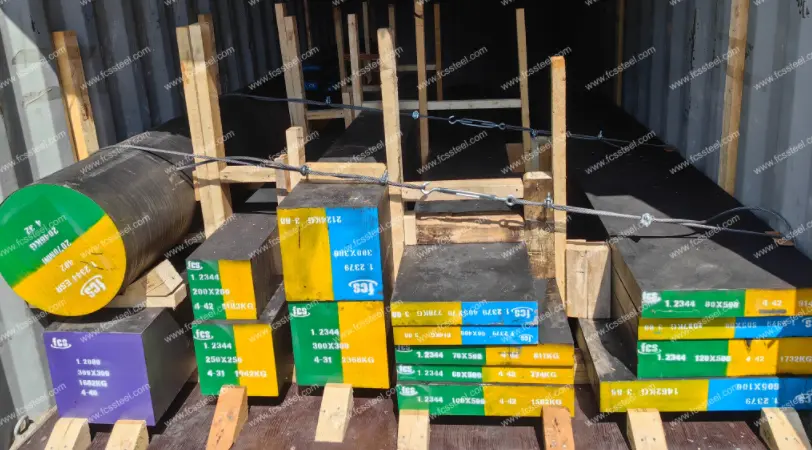
Don’t let low raw material quotes fool you into overestimating your savings. Importing steel from China involves various international freight, duty, and clearance charges that eat into that initial gap. To find your true savings, you must calculate the total landed cost.
Let’s look at the real numbers for a 5,000 kg shipment of high-purity 1.2083 ESR mold steel:
|
Cost Element |
China Import (FCS Direct) |
European Local Supplier |
|
Material Price (5,000 kg) |
€20,000 (€4.00/kg) |
€32,500 (€6.50/kg) |
|
Freight & Insurance |
€1,800 |
€400 |
|
EU Customs Duty (3.2%) |
€698 |
€0 |
|
Brokerage & Customs Clearance |
€350 |
€100 |
|
Inland Delivery to Warehouse |
€450 |
€300 |
|
Total Landed Cost (ex-VAT) |
€23,298 |
€33,300 |
|
Final Landed Cost per KG |
€4.66 / kg |
€6.66 / kg |
The Real Bottom Line:
On paper, the unit price difference looks huge (€2.50/kg). Once you add import duties, freight, and port clearance, that gap narrows to €2.00/kg.
However, when you buy in volume—such as this 5-ton batch—those fixed logistics costs get spread out, delivering a net cost saving of 30% (€10,000+ per order). While small individual orders may get consumed by fixed import fees, bulk sourcing direct from a true mill like FCS ensures substantial, bottom-line profitability.
Note on Import VAT: While import VAT (e.g., 19% in Germany) is paid at clearance, it is fully recoverable in your normal tax filing and does not add to your ultimate material cost.
Verify ESR in Four Steps
Start with the certificate and heat number — it’s the fastest filter. Only move to sample and audit if the paperwork survives.
Step 1: Contract the ESR route. Make ESR a contractual line item by requiring the EN 10204 3.1 certificate to name the final remelt mill, the original heat number, the ESR run number, and the full remelt route. For critical tooling, go ahead and upgrade to EN 10204 3.2 with independent inspection. Check the paperwork for these basics:
-
Certificate type (strictly 3.1 or 3.2)
-
Signatory authorized independent of production
-
Chemistry values checking out against your spec limits (C 0.36–0.42%, Cr 12.50–14.50%, P/S ≤0.030%)
-
No missing pages or oddly altered PDF fonts
At FCS, we put the ESR run number and remelt route directly on the MTC before loading.
Step 2: Audit traceability on one bar. Run a fast traceability audit on one random bar right before shipment. Just photograph the stamped heat number, match it against the MTC and packing list, and ask the mill for its internal routing record linking that ingot to your finished product.
Step 3: Pair PMI with macroetch. Remember that PMI or OES only confirms the chemical composition; it cannot verify the remelt process on its own. You need to pair it with an ASTM A604 macroetch report and metallography at 100–200× showing reduced banding.
Step 4: Sample gate and quarantine. Treat a pre-production sample from the actual heat as a hard gate, keeping an AQL of 2.5 for major defects and 4.0 for minor defects before bulk cutting starts. If heat numbers mismatch or the mill won’t produce internal documents, quarantine the shipment immediately. When checking the sample, verify:
-
Heat number matching the MTC and ESR run record
-
Hardness in HRC, with the test method stated (HBW or HRC)
-
UT acceptance class against DIN EN ISO 4957
We cut the sample from the actual heat and seal it with the heat number and approval date.
Audit the Supplier Before the PO
Before issuing a Purchase Order, verify the seller’s official Chinese corporate name and business license through public registries (like GSXT or Qichacha). Ensure their registered business scope explicitly includes manufacturing terms such as “Manufacturing” (制造) or “Production” (生产), rather than merely “Trading.” To prevent fraud, ensure the quotation, proforma invoice, contract, and beneficiary bank account all match this exact licensed entity name.
You can also commission an independent factory audit through third-party agencies such as SGS, Bureau Veritas, or TÜV Rheinland to verify physical machinery and actual production capability.
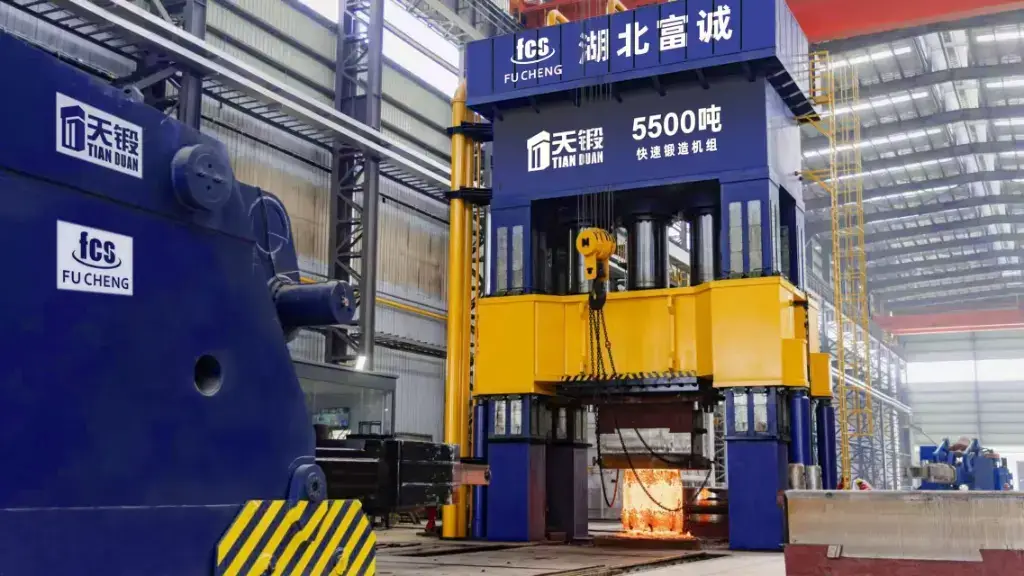
As a genuine mill established in 2007 with TÜV ISO 9001 certification, FCS operates a 5,500-ton hydraulic fast-forging press with an annual capacity exceeding 60,000 tons. Our entity name is 100% consistent across all legal, banking, and export documents, and we fully welcome third-party audits (SGS, BV, TÜV) and pre-shipment inspections.
Lock Down Customs and Incoterms
Most disputes over importing 1.2083 ESR mold steel from China stem from vague contract terms regarding delivery and customs clearance. To avoid misunderstandings, always specify the exact Incoterm alongside a precise location—for instance, “CIF Rotterdam Port, Incoterms® 2020” or “CFR Hamburg Port, Incoterms® 2020.”
Please note that standard mill-direct exports are typically handled under CIF, CFR, or FOB terms. Under these terms, the buyer acts as the Importer of Record, utilizing their own EORI number and EU VAT registration to clear customs and pay applicable import duties and VAT at the port of entry. Avoid ambiguous or non-standard terms like “DAP, duty paid.” Clear specification of the Incoterm, destination port, and customs responsibility in your Purchase Order (PO) ensures a smooth, dispute-free clearance process.
Protect the Payment and Contract
A perfect 3.1 certificate won’t save you if the mill goes under mid-production. Tie each payment to verified progress. Pay 10% on signing, 20% on sample approval, 30% after inspection, 30% on shipment, and 10% after acceptance. Retain 5–10% for 30–90 days post-acceptance.
For high-risk suppliers, use an irrevocable, confirmed letter of credit instead of open-account terms. Add a retention-of-title clause for delivered steel. Also state in writing that any buyer-funded tooling or raw material remains your property, kept segregated and insured.
Build in termination rights for insolvency, repeated default, or missed milestones. Add step-in rights as well, allowing you to seize work-in-progress and appoint a replacement mill if the supplier fails.
Stress-Test Three Failure Scenarios
A contract looks solid until the factory floods, the port shuts down, or the mill’s bank calls in a loan mid-production. Run these three scenarios before you commit to a full container order.
Scenario 1: Plant failure. Assume the supplier’s main site goes dark for 2–4 weeks from fire, equipment breakdown, or a strike. Ask what finished 1.2083 ESR inventory they hold, whether a qualified subcontractor can pick up the run, and how fast they can restart. Calculate Time-to-Survive against Time-to-Recover. If TTR beats TTS, you’re covered.
Scenario 2: Logistics breakdown. Model a multi-week shutdown at Shanghai or Ningbo alongside a container shortage. Ask for an alternate port and carrier lane, the extra transit time, and who approves substitutions.
Scenario 3: Financial or system failure. Mills running into cash-flow trouble or taking a ransomware hit on their ERP often fail to produce certificates or ship on schedule. Ask for proof of financial health and confirm they maintain offline backups for quality records.
Any supplier with a single site, no named backup, and no clear answers to these three questions is an immediate red flag.
The Verification Checklist
Print this list and run every quote against it before you wire a deposit.
-
Designation: MTC states DIN 1.2083/X42Cr13 tool steel, ESR condition, heat number, and standard
-
Route proof: Supplier confirms the full EAF + LF + VD + ESR process, rather than vacuum degassing alone
-
Chemistry: C 0.36–0.42%, Cr 12.50–14.50%, P/S ≤0.030% each
-
Documents: EN 10204 3.1 MTC, ESR furnace log, and UT report to EN 10228-3 Class 4
-
Audit: Verification from SGS, Bureau Veritas, or TÜV, with the ISO 9001 certificate verified directly with the issuing body
-
Pricing: US$1,800–2,000/ton at a 10-ton MOQ; flag anything below this range
-
Traceability: Heat number matches across the bar, shipping tag, packing list, and invoice
Conclusion
Sourcing 1.2083 ESR mold steel from China works when you treat it as an engineering decision. Reliable suppliers hand over spectral analysis, hardness reports, and genuine EN 10204 3.1 certificates without hesitation. Anyone who stalls or sends vague PDFs tells you everything you need to know before you pay a deposit.
Your margin on this deal is decided during due diligence. Verify the ESR process, test a sample batch, inspect pre-shipment, and lock payment terms to performance milestones.
Run the checklist above on us: ESR run number on the MTC, QC-signed 3.1, sample sealed from the actual heat, 10/20/30/30/10 payment, and a container plan within 48 hours.
If you source 1.2083 ESR in 20GP lots, send your spec and destination port to [email protected].