
A quotation lands on your desk with “1.2767” buried in the spec sheet, and you wonder if this high-nickel cold work steel actually fits the die you are designing, or if it is just another number a supplier is pushing. Skip the metallurgy textbook detour. You need a straight answer on which industries run this grade in production and which mold types justify its cost. This breakdown shows where 1.2767 tool steel fits, from automotive stamping dies to precision gauges, with the hardness ranges and impact toughness figures that separate a good fit from an expensive mistake. You’ll also see how it stacks up against 1.2510 and 1.2842 tool steel when your project sits on the fence, so you can settle the selection question before it reaches your engineering review.
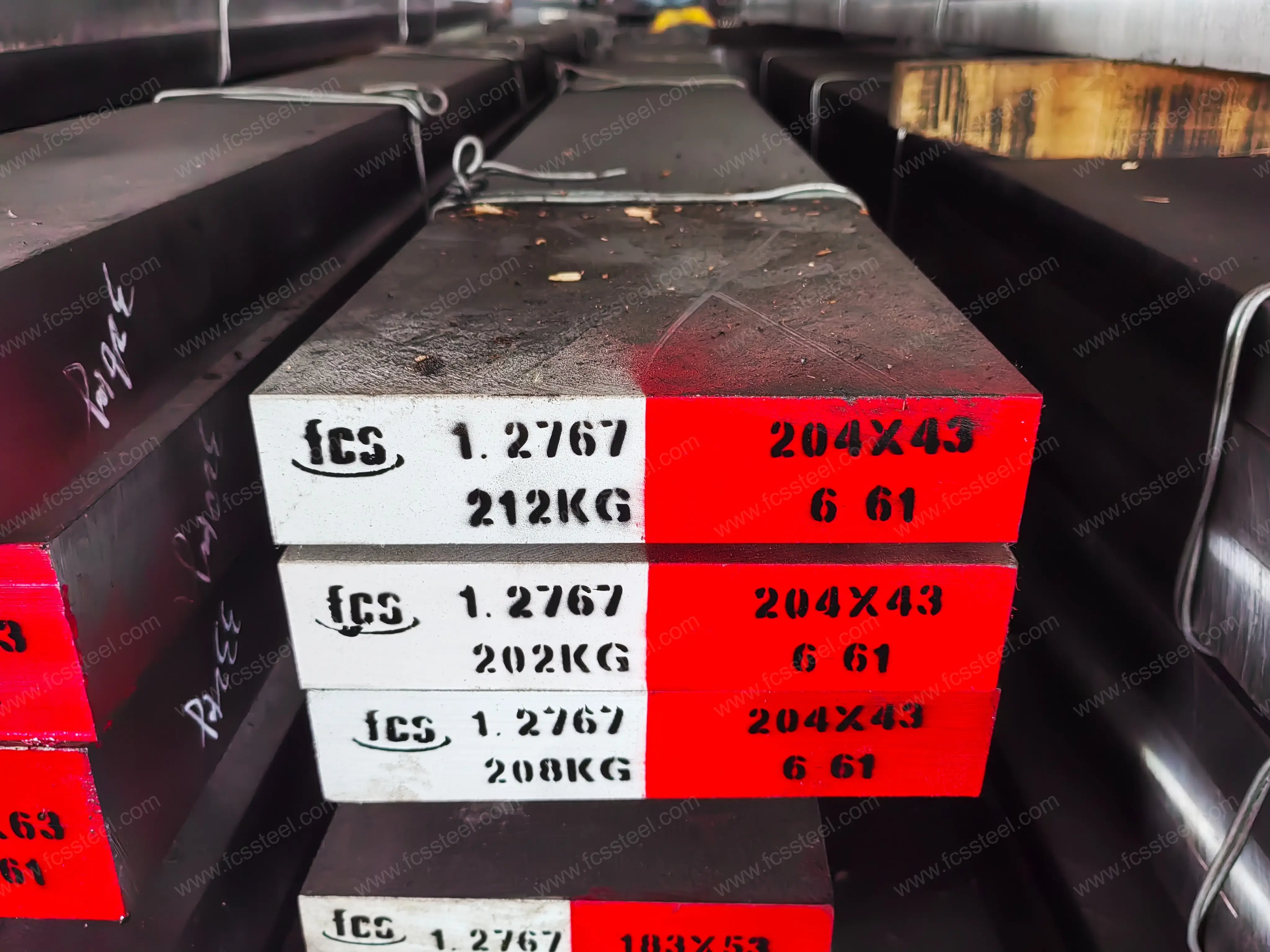
1.2767 Tool Steel Applications
Supplied soft-annealed at 262–285 HB, 1.2767 tool steel hardens through its full section to a working range of roughly 50–56 HRC. That through-hardening behavior, paired with high toughness, decides where this grade fits on a shop floor — and where it doesn’t.
|
Industry / Mold Requirement |
Fit |
Component Examples |
Why It Works |
|---|---|---|---|
|
Optical & high-gloss plastics |
Strong |
Cavity plates, cores, inserts |
Polishes cleanly for transparent, cosmetic-grade parts |
|
Large plastic molds under load |
Strong |
Big cavity plates, stressed inserts |
Handles bending and compressive stress across large cross-sections |
|
Thermoset molding |
Good |
Mold plates, inserts |
Balances surface finish with strength |
|
Embossing & patterning |
Strong |
Large embossing tools |
Toughness demands are highest here |
|
Cold forming & heavy forming |
Strong |
Bending, drawing, cold-forging dies |
Resists fracture under repeated forming loads |
|
Cutting & shearing |
Good |
Thick-material blades, punches |
Handles high-stress shearing of thick stock |
|
Hot forging |
Conditional |
Forging tools |
Compare against H13 or W302 for sustained heat exposure |
If fracture, impact, or bending is your main failure risk — and polish quality matters — 1.2767 fits. If wear resistance or continuous high-temperature service is the issue, look toward a dedicated hot-work grade instead.

Plastic Injection & High-Gloss Mirror Molds
For transparent parts or cosmetic housings, mold steel must polish to a flawless finish and handle high injection pressures. 1.2767 combines structural toughness with excellent polishability to meet both demands. If you need a true optical mirror finish, specify ESR (Electro-Slag Remelted) quality material. The ESR process reduces the tiny internal inclusions that cause pitting during final polishing.
Heavy-Duty Forming, Cold Forging, and Stamping
Automotive stamping dies for high-strength sheet metal, cold-extrusion punches, and massive hot-pressing tool assemblies take brutal, repeated shock. The steel needs strength all the way through the block. The high nickel content in 1.2767 provides through-hardenability, allowing large tool sections to maintain their integrity deep into the core. Rigid, brittle steels often crack under heavy compressive loads, while 1.2767 absorbs the shock to keep production lines running. For continuous hot-pressing, check your operating temperatures against dedicated hot-work grades before specifying this alloy.
Embossing, Coining, and Precision Pressing
Appliance panel tools, cutlery dies, and specialized coining stamps share a mechanical challenge. They must reproduce fine surface details under intense, localized pressure. Steel selected only for maximum hardness risks the fine pattern edges chipping off during early production runs. 1.2767 provides a practical balance. It delivers enough working hardness to maintain crisp patterns, alongside the structural stability to survive thousands of intense pressing cycles without micro-fracturing.
Heavy Shearing, Cutting, and Deep Drawing
Engineers often choose high-carbon grades for industrial knives or cutting dies to maximize wear life. Shearing thick material or deep-drawing difficult alloys requires a different approach. A chipped edge halts a press long before abrasive wear becomes an issue. For thick-stock shear blades, drawing jaws, and heavily stressed punches, toughness is the primary defense. 1.2767 prevents premature edge fracture in cutting and drawing applications where impact and bending forces overwhelm standard wear-resistant tooling.
Chemical Composition and Material Properties
|
Element |
C |
Si |
Mn |
Ni |
Cr |
Mo |
P |
S |
|---|---|---|---|---|---|---|---|---|
|
Typical (%) |
0.45 |
0.25 |
0.40 |
4.00 |
1.35 |
0.25 |
— |
— |
|
Range / Max. (%) |
0.40–0.50 |
— |
— |
3.80–4.30 |
1.20–1.50 |
0.15–0.35 |
≤0.03 |
≤0.03 |
-
Through-hardening: Good hardening depth makes 1.2767 suitable for thick inserts and large tool sections.
-
Toughness: Resists cracking under repeated impact and bending loads, where more wear-resistant steels may chip.
-
Compressive strength: Handles the heavy loads found in forming and cold-forging tools.
-
Polishability: Takes a high polish for appearance-critical mold cavities. ESR quality helps reduce inclusion-related polishing defects.
-
Machining: Supplied soft-annealed for machining before hardening; also suitable for EDM, texturing, and etching.
-
Hardness: Soft-annealed delivery is typically ≤260 HB, subject to the supplier’s specification. Working hardness is around 54 HRC, depending on heat treatment.
Choose 1.2767 when a mold needs both a fine finish and toughness through a thick section. For general-purpose molds with moderate demands, P20 may be more economical: its prehardened delivery, typically around 30–32 HRC, avoids hardening after machining.
Recommended Working Hardness by Application
You can’t just aim for maximum hardness and hope for the best. Dialing in the right HRC for your specific tool geometry and load type is what prevents premature cracking. Here is a quick reference guide for 1.2767 based on real-world shop floor applications:
|
Application / Tool Type |
Target Hardness |
Performance Focus |
|---|---|---|
|
Plastic Injection (Mirror Molds) |
50–54 HRC |
Balances excellent polishability with enough structural stability to handle injection pressures. |
|
Automotive Stamping & Forming |
52–55 HRC |
Maximizes toughness to prevent insert cracking under repeated bending stresses. |
|
Cold Forging & Extrusion |
52–56 HRC |
Delivers maximum shock absorption for heavy, repeated compressive blows. |
|
Heavy-Duty Shear Blades |
54–56 HRC |
Provides just enough edge retention while avoiding the brittle chipping seen in harder D2 steels. |
|
Embossing & Coining Dies |
54–58 HRC |
Ensures high compressive strength for intense, localized pattern pressure. |
Grade Comparisons: 1.2767 vs. 1.2510, 1.2842, and 1.2764
Swapping steel numbers on a quote sheet feels harmless until the die cracks in week two. 1.2767 is not a drop-in substitute for 1.2510 or 1.2842. It’s a nickel-alloyed, through-hardening steel built for toughness; the other two are oil-hardening cold-work grades built for wear resistance in smaller tooling.
|
Grade |
Composition / Condition |
Strength |
Best Fit |
|---|---|---|---|
|
1.2767 |
0.45% C, 1.4% Cr, 0.3% Mo, 4.0% Ni; annealed ≤285 HB; hardens 50–56 HRC |
Toughness, impact resistance, hardenability |
Large sections, impact-loaded dies, forming/drawing tools |
|
O1-type, tungsten-bearing; annealed ~220 HB |
Wear resistance, machinability |
Punches, cutting dies, edge-retention work |
|
|
O2-type; paired with 1.2510 in HASCO datasheets |
High hardness, compressive strength |
Guide strips, ejectors, cutting stamps |
|
|
1.2764 |
— |
— |
Confirm supplier certificate before substitution |
Bottom line: 1.2510 and 1.2842 run broadly equivalent to each other — tungsten just gives 1.2510 an edge on wear. Neither shares 1.2767’s toughness profile. Don’t blur that line on an RFQ.
Procurement Checks and Die Design Requirements
-
Prepare the RFQ: Provide the latest controlled drawing, revision number, 1.2767 grade, delivery condition, stock dimensions, annual and lifetime volumes, critical tolerances, and surface finish requirements.
-
Confirm process fit: Check part geometry, stock thickness, production volume, and secondary operations against the proposed die concept.
-
Check press compatibility: Verify clamping, tie-bar spacing, die dimensions, and the ejection interface.
-
Agree on heat treatment: Confirm target hardness and treatment requirements for the actual tool section before approving detailed design.
-
Define tryout acceptance: Set limits for dimensions, burrs, cracks, and springback. Agree on sample quantities before testing.
-
Request quality records: Require material certificates and heat-treatment records, including final hardness results.
Technical Support and Bulk 1.2767 Sourcing
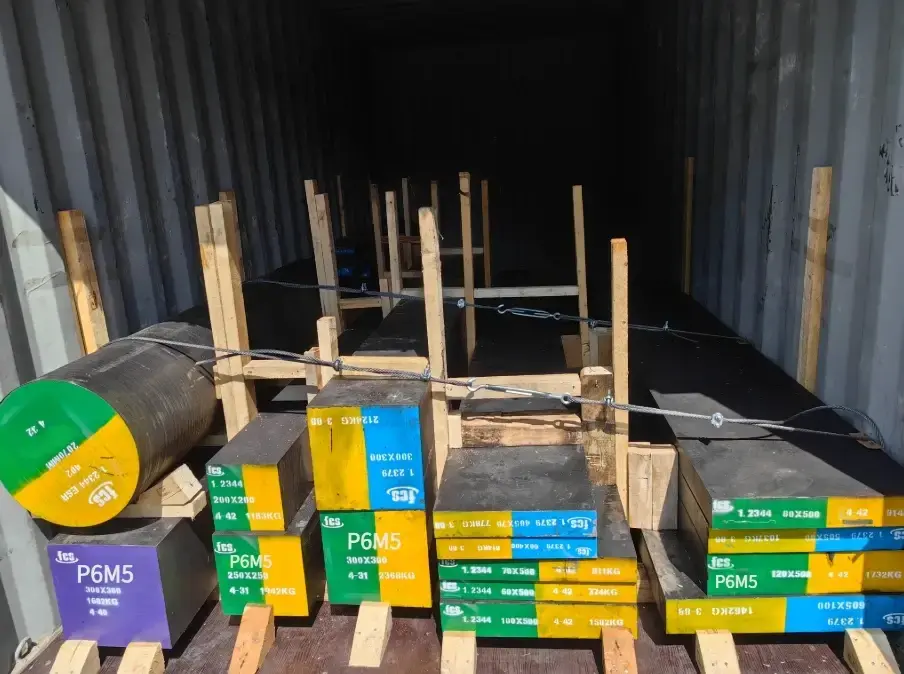
Successfully sourcing 1.2767 tool steel takes more than just dropping a grade number on a purchase order. To make sure the material actually stands up to your tooling demands, you need to clearly define the intended application, section dimensions, and delivery condition upfront.
Since 2007, FCS Tool Steel has backed industrial buyers and distributors with serious manufacturing capacity. Operating a 5,500-ton press at our ISO 9001:2015 certified facility in Huangshi, we deliver fully traceable massive blocks and long bars, all backed by EN 10204 3.1 inspection certificates.
Keep in mind that our production is built for scale. We operate strictly on a bulk-supply model, meaning orders require a full-container-load (FCL) minimum of 20–25 tonnes. Because of this, we cannot accommodate retail cut-piece requests.
Ready to price out your next run? Send us your required dimensions, surface finish, target standard, and preferred destination port. Our team will quickly review your specs against our current production schedule and put together a tailored supply plan.