
Introduction:
When dealing with heavy-duty tooling like scrap-cutting blades or stamping dies, finding the right steel is a balancing act. If it’s too hard, the edge chips under impact; if it’s too soft, rapid wear halts production. 1.2746 tool steel solves this by delivering the perfect sweet spot: exceptional surface wear resistance backed by rugged core toughness.
For distributors and toolmakers buying in bulk, consistency is everything. That’s why, as a dedicated wholesale tool steel manufacturer, FCS supplies reliable, factory-direct forged and annealed 1.2746—giving you the stable foundation your manufacturing demands without the guesswork.
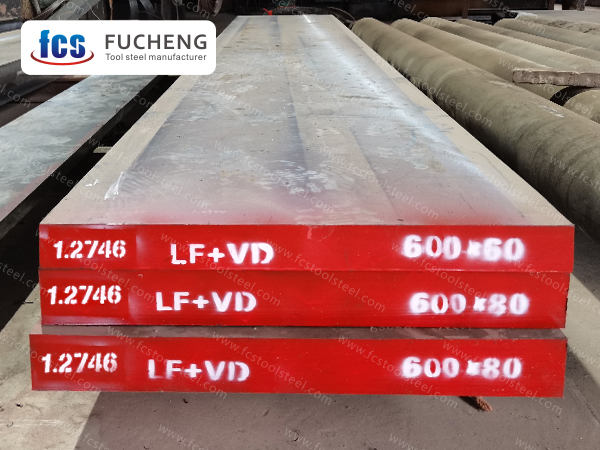
What Makes 1.2746 Useful for Tooling?
When checking 1.2746 steel equivalents, you will usually see it associated with the designation 45NiCrMoV16-6. The standout 1.2746 tool steel properties come directly from its nickel-alloyed composition. It provides a unique combination of core toughness, solid through-hardening capability, and serious abrasive-wear resistance.
That balance actually matters in service. You see, a tool might remain intact but completely lose its working profile through wear. Or, it could retain a hard edge yet suffer local chipping. The material has to address the physical demands of the complete component.
Typical Chemical Composition
|
Element, wt.% |
C |
Si |
Mn |
Cr |
Mo |
Ni |
V |
|---|---|---|---|---|---|---|---|
|
Typical content |
0.45 |
0.30 |
0.80 |
1.50 |
0.80 |
4.00 |
0.50 |
These are typical values. The agreed composition limits and actual heat analysis govern acceptance of supplied material.
Main Applications of 1.2746 Tool Steel
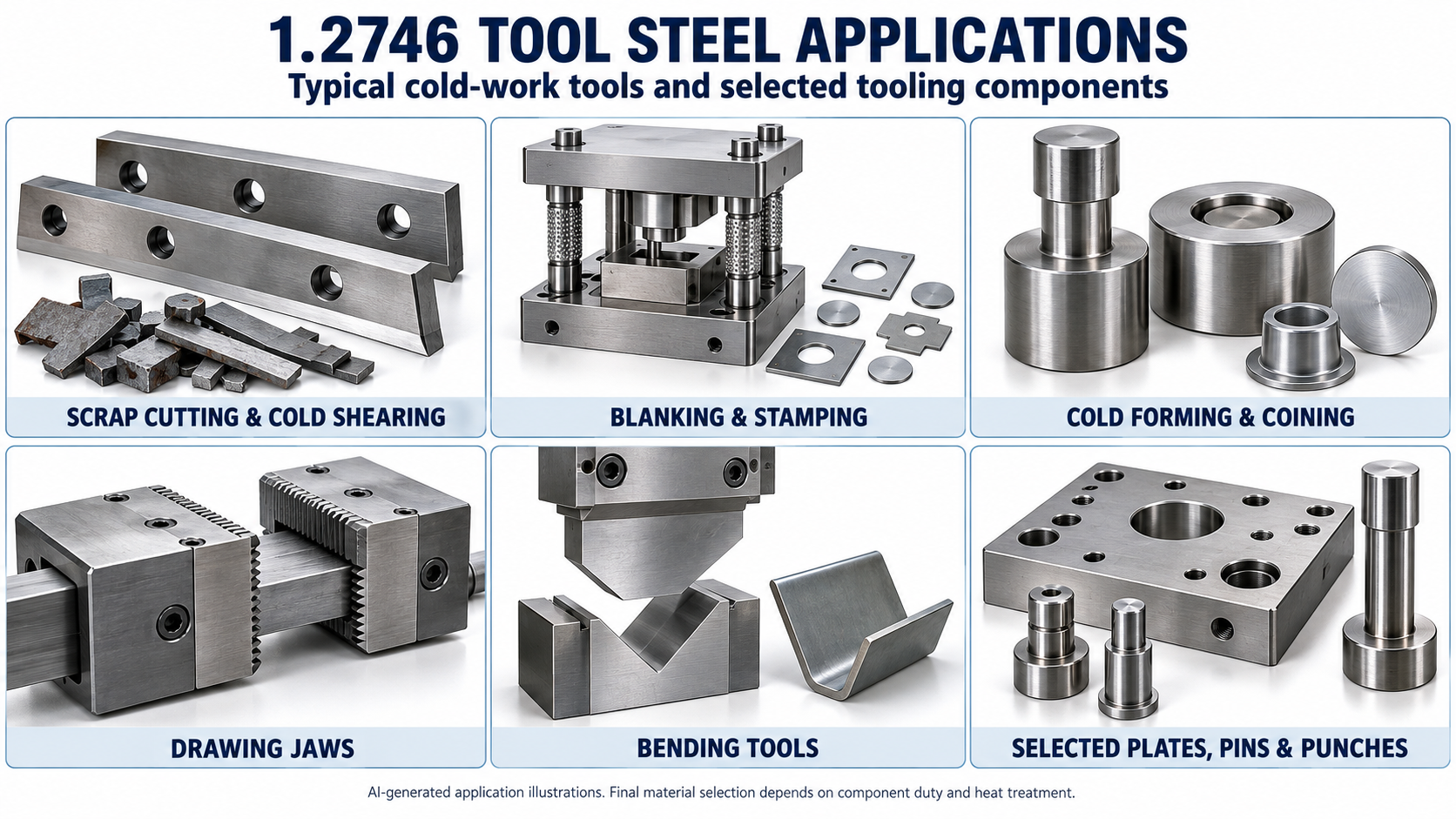
|
Application |
Typical tools |
Main material demands |
|---|---|---|
|
Scrap cutting |
Cold-shear and scrap-cutting blades |
Edge retention and resistance to mechanical shock |
|
Blanking and stamping |
Cutting tools, punches, and inserts |
Wear resistance and toughness |
|
Cold forming and coining |
Forming and coining tools |
Profile retention under repeated contact loads |
|
Drawing and bending |
Drawing jaws and bending tools |
Contact-surface durability and toughness |
|
Mold components |
Selected plates, pins, and punches |
Properties suited to the component’s mechanical duty |
1. Scrap-Cutting Blades and Cold-Shear Blades
Scrap comes in different shapes and thicknesses. Cutting loads change from one section to the next. The blade needs an edge that resists wear and a body that withstands mechanical shock.
This is a well-established application for 1.2746. Its combination of toughness and wear resistance addresses both demands. A 50–54 HRC working-hardness range provides a reference for the grade in this application. This concerns the finished tool, not the annealed stock supplied to the blade manufacturer.
A worn edge and a cracked blade tell different stories. Gradual rounding points toward wear. Chipping also calls for checks on clearance and edge geometry. Cracks in the blade body require attention to support, mounting, and processing.
The steel supplies the material properties. The blade arrangement must allow those properties to work.
2. Blanking, Stamping, and Fine-Blanking Tools
Every cut loads the working edge. Over time, wear changes its profile. A chipped edge can stop production before the rest of the tool is worn out.
1.2746 is used in blanking, stamping, and fine-blanking tooling. Its wear resistance and toughness are relevant to cutting components exposed to repeated mechanical loading.
The individual part matters. A supported insert and a slender punch do not carry loads in the same way. An insert may mainly need edge retention. A punch may also face bending and local stress concentrations.
Workpiece material, thickness, tool geometry, and the existing damage pattern help define the requirement. “Steel for stamping dies” is too broad a description to approve material for every component.
3. Cold-Forming and Coining Tools
Forming tools press material into shape. Coining tools reproduce a defined profile or feature. Their working surfaces carry repeated contact loads and must retain the required geometry.
1.2746 is an established option for these applications. Toughness helps resist mechanical damage; wear resistance helps preserve the contact surface.
The final condition must suit the component. A compact, supported insert and a long punch may need different hardness levels. Surface wear, deformation, and fracture are separate problems. Increasing hardness is not a complete answer to all three.
Workpiece condition, lubrication, support, and surface treatment also affect performance. The material decision should follow the actual forming operation.
4. Drawing Jaws and Bending Tools
Drawing jaws transmit force through their contact surfaces. Bending tools repeatedly load a working profile. Both need durable contact areas and enough toughness for the applied loads.
Drawing jaws and bending tools are documented uses of 1.2746. The grade provides a relevant property balance, but contact geometry, lubrication, and support still affect service performance.
For these tools, surface hardness is only part of the specification. The complete component must carry the load without losing its required shape or suffering mechanical damage.
5. Selected Mold Components and Tooling Parts
Selected plates, pins, punches, and other tooling parts also appear in the application range for 1.2746.
For mechanically loaded components, toughness and wear resistance may be the main concerns. Cavity inserts bring extra requirements. Resin fillers, corrosion, temperature, and surface finish can change the material choice.
A tooling-part application does not make 1.2746 a universal plastic-mold steel. Define the component and its duty before specifying the raw material.
Other Applications and Important Limits
Selected forging and hot-pressing tools, bushings, and piercing tools are also listed applications. Hot service needs a separate review. Temperature, contact time, and repeated heating and cooling introduce demands beyond room-temperature toughness and wear resistance.
|
Requirement |
What needs confirmation |
|---|---|
|
Repeated high-temperature loading |
Hot strength, softening, and thermal-fatigue requirements |
|
Die-casting service |
Performance under the actual thermal cycle and mechanical loading |
|
Corrosive plastic processing |
Resistance to the relevant exposure conditions |
|
Highly abrasive filled polymers |
Filler characteristics, wear location, and suitable material alternatives |
|
Mirror-finish cavities |
Polishing performance and surface-acceptance requirements |
A forging application does not establish general suitability for die casting. Likewise, wear resistance alone does not establish suitability for every filled resin.
What Matters When Purchasing 1.2746 Raw Material?
-
Grade and chemistry: Specify 1.2746, the governing specification, and composition limits.
-
Sizes and quantities: List product form, dimensions, tolerances, allowance, and tonnage by size.
-
Delivery condition: Confirm the supply state, hardness limit, and test method.
-
Inspection: Define tests, coverage, acceptance criteria, and reports.
-
Traceability: Match material heat numbers with certificates and packing records.
-
Shipment: Agree delivery stages, corrosion protection, handling, and bundle identification.
Bulk 1.2746 Tool Steel Supply from FCS
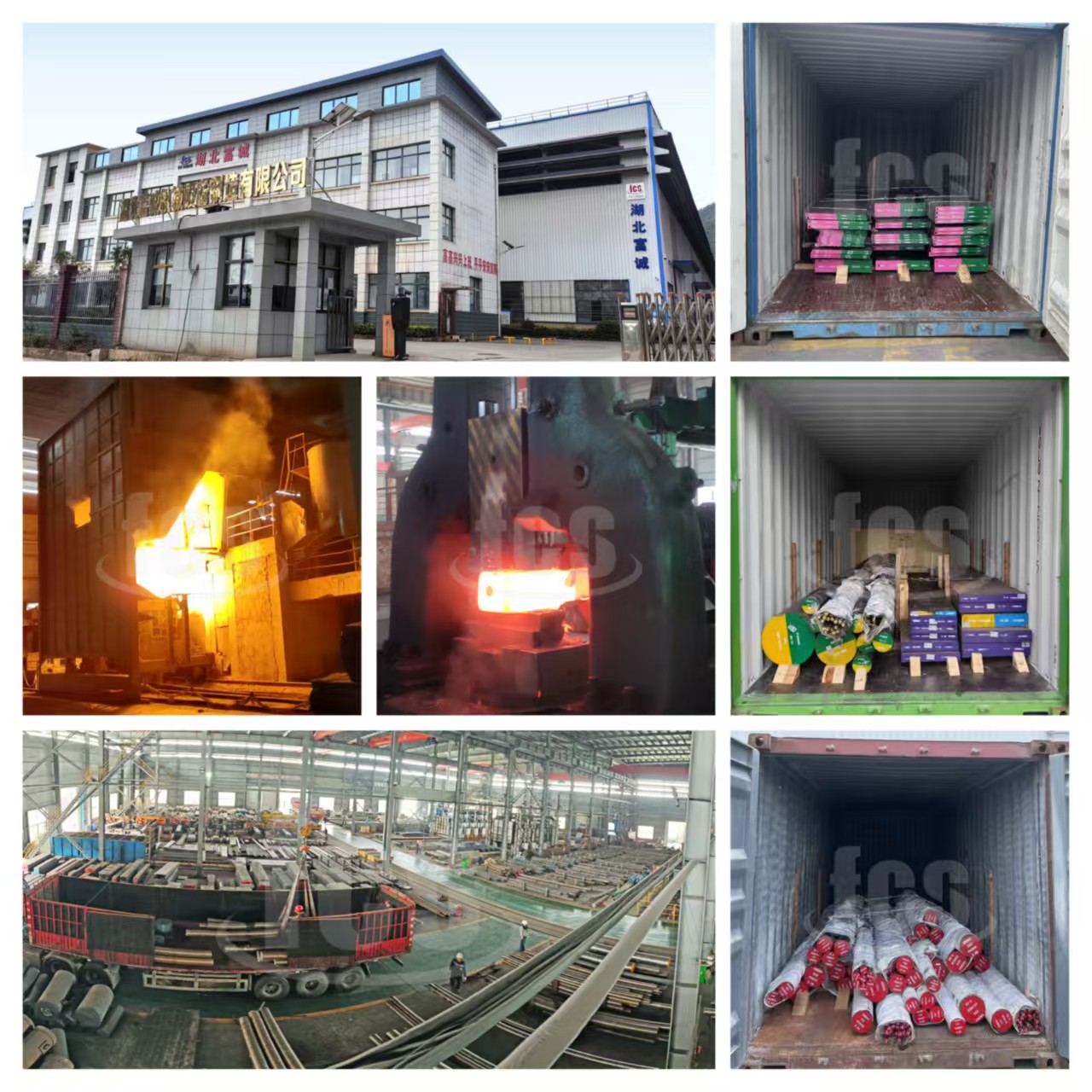
Finding reliable 1.2746 tool steel suppliers takes work when market quality varies. FCS ships factory-direct, full-container wholesale raw material (LF+VD+forged, annealed at ≤295 HBS) to overseas stockholders and distributors.
As a source mill, we handle your bulk orders using our own manufacturing equipment:
-
Established in 2007: Nearly two decades of direct steel-making experience.
-
5,500-Ton Forging Press: Provides the deep core consolidation required for heavy blocks and long bars.
-
60,000+ Tons Annual Capacity: Built to handle year-long stocking programs.
-
TÜV NORD ISO 9001 Certified: Verified by rigorous third-party audits.
Our QC team tests every piece before loading using two handheld XRF spectrometers, guaranteeing zero material mix-ups.
To prevent rust during ocean freight, we coat peeled bright bars with anti-rust oil and wrap them in VCI film. Heavy plates and forged blocks receive an even layer of anti-rust paint on all six sides. We also apply custom WMS color-coding paint to the ends and sides so the shipment matches your warehouse intake system.
Ready to Secure Your Bulk 1.2746 Supply?
From high-impact scrap blades to heavy-duty cold-forming dies, your tooling demands consistency. As a dedicated mill, FCS partners with tool steel stockholders, distributors, and major industrial buyers to deliver that stability.
Please note our bulk supply policy: We handle factory-direct, Full Container Load (FCL, 20–25 tons minimum) shipments. Our standard production focuses on forged long bars (2,500mm–5,800mm) and heavy forged blocks. To maintain our manufacturing efficiency and pricing, we do not offer retail cut-piece sales or accept orders under 3 tons. If you need single cut pieces or small trial orders, please contact a local steel distributor.
If you are a buyer looking for a reliable partner for wholesale tool steel orders or a long-term stocking program, we can help. Send FCS your specific dimensions, tonnage by size, and inspection requirements to get a factory-direct quote.