High-temperature tooling can fail early. It cracks under thermal stress. It loses hardness during long die casting runs. The steel grade you pick can become an expensive mistake.
Manufacturers want longer die life. They need consistent performance above 600°C. This has made the debate between 1.2365 and H13 (1.2344) steel more intense.
H13 has been the go-to choice for hot-work tooling for decades. But 1.2365 is now showing up as the better option. It offers stronger thermal fatigue resistance. You get better hot hardness retention. Plus, it’s easier to machine, which can cut your processing costs by up to 30%.
This comparison looks past the marketing hype. We examine the metallurgical differences between these two steels. You’ll see real-world performance data from forging and die casting operations. We cover the specific conditions where your 1.2365 vs. H13 (1.2344) steel choice impacts your profits. This helps you make the right decision before placing your next tool order.

1. Chemical Composition
These two steels perform differently at the molecular level. Small changes in alloying elements create big differences in how each steel handles extreme heat.
The Molecular Breakdown
At the molecular level, these two steels take different approaches to heat resistance. While H13 relies on a balanced cocktail of elements, 1.2365 doubles down on molybdenum to fight thermal fatigue. Here is the specific breakdown:
| Element | 1.2365 (H10) | H13 (1.2344) | Performance Impact |
|---|---|---|---|
| Molybdenum | ~2.80% (High) | 1.10–1.75% | The biggest differentiator. High Mo gives 1.2365 superior hot hardness and stability. |
| Carbon | ~0.32% (Lower) | 0.32–0.45% | Lower carbon in 1.2365 improves toughness and acts as insurance against cracking. |
| Chromium | ~3.00% (Lower) | 4.75–5.50% | Lower Cr boosts thermal conductivity, helping heat escape faster from the die. |
| Vanadium | ~0.50% | 0.80–1.20% | H13’s higher V content creates hard carbides, offering better abrasive wear resistance. |
You can see the trade-off clearly: H13 is built for general wear resistance, but 1.2365 is chemically engineered to survive extreme thermal shock and cycling.
2. Heat Performance
Look to 1.2365 for thermal shock. You get high molybdenum content (~2.8%). This stabilizes the steel’s structure. It results in great hot hardness, or red hardness. Your dies keep a sharp edge at red-hot forging temperatures. They also absorb the stress of fast heating and cooling. This steel stops “spiderweb” heat checks. Those cracks often ruin tools in thermal cycling.
H13 focuses on wear resistance. It has higher vanadium content. This creates hard carbide particles that act like tiny armor against friction. Also, H13 resists tempering well. It won’t get soft during long heat exposure. Choose this steel if your main issue is surface wear rather than thermal cracking.
Performance Comparisons
Each steel specializes in a different type of heat stress. Choose 1.2365 for toughness against cracking, or H13 for resistance to rubbing wear.
| Feature | 1.2365 (H10) | H13 (1.2344) |
|---|---|---|
| Hot Hardness | Excellent. Keeps edge shape at red-hot temps (High Mo). | Good. Resists softening, but less stable under shock. |
| Wear Resistance | Standard. | Superior. High Vanadium carbides act as armor against abrasion. |
| Thermal Fatigue | Best Choice. Resists “spiderweb” heat checking. | Vulnerable to cracking under rapid cycling. |
| Primary Strength | Handling Thermal Shock. | Resisting Constant Friction. |
3. Hot Hardness: Strength Above 600°C
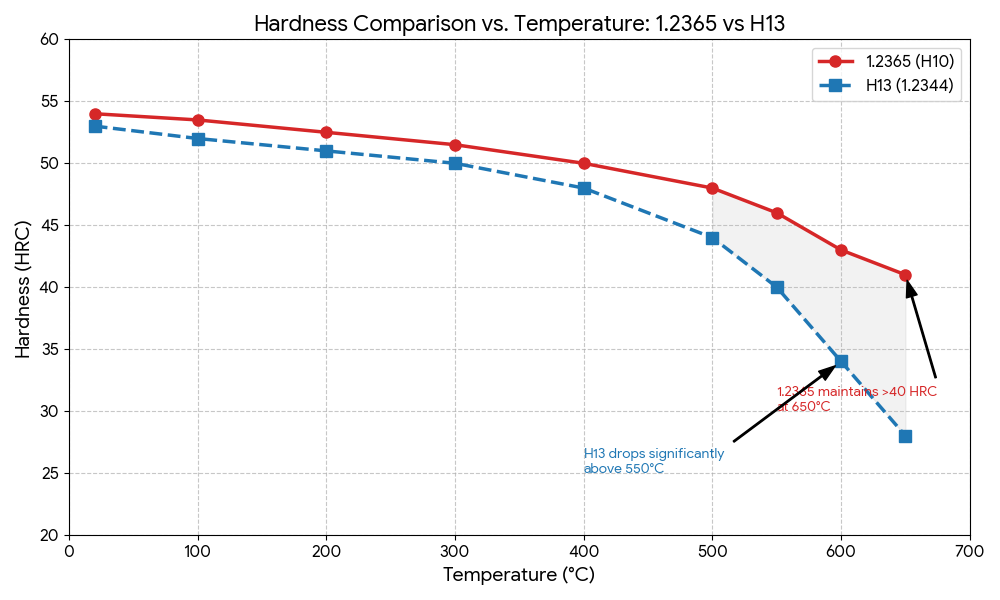
1.2365 stands apart from other hot work steels at extreme temperatures. Your dies run above 600°C? Most tool steels start softening through tempering. 1.2365’s high molybdenum content (2.8%) fights this breakdown. It keeps working hardness where other grades give up.
Test Results at 600°C
Lab tests show how well the hardness holds up. Follow the heat treatment guide (quench from 1020-1050°C and triple-tempered at 550-650°C). You get these results with 1.2365:
| Temperature Condition | Hardness Level (1.2365) |
|---|---|
| Room Temperature | 52-56 HRC |
| At 600°C | 41-45 HRC (keeps high tensile strength) |
| At 650°C | Holds >40 HRC (constant heat) |
| In-Service Working Hardness | Keeps 50-52 HRC (long cycles >600°C) |
Why this matters: At 600°C, softer steel deforms instantly. High hot hardness prevents this dimensional loss, cutting scrap rates and stopping expensive production downtime.
4. Thermal Fatigue: Fighting Heat Checks
Dies need to release heat quickly. If they generally fail to cool down, you get heat checking, or spiderweb cracks. 1.2365 manages this thermal stress better than H13. The chemistry prioritizes heat transfer, not just hardness. This distinction decides your speed. You can ramp up production, or you must slow down to save the tool.
| Metric | 1.2365 (H10) | H13 (1.2344) |
|---|---|---|
| Thermal Conductivity | ~30 W/m·K (High) Heat moves out fast. |
~26 W/m·K (Standard) Heat stays longer. |
| Chemistry Impact | Lower Cr (~3.0%) helps flow | Higher Cr (~5.0%) traps heat |
| Water Cooling? | Safe. Resists shock cracking. | Risky. Likely to fail fast. |
The Operational Advantage: A 20% conductivity gap gives you more options. Heat leaves the die faster with 1.2365. So, feel free to use aggressive water cooling. This cuts your cycle times. H13 is often too brittle for this. It might crack under the same cooling shock.
5. Toughness vs. Brittleness Control
Excellent Toughness
Carbon control determines if your die acts like a resilient spring or brittle glass. H13 specifications allow for a relatively wide swing in carbon content. This inconsistency creates risk; one batch of steel might perform well, while the next snaps unexpectedly under load. 1.2365 tightens this range significantly, keeping carbon levels lower and more precise. This acts as a safety net. When a forging hammer strikes or high-pressure metal shoots in, 1.2365 absorbs that mechanical shock. Instead of suffering catastrophic fractures, the steel has the toughness to yield slightly, preventing the sudden, dangerous failures often seen in standard H13 blocks.
Preventing Brittleness
The difference is even clearer during long-term heat exposure. H13 is prone to “temper embrittlement” if it stays in the critical temperature zone too long—it essentially loses its toughness and becomes vulnerable to cracking.
1.2365 is chemically engineered to resist this breakdown. Its molybdenum-rich structure stops the internal grain boundaries from weakening during thousands of heating and cooling cycles. Where H13 would develop deep surface cracks early in the run, 1.2365 maintains its structural integrity. It “breathes” with the thermal stress rather than breaking, keeping your die surface smooth long after H13 would have been scrapped.
6. Real-World Production Performance
Cold forging data shows how steel choice affects tool life. Engineers predict die life using low-cycle fatigue testing, crack growth analysis, and finite element modeling (FEM). This method calculates cycles until cracks start. Then it projects how cracks grow until failure. The numbers tell you when to replace tools—before production stops.
3 Factors for Longer Life
Three elements control how long your 1.2365 vs. H13 (1.2344) steel forging dies last under extreme loads:
- Notch radius optimization reduces stress at critical die features. Sharp corners create failure points. Proper radius design spreads stress across larger areas. Your dies resist cracks longer.
- Pre-stressing methods extend operational cycles. Dies get controlled pressure before production use. This boosts the tool’s ability to handle repeated impacts. Case studies show 20-50% more cycles before cracks start with pre-stressing and fatigue-resistant steel grades.
- Material selection sets baseline performance. High-fatigue-resistance steels like 1.2365 provide the foundation. The molybdenum-rich makeup resists tiny cracks during heat cycles. Dies stay stable through hundreds of thousands of forging operations.
Heavy-Duty Use Cases
Loaded die inserts gain most from this three-factor approach. Combine 1.2365’s superior heat fatigue resistance with optimized notch geometry and pre-stressing. You get measurable gains: fewer emergency stops, lower tooling inventory costs, and predictable replacement schedules.
The performance gap grows in high-volume aluminum forging and magnesium die casting. 1.2365 dies under water cooling keep crack-free surfaces longer than H13 versions. Production managers track actual cycle counts—the data confirms material choice matters more than processing variables alone.
7. Application Guide: When to Choose 1.2365
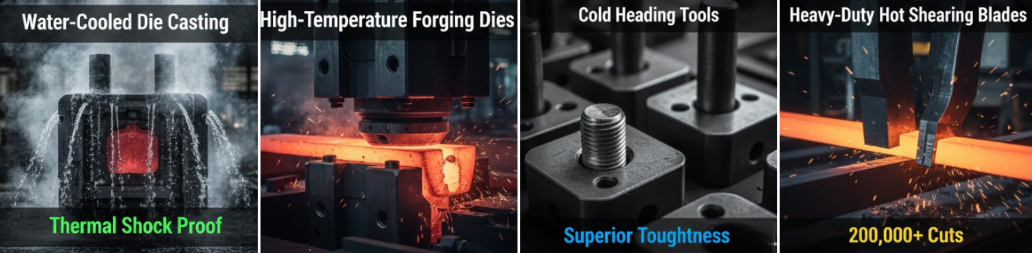
Material choice often decides if a tool runs for months or fails in weeks. Use this quick guide to see where 1.2365 outperforms standard H13 (1.2344).
| Production Scenario | Why Choose 1.2365 | The H13 Risk |
|---|---|---|
| Aggressive Water Cooling (e.g., brass casting, pressure dies) | Thermal shock proof. High conductivity (30 W/m·K) handles rapid cooling without cracking | Develops surface cracks (“heat checks”) quickly under water shock |
| Cold Forming & Impact (e.g., screws, bolts, rivets) | Superior toughness. Lower carbon (0.32%) prevents brittle snapping under heavy loads | Higher brittleness often leads to sudden catastrophic failure |
| High Hardness Requirement (>600 °C operations) | Holds 50–52 HRC. High Mo (2.8%) resists softening during long, hot runs | Tends to soften to 45–50 HRC, leading to faster wear |
| Extrusion & Plastic Molding (e.g., block receivers, plugs) | Faster heat transfer. Low chromium structure reduces gradients and speeds up cycles | Slower heat dissipation creates higher internal stress |
Quick Rule: If your main problem is thermal cracking or you need water cooling, 1.2365 is your answer. If your main problem is pure abrasive wear (sandpaper-like rubbing), H13 might still be the standard choice.
Final Decision Checklist
Run this four-step check before you order:
- Cooling method: Need direct water contact? → 1.2365
- Load profile: Cold forming or mixed stress? → 1.2365
- Hardness target: Need 50-52 HRC range? → 1.2365
- Failure mode: Thermal cracking before wear? → 1.2365
Skip 1.2365 if you need maximum impact strength or V-carbide wear protection. H13’s higher vanadium (1.00% vs. 0.50%) gives better abrasion protection for heavy die casting.
Hot shear knives show the real difference. 1.2365 versions resist heat checking through 200,000+ cuts. H13 versions develop surface cracks at 120,000-150,000 cycles in the same conditions. The molybdenum boost means more uptime.
8. Machinability and Processing Advantages
Processing time hits your budget harder than raw steel prices. 1.2365 gives you a huge win here. It can cut total manufacturing costs by up to 40% against H13.
- Faster Machining Speeds: Check the machinability rating: 90-95% (vs. H13’s 55%). So, run those spindle speeds high. You remove material 1.6–1.7 times faster. Take a complex milling job. If H13 needs 100 minutes, 1.2365 often finishes in just 60.
- Lower Tooling Costs: H13 has high silicon content. It is abrasive and pushes you to buy expensive PCBN inserts once hardness passes 40 HRC. 1.2365 uses standard carbide tools the whole time. This reduces insert wear by 20–30%. You save cash on consumables and avoid downtime for tool changes.
- Predictable Heat Treatment: 1.2365 holds its shape well during quenching. H13 distortion is hard to guess, so you have to leave large machining allowances. 1.2365 lets you machine closer to the net shape. This slashes final grinding work and scrap from distortion.
Conclusion
H13 limits shouldn’t stop your production speed. 1.2365 steel succeeds where standard grades fail. You get strong hot hardness above 600°C. Also, you enjoy a 40% drop in machining costs. Thermal cracking kills profits. This steel stops that problem cold.
Don’t settle for average performance. Your dies face extreme heat or aggressive cooling. So, make the switch. Talk to your supplier today about using 1.2365 for your next run. Stop swapping tools so often. Start breaking production records. Your bottom line will show the difference.