Introduction:
Sourcing 1.2365 (H10) hot work tool steel is not a routine purchasing task. This grade sits in a narrow window between performance and process control. Small deviations in chemistry, melting practice, or heat treatment response can translate into shorter die life, thermal cracking, or unpredictable deformation in service.
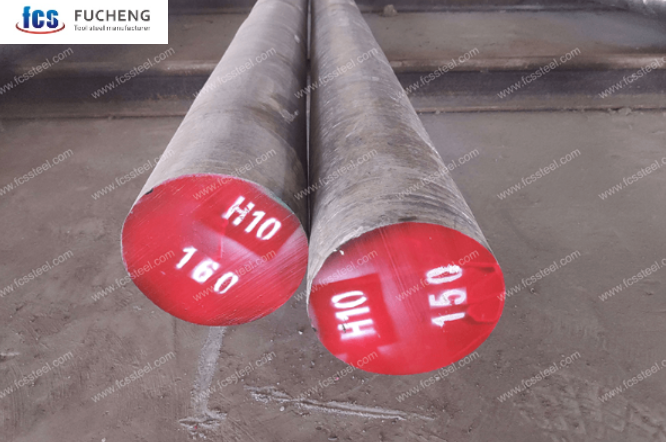
H10 is typically selected for extrusion dies, forging tools, aluminum and copper alloy die-casting molds, and other applications where tools are exposed to repeated thermal cycling between 500–650 °C. In these conditions, buyers care far less about nominal hardness values and far more about hot strength retention, resistance to thermal fatigue, and long-term structural stability.
South Korea has developed a strong reputation for steelmaking discipline and process control. However, not every large steel producer is automatically a good H10 supplier. Some excel in volume. Others specialize in construction or commodity grades. Only a small number are truly optimized for hot work tool steels.
This guide evaluates five commonly referenced South Korean steel suppliers strictly from an H10 buyer’s perspective. Instead of listing corporate financials or market capitalization, we focus on what matters in real procurement decisions.
What H10 Buyers Really Care About
Before reviewing suppliers, it helps to align on true decision drivers when buying 1.2365:
-
Chemical Stability, Not Just Compliance
Meeting DIN or ASTM ranges is not enough. Mo and V fluctuations directly affect hot hardness and resistance to softening. -
Melting & Refining Route
ESR or equivalent secondary refining is critical for thermal fatigue resistance and internal cleanliness. -
Heat Treatment Responsiveness
Good H10 should tolerate reasonable variations in quench and temper cycles without distortion or brittle behavior. -
Batch-to-Batch Consistency
Toolmakers rarely buy once. Repeatability matters more than peak performance numbers. -
Technical Communication
When a die cracks or softens early, buyers need engineers, not sales reps.
With these criteria in mind, here is how the five suppliers compare.
1. FCS Tool Steel
Positioning: Dedicated Tool Steel Specialist
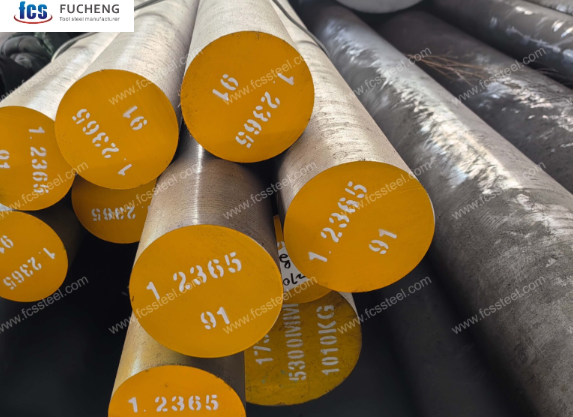
FCS Tool Steel factory maintains a strategic stock level of 2,000 to 5,000 tons to ensure rapid availability. This inventory includes dedicated buffers for 1.2365 and other hot work grades, allowing for immediate shipment of standard sizes. Core grades are comprehensive, and their production system covers all major international specs including GB, ASTM, DIN, JIS, and SS standards.
Core Strengths
FCS is structurally different from most large Korean steel producers. It is built around tool steel, not commodity output. That distinction matters.
Their melting route—EAF + LF + VD followed by ESR—is well suited to H10 production. ESR in particular improves carbide distribution and reduces segregation, which directly impacts thermal fatigue resistance in hot work applications.
Unlike general mills, FCS supports custom chemistry control. For H10 buyers running demanding copper or brass die-casting operations, this allows fine-tuning of Mo and V levels within standard limits to balance toughness and hot strength.
Processing & Flexibility
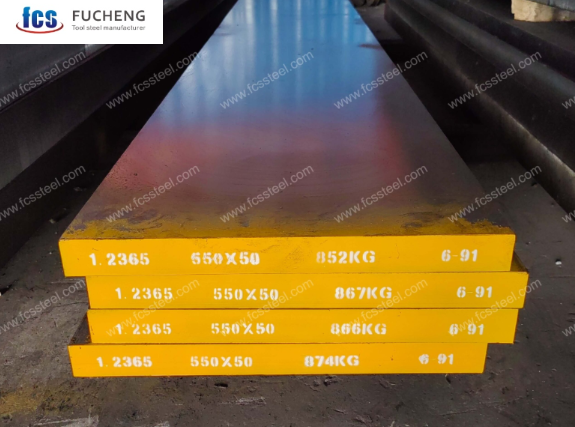
FCS operates in-house forging, annealing, and precision cutting. This vertical integration reduces lead time variability and allows buyers to receive application-ready blocks, plates, or round bars with consistent internal structure.
Although 1.2365 is not always stocked for same-day shipment, FCS compensates with fast melt scheduling and flexible batch sizes, which is valuable for OEMs and mold shops ordering project-based quantities rather than full heats.
Technical Support
This is where FCS clearly separates itself. Buyers have access to engineers familiar with:
-
Typical H10 tempering curves
-
Distortion control strategies
-
Application-specific failures (thermal checking, corner cracking)
This support reduces trial-and-error costs for toolmakers.
Verdict for H10 Buyer
Best choice for buyers who need controlled chemistry, ESR quality, and technical support for demanding hot work tooling. Especially suitable for extrusion, forging, and non-ferrous die casting.
2. POSCO Special Steel Division
Positioning: Large-Scale Integrated Steel Producer
POSCO is South Korea’s largest integrated steel maker. They produced 36 million tons of crude steel in 2023. The company runs several divisions. These cover carbon steel, stainless steel, and specialty steel products. Their Special Steel Division serves industries that need high-performance alloy materials.
The company made 1.6 million metric tons of stainless steel in 2023. This shows their scale in specialty metals. They use blast furnace operations for 97% of output. Electric arc furnaces handle the remaining 3%. The EAF capacity hit 1,057 thousand tons in 2023. It grew to 1,154 thousand tons in 2024.
Strengths
POSCO’s advantage is scale and process stability. Their integrated operations deliver consistent quality for mainstream alloy and special steels. For buyers needing large, repetitive orders of standard grades, POSCO offers unmatched supply security.
Limitations
H10 (1.2365) is not a visible flagship product within POSCO’s portfolio. Public technical documentation specific to H10—such as detailed chemistry targets, heat treatment guidelines, or tooling case studies—is limited.
This usually indicates that H10 is produced on-demand or as a secondary grade, rather than as a continuously optimized product.
Large integrated mills are excellent at what they prioritize. Niche hot work tool steels often receive less application-level attention.
What This Means for Buyers
If your requirement is:
-
Large volume
-
Standard specification
-
Minimal customization
-
Internal heat treatment handled independently
POSCO can work.
If you need tight chemistry control, rapid technical feedback, or tooling-specific guidance, the fit becomes less ideal.
Verdict for H10 Buyer
Excellent for massive standard orders, but limited transparency and support for specialized H10 tooling requirements.
3. SeAH Steel Corporation
Positioning: Diversified Industrial Steel Group
SeAH Steel Corporation brought in 3.81 trillion KRW in revenue through September 2025. They rank among South Korea’s major steel producers. The company holds total assets worth 5.56 trillion KRW as of fiscal year 2024. Market cap hit 335.68 billion KRW on December 5, 2025.
They run two main business segments. The legacy pipe business brings stable revenue with cyclical patterns. The renewables segment needs big investment but hasn’t started production yet. This dual setup impacts their tool steel operations and customer service.
Strengths
SeAH is operationally disciplined and financially stable. Their strength lies in process consistency and large-scale industrial supply. For buyers prioritizing supplier longevity and corporate stability, this is reassuring.
H10-Specific Considerations
SeAH’s public materials do not clearly position 1.2365 as a strategic product. There is limited visibility into:
-
Dedicated hot work steel production routes
-
ESR availability for H10
-
Application-level documentation
Tool steel appears to be a minor segment compared to their core pipe and industrial steel businesses.
Buyer Implications
For procurement teams with strong in-house metallurgy and heat treatment expertise, SeAH can be a workable source for non-critical H10 applications.
For buyers relying on supplier-side technical input, the value proposition is weaker.
Verdict for H10 Buyer
Reliable industrial supplier, but H10 is not a core focus—best for buyers who already control heat treatment and tooling design internally.
3. SeAH Steel Corporation (SeAH Besteel)
Positioning: The Heavy Industry & Automotive Special Steel Leader
While SeAH is famous for its massive steel pipe operations, its distinct advantage in the tool steel sector comes from its special steel division (SeAH Besteel). They are the dominant supplier for the Korean automotive and heavy machinery industries. Unlike general mills, SeAH is built to handle high-specification alloys demanded by global automotive giants.
Their operational backbone is impressive. With an annual production capacity exceeding several million tons of special steel, they operate one of the world’s largest single-site special steel plants in Gunsan. This scale allows them to control the entire process—from scrap melting to precision rolling—under rigorous “automotive-grade” quality systems.
Industrial Strengths for H10 Buyers
SeAH’s value proposition is not just size, but Heavy Forging Capability. They operate massive hydraulic forging presses (up to 13,000 tons in their specialized facilities) which enables them to produce:
-
Exceptional Core Reduction: For large H10 blocks (used in massive die-casting or extrusion presses), SeAH’s powerful forging ensures that the center of the steel block achieves sufficient deformation. This eliminates the “soft center” porosity issues often found in smaller mills.
-
Clean Steel Technology: Driven by the demands of automotive powertrain parts, SeAH utilizes advanced Vacuum Degassing (VD) and continuous casting technologies. This results in 1.2365 material with very low non-metallic inclusion levels, critical for extending die life.
Availability & Procurement Approach
SeAH operates effectively as a “Wholesale Industrial Supplier.” Their production schedules are optimized for large campaigns. For a buyer needing 1.2365 (H10):
-
Best for Program Orders: If you are planning ample volume for a yearly tooling program, SeAH offers excellent consistency and competitive pricing.
-
Distribution Channels: Unlike FCS which might cater to direct tooling orders, SeAH’s materials are commonly sourced through major Korean distributors who stock their large forged rounds and flats, cutting them to size for end-users.
Buyer Consideration
SeAH is an industrial powerhouse. Their 1.2365 is produced with the same discipline used for critical automotive engine components. While they may offer less flexibility for small, “one-off” custom chemistry adjustments compared to niche boutique mills, their material reliability is top-tier for standard specifications.
Verdict for H10 Buyer
The “Heavyweight Champion” option. Ideal for buyers needing large-sized forged blocks or high-volume standard rounds where internal soundness and huge reduction ratios are critical.
4. Dongkuk Steel Mill
Positioning: The Pioneer of Electric Arc Furnace (EAF) Steel in Korea
As South Korea’s first private steel manufacturer, Dongkuk Steel Mill holds a significant legacy in the industry. Unlike integrated mills that rely heavily on blast furnaces, Dongkuk specializes in Electric Arc Furnace (EAF) technology. This focus allows them to produce high-quality general steel and specialty plates with greater flexibility than typical mass-production giants.
Dongkuk operates heavily in the heavy plate sector, with an annual capacity exceeding several million tons across their Pohang, Incheon, and Dangjin plants. They are a primary feeder for the Korean domestic infrastructure and machinery sectors.
Core Strengths for Tool Steel Buyers
While widely known for construction and color steel (Luxteel), Dongkuk’s heavy plate division is a formidable source for large-dimension alloy steels.
Their strength lies in Standardized Process Efficiency. Through their advanced “Eco-Arc” furnaces and secondary refining capabilities, they produce alloy steels that strictly adhere to Korean (KS) and Japanese (JIS) standards. For buyers of 1.2365 (H10), this means:
-
Reliable Baseline Quality: Their automated computer-controlled melting ensures that chemical composition consistently hits the standard specification ranges.
-
Large Block Availability: With rolling mills designed for shipbuilding and heavy industry, Dongkuk can supply exceptionally thick plates and forged blocks, which is advantageous for large hot-work dies.
-
Domestic Logistics: Their extensive network of distribution centers across Busan, Incheon, and Pohang ensures that material movement within Korea is seamless and cost-effective.
Supply Chain & Availability
Dongkuk typically operates through a robust network of authorized distributors and stockists rather than direct-to-small-consumer sales. For H10 buyers, this often means accessing Dongkuk material via major local stockholders who carry forged or rolled black surfaces.
Their EAF route is particularly efficient for batch recycling and refining, making them a sustainable choice for companies prioritizing green procurement and carbon footprint reduction in their supply chain.
Suitability
Dongkuk produces a solid industrial-grade product. Their 1.2365 (H10) is well-suited for standard forging dies and heavy industrial parts where extreme cleanliness (like VAR/ESR grades) might not be strictly required, but structural integrity and standard compliance are non-negotiable.
They are an excellent source for buyers who need reliable, standard-grade material backed by the certification and stability of a major corporate manufacturer.
Verdict for H10 Buyer
A strong choice for standard industrial-grade H10, particularly for large-sized blocks or plates. Best for buyers who value supply stability and adhere to standard specifications without requiring highly customized chemistry.
5. Daehan Steel
Positioning: The Construction Steel & Rebar Specialist
Daehan Steel is a powerhouse in the South Korean steel industry, but its domain is distinct. They are the market leaders in Reinforced Steel Bars (Rebar) and Bar-in-Coil (BIC) solutions. With their advanced “Stanch” processing service and highly automated EAF facilities in the Busan Noksan Complex, they have revolutionized how construction steel is supplied to infrastructure projects.
Their operation is streamlined for high-speed, high-volume production of construction-grade carbon steels. They are efficient, sustainable (using 100% scrap), and logistically superior within the Korean domestic market.
The H10 (1.2365) Reality Check
For international buyers browsing lists of Korean steel mills, exclusion is just as important as inclusion. It is crucial to understand that Daehan Steel is not a tool steel manufacturer.
Producing 1.2365 (H10) hot work tool steel requires:
-
Precise Alloy Balancing: Controlling Molybdenum and Vanadium within tight tolerances (0.1% variances matter).
-
Secondary Refining: Processes like ESR or VAR to remove microscopic inclusions that cause die cracking.
-
Soft Annealing: Extended thermal cycles to make the steel machinable.
Daehan’s production lines are optimized for construction tensile strength, not thermal fatigue resistance. Their furnaces run fast cycles to produce rebar, which is the opposite of the slow, controlled melting required for H10 tool steel.
Why They Are on This List
Daehan often appears in general “Korean Steel Supplier” searches due to their export volume. However, for a procurement manager looking for hot work die materials, Daehan serves as a raw material reference only, or a potential source for mild steel structural supports around the die casting machine—but never for the die itself.
Verdict for H10 Buyer
Excellent source for construction projects, but not applicable for 1.2365 tooling. Do not confuse their industrial scale with specialty alloy capability.
How Different Buyers Should Choose
For Die Casting & Extrusion Toolmakers
→ Choose FCS
You benefit from ESR quality, chemistry control, and application-level technical support.
For Automotive or Large OEM Procurement
→ POSCO (with caution)
Works for standardized, high-volume needs if internal expertise compensates for limited H10 specialization.
For Buyers with Strong In-House Metallurgy
→ SeAH
Acceptable if you do not rely heavily on supplier-side engineering support.
For Cost-Driven, Non-Critical Applications
→ Dongkuk (limited use cases)
Only where tooling risk is low and replacement cost is acceptable.
For Construction or Commodity Steel Buyers
→ Daehan
Not recommended for H10 tooling.
Final Summary
Choosing a 1.2365 (H10) supplier in South Korea is less about company size and more about process focus. Hot work tool steel punishes shortcuts. The wrong supplier increases downtime, scrap rates, and total tooling cost.
Smart buyers look beyond brochures. They ask:
-
Is H10 a priority product?
-
Can the supplier explain failure modes?
-
Do they support long-term tooling performance?
Answer those questions first—and supplier choice becomes clear.