
Introduction:
A bad heat treatment is a huge financial loss for 1.2344 steel users. It goes beyond a simple technical error. You spend 40 hours machining a complex die. Then it warps in the quench. Or it breaks on the forging press. The financial pain hits hard.
Tooling disasters often involve fast thermal cracking, deep bending, or rapid surface wear. These issues usually link back to basic errors. Someone rushed the preheat. Or they skipped a tempering cycle. This mistake costs you an expensive tool. Plus, you lose weeks of critical production downtime.
Learn the heat treatment flow to stop these failures. But even a perfect thermal cycle cannot save a flawed block of steel. The raw material might hold hidden internal stress. It might lack the correct chemistry. This leads directly to cracks. So, choose a proven supplier. Correct pre-treatment quality matters just as much as the furnace.
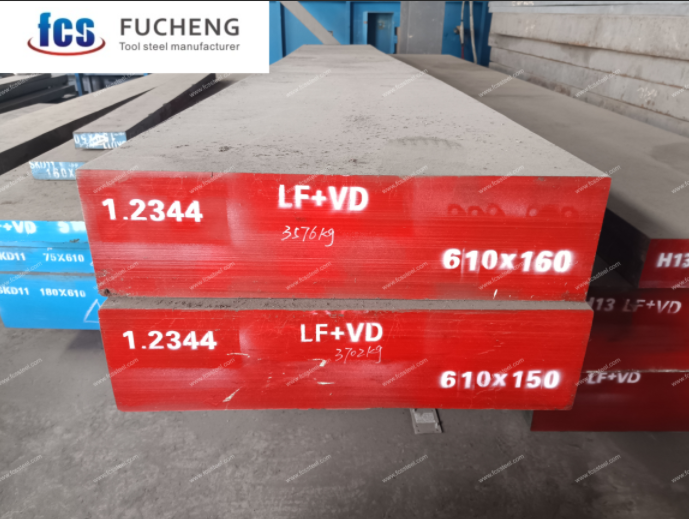
1.2344 Tool Steel Heat Treatment Guide
A typical 1.2344 heat treatment process includes the following stages. Each stage plays an important role in achieving the desired microstructure and performance.
The full process chain runs: anneal → stress relieve → first preheat → second preheat → austenitize → quench → first temper → second temper. Each stage has a specific job. Together, they:
- Control hardness
- Manage residual stress
- Prevent cracking and distortion that can ruin finished tooling
This guide covers all eight stages. You’ll find the exact temperatures, soak times, and thickness-based rules that make each one work.
Why Heat Treatment Matters
1.2344 tool steel goes by several names depending on where you work: DIN 1.2344, AISI H13, or X40CrMoV5-1 tool steel. Same steel, different passport. It sits in the chromium-molybdenum-vanadium (Cr-Mo-V) hot-work tool steel group — and that alloy mix tells you everything.
The chemical composition of 1.2344 falls within carefully controlled standard ranges.You get 0.35–0.42% carbon. This balances hardness and thermal fatigue resistance. Next, about 5% chromium improves hardenability and oxidation resistance at elevated temperatures. Plus, ~1.4% molybdenum triggers secondary hardening. Finally, ~1.0% vanadium keeps the grain structure tight. You avoid wear at high temperatures.
Together, these alloying elements provide excellent hot strength, temper resistance, and thermal fatigue resistance, making 1.2344 well suited for die casting, hot forging, and extrusion tooling.
But that same alloy makeup makes the steel sensitive to heat treatment errors. The Cr-Mo-V carbides behind H13’s performance need precise thermal conditions to stabilize. Skip steps or rush the process, and those carbides turn into weak points — uneven distributions that start cracks right where stress hits hardest.Heat treatment isn’t the final step. For 1.2344, it’s what either unlocks the steel’s full performance or plants the seeds of early failure.
1.2344 Heat Treatment Flow & Key Performance Drivers
Every step in the 1.2344 thermal cycle has a strict mechanical purpose. Here is the complete flow and exactly how it dictates tool survival:
| Stage | Process Details | Key to 1.2344 Performance |
|---|---|---|
| 1. Annealing | Softens the blank to ≤235 HB and removes early manufacturing stress. | Erases forging stress. Creates a uniform, ductile baseline before CNC roughing. |
| 2. Stress Relieving | Heats the roughly machined block to 600–650°C to clear out cutting tension. | Clears out residual machining tension. Prevents aggressive warping during the quench. |
| 3. Preheating | Slowly increases temperature in stages to match the core and surface temp. | Prevents thermal shock. Placing a cold die directly into a 1000°C furnace greatly increases the risk of internal cracking. |
| 4.Austenitizing | Typically held at 1020–1030°C to dissolve carbides effectively. | Dissolves carbides properly. Pushing past 1050°C causes extreme, irreversible grain growth (brittleness). |
| 5. Quenching | Rapidly cools the steel (via gas or oil) to form fresh, extremely hard martensite. | Forms hard martensite. Uneven cooling directly guarantees dimensional distortion. Water quenching is not recommended. |
| 6. Tempering | Reheats to 540–560°C using double or triple tempering with full cooling between cycles. | Relieves the severe quench stress and removes dangerous retained austenite. It turns brittle metal into a tough, stable die. |
What Actually Breaks 1.2344 Performance?
- False Timing: Starting the soak timer when the furnace hits the target temp, rather than the workpiece core. The core stays soft, and the die washes out in production.
- Skipping the Second Temper: A single temper leaves metastable retained austenite. The tool will shift dimensions or crack unpredictably weeks later.
- Surface Decarburization: Atmospheric exposure during high-heat cycles burns off surface carbon, leading to soft cavity faces and severe sticking issues in die casting.
Why Strict Manufacturer Standards Are Non-Negotiable
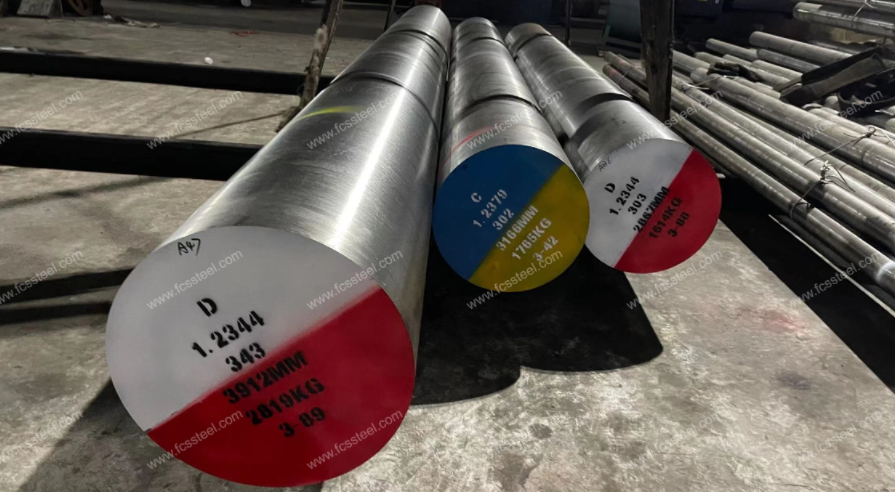
When a production facility rushes these steps or relies on outdated equipment, the financial damage usually lands on your factory floor. Here is what happens when crucial quality controls fail:
- Hardness Uniformity Failures: The core and surface hardness must align. If a heat treater rushes the austenitizing soak time, the core stays soft. Your expensive die will simply wash out or dent during its very first production run.
- Microstructure & Grain Ruin: You need fine, evenly distributed carbides. Overheating causes severe grain coarsening. The result? The tool becomes incredibly brittle and literally shatters under the physical impact of a forging press.
- Dimensional Distortion: A decent facility tightly controls the high-pressure gas quench rate. If a shop blasts a complex geometry with uneven cooling to save time, the tooling warps. You lose days on heavy finish-grinding or scrap the block entirely.
- Surface Decarburization: The furnace requires a controlled vacuum atmosphere. Open-air heating burns carbon right off the surface. That means your crucial cavity surface ends up soft, causing severe sticking issues when casting parts.
- Process Traceability Logs: If a shop doesn’t log their core thermocouple data, they are guessing. When a die cracks in the field three weeks later, a lack of solid thermal data means you can’t figure out if it was a flawed design, bad steel, or a ruined heat cycle.
How to Choose a Reliable 1.2344 Manufacturer
Great heat treatment starts with tight steel specs. Stop guessing and put these exact technical limits into your next supplier agreement. Here is what we guarantee, and what you must demand:
- Pinpoint Chemistry: C: 0.35–0.42%, Cr: 4.80–5.50%. No loose tolerances, or your quench hardness will fluctuate unpredictably.
- Carbide Microstructure: Demand NADCA #207 or equivalent certification. You need fine, uniform carbides without severe banding to survive thermal shock.
- Spheroidized Annealing: The block must arrive fully annealed at ≤235 HB. This guarantees smooth, stress-free CNC roughing with no hidden hard spots.
- Ultrasonic Testing (UT): Specify ultrasonic testing in accordance with SEP 1921, with the acceptance class selected according to the application (typically Group 3 Class D/d or higher).
- Steel Cleanliness: Specify strict ASTM E45 limits for non-metallic inclusions to stop micro-cracking under high forging pressure.
When you work with us, we deliver fully certified 1.2344 blocks that hit these exact targets, ensuring your dies survive the furnace every single time.
Target Properties After Optimized Heat Treatment
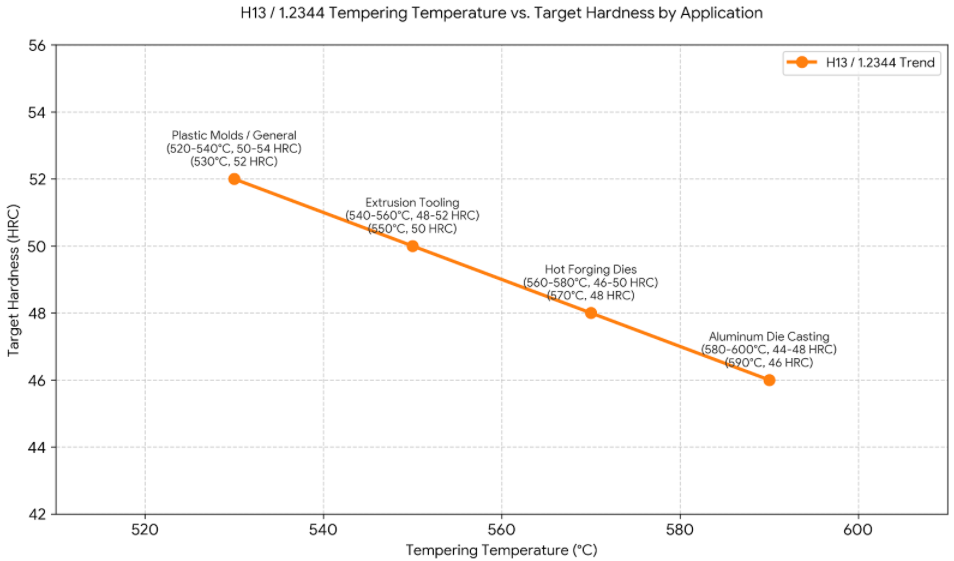
Hitting the right numbers depends entirely on what the tool actually does. Here is how 1.2344 dialed-in properties break down across major applications:
| Application | Target Hardness | Temper Temp | Performance Focus |
|---|---|---|---|
| Aluminum Die Casting | 44–48 HRC | 580–600°C | Maximizes thermal fatigue limits and fights severe heat checking. |
| Hot Forging Dies | 46–50 HRC | 560–580°C | Balances heavy wear resistance with protection against plastic deformation. |
| Extrusion Tooling | 48–52 HRC | 540–560°C | Maintains high yielding strength under extreme sliding friction. |
| Plastic Molds / General | 50–54 HRC | 520–540°C | Delivers peak hardness, crisp polishability, and indentation resistance. |
Note: Don’t accept hardness alone as your only proof of success—always verify impact toughness according to the applicable specification and project requirements to ensure the die won’t suddenly shatter on the press.
Conclusion
1.2344 tool steel heat treatment isn’t about memorizing temperatures. It’s about preventing a $10,000 die from shattering on the press. Every stage—from a careful preheat to that mandatory second temper—handles a specific internal stress. Skip one step, and you pay for it with early failure and lost production.
But let’s be honest: even a perfect furnace cycle can’t fix cheap, flawed steel. Your mold’s survival starts with a premium, stress-relieved block. Stop risking weeks of machining time on unpredictable material. Ready to work with steel that responds right every single time? Contact FCS Steel today for a quote on top-grade 1.2344 blocks.