
Picking the wrong tool steel mid-project isn’t just frustrating — it costs you money. H13 and H11 tool steel look nearly identical on paper. The choice seems random, until a die cracks under thermal cycling or a punch wears out three runs too early. These two hot-work steels serve different purposes. Knowing which one fits your application comes down to a few key properties most spec sheets skip over. This guide breaks down the chemistry, compares what matters most in the shop, and gives you a clear, no-guesswork framework for choosing between H13 and H11 — including heat treatment specifics your team can use today.
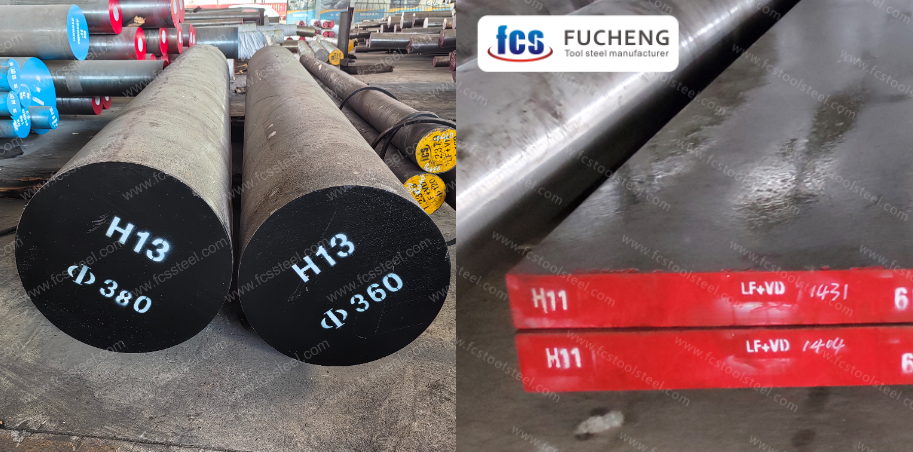
H13 vs H11: Key Chemical Differences
Both steels sit in the same 5% chromium hot-work family. Same class, same general DNA — but the chemistry differences buried inside them determine whether your die survives a full production run or fails before it should.
The gap comes down to four elements: carbon, chromium, molybdenum, and — most important of all — vanadium.H11 carries 0.3–0.6% vanadium. H13 carries 0.8–1.2%. That 0.5% gap sounds minor. It isn’t.
More vanadium means more vanadium carbides (VC) spread through the steel matrix. Those carbides are hard and heat-stable. They hold firm at 500–600°C. They fight surface wear under hot sliding and erosion. They protect the die’s surface through repeated heat cycles. H13 has a higher carbide volume — and that gives you longer hot-wear life.
The trade-off is real. More carbides mean lower bulk toughness. H11’s leaner vanadium content makes it more crack-resistant under shock loading. That’s a genuine advantage in high-impact applications.
Carbon, Chromium, and Molybdenum Differences
| Element | H11 | H13 | What It Changes |
|---|---|---|---|
| C | 0.32–0.40% | 0.38–0.45% | H13 gains martensite hardness; H11 retains toughness |
| Cr | ~4.75% | ~5.3% | H13 gets better oxidation resistance and red hardness |
| Mo | ~1.30% | 1.1–1.75% | H13 resists tempering drop across thick sections |
The Cr and Mo increases in H13 aren’t dramatic on their own. Together, though, they push section-depth hardenability. They cut hardness loss after repeated tempering cycles. They boost performance right where die surfaces run hottest — and that’s exactly where it counts.
Industrial shorthand worth memorizing:
– H11 = toughness-first. Built to survive impact and shock without cracking.
– H13 = wear-and-heat-first. Built to hold hardness and resist thermal fatigue over long runs.
One industry description sums it up well: H13 and H11 are closely related hot-work tool steels developed for different performance priorities.— same base architecture, with chemistry shifted toward hot-wear performance.
H13 vs H11: Top 5 Performance Properties
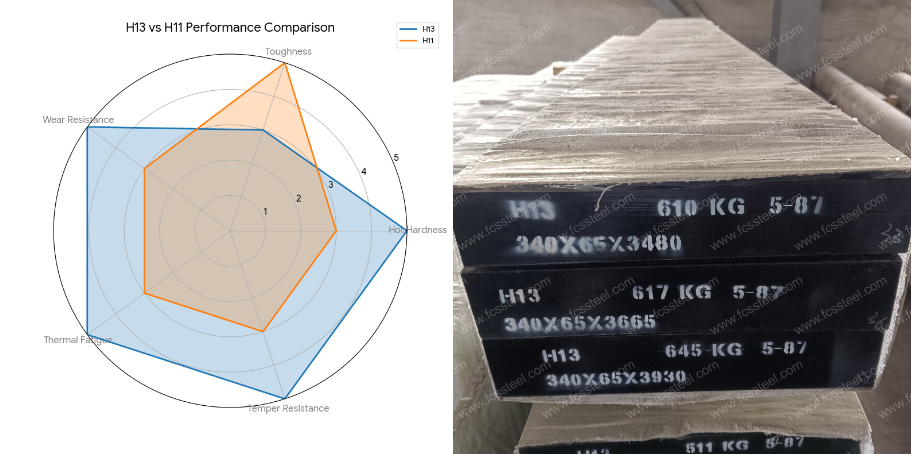
Five properties define your die’s lifespan. Here is what happens under the surface.
1. Hot Hardness Retention
H13: Holds its ground past 600°C. The 0.8–1.2% vanadium boosts secondary VC carbide formation during tempering. These carbides lock into the steel matrix. They refuse to soften. You get a solid working hardness even at intense heats.
H11: Peaks lower. It holds half the vanadium. It lacks a dense carbide network. So, continuous 600°C+ exposure causes it to lose its shape over time.
2. Toughness & Shock Resistance
H13: Dense carbides make H13 wear-resistant. But they also add brittleness. Heavy, concentrated shock loads hit the tool. Then, those hard particles give deep cracks a clear path to spread.
H11: The undisputed winner here. Less vanadium creates fewer rigid carbides. You get a much more uniform grain structure. It absorbs massive mechanical hammer blows and fights off deep fracturing.
3. Wear Resistance (Hot Sliding and Erosion)
H13: Packs up to triple the vanadium of H11. This chemistry builds a hard, protective shield of V-carbides. It fights off the abrasive wash of high-velocity molten aluminum. It also handles aggressive billet friction well.
H11: A leaner structure leaves the tool surface vulnerable. Hot abrasive sliding and molten metal flow wear it down much faster.
4. Thermal Fatigue Resistance (Heat Checking)
H13: Perfect for long-cycle operations. The high red hardness stops tiny plastic shifts. These shifts happen during mold temperature spikes. Stopping them delays the dreaded heat check network.
H11: It handles sudden thermal shocks well. But repetitive heating and cooling cycles cause permanent deformation. Those tiny shifts add up. Your tool suffers premature surface cracking.
5. Temper Resistance (Softening Rate)
H13: The Cr-Mo-V blend triggers a strong secondary hardening effect. The softening curve stays flat during continuous 550–600°C service. This stretches your tooling life by over 20%.
H11: Shows a weaker secondary hardening peak. Constant high heat drops its hardness cycle after cycle. You will need a quick tool refurbishment.
Quick reference summary:
| Property | H11 Wins | H13 Wins |
|---|---|---|
| Hot hardness retention | ✓ | |
| Impact toughness | ✓ | |
| Hot wear resistance | ✓ | |
| Thermal fatigue resistance | ✓ | |
| Temper resistance | ✓ |
The pattern holds across every category. H11 is the tougher steel for shock-dominated applications. H13 is the more durable choice for everything driven by heat, wear, and cyclic thermal stress.
H13 Applications: High Heat & Wear
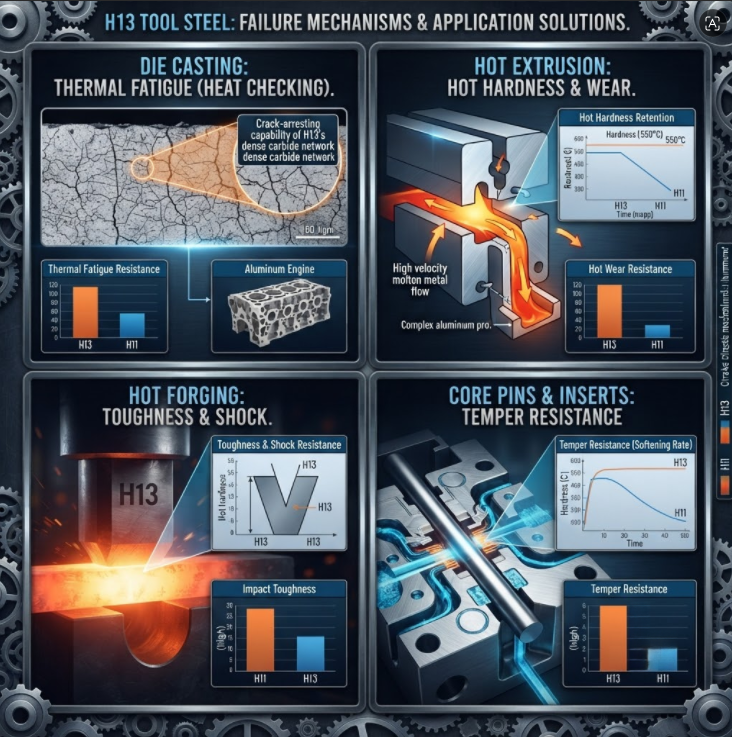
H13 tool steel is the go-to choice when heat, wear, and thermal fatigue are your main problems. It simply survives conditions that destroy standard hot-work steels.
Here is where it actually belongs on the shop floor:
- Die Casting Dies (Aluminum, Magnesium & Zinc): Excellent resistance to thermal fatigue, heat checking, and hot wear under repeated high-temperature casting cycles.
- Hot Extrusion Dies: Maintains hot hardness and dimensional stability during continuous aluminum extrusion under high pressure.
- Hot Forging Dies & Punches: Provides an excellent balance of toughness, wear resistance, and resistance to thermal cracking.
- Core Inserts, Sleeves & Ejector Pins: Ideal for localized high-temperature regions where thermal erosion and cyclic stress are most severe.
Honestly, the reasons H13 wins here are straightforward. Its specific Cr-Mo-V chemistry solves three major failure modes. First, it stops thermal fatigue (heat checking) from continuous cycling. Second, it resists softening, holding a solid 42–48 HRC even around 550°C. Finally, it fights off gate erosion and washout caused by fast-moving molten metal.
H11 Applications: Maximum Impact Survival
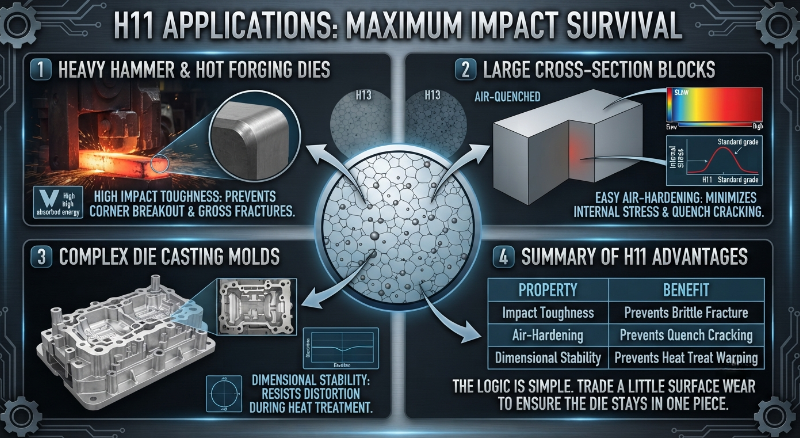
H11 doesn’t try to do everything. It simply keeps your tooling from snapping under heavy pressure. By cutting back on vanadium, you get fewer rigid carbides in the steel. The return trade-off is pure structural toughness.
Here is where H11 actually belongs:
- Heavy hammer and hot forging dies: When a tool takes brutal, repetitive physical hits, you need a serious safety margin against cracking. H11’s high impact toughness prevents corner breakout and gross fractures.
- Large cross-section blocks: Massive tools often crack right in the quench tank. Because H11 air-hardens easily, it cools slower and builds up much less internal stress for thick components.
- Complex die casting molds: For intricate or thin-walled cavities, early distortion during heat treatment ruins the tool before it ever runs a part. H11 holds its size and shape extremely well.
The logic here is simple. If your main problems are brittle fracture, chipped edges, or warping inside the furnace, H11 is your answer. You trade a little surface wear resistance to ensure the die stays in one piece.
How To Choose Between H13 and H11
Skip the spec sheet. Look at how your last tool failed instead. Use this direct framework to make your choice:
- Identify past failures. Look at your last die. Did it fail at the surface? Heat checking, erosion, or softening mean you need H13. Did it crack at the corners? Did it fracture deep inside? Pick H11.
- Check your temperatures. Continuous high-pressure cycles at 450–600°C need H13. It handles heat stress better. Staying under 500°C with heavy mechanical hammer hits? H11 is your safer option.
- Look at part size. Large tool blocks and deep cavities face a higher risk of cracking under stress. Use H11 for these. Medium or thin-wall inserts need surface stability. Choose H13 for those parts.
- Weigh the mixed risks. Thermal wear might drive over 60% of your problems. Stick with H13. Impact and fracture risks might cause most failures. Go with H11 in that case.
- Verify your furnace capabilities. H13 needs strict tempering control at 540–620°C. This helps it reach peak hardness. Your furnace control might lack exact precision. H11 is much easier to process.
Heat Treatment Essentials for H13 and H11
Heat treatment makes or breaks tool steel. Mess up these numbers, and your die fails before the first shot. Here is the exact cheat sheet for your shop.
H13: Heat Treatment Parameters
| Process Step | Parameters | Shop Floor Rules |
|---|---|---|
| Preheat | 2 Stages: 1) 621–677°C 2) 816–871°C | Ramp up at 222°C/hr or less. Add a third stage for blocks over 200mm. |
| Austenitize | 982–1032°C (995–1025°C standard) | Soak 30 minutes for every inch of thickness. Avoid soaking it too long. |
| Quench | Vacuum gas or forced air | Cool it at 28°C/min or faster down to 538°C. Skip oil cooling for large parts. |
| Temper | Double temper minimum | Start this step while the part sits near 50°C. Heat it for at least 2 hours per inch. |
H11: Heat Treatment Parameters
| Process Step | Parameters | Shop Floor Rules |
|---|---|---|
| Preheat | Staged heating (like H13) | Large sections need this. It stops the steel from cracking. |
| Austenitize | 1000–1020°C | Keep H11 cooler than H13. This protects the grain structure. Soak it for 1 hour per 25mm. |
| Quench | Staged air or forced gas | Cool down at 20–25°C/min to 540°C. A slower rate stops cracking. |
| Temper | Triple temper for blocks ≥200mm | Temper it higher at 600–630°C. This hits the 42–45 HRC target. |
Tempering Range, Hardness, and Best Uses
Your chosen heat changes the steel’s performance. Warning: Avoid the 500°C secondary peak. The tool will break easily.
| Tempering Temp | Resulting Hardness | Best For… |
|---|---|---|
| 510–540°C | ~55 HRC (Peak) | Skip this range. The steel shatters easily at this heat. |
| 530–560°C | 48–52 HRC | Use this for standard die casting. It also fits broad extrusion jobs. |
| 560–620°C | 47–49 HRC | Pick this for tools facing high heat. It takes heavy hits well. |
| ~593°C | 44–48 HRC | Most shops pick this for aluminum die casting. |
| ~621°C | 40–44 HRC | Use this for tools taking massive hits. You get maximum toughness. |
Quick Decision Chart: H13 vs H11
Five variables. One decision. Here’s the whole thing on one page.
| Decision Factor | Choose H13 | Choose H11 |
|---|---|---|
| Working temperature | Continuous service ≥ 550°C | Intermittent or ≤ 550°C |
| Dominant failure mode | Heat checking, erosion, softening | Cracking, fracture, weld repair failures |
| Cross-section + impact | Medium sections, high thermal cycling | Large sections, heavy hammer impact |
| Cost sensitivity | Downtime is expensive — pay the premium | Material cost matters — save €200–300/ton |
| Local supply | North America (H13 is the default stock) | Europe (H11/1.2343 is the standard shelf grade) |
One sentence to remember: Hot wear and thermal fatigue → H13. Impact, fracture, and crack resistance → H11.
Sometimes both steels fit the job. Temperature and toughness requirements both land in the middle — so neither spec sheet gives you a clear winner. Break the tie with three questions, in order:
- What does your heat treater know best?
- What’s sitting on your supplier’s shelf right now?
- What killed your last three dies?
Those answers pick the right steel. The spec sheet doesn’t.
Conclusion
The wrong choice between H13 and H11 shows up fast in your scrap bin. H13 takes on extreme, constant heat without breaking down. H11 survives heavy hammer impacts day after day. Stop guessing which steel fits your shop operations best. Grab the framework from this guide. Match the steel traits to your exact tool failures. Next, confirm your heat treatment numbers before cutting any raw metal.
Need help planning an upcoming project? Send us your exact operating specs. Contact our team to help you skip the costly trial-and-error phase. We pick the perfect chemistry for your specific needs. Plus, we deliver the steel straight to your loading dock. You get to focus your energy on building dies that last.