
A die that fails too soon. A forging run cut short by heat checking. An extrusion die that cracks under thermal cycling. None of these are random bad luck. They trace back to one decision — choosing the wrong steel.
ESR 1.2344 tool steel has become the go-to material spec for toolmakers who want fewer breakdowns and longer production runs. It separates those who fight constant downtime from those who keep running hard and turning a profit.
Not all H13 is the same, though. The “ESR” designation is not just a label. It changes how the steel holds up under the punishing heat and pressure of die casting, forging, and extrusion. What follows breaks down what that difference looks like in practice — and how you can use it to your advantage.
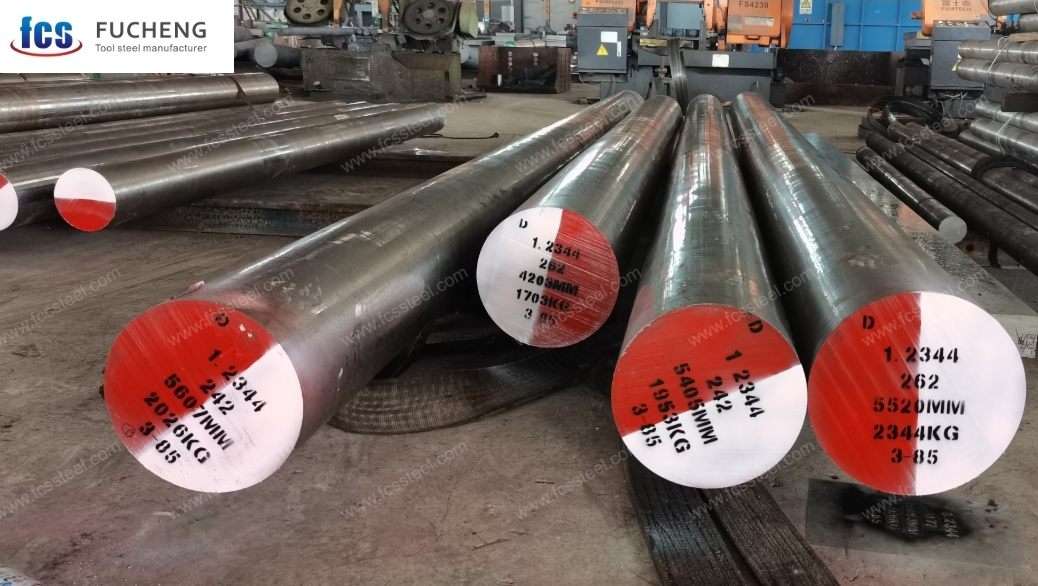
What Is ESR 1.2344 Tool Steel
At the chemistry level, 1.2344 is a chromium-molybdenum-vanadium hot-work tool steel. It is standardized under DIN EN ISO 4957 as X40CrMoV5-1, and it matches AISI H13 in North American markets. The composition runs 0.35–0.42% carbon, 4.8–5.5% chromium, 1.10–1.50% molybdenum, and 0.85–1.15% vanadium. That alloy recipe is not a secret. Every steel mill producing this grade works from the same numbers.
So if the chemistry is identical, what does ESR change?
The Remelting Process — What Actually Happens
ESR stands for Electro-Slag Remelting. A conventional 1.2344 electrode gets remelted inside a molten slag bath, held inside a water-cooled copper mold. Metal droplets fall through the slag and re-solidify from the bottom up — in a controlled direction — into a fresh ingot.
That slag bath is not incidental. It does three things at once:
- Trapping and absorbing non-metallic inclusions — oxides and sulfides that would otherwise stay locked inside the steel
- Removing dissolved gases — porosity drops as gas bubbles escape during droplet transfer
- Forcing controlled, directional solidification — this eliminates the segregation bands and composition gradients that form in conventional ingots as they cool unevenly from the outside in
The result is measurable. Sulfur content — a reliable marker for inclusion density — drops from a typical 0.010–0.020% in standard 1.2344 down to ≤0.003% in ESR material. That is not a small refinement. It is a structural shift in what the steel looks like under a microscope.
Why Cleanliness Translates to Die Life
Fatigue cracks in hot-work tooling do not start at random. They start at stress concentrators — and the most common stress concentrators in tool steel are inclusions and segregation bands. Under cyclic thermal and mechanical loading, those sites are where heat checking begins, where spalling starts, and where a die that should run another 50,000 cycles instead fails at 30,000.
ESR removes most of those initiation sites. What you get is a denser, more uniform microstructure — often supplied in an extra fine structure (EFS) annealed condition. Carbide distribution is tighter. Grain structure is more uniform. The property profile across a large die block stays consistent from surface to core.
That last point matters most in large tooling. Conventional 1.2344 in thick sections often shows a clear gradient: harder and tougher near the surface, softer and less consistent toward the center. ESR suppresses that gradient. This becomes critical any time a die block exceeds 300 mm in section thickness.
The Property Numbers That Follow
After proper hardening and tempering, ESR 1.2344 reaches 50–56 HRC. Most die casting and forging applications target 52–54 HRC as the working range. Delivered soft-annealed, the material comes in at ≤230 HB — the same ceiling as standard 1.2344. At delivery condition, the advantage is cleanliness, not hardness.
The mechanical gains ESR delivers show up in three specific areas:
- Transverse toughness — conventional 1.2344 is weakest perpendicular to the forging direction, where inclusion stringers concentrate. ESR 1.2344 is far more isotropic. Transverse and longitudinal impact values come much closer together.
- Thermal fatigue resistance — the cleaner, more uniform microstructure carries lower residual stress from directional solidification. It resists heat checking under repeated thermal cycling better than standard material.
- Polishability and surface integrity — fewer inclusions mean fewer pull-outs and pits during fine polishing. That is why ESR 1.2344 is the go-to choice for high-gloss plastic molds and precision die-casting inserts.
Two steels. Same alloy designation. A very different performance ceiling — and the gap grows widest where tooling is under the most stress.
ESR 1.2344 vs. Standard H13 Tool Steel
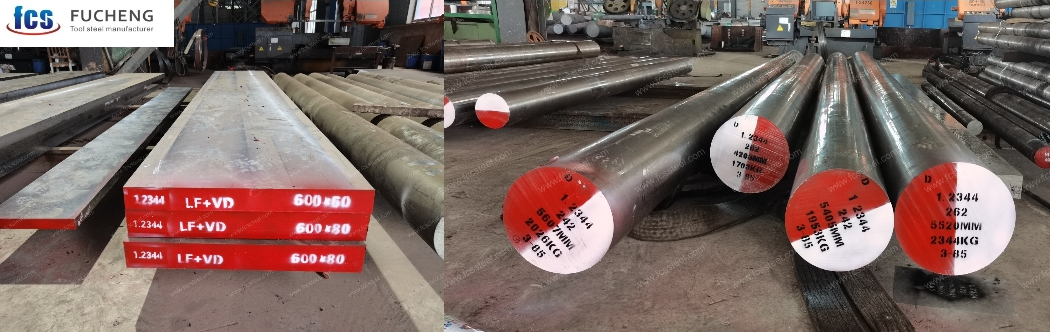
| Features | Standard H13 | ESR 1.2344 |
|---|---|---|
| Chemical Makeup | Same | Same |
| Total Impurities | > 0.2% | < 0.2% |
| Average Impurity Size | 20 µm | 10 µm (50% smaller) |
| Max Impurity Size | 50 µm | 28 µm |
| Metal Structure | Uneven pattern (banding) | Even and uniform |
| Cross-Direction Strength | Low (drops fast) | High (matches length-wise) |
| Core Consistency (>400mm) | Varies from center to edge | Same from center to edge |
| Performance Boost | Base level | Flexibility +10%, Area reduction +18% |
Where Standard H13 Holds Its Ground
Standard H13 is the right choice in these situations:
- Production runs are short and replacement downtime is tolerable
- Surface finish requirements are moderate
- The failure mode is simple surface wear, not internal fatigue
- Die or tool life is not the primary cost driver in the operation
Nothing wrong with running standard H13 there. Specifying ESR where it is not needed adds cost without adding value.
Where ESR Becomes the Clear Choice
The calculation flips under any of these conditions:
- High cycle counts — thermal cycling in the hundreds of thousands
- Transverse or through-thickness stress — complex die geometry, cross-cavity loading, multi-axis forging pressure
- Strict surface finish requirements — ESR’s lower inclusion density produces higher polish quality and more consistent coating adhesion
- Tight dimensional stability after heat treatment — tighter chemistry means fewer surprises after the block comes out of the quench
- High downtime cost — one unplanned production stop costs more than the ESR premium on the entire die
The practical rule is simple. A tool that is hard to replace, runs long, or sits in a process where a single failure triggers a production cascade — that tool needs ESR 1.2344. Not as a premium. As the baseline specification.
ESR 1.2344 for Die Casting Dies
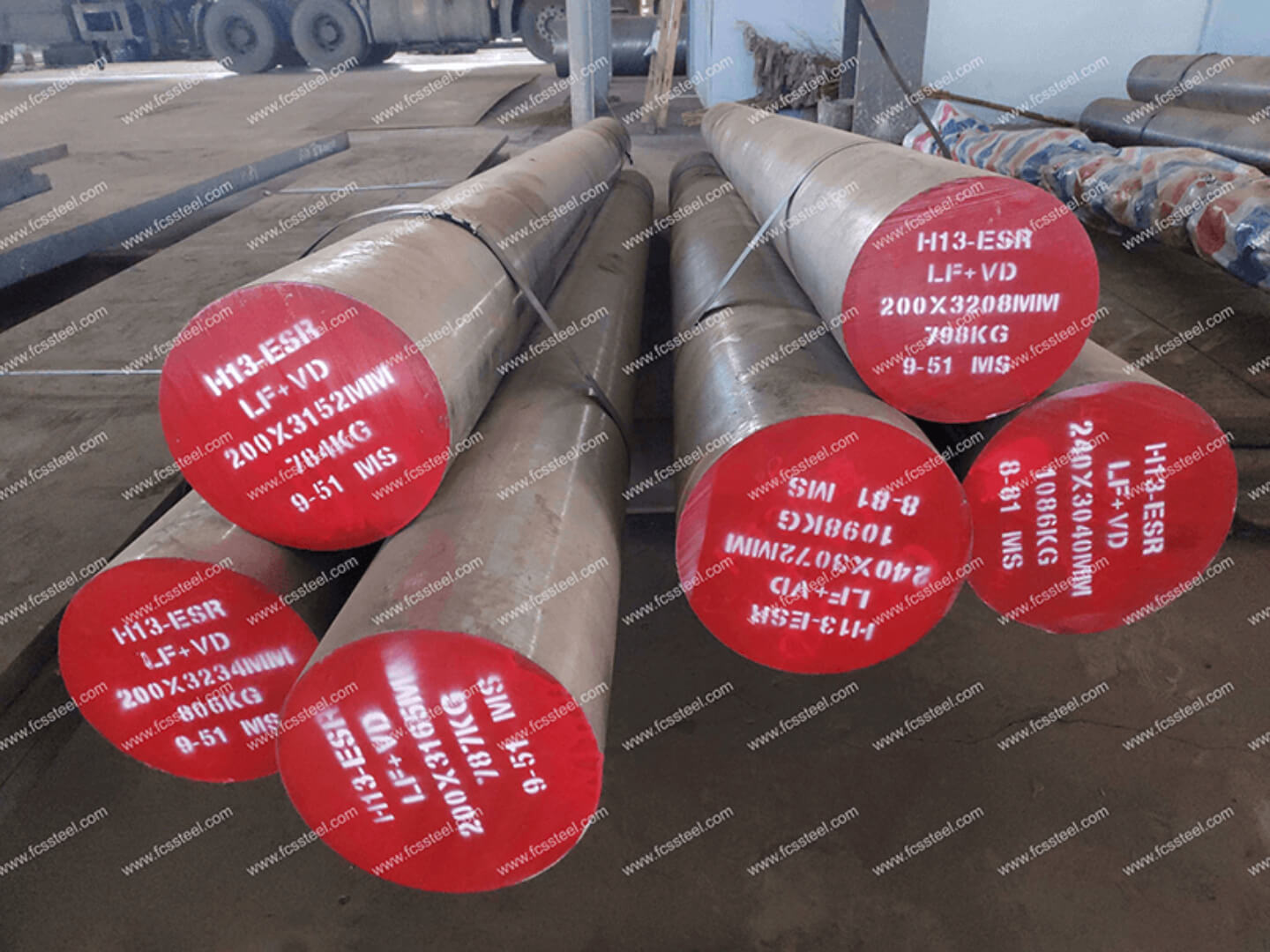
High-pressure aluminum die casting destroys standard tool steel. ESR 1.2344 is an absolute must for this harsh environment. Here is why:
- Survives brutal thermal shock: Molten aluminum hits the die at 720°C. Cold water sprays follow right after. This process creates massive temperature swings. ESR technology handles this violent thermal fatigue much better than standard grades.
- Stops cracks at the source: Standard H13 cracks along hidden impurities. The ESR remelting process builds a pure, clean structure. This removes those weak spots. You stop heat-checking right at the sharp corners and gate areas.
- Massive lifespan boost: Standard cavity inserts often need replacing after a few thousand cycles. This steel pushes your continuous production deep into hundreds of thousands of shots. You keep your machines running much longer.
- Perfect coating adhesion: The refined foundation holds PVD coatings strong. You cut annoying aluminum soldering by up to 80%. Plus, you boost your overall service life 2 to 5 times.
You get predictable, profitable performance. This steel saves you from sudden, expensive machine downtime.
Where ESR 1.2344 Earns Its Place in the Die
Any die casting component that touches metal or takes on thermal cycling is a strong fit for ESR 1.2344:
- Cavity inserts and cores — the main heat-checking zones — run at 44–52 HRC working hardness, within a tempering range of 538–590°C that keeps hot strength up without pushing brittleness risk too high
- Shot sleeves — in direct contact with molten aluminum and under constant piston friction — gain real value from ESR’s thermal fatigue resistance and steady hot hardness
- Biscuit and runner sections — often underspecified in practice — take on aggressive metal flow and repeated thermal cycling that cuts tool life short with standard H13
ESR 1.2344 for Forging Dies
Forging dies handle intense heat and heavy impacts. Standard H13 often fails under this pressure. ESR 1.2344 fixes this issue.
- Beats multi-axis stress: Forging pushes metal from all directions. Standard H13 lacks strength across its grain. The ESR remelting process builds an even, solid structure. Your die gains equal strength from top to bottom.
- Survives extreme heat: Your tools jump from a 400°C preheat to 1,250°C hot billets daily. The refined ESR material handles these huge temperature swings. It stays strong on the inside. You avoid the internal cracking that destroys lesser steel.
- Stops sudden failures: Standard steel hides tiny flaws. These flaws turn into deep cracks. Chunks of your die face then snap off without warning. ESR removes these weak spots. You get gradual surface wear. This means fewer emergency machine shutdowns.
- Runs harder and safer: You can run these dies at a tough 48–50 HRC. They absorb heavy hammer hits without shattering. Plus, nitriding bonds tight to the ultra-clean base. This shields your high-wear flash lands.
High-production shops notice this difference. You gain hundreds of thousands of extra blows.
Where ESR 1.2344 Belongs in a Forging Setup
The application list goes well beyond the die cavity itself:
- Closed-die forging inserts — fine-detail features and thin ribs crack under impact with standard steel. ESR’s toughness and thermal fatigue resistance keep edge integrity intact.
- Press forging upper and lower dies — high-cycle production runs benefit from ESR’s cleanliness. It pushes crack initiation deep into the run rather than early.
- Upset forging tools — heavy compressive and bending loads need uniform mechanical properties through thick cross-sections. ESR delivers that uniformity reliably where conventional grades fall short.
- Hot shear knives, bolsters, and support blocks — these die periphery components take thermal shock and impact. ESR 1.2344 holds system integrity where standard grades crack early.
ESR 1.2344 for Extrusion Dies
Extrusion dies rarely break from a single bad hit. They wear out slowly. Hot metal sliding constantly over the die face demands serious steel. Here is why ESR 1.2344 wins:
- Fights non-stop wear: Aluminum and brass push through at 430–800°C. The steel’s molybdenum holds its strength up to 600°C. You get tough wear resistance safely at 44–52 HRC.
- Stops microscopic damage: Standard steel hides impurities. Constant sliding turns these tiny flaws into micro-cracks along bearing lands. ESR cleans this up, wiping out the exact spots where wear usually begins.
- Locks in exact sizes: Complex bridge dies take pressure from every angle. ESR’s even grain structure resists this multi-directional stress. Your profile dimensions stay locked in tight.
- Doubles your output: Standard dies often start drifting around 50,000 cycles. This clean steel pushes your campaigns closer to 100,000 billets.
It turns surprise breakdowns into simple, planned downtime.
The Full Component List
ESR 1.2344 covers the entire extrusion tooling system — not just the die face:
- Flat and porthole dies, part dies — the primary wear zones under continuous metal flow
- Mandrels — for tube extrusion in aluminum, copper, and brass; listed in datasheets as a core ESR 1.2344 application
- Container liners and pressure pads — in direct contact with hot billets and axial load in copper/brass systems
- Die rings, bolsters, die cases, adaptor rings — supporting elements under high hoop stress and thermal cycling
- Support blocks, stamps, and sealed cores — ancillary components in aluminum extrusion lines that wear out faster with standard grades
In high-cycle extrusion environments, ESR’s micro-cleanness can double die life compared to conventional H13 — moving from ~50,000 cycles toward 100,000 and beyond. For a production line running thousands of billets per campaign, that is not a small gain. It is the difference between planning your maintenance and reacting to it.
How to Choose a Reliable ESR 1.2344 Supplier
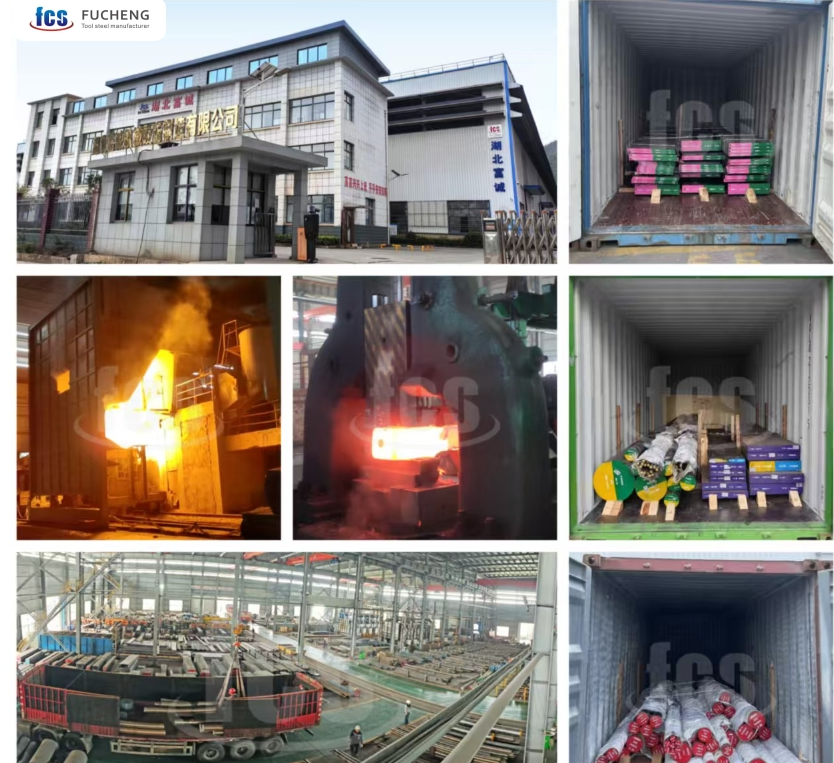
The biggest pain point in sourcing tool steel is paying the premium for electroslag remelting, only to receive standard EAF material masked by vague certifications. This ambiguity causes premature die failure. To secure genuine, high-quality ESR 1.2344, you must vet the tool steel factory using strict criteria:
- Demand Authentic Certification: Require an EN 10204 3.1 or 3.2 inspection certificate alongside a verifiable ESR process certificate detailing the remelt batch.
- Require 100% UT Testing: For forged blocks, mandate “UT 100% per EN 10308, indication class ≤3” to guarantee internal micro-cleanliness without inclusions.
- Specify Precise Hardness Targets: Delivery hardness must be max 230 HBW. Service hardness (e.g., 46–50 HRC) must be achieved through defined vacuum heat treatment and double tempering.
- Ensure Absolute Traceability: The steel must trace straight back from the primary heat to your final block ID.
To avoid supply chain guesswork, choosing a reliable manufacturer like FCS is essential. FCS delivers authentic ESR 1.2344 that strictly meets these exact standards, providing the pristine microstructure and isotropic toughness your high-cycle dies demand.
Conclusion
Tool dies breaking too soon isn’t bad luck. It points to weak materials. Standard H13 fails under extreme heat and heavy pressure. Modern casting, forging, and extrusion push this steel past its breaking point. You need something stronger. ESR 1.2344 steel fixes this problem. The refining process removes tiny flaws that cause cracks. You get better tool life. This turns sudden downtime into steady, high-cycle production. You save money and boost profits. Stop paying the hidden costs of weak tools. We are a trusted steel maker at FCS.
Our team offers real, fully-certified ESR 1.2344 steel. This material handles your hardest jobs. Bad steel ruins your schedule. Take control of your production time. Contact FCS today. Upgrade your steel choice. Plus, your tools will last much longer.