
Introduction: The Hidden Cost of “Trust”
Every year, buyers celebrate landing a “great deal” on tool steel, only to watch those savings evaporate when a mold cracks mid-production or tools fail prematurely.
Let’s be blunt. The tool steel industry operates on a massive information asymmetry. What you consider a “trusted relationship” is often just your supplier’s hidden profit margin. Behind those seemingly perfect, low-cost quotes hide undocumented material substitutions, meaningless labels, and deleted specifications.
After 19 years on the factory floor, working directly with buyers who have been severely burned, I’ve seen exactly how these games are played behind closed doors. This article strips away the marketing jargon to expose five distinct industry traps that suppliers use to cut corners—and gives you the exact blueprint to stop paying for them.
The Price Gap That Hides the Trap
A quote arrives thousands below the market average. You aren’t getting lucky. You buy a compromise. Suppliers build this tempting price gap through shortcuts in three specific areas:
- Chemical Composition: Suppliers cut expensive elements like Molybdenum and Vanadium. This saves them thousands per heat.
- Downgraded Melting Processes: You pay for premium EAF or ESR steel. The factory delivers basic induction furnace material.
- Skipped Quality Controls: Crucial steps like long annealing times and strict ultrasonic testing cost money. Suppliers rush them. Some factories skip them.
These shortcuts put a ticking time bomb in your production line. Here are the five most common traps suppliers use to hide these downgrades.
What to Demand Instead of the Label
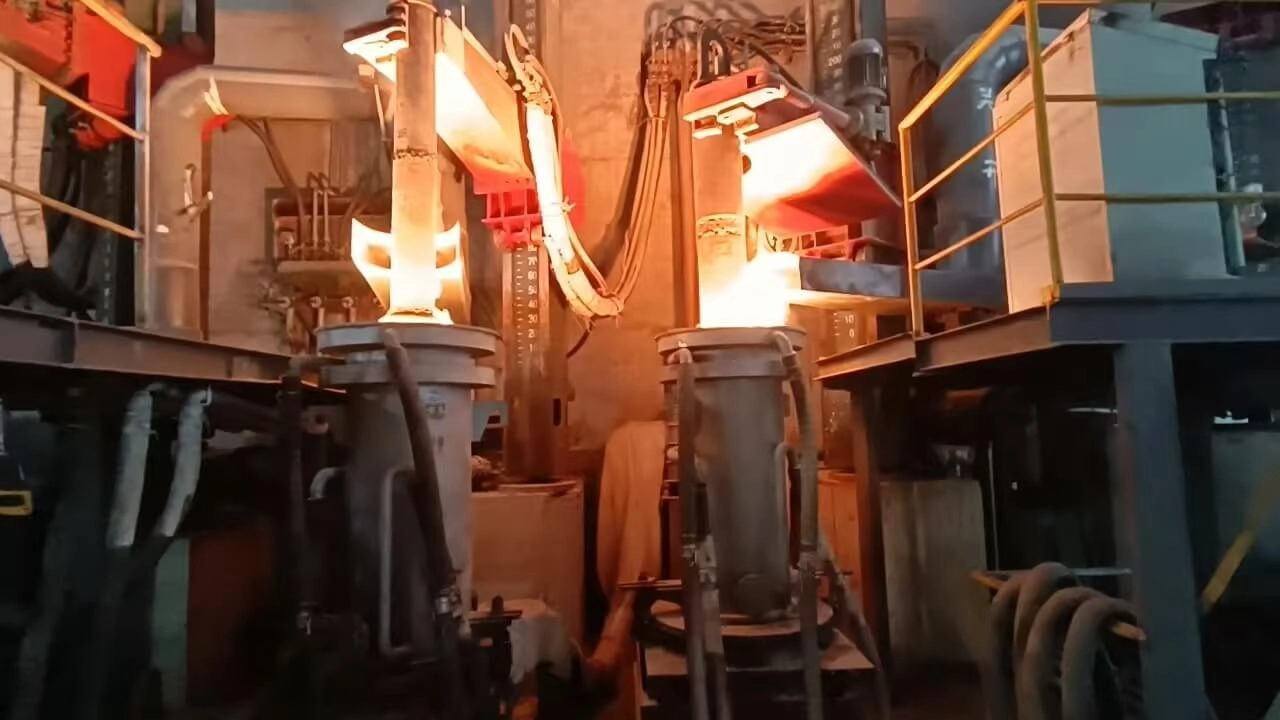
Stop accepting “ESR quality” as a complete answer. These are the numbers that matter:
- Sulfur (S) ≤ 0.010 wt% — confirm on the mill cert, not the brochure
- Inclusion ratings per ASTM E45 or ISO 4967 — get maximum A/B/C/D ratings in writing
- Primary melt route confirmation — EAF air melt? EAF + LF/VD? This defines what ESR is refining in the first place
- Full remelting route — EAF → ESR only, or EAF → ESR → VAR?
- Transverse vs. longitudinal impact/tensile data — isotropy matters to your application? Prove it with numbers, not assurances
The price uplift needs to come with documented, quantified gains. Your supplier can’t produce inclusion ratings and sulfur figures? They’re selling you the word ESR — not the process.
That’s a label. You already know what those cost.
Trap 1: Grade Substitution
You ordered DIN 1.2379 or 1.2344, but your supplier secretly ships standard D2 or H13 instead. Why does this happen? Honestly, it always comes down to expensive alloying elements.
Take D2 versus 1.2379. Standard D2 generally contains lower Molybdenum (Mo) and Vanadium (V). By shaving just 0.2% off these costly elements during melting, suppliers save thousands of dollars per heat. They pocket that extra margin, but you absorb the disaster downstream. Without those critical Mo and V levels, the steel loses secondary hardness and wear resistance. Your tooling ends up chipping or cracking right in the middle of a critical production run.
Legitimate mills never play this alloy-shaving game. They deliberately target the upper tolerance limits of exact DIN specifications to guarantee performance, and they back it up with raw spectral analysis. If your supplier dodges questions about strict Mo and V limits, you’re likely buying a downgraded substitute.
Trap 2: Passing Off Basic EF as EAF or EF+LF+VD
Suppliers frequently claim their steel is processed via EAF (Electric Arc Furnace) or fully refined with EF+LF+VD. In reality, many just use a basic EF (Induction Furnace). Why? Buyers simply want premium specs on paper, and suppliers want the markup without absorbing the actual cost.
Here’s an industry secret about true EAF: Only a few domestic mills actually have it. Even they don’t use it frequently. EAF operations cost a fortune to run and cause severe, expensive alloy burning and loss during melting.
On the other hand, skipping the LF (Ladle Furnace) and VD (Vacuum Degassing) steps is a disaster. A basic EF just melts; it doesn’t refine. Without LF+VD, you leave harmful gases and non-metallic inclusions trapped inside. For the buyer, this means poor toughness, inconsistent machining, and sudden tool failure.
Legitimate mills never skip the LF+VD refining route for tool steel. To spot the fake, don’t trust the quote. Check the Mill Test Report (MTR) for the explicit melting method and verify the exact gas content (Oxygen and Nitrogen) levels.
Trap 3: Passing Off Electric Furnace (EF) Steel as ESR
ESR — Electroslag Remelting — starts with an already-melted billet. That billet, made via EAF, becomes a consumable electrode. The electrode dips into molten slag. Droplets remelt, drip through the slag bath, and resolidify in a water-cooled copper mold. The result is a cleaner, more uniform ingot. What it is not is a different steel.
Many suppliers charge an ESR (Electroslag Remelting) premium but actually deliver high-quality EF steel. Because true ESR consumes massive electricity and time, drastically increasing processing costs.
To be perfectly objective, some top-tier EF materials are manufactured so well today that they can actually pass strict E/e class ultrasonic testing. Suppliers actively use these clean UT reports to convince buyers they are getting real ESR.
However, passing a UT scan only proves the absence of macroscopic internal flaws. The main difference lies in microscopic purity and isotropy. ESR actively remelts the ingot, eliminating sulfur and microscopic inclusions, resulting in highly uniform mechanical properties in all directions.
When you unknowingly use EF instead of ESR, the consequences appear midway through production. The mold might look fine initially, but it will eventually suffer from premature heat checking, poor mirror-polishability, or lower fatigue resistance. You paid a premium for maximum performance, but received standard lifespan.
Trap 4: Fake Mill Brands
Right now, a pallet of tool steel sits in a distribution warehouse with a “Fushun” tag. Fushun never made it.
This happens every day in tool steel distribution. Most buyers never realize it. A supplier buys a basic forged block from an unknown private mill. The supplier cuts it and machines it. They might add a nice label. Then they quote it to you under a famous domestic mill name. The steel is real. That brand name is pure decoration.
The Document That Exposes Everything
Every melt of tool steel produces a Mill Test Report (MTR). This rule applies everywhere, regardless of the maker. Treat this document as your steel’s birth certificate. It lists these key details:
- Producing mill name and location — The actual factory, not your service center or distributor.
- Heat number — A tracking code linking that melt to a specific furnace.
- Grade and specification — H13, D2, 1.2344, P20, and similar standards.
- Chemical analysis — The percentages of Mo, V, Cr, S, and other elements.
- Mechanical properties — Details on hardness, impact toughness, and yield strength.
Faking a heat number is outright fraud. This number sits on the MTR header and the metal tags. Factories also stencil it right onto the steel blocks. A block arriving with “XYZ-MILL 1.2344 HEAT NO. 4723” reveals the maker, the 1.2344 grade, and the melt source. Your purchase order might demand a top-tier brand. Then the block rolls off the truck displaying a small private mill’s name. You don’t need a laboratory. Stop the delivery right away.
Trap 5: Skipped QC
A quote 20% below the market median is a red flag, not a lucky deal. Suppliers do not just slash their costs out of nowhere. They hit that rock-bottom number by cutting crucial steps from your order. Here is what they remove from the process:
- Shortened Annealing Time: Proper annealing takes massive time and energy. Rushing this step saves them cash. But it traps severe stress inside the steel. This guarantees your mold bends during machining.
- Downgraded Ultrasonic Testing (UT): They skip strict E/e class testing to chop expenses. You receive either a basic flaw check or a recycled old report. You will not spot the hidden microscopic cracks until your tool snaps mid-production.
- Shaved Tolerances: They ship blocks at the absolute minimum minus tolerance. This gives you zero margin for your final milling work.
- Those upfront savings are fake. You end up paying the real price later on the production floor.
How FCS Eliminates These Industry Traps
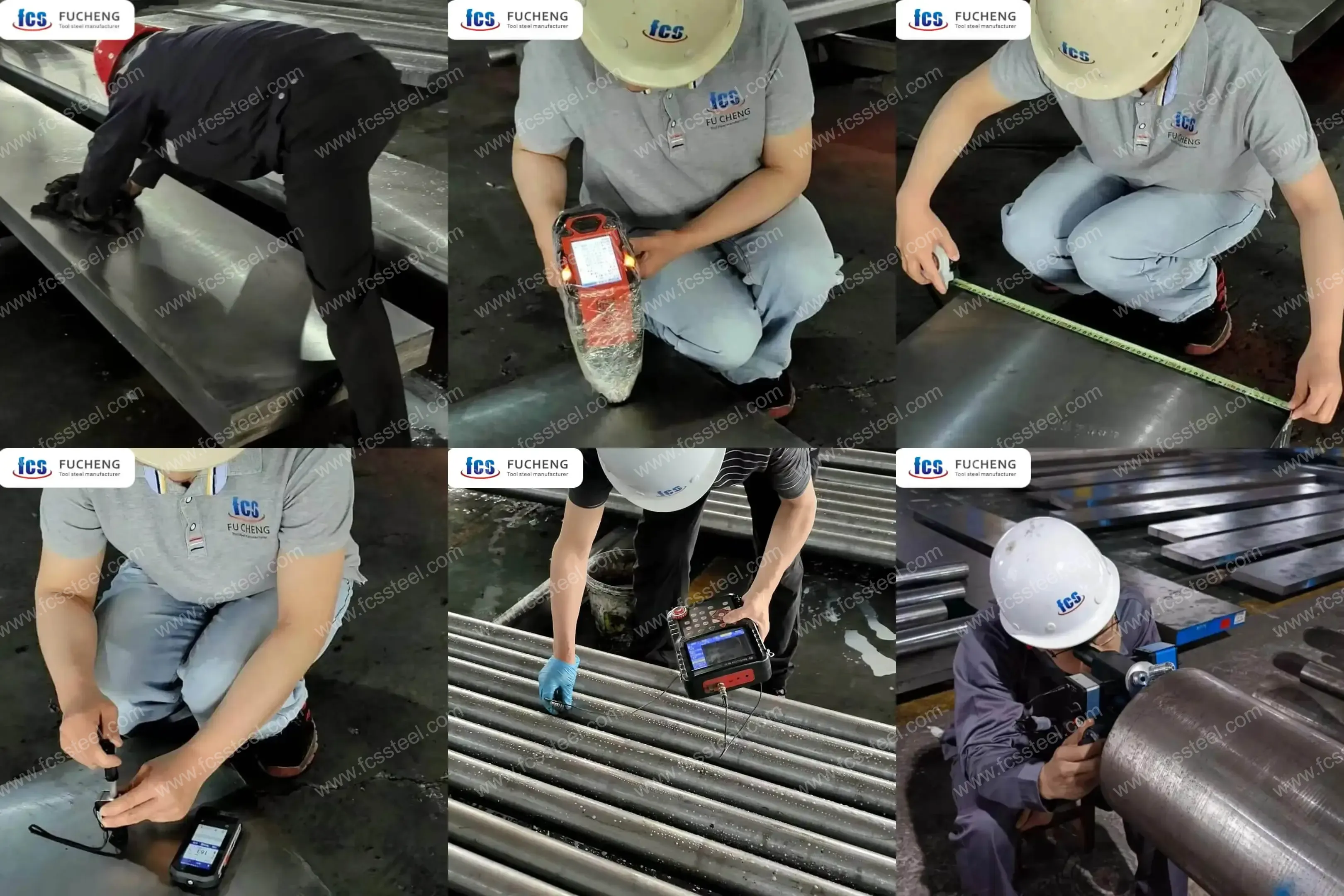
You shouldn’t have to play detective just to buy good tool steel. At FCS, we bypass these traps entirely by running a completely transparent operation. No middlemen. No hidden substitutions.
- End-to-End Control: We manage the full production line with our own complete equipment. We control the process, so you never get unexpected surprises.
- Real Traceability: Every single steel bar leaving our facility carries a precise heat number. It traces right back to the original melt.
- 100% Testing: We do not guess on quality. Our steel goes through a rigid 7-step inspection process, which includes 100% ultrasonic testing before shipping.
- Verifiable Paperwork: You get honest, unedited Mill Test Reports (MTRs). We show you the exact chemistry and the real melting route.We don’t just ask for your trust. We hand you the proof.
Conclusion
These five traps happen every single day. They are not rare exceptions. A mid-production mold crack causes brutal downtime and heavy financial losses. Irresponsible suppliers ignore the problem. They feed you endless excuses to dodge the blame.
Don’t wait for a major tool failure to check your purchase. Stop relying on blind trust. You need solid proof for your steel quality.
Want to know what you pay for? Send us your tooling drawings. You can also share your current Mill Test Report (MTR). Our team reviews these documents for free. We expose any hidden red flags to secure your investment.
Reach out to us at [Insert Email/Contact Link Here]. Get your free MTR audit today.