
Introduction:
Stuck choosing between 1.2365 and 1.2714 steel for your die blocks? A bad call leads to cracked dies and unexpected downtime. You also risk wasting budget on over-spec materials.
The breakdown is simple. 1.2365 handles high heat and abrasion easily. But 1.2714 works best for heavy impact loads.
We compare real-world performance in this guide. You can pick the exact grade to keep production running. Plus, it helps keep your costs down.
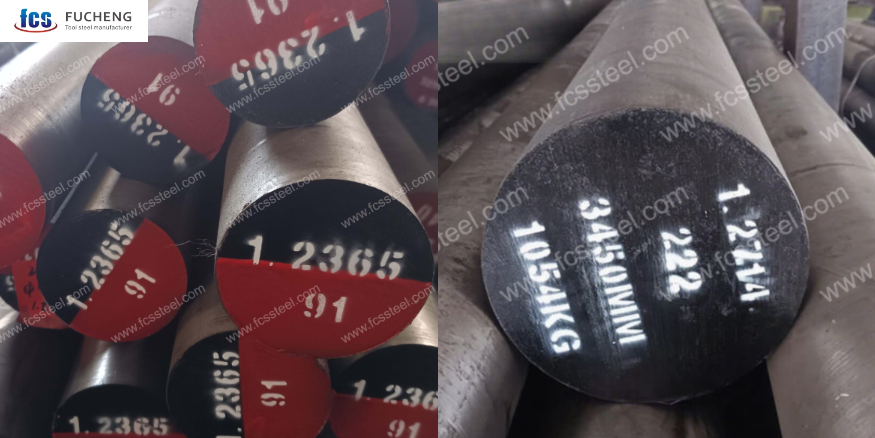
1. Chemical Composition and key perfomance
The alloy elements limit what each steel can do. Instead of wading through paragraphs, here is the direct comparison of the key elements that drive heat resistance and toughness. The difference in Chromium and Nickel is the main story here.
Table 1: Chemical Composition (wt.%)
| Element | 1.2365 (H10) | 1.2714 (L6 Variant) |
|---|---|---|
| Carbon (C) | 0.32 – 0.45 | 0.50 – 0.60 |
| Chromium (Cr) | 3.00 – 3.75 | 1.00 – 1.20 |
| Molybdenum (Mo) | 2.00 – 3.00 | 0.45 – 0.55 |
| Nickel (Ni) | ≤ 0.30 | 1.50 – 1.80 |
| Vanadium (V) | 0.25 – 0.75 | ≤ 0.10 |
| Silicon (Si) | 0.80 – 1.20 | 0.20 – 0.35 |
| Manganese (Mn) | 0.30 – 0.60 | 0.40 – 0.70 |
Table 2: Core Performance Comparison (Relative Rating)
| Performance Aspect | 1.2365 (H10) | 1.2714 (L6 Variant) |
|---|---|---|
| Toughness | ★★★☆☆ | ★★★★★ |
| Impact / Shock Resistance | ★★★☆☆ | ★★★★★ |
| Heat Resistance | ★★★★★ | ★★☆☆☆ |
| Thermal Fatigue Resistance | ★★★★★ | ★★☆☆☆ |
| High-Temperature Strength | ★★★★☆ | ★★☆☆☆ |
| Wear Resistance | ★★★★☆ | ★★★☆☆ |
| Dimensional Stability at Heat | ★★★★☆ | ★★☆☆☆ |
*Note: While some leaner analysis exists, standard 1.2714 typically maintains adequate carbon levels to support its toughness profile.
This chemical gap explains the behavior: 1.2365 relies on Chromium and Molybdenum for hot work stability, while 1.2714 uses Nickel to survive heavy pounding without cracking.
2. 1.2365 vs 1.2714 Steel:
Your tooling’s lifespan hangs on these mechanical properties. Instead of digging through paragraphs, look at how the numbers stack up side-by-side. The trade-off is clear: you either get superior heat resistance (1.2365) or maximum impact strength (1.2714).
| Property | 1.2365 (H10) | 1.2714 (L6 Variant) | The Winner |
|---|---|---|---|
| Max Hardness (Room Temp) | 48 – 52 HRC | 54 – 58 HRC | 1.2714 for cold/warm strength. |
| Hot Hardness Stability | Excellent Beats H13; stable carbides resist softening >500°C. |
Low Rapidly drops to 42-46 HRC when tempered >400°C. |
1.2365 for high-heat dies. |
| Impact Toughness | Balanced Resists thermal fatigue and heat checking. |
Very High Hits 55 J (long) / 37 J (cross). |
1.2714 for heavy forging shocks. |
| Core Strength | High Hot Tensile Resists creep under heat. |
1250 MPa Tensile 1000 MPa Yield Strength. |
1.2714 for deep, uniform strength. |
The Bottom Line: If your dies fail from heat checking or softening, switch to 1.2365. If they fail from cracking under heavy blows, stick with 1.2714.
3. Heat Treatment and Hardening
Heat treatment turns these tool steels into ready-to-use parts. The process differs a lot between grades. 1.2365 demands high heat to lock in its thermal properties, while 1.2714 gets the job done at lower temperatures.
1.2365 (Hot Work Cycle)
This grade requires high energy input to activate its chrome-molybdenum structure. You must control the cooling rate strictly.
Hardening Temp: 1100-1150°C (Oil or Air quench).
Preheat: High range (800-900°C) to stop thermal shock.
Tempering: Double cycle at 560-620°C.
Target Hardness: 46-50 HRC.
1.2714 (Toughness Cycle)
Thanks to Nickel, this grade reaches deep, consistent hardness with less heat. It is easier on your furnace and budget.
Hardening Temp: 840-880°C (Oil quench immediately).
Preheat: Moderate range (650-700°C).
Tempering: 540-660°C (Time depends on thickness).
Target Hardness: 40-54 HRC (Flexible range).
The Trade-off: Use 1.2714 for thick blocks (over 150mm) where you need uniform core strength without extreme heating costs. Choose 1.2365 only when you have the furnace capability to hit those high austenitizing temperatures for maximum heat resistance.
4. Performance in Die Block Applications
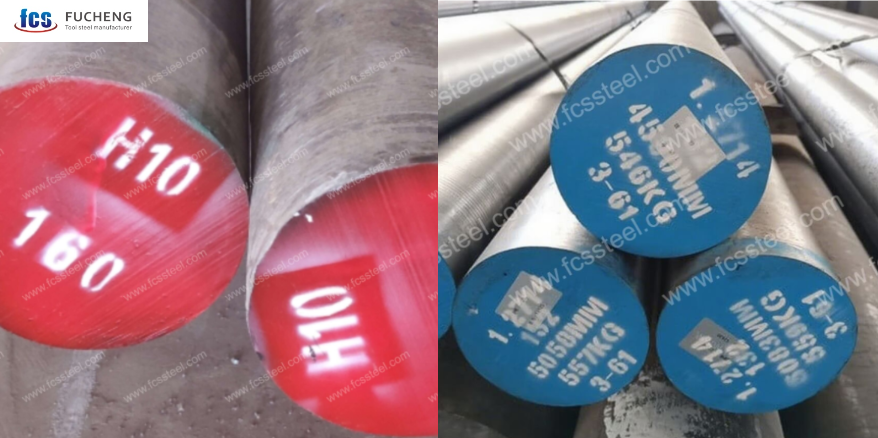
Die blocks face brutal conditions. Heat builds up fast, and impact forces repeat thousands of times per shift. Your steel choice determines whether blocks crack early or last through the run. Here is how they compare in the mix.
| Performance Metric | 1.2365 (The Heat Shield) | 1.2714 (The Hammer) |
|---|---|---|
| Primary Strength | Handling high thermal loads. 3.0-3.5% Chromium creates stable carbides. | Absorbing shock. 1.5-1.8% Nickel prevents cracking under heavy blows. |
| Heat Resistance | Excellent. Resists softening up to 550°C. Maintains 50-52 HRC during spikes. | Moderate. Works best at lower temps. No brittleness in 230-425°C tempering range. |
| Thermal Stress | Handles fast water cooling. High conductivity (34.5 W/mK) moves heat away from edges. | Good stability. Core stays hard even in thick sections up to 75mm. |
| Machinability & Surface | Harder to machine. Often needs PVD/TiN coatings for extreme wear. | Better. Smooth machining at 192 HBW. Pre-hardened blocks (40-44 HRC) cut faster. |
| Best Use Case | High-speed forging, Al-Extrusion, Die casting. | Heavy forging hammers, Support tooling, Large dies. |
5. Picking the Right High-Wear Insert: Wear vs. Shock
Insert failures kill your budget and pause production. The fix starts with choosing the right steel base, not just adding surface coatings. Look at your scrap pile. How do your tools fail? That answer dictates your choice.
Scenario A: Failure by Abrasive Wear & Heat
If your dies lose dimensions from friction or heat softening, switch to 1.2365. It dominates in high-heat, abrasive conditions.
Why it works: Its Vanadium and Chromium carbides create a hard “shield” structure. This boosts abrasion resistance by 20-30% compared to standard grades. In hot closed die forging, 1.2365 resists plastic deformation better than W360 or 1.2344. It maintains a Hot Hardness rating of 6/9, keeping its edge even when operating above 500°C.
Scenario B: Failure by Cracking & Impact
If your tools snap, chip, or crack under heavy blows, 1.2714 is your answer. It trades surface hardness for pure core toughness.
Why it works: With 1-2% Nickel content, this grade acts as a shock absorber. It scores a massive 8/9 for shock resistance. The lower carbon content allows the steel to flex rather than snap. While you sacrifice some wear resistance (rating only 3/9), you gain a die block that survives thousands of hammer strikes that would shatter 1.2365.
The Golden Rule: Don’t look for a steel that does both perfect. If you need wear resistance, buy 1.2365. If you need to stop catastrophic cracking, buy 1.2714.
6. How They Machine and Manufacture
Machinability ratings separate these two grades in the workshop. 1.2714 machines at 90% of water-hardening steel baseline rates. Cut times stay short. Tool wear runs moderate. Most shops call it “very good” for machining. 1.2365 gets a “C” rating for good machinability when you anneal it right. You’ll burn through more carbide inserts. Cutting speeds drop lower.
The numbers show a clear gap. Compare 1.2714’s 90% rating to other tool steels. A2 steel sits at just 42%. D2 steel drops to 27%. Even 4140 reaches 66%. 1.2714 machines faster than most hardened tool steel grades.
Hardness States and Production Planning
Annealed hardness sets your machining approach. 1.2714 arrives at max 250-255 HB. Drills bite clean. End mills hold their edge longer. 1.2365 needs the right annealing too. Skip this step and you’ll fight the material through every operation.
Pre-hardened delivery changes setup times. 1.2714 ships at 28-32 HRC in pre-hardened condition. This matches P20+S levels. You skip the hardening cycle for many jobs. Machine the block. Install it straight into the press. 1.2365 stays stable during heat treatment because it air-hardens. Tight tolerances hold through the quench. Precision die blocks need less grinding after hardening.
Hot working opens up forming options for 1.2714. Roll it. Forge it. Extrude it into complex shapes. The process cuts down porosity. The grain structure gets better. Watch out for scaling and grain growth at high temperatures though.
7. Cost Analysis by Production Volume

Material costs vary based on your production scale. Small shops work with one set of numbers. High-volume manufacturers work with different numbers.
1.2714 works best for low to medium production runs. This chrome-nickel-molybdenum grade costs 15-20% less than 1.2365 upfront. Small batch tooling for printing punches? This grade handles it well. Extrusion matrices running moderate cycles benefit too. The lower alloy content cuts your initial investment. You’ll replace tools more often. But total cost stays lower for runs under 50,000 parts.
1.2365 pays back in high-volume operations. The price premium sits at 20-30% higher than baseline grades. Tool life extends by similar margins though. Dies running 200,000+ cycles need fewer replacements. Hot forging operations see less downtime. One 1.2365 die block does the work of two 1.2714 blocks in heavy aluminum extrusion.
Volume Break-Even Points
Hot-work steels trade around 9-12 USD/kg for typical sizes as of December 2024. 1.2365 runs near the top of this range. 1.2714 sits in the middle. Bulk orders over 500kg drop unit costs by 8-12%. Small quantities under 50kg add 15-25% premiums.
Production stops cost more than materials in high-volume plants. A die change takes 2-4 hours of press time. Calculate your cycle count. Match it to expected tool life. The numbers tell you which grade saves money in your setup.
8. Corrosion Resistance and Maintenance Requirements
Both grades need active corrosion management. Neither steel hits the 10.5-13.5% chromium threshold for natural corrosion resistance. 1.2714 contains just 0.8-1.0% chromium. 1.2365 runs at about 5% chromium. Both fall far short of the 13-15% chromium in corrosion-resistant tool steels like X50CrMoV15 steel.
1.2714 corrodes in moisture and harsh environments. Low chromium means minimal oxidation protection. Rust forms fast on exposed surfaces. 1.2365 shows the same weakness. Hot-work grades focus on thermal properties, not corrosion resistance. Stainless grades beat both by a wide margin.
Protection and Maintenance Steps
Surface treatments are a must for both grades. Nitriding adds a hard, corrosion-resistant layer. PVD or CVD coatings block moisture. Skip these steps? You’ll see rust within days in humid shops.
1.2714 needs specific heat treatment. Harden to 54-58 HRC through proper oil quenching. Temper between 500-600°C to lock in properties. Watch for scaling during hot working above 1100°C. This damages the surface. Check working hardness at 373-534 BHN during production runs.
Storage matters more than most shops think. Keep blocks dry. Check for moisture exposure each week. Add corrosion coatings before first use. 1.2714 has higher impact resistance. This cuts down surface cracking. Fewer exposed metal areas mean less corrosion risk over time.
9. Application Guide: Making the Final Choice
Your decision really boils down to one factor: Operating Temperature. If your tools run red-hot, 1.2365 is your safety net. If they take brutal pounding at lower temperatures, 1.2714 is the workhorse you need.
1.2365: The High-Heat Specialist
Pick this grade for processes where heat kills standard steels. It thrives in aluminum extrusion dies, high-speed hot forging, and die casting molds. With superior thermal conductivity, it moves heat away from critical edges, preventing cracks even when water cooling shocks the surface.
1.2714: The Impact Survivor
This is your go-to for heavy-duty shock absorption. It powers through in large forging hammer dies, heavy punches, and plastic injection molds requiring massive core strength. The nickel content ensures deep hardening, so even thick blocks won’t fail under sudden, massive loads.
Quick Selection Checklist
Choose 1.2365 if: Working temps exceed 500°C, abrasive wear is high, or you need resistance to thermal shock (heat checking).
Choose 1.2714 if: Working temps stay under 400°C, the tool faces heavy impact (hammer blows), or you need pre-hardened convenience for large bases.
Conclusion
Choosing between 1.2365 and 1.2714 depends on your die’s “killer”: heat or impact. If your tools snap or chip under heavy blows, 1.2714 is the essential choice. Its nickel-rich chemistry acts as a shock absorber, preventing catastrophic cracking in high-impact forging.
Conversely, if your dies fail from surface softening or “washing out,” switch to 1.2365. It offers superior red hardness and abrasion resistance for high-heat applications like aluminum extrusion, often at a lower cost. Stop guessing—audit your scrap pile.
If you see cracks, buy 1.2714. If you see worn edges, pick 1.2365. Matching the grade to your specific failure mode is the fastest way to slash downtime and protect your profits.