
After nearly 20 years in the tool steel industry, we have seen countless customers deal with chipped punches, cracked dies, premature wear, and unstable tool life because the steel selected at the beginning did not match the actual working conditions.
Cold stamping covers very different applications. Electrical steel, automotive high-strength sheet, stainless steel, precision progressive dies, and cutting tools can place very different demands on the material.
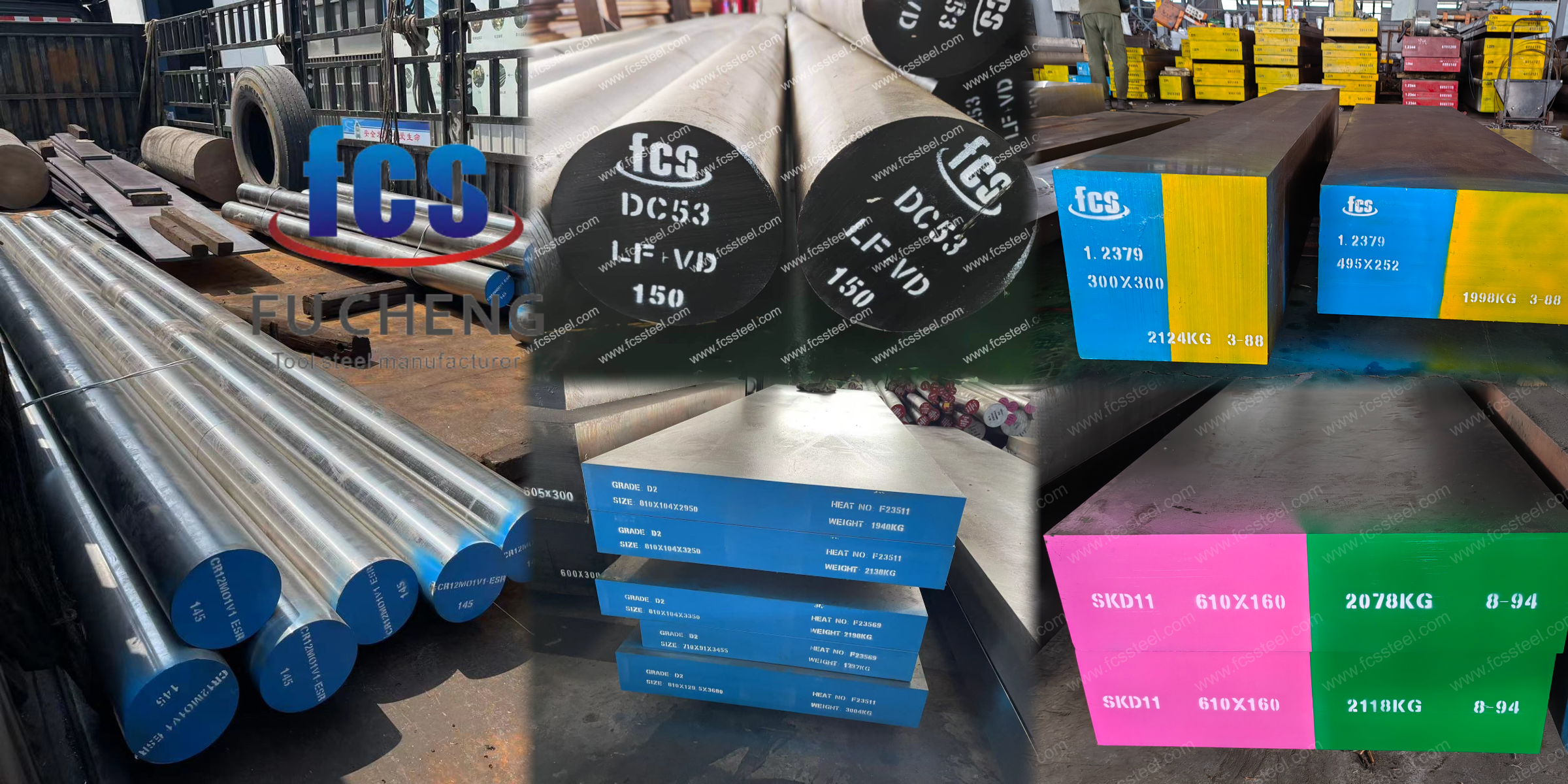
For steel distributors, maintaining a profitable inventory means offering the right balance of conventional grades (D2/1.2379, SKD11) and premium high-toughness grades (DC53, D6) to meet diverse stamping demands.
This guide analyzes cold work steels from both an end-use application perspective and a procurement strategy to help you optimize your warehouse inventory.
Cold Stamping Die Steel Selection Chart
|
Application |
Recommended Grade |
Main Reason |
|---|---|---|
|
Electrical steel stamping |
High wear resistance |
|
|
Automotive thick-plate stamping |
Higher toughness and chipping resistance |
|
|
Precision progressive dies |
DC53 |
Toughness + dimensional stability |
|
Stainless steel stamping |
DC53 |
Wear + toughness + resistance to edge failure |
|
High-strength steel blanking |
DC53 |
Better balance under high load |
|
Shear blades / slitter knives / cold rolls |
High wear resistance, adjusted for toughness |
|
|
General stamping |
Cr12MoV |
Cost-performance |
|
JIS-specified tooling |
SKD11 |
JIS specification compliance |
This table is a starting point. Material thickness, strength, production speed, tool geometry, clearance, and actual failure mode can change the final choice.
Tool Steel Grades Comparison (D2, DC53, SKD11)
These five grades represent the main choices customers encounter in cold work tooling: 1.2379/D2 and SKD11 as conventional high-carbon, high-chromium grades; DC53 as a tougher 8% Cr alternative; 1.2436/D6 as a higher-carbide wear-resistant grade; and Cr12MoV as a more economical conventional option.
|
Grade |
Common Reference |
C % |
Cr % |
Mo % |
V % |
W % |
|---|---|---|---|---|---|---|
|
1.2379 |
AISI D2 / X153CrMoV12 |
1.45–1.60 |
11.0–13.0 |
0.70–1.00 |
0.70–1.00 |
— |
|
DC53 |
Daido 8% Cr cold work steel |
~0.95–1.05 |
~7.9–8.5 |
~1.5–2.1 |
— |
— |
|
1.2436 |
X210CrW12 / D6 |
~2.0–2.3 |
11–13 |
— |
— |
~0.6–0.8 |
|
Cr12MoV |
GB/T 1299 |
1.45–1.70 |
11.0–12.5 |
0.40–0.60 |
0.15–0.30 |
— |
|
SKD11 |
JIS SKD11 |
~1.4–1.6 |
~11–13 |
~0.8–1.2 |
~0.2–0.5 |
— |
Typical chemistry ranges. Exact limits depend on the applicable standard and mill specification.
The chemistry explains much of the performance difference.
1.2379/D2 and SKD11: These use the 12% Chrome formula. The high carbon and chromium levels combine to form large, blocky primary carbides (M7C3 type) during solidification. These carbides act like hard rocks embedded in the steel matrix. They provide excellent abrasive wear resistance, but since they reach 20-30 microns in size, they often become crack initiation points under heavy impact.
DC53: Dropping Carbon to ~1.0% and Chromium to ~8% shrinks those massive primary carbides. It also doubles the Molybdenum content to around 2% to promote secondary hardening. The result is a finer, more uniform microstructure. DC53 reaches a higher hardness (62-63 HRC) than D2, while delivering more than double the Charpy impact toughness of conventional SKD11.
1.2436/D6: This grade takes the opposite approach. With carbon pushed over 2.0% and the addition of Tungsten (W), the carbide volume fraction is massive. The steel is hard and wear-resistant, but brittle. Use D6 when severe abrasive wear is the main problem and impact forces are zero.
Cr12MoV: This is the budget workhorse. It shares the 12% Chrome baseline but cuts back on Molybdenum and Vanadium. You lose some deep hardenability and temper resistance compared to 1.2379, but it hits 58-60 HRC for standard, low-stress production runs.
Die Steel Applications in Cold Stamping
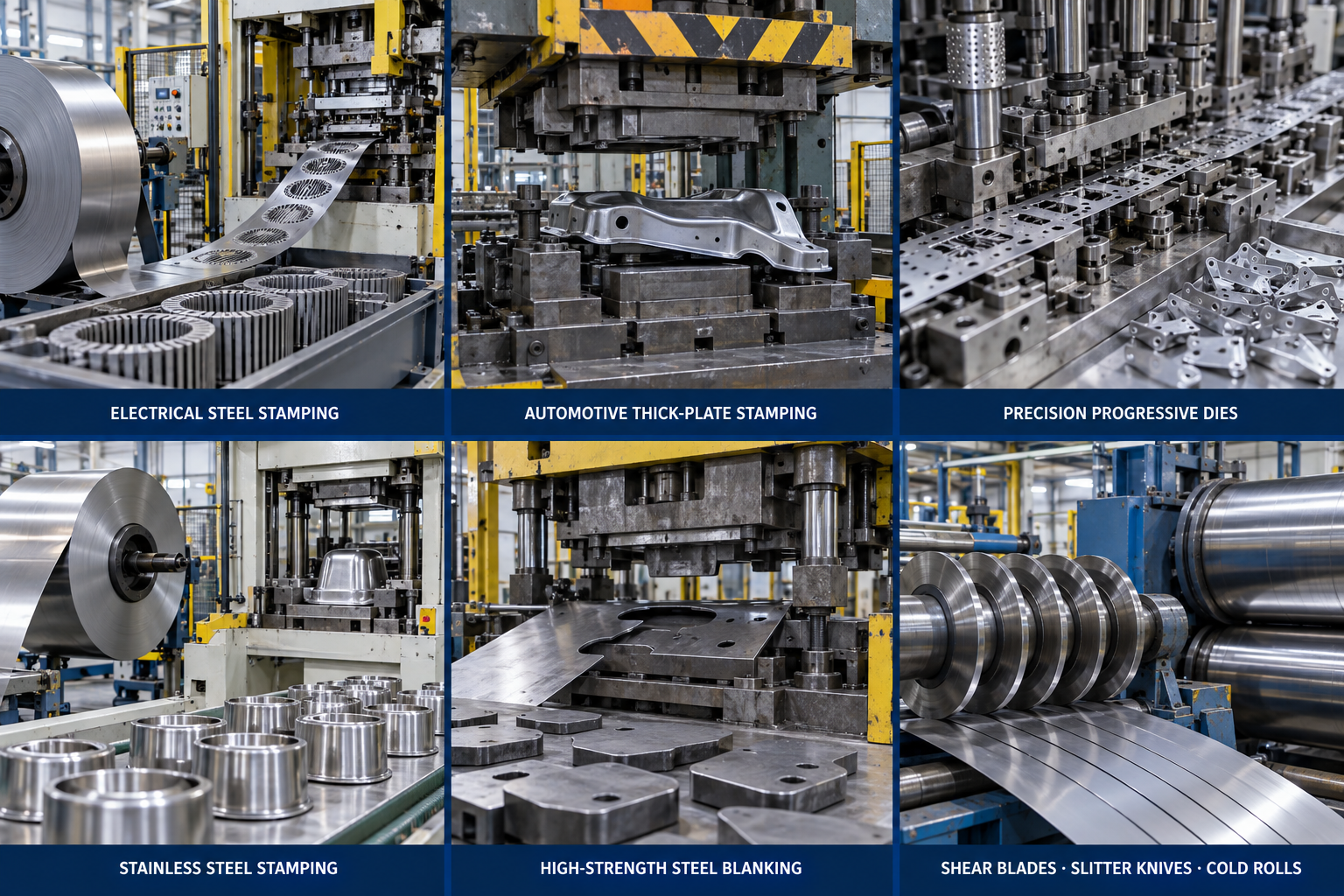
Quick Reference: Strategic Inventory Guide for Distributors
Want to optimize your warehouse profitability? Here is a no-nonsense breakdown of how to position these three core grades to your downstream clients:
|
Steel Grade |
Warehouse Positioning |
Target Market / Application |
Your Core Sales Pitch |
|---|---|---|---|
|
1.2379 / D2 |
The Liquidity King (High Volume) |
General stamping, electrical steel laminations |
“The global standard. Fast turnover that reliably covers 60% of your daily, general-purpose procurement orders.” |
|
DC53 (incl. ESR) |
The High-Margin Problem Solver |
Automotive AHSS, heavy thick-plate stamping |
“The ultimate upgrade. Pitch this to auto clients struggling with chipped D2 punches to secure lucrative, long-term contracts.” |
|
1.2436 / D6 |
The Niche Specialty (High Wear) |
Industrial slitter knives, thin-gauge shear blades |
“The extreme edge-holder. An absolute must-stock for clients running demanding steel coil slitting lines (under 1mm).” |
1. Electrical Steel Stamping (1.2379 / D2)
Let’s talk about motor laminations, EV stators, and transformers. Electrical steel is incredibly abrasive due to its silicon content, and usually just 0.35 to 0.5 mm thick. You’re looking at 400+ strokes per minute with die clearances as tight as 3-5% of the sheet thickness. Under these conditions, 1.2379 (D2) remains the industry heavy-weight. Why? Because its massive volume of M7C3 primary carbides literally slices through the silicon.
But there’s a catch with the heat treatment. For high-speed lamination dies targeting 60–62 HRC, deep cryogenic treatment (-196°C) is highly recommended between tempering cycles. If you skip this, retained austenite stays in the steel. The result? The punch edge suffers from micro-rounding, instantly creating unacceptable burrs on the laminations. You’ll be pulling the die for early grinding while the press sits idle.
2. Automotive Structural Parts (DC53)
When stamping 2.5–5 mm thick chassis components, suspension brackets, or seat tracks, the yield strength often exceeds 600 MPa. The sheer tonnage of the press creates massive compressive stress and lateral shock on the tooling. If you use standard D2 here, those brittle carbides will likely shatter.
This is exactly where DC53 earns its keep. Its finer carbide structure delivers over 60 Joules of impact toughness—double that of SKD11. Typically tempered at a high 520–530°C to reach 60-62 HRC, it prevents catastrophic edge fracture. I’ve seen shops try to save money with lower-toughness steel, only to have a punch head snap clean off mid-production, severely damaging the die block and halting the entire press line.
3. Precision Progressive Dies (DC53)
When your customers make highly precise dies—like for small electronics—they need steel that stays perfectly flat. If a steel block warps or bends even a fraction of a millimeter while they cut it, the whole block is ruined.Standard D2 sometimes has this warping problem. DC53 does not. It is widely known in the industry for staying completely straight and stable.Precision toolmakers will specifically ask for DC53 because they don’t want to risk their expensive dies warping.
4. Stainless Steel Stamping (DC53)
Stamping stainless steel—like the material used for kitchen sinks or medical tools—is notoriously hard on regular steel. It tends to stick and tear, which destroys standard materials incredibly fast.
This is a major headache for the industry. Conventional grades like D2 just wear out too quickly in these conditions. DC53 at 62 HRC provides the rigid, non-deforming substrate,which is tough enough to handle the daily punishment of stainless steel without breaking down.It is the obvious grade for cutting or stamping stainless steel. Keeping it in your warehouse means you always have a ready-to-go answer for one of the market’s most common problems.
5. High-Strength Automotive Blanking (DC53)
Modern automotive lightweighting relies heavily on AHSS (Advanced High-Strength Steel) above 980 MPa, and hot-stamped parts like 22MnB5 crash beams sitting around 1500 MPa. Blanking this material sends a violent acoustic shockwave straight up the punch when the material finally fractures.
DC53 is the absolute baseline here, but honestly, for anything over 1180 MPa, conventional ingot steels start to fail. Attempt this with standard SKD11, and the cutting edges will micro-chip immediately, or the punches will literally shatter under the reverse-shock load.
6. Slitter Knives & Shear Blades (1.2436 / D6)
Processing massive coils of silicon or stainless steel requires edge retention that can survive thousands of meters of continuous friction. For thin-gauge slitter knives (under 1 mm), 1.2436 (D6) is fantastic. Its 2.0%+ Carbon and Tungsten addition form an incredibly dense, wear-resistant barrier.
These knives require extremely precise double tempering to stabilize dimensions. If the wrong steel or poor treatment is used, the knife edge rolls over rather than shearing cleanly. This tearing action leaves terrible burrs, potentially ruining an entire expensive coil. Note: for thicker plate shears (>5 mm), D6 is too brittle, so you’d pivot to a modified DC53 or H13.
7. General Stamping & Short-Run Tooling (Cr12MoV)
Not every die stamps ultra-high-strength steel. If you’re running short-to-medium production (under 100,000 parts) for mild steel SPCC brackets, Q235 plates, or simple appliance panels, budget matters. Cr12MoV hits the sweet spot perfectly.
It provides decent 12% Chrome wear resistance but saves you money by cutting back on expensive Molybdenum and Vanadium. You’ll typically treat it to 58-60 HRC. The only trap? It lacks deep hardenability. If you use Cr12MoV for massive die blocks (say, over 200mm thick), the core won’t harden properly. The surface might read 60 HRC, but the soft core will eventually sink under heavy press loads.
8. JIS Standard Export Tooling (True SKD11)
If you are building dies for automotive Tier 1 suppliers in Japan or Europe, strict compliance is non-negotiable. When the drawing calls for SKD11, it means exactly that chemistry—not “something similar.” True SKD11 has a specific Molybdenum and Vanadium range that differs slightly from European 1.2379.
The real challenge here isn’t just the heat treatment; it’s the paper trail. You have to provide EN 10204 3.1 material certificates and Ultrasonic Testing (SEP 1921 Class E/e) reports. I’ve seen shops substitute a cheaper D2 equivalent to save a few bucks, only to have the end-user’s incoming quality audit reject the entire tool, leading to massive financial penalties and delayed runoff.
Tool Steel Quality & Processing Checklist
Heat Treatment
Ask the supplier for the recommended heat-treatment route for the exact grade and section size.
As a reference, D2 commonly uses approximately 1020–1040°C quenching and around 520°C tempering, while DC53 uses its own high-temperature tempering route around 520–530°C.
ESR
ESR is worth considering for large, highly stressed, expensive, or chipping-sensitive tooling.
Its main advantages are improved cleanliness, reduced segregation, and more consistent carbide distribution. Ask for Heat No. traceability and the corresponding material certificate.
Cryogenic Treatment
Deep cryogenic treatment is not automatically required for every D2 or DC53 tool.
Consider it when retained austenite, dimensional stability, or wear performance makes the additional process worthwhile.
FCS Tool Steel: Engineered for Your Actual Working Conditions
FCS Tool Steel: Your Strategic Partner
Let’s be honest—anyone can quote a price per ton for standard D2 or SKD11. But when a punch snaps mid-production or an expensive die block cracks during heat treatment, those initial material savings evaporate instantly. At FCS steel factory, we don’t just fill orders; we solve tooling problems, look at your specific reality then recommend the grade.
Our Wholesale Commitment:
-
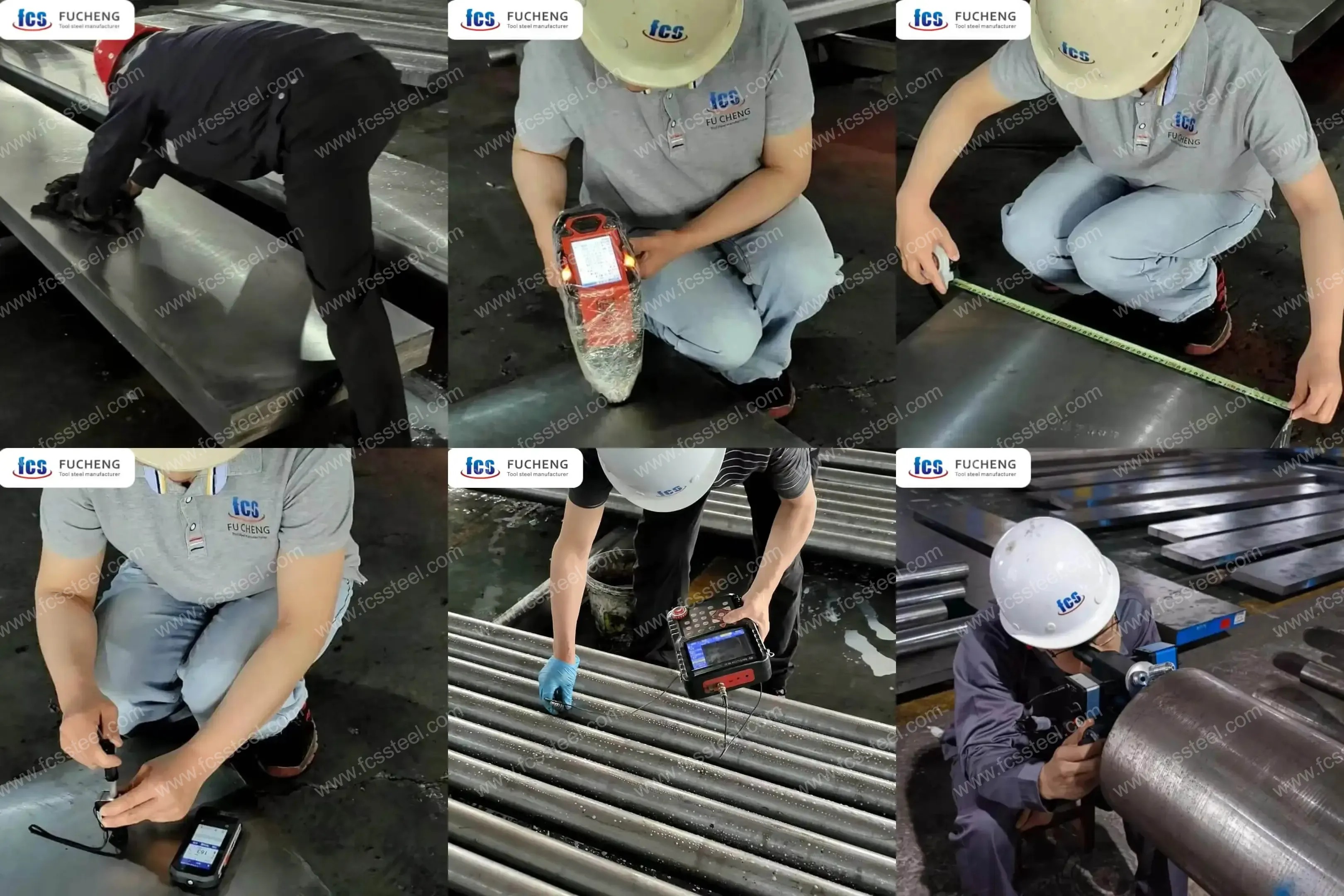
100% Ultrasonic Inspection: Every single bar and block is UT tested to SEP 1921 Class D/d or E/e before container loading. No hidden internal voids, which means no unexpected cracking when your buyers start machining.
-
Strict Annealing Hardness Control: We guarantee uniform spheroidized annealing (typically < 255 HBW for D2 and ≤ 235 HBW for DC53). This ensures your clients can machine and saw the material smoothly without ruining their tools.
-
Zero Grade Mix-ups: We perform 100% piece-by-piece XRF spectrometer testing prior to shipping. When you order D2 or DC53, you get exactly that chemistry—no costly surprises when the material hits your floor.
Our philosophy is simple: we make sure the steel that arrives on your shop floor is engineered for the tool you are actually building, not just a standard grade blindly copied onto a purchase order.
Looking for a Reliable Tool Steel Partner?
Struggling with premature die wear, edge rolling, or unexpected cracking? Don’t leave your next tool’s performance to chance.We are here to provide the premium tool steels you need, keeping your inventory highly competitive and ready to ship.
You don’t need to be a metallurgy expert to offer great solutions. If youever run into tough stamping issues like die wear or cracking, just lean on us. We’ll help you quickly recommend the right steel grades to solve their problems, keeping your clients happy and your sales growing.