
Introduction:
Choosing steel grades for tough industrial jobs? You need the full material profile. This applies to tools, dies, and high-stress parts.
1.2365 (32CrMoV12-28) steel is a hot work tool steel. It contains chromium, molybdenum, and vanadinum alloys. This steel offers excellent toughness. Plus, it resists thermal fatigue and stays stable at high temperatures.
Many engineers and buyers face a problem. They can’t find complete, useful data beyond basic spec sheets.
This 1.2365 steel material data sheet gives you what you need. You’ll learn how each alloying element affects performance. We cover heat treatment methods that bring out the best properties. You’ll also see real applications where 1.2365 beats other options.
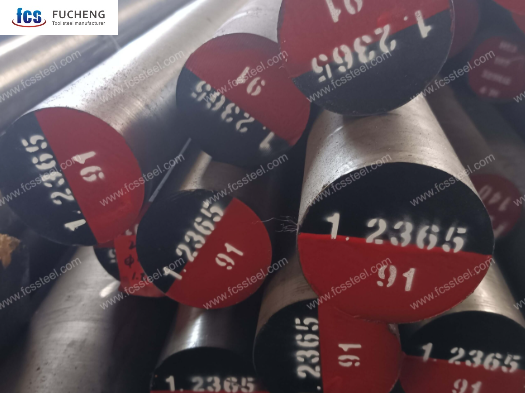
Material Overview
1.2365 steel is a hot work tool steel in the chromium-molybdenum family. You’ll find it listed under several international standards: DIN 1.2365 (32CrMoV12-28), AISI H10, X32CrMoV12-28, SKD7, and BH10. These different names make it easy to source and compare across global markets.
What sets 1.2365 apart? It has higher molybdenum content (2.00-3.00%) than standard hot work steels like H11/1.2343 and H13/1.2344.
This extra molybdenum forms more stable carbides in the steel. The result? Better hot hardness and stronger resistance to thermal fatigue. This steel holds its hardness at temperatures up to 400-500°C. So it works well under long exposure to extreme heat cycles.
Key Features and Benefits
What makes 1.2365 the go-to choice for severe hot work? It balances extreme toughness with the ability to handle rapid temperature shifts. Unlike standard H13 steel, this grade specifically targets thermal shock resistance, allowing for aggressive cooling strategies without cracking.
| Key Feature | Production Benefit |
|---|---|
| High Thermal Conductivity | Removes heat faster; shortens cycle times. |
| Thermal Fatigue Resistance | Prevents “spiderweb” cracks (heat checking). |
| Water Cooling Capable | Stable under water quenching; increases output. |
Chemical Composition
| Element | Range (%) | Typical (%) |
|---|---|---|
| C (Carbon) | 0.28-0.45 | 0.32 |
| Si (Silicon) | 0.10-1.25 | 0.25-1.00 |
| Mn (Manganese) | 0.15-0.70 | 0.20-0.50 |
| P (Phosphorus) | ≤0.030 | – |
| S (Sulfur) | ≤0.030 | – |
| Cr (Chromium) | 2.70-3.75 | 3.00 |
| Mo (Molybdenum) | 2.00-3.00 | 2.80 |
| V (Vanadium) | 0.25-0.75 | 0.50 |
Phosphorus and sulfur stay at ≤0.030%. This stops brittleness. These impurities can crack the steel during hot work.
Element Effects on Performance
The specific alloy blend of 1.2365 drives its ability to handle extreme thermal stress. Here is how the chemistry translates to shop-floor results:
- Chromium: Ensures deep hardenability through the part and forms carbides that specifically fight thermal cracking (heat checking) during rapid heating cycles.
- Molybdenum: The engine for hot performance. It maintains hardness at temperatures up to 600°C and prevents the tool from softening during use.
- Vanadium: Acts as a grain refiner. It creates a fine structure for better toughness while forming hard carbides that resist wear.
- Carbon Balance: Carefully tuned to offer maximum ductility while still allowing the steel to reach peak working hardness (approx. 52 HRC).
- The Cr-Mo-V Synergy: This combination creates a stable microstructure that allows for water cooling without cracking—a significant advantage over standard H13. It ensures the tool holds its precise shape even under heavy thermal load.
Mechanical Properties
1.2365 steel changes its mechanical profile significantly based on the heat treatment strategy. The tables below outline the trade-offs between hardness, toughness, and machinability.
Hardness Response to Tempering Temperature
| Condition / Tempering Temp | Hardness Value | Application Context |
|---|---|---|
| Annealed | Max 229 HB | Soft state; optimal for machining. |
| 150°C | ~58 HRC | Max hardness; low toughness (brittle). |
| 538 – 621°C | 50 – 52 HRC | Ideal Working Range. Best balance of toughness and heat resistance. |
| 650°C | ~41 HRC | Too soft for high-wear areas; improved ductility. |
Key Insight: While low-temperature tempering yields high hardness (58 HRC), it is unsuitable for hot work due to brittleness. The 50-52 HRC range is the standard target, requiring double tempering to stabilize the microstructure.
Tensile Strength & Elastic Modulus
| Property | Annealed State | Hardened State (>500°C Temper) |
|---|---|---|
| Tensile Strength | 231 MPa | ≥ 980 MPa (4.2x increase) |
| Yield Strength | 154 MPa | ≥ 730 MPa (4.7x increase) |
| Elastic Modulus | – | 207 GPa (20°C) → 176 GPa (500°C) |
| Elongation | ~56% | Varies with hardness (Lower) |
Key Insight: Heat treatment unlocks the steel’s load-bearing potential, increasing yield strength by nearly 5 times. However, stiffness (Modulus) naturally decreases by about 15% as operating temperatures rise to 500°C.
Thermal Properties and Hot Work Performance
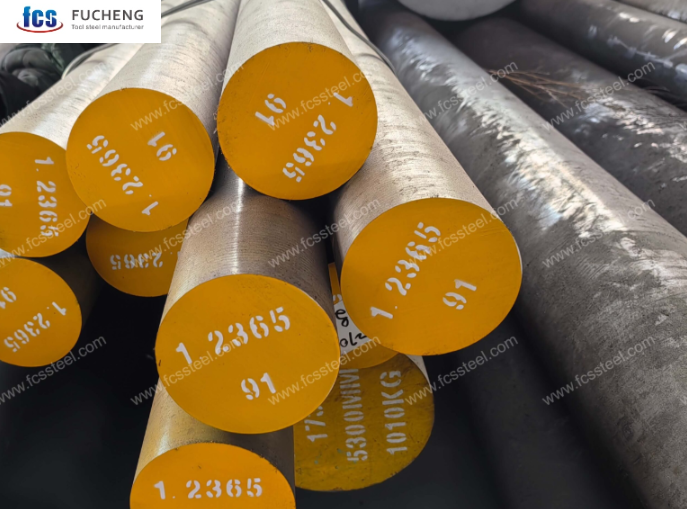
Good heat management defines tool life. 1.2365 steel offers excellent stability across primary operating temperatures, ensuring consistent performance.
Physical Properties vs. Temperature
| Temp | Conductivity (W/m·K) | Expansion (10⁻⁶/°C) | Specific Heat (J/g·K) |
|---|---|---|---|
| 20°C | 30.0 – 32.1 | – | 0.46 |
| 350°C | 33.2 (Peak) | 13.8 (at 300°C) | – |
| 500°C | 30.1 | 14.6 | 0.55 |
| 600°C | 29.7 | – | 0.59 |
Analysis: Thermal conductivity peaks at 350°C, helping tools shed heat efficiently. The controlled thermal expansion minimizes warping, maintaining tight tolerances even under stress.
High-Temperature Mechanical Strength (Red Hardness)
| Temp | Working Hardness | Tensile Strength |
|---|---|---|
| 100°C | 51 HRC | 1730 N/mm² |
| 550°C | 50 HRC | ~1650 N/mm² |
| 600°C | 48 HRC | 1570 N/mm² |
| 700°C | 29 HRC (Fail) | 940 N/mm² |
Analysis: The steel retains excellent hardness (50 HRC) and strength up to 550°C. The sharp drop at 700°C indicates the material’s absolute thermal limit.
Operational Capability
| Thermal Fatigue | High resistance to heat checking; fine carbide network prevents micro-cracking during rapid temperature shifts. |
| Cooling Strategy | Suitable for aggressive water cooling, allowing for faster production cycles than H13. |
| Forging Range | 1100-900°C. Do not forge below 900°C to avoid structural damage. |
Heat Treatment Process
Proper heat treatment is the difference between a long-lasting tool and a cracked die. 1.2365 steel requires precise temperature stages to unlock its full thermal fatigue resistance.
Standard Process Workflow
| Stage | Temperature | Method / Notes |
|---|---|---|
| 1. Annealing | 750-810°C | Slow furnace cooling to 600°C, then air cool. Target: Max 229 HB. |
| 2. Stress Relieving | 600-650°C | Hold 2 hours. Essential after rough machining to prevent warping. |
| 3. Hardening | 1010-1060°C | Preheat at 815°C first. Quench in Oil, Salt Bath, or Pressure Gas. |
| 4. Tempering | 520-570°C | Double tempering required. Target: 50-52 HRC. |
Critical Control Points
Preheating is Mandatory: Never heat standard cold dies directly to hardening temperatures. Step heating (at 815°C) stops thermal shock.
Immediate Tempering: Quenched steel is unstable. Move the part to the tempering furnace as soon as it reaches 50-70°C. Delays cause cracking.
Quench Selection: For complex shapes, prioritize Salt Bath (Marquenching) or Vacuum Gas quenching. These methods reduce distortion compared to oil.
Double Tempering: The first cycle sets the hardness; the second cycle relieves new stresses. Skipping the second cycle risks early failure in service.
Primary Applications of 1.2365 Steel
1.2365 steel is the preferred choice for heavy-duty hot work applications, particularly where standard grades fail due to thermal fatigue or loss of hardness. Its primary applications include:
1. Die Casting Molds (Non-Ferrous)
Brass casting molds
Aluminum alloy die casting molds
Copper alloy die casting molds
High-thermal-stress die components
2. Forging Tools and Punches
Hot forging punches
Hot closed die forging tools
High-speed forging dies
Valve forging tools (proven replacement for 1.2343)
3. Extrusion and Fastener Tooling
Extrusion presses for tube production
Recipient bushes and block receivers
Screw, nut, rivet, and bolt production equipment
4. Press Tools and Hot Shearing
Press mandrels
Die inserts and pressure dies
Hot shear knives
5. Automotive and Mechanical Components
Hot work dies for metal processing chains
Parts requiring high hardness retention and thermal fatigue resistance
Performance Comparison: Wear Resistance in Forging
| Steel Grade | Wear Behavior | Performance Characteristic |
|---|---|---|
| 1.2365 | Slower wear rate | Even carbide distribution; high shape stability |
| W360 | Slower wear rate | Comparable durability to 1.2365 |
| 1.2344 / H13 | High calotte height loss | Subject to rapid abrasive wear |
| Unimax | High calotte height loss | Less resistant in this specific application |
Material Selection Guide – Choosing 1.2365
You should switch to or select 1.2365 steel if your production faces these specific challenges:
1. Critical Heat Range (400-600°C): Your tools operate continuously in this high-temperature zone where standard H13 steel often softens and loses dimensional stability.
2. Thermal Fatigue Failures: You see early “heat checking” (spiderweb cracks) on your dies. 1.2365’s alloy mix specifically targets resistance to these rapid temperature swings.
3. Water Cooling Needs: Your process requires aggressive water cooling to keep cycle times fast. Unlike many other grades, 1.2365 handles the thermal shock of water quenching without cracking.
4. Hot Hardness Demands: You need tools to maintain ~50 HRC even at 550°C. This steel keeps its edge and shape when other materials start to deform.
5. Heavy-Duty Applications: Ideal for high-stress jobs like hot shearing blades, extrusion liners, and fast-cycle forging dies where toughness and heat resistance must exist together.
Skip 1.2365 if:
– Operating temperatures stay below 300°C (cheaper grades work fine)
– Corrosion resistance matters more than thermal fatigue life
– Maximum toughness at room temperature is critical
– You need easy machining in the hardened state
Match your needs against these criteria. 1.2365 costs more than standard tool steels. Make sure the thermal performance benefits justify the price.
Supply Chain and Procurement Data
Understanding regional strengths and supply specifications ensures you get the right quality and form for 1.2365 steel.
Global Producer Strengths
| Region | Global Producer Strengths | Key Strengths & Features | Typical Processing |
|---|---|---|---|
| Germany | (e.g., GMH, BGH, Dörrenberg) | Advanced logistics, high purity via ESR/EFS, consistent toughness (46–54 HRC range). | Stock optimized for water cooling; automated warehousing. |
| Japan | (JIS SKD7) | Tight composition control, superior uniform carbide distribution, excellent thermal fatigue life. | High-precision metallurgy focusing on microstructure. |
| China | (Fucheng) | Cost-effective custom finishing, precision grinding (Ra ≤1.6), flexible forging options. | Custom cutting, peeling, and pre-hardening machining. |
Available Forms and Required Certification
| Category | Specifications & Requirements |
|---|---|
| Round Bar Sizes | 12mm – 600mm diameter (Covers small punches to large dies) |
| Flat/Plate Specs | Thickness tolerance: -0 to +0.1mm Flatness deviation: Max 0.01/100mm |
| Essential Documents | EN 10204/3.1 Mill Test Certificate (Must include Heat Lot #, Chemistry, Mechanical Properties) |
| Global Standards | DIN 32CrMoV12-28, ASTM A681 (H10), JIS SKD7 |
Conclusion
1.2365 (32CrMoV12-28) works where standard H13 fails. It is your best bet for extreme hot work. You get excellent resistance to thermal fatigue and stability with water cooling. This makes it vital for heavy-duty forging and die casting. But watch out. Performance depends on precise heat treatment.
Pick this grade for high operating temperatures (400-600°C). You trade constant repairs for reliable, fast production. Always buy certified material. This ensures your tooling lasts as long as it should.