
Why Copper Extrusion Mandrels Are So Demanding
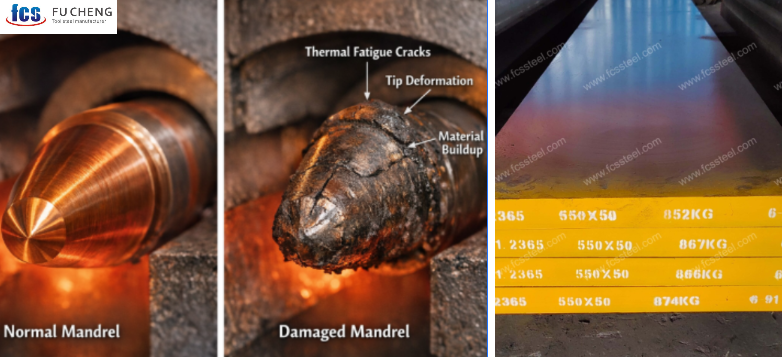
Few tools in metalworking take this kind of abuse. A copper extrusion mandrel faces heat, pressure, thermal shock, and abrasion — all in the same cycle. It has to hold its shape through every single one.
Here’s what that looks like in practice:
- Temperatures at the mandrel tip reach 930–1100°C during full-bonding extrusion cycles. That’s well past the point where standard H13 tool steel starts losing its temper.
- Hydrostatic pressures in the weld zone hit 10 MPa. At the same time, the ram drives hundreds of tons of force through a pierced copper billet.
- The mandrel runs multiple cycles within a single shift — advance, pierce, retract, re-advance. Heat builds at the tip faster than passive cooling can clear it.
The failure modes that follow aren’t random. Thermal fatigue and warping lead the list. A tip that loses hardness starts producing tube walls with uneven thickness. That variation creates scrap. Scrap costs you revenue and pulls the production line down — a line that was never set up to handle either.
Metallurgy of 1.2365 Steel for Extrusion Mandrels
Six elements. That’s what separates a mandrel that survives 50,000 cycles from one that warps by cycle 8,000.
1.2365 steel isn’t complicated by chance. Every number in its composition exists because the copper extrusion environment demanded it. Here’s what the chemistry does when the pressure comes on.
| Element | Content | Role | Effect | Why It Matters for Mandrels |
|---|---|---|---|---|
| Carbon (C) | 0.28–0.35% | Controls hardness, limits coarse carbides | ~50–52 HRC with good toughness | Resists shock during piercing cycles |
| Chromium (Cr) | 2.7–3.2% | Forms Cr-carbides, improves oxidation resistance | Stable at 400–500 °C | Reduces thermal fatigue cracking |
| Molybdenum (Mo) | 2.5–3.0% | Increases hot hardness, refines carbides | Holds hardness near 500 °C | Slows mandrel wear |
| Vanadium (V) | 0.4–0.7% | Forms fine VC carbides | Limits grain growth | Reduces high-temperature creep |
What the Numbers Look Like at Temperature
| Property | Room Temp | At 500°C | At 600°C |
|---|---|---|---|
| Hardness (HRC) | 50–52 | 48–50 | 42–45 |
| Tensile Strength (N/mm²) | 2070 | 1200–1400 | 900–1100 |
| Yield Strength (N/mm²) | 1700 | 1000 | 700 |
| Thermal Conductivity (W/m·K) | 32–33 | 30–31 | 29–30 |
Thermal conductivity in the 30–33 W/m·K range is a real practical edge. Water-cooled mandrel systems can pull heat away from the tip during cycling. Drop below that conductivity level and internal cooling stops delivering returns.
The composition doesn’t just resist heat. It manages it.
Hot Hardness Retention
Room temperature hardness is easy to achieve. Any decent steel can hit 50 HRC sitting on a rack. The real question is what happens to that number once the billet reaches 900°F. That’s what separates a mandrel that runs a full production quarter from one that dies mid-shift.
That’s where 1.2365 steel stands apart.
50–52 HRC at operating temperature is the floor. Drop below that, and a mandrel stops being a precision tool. It becomes a liability. Fall under 35–40 HRC during sustained heat exposure, and the geometry starts to drift. Wall thickness variation follows. Then scrap follows that.
Look at what heat exposure alone does to a steel that can’t hold its temper:
| Exposure at 177°C (350°F) | Yield Strength Loss |
|---|---|
| 1 hour | 5.7% |
| 3 hours | 12.3% |
| 6 hours | 15.2% |
| 8 hours | 18.9% |
That’s a mild temperature by copper extrusion standards. Real process temperatures run much higher. An 8-hour shift at full operating loads gives a softening mandrel no recovery time. None.
So what makes 1.2365 different? Its tempering response works with thermal load, not against it. Heat treatment done right — quench plus two to three tempers, with optional cryogenic treatment — builds compressive stress into the surface layer. That stress blocks crack growth before it starts. Add the fine carbide distribution already in the microstructure, and you get a 59% reduction in surface wear rate compared to standard hot work steel treated the usual way.
Hardness retention isn’t just a material property here. It’s a design outcome. German copper extrusion makers have seen the difference in service life numbers. Those numbers don’t leave much room for debate.
Thermal Fatigue Resistance
Why 1.2365 Performs Better Than H13 in Water-Cooled Mandrels
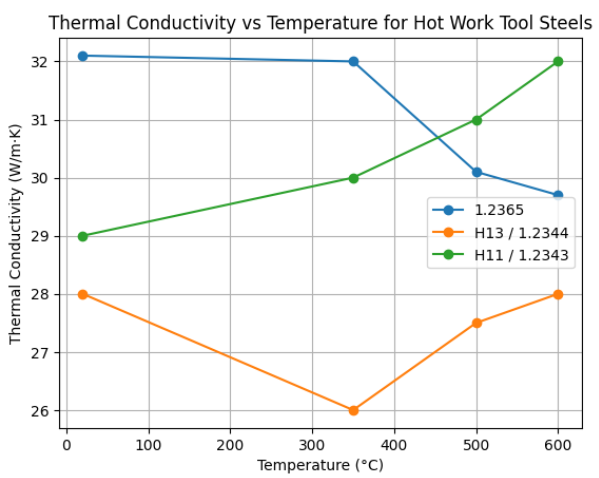
In copper extrusion lines, mandrels face constant thermal cycling: billet contact, rapid cooling, then immediate reheating. Over time, this cycle creates surface stress that leads to heat checking — a spiderweb pattern of cracks.
Compared with H13 steel, 1.2365 handles these cycles far better. Three thermal properties explain the difference.
| Property | 1.2365 | H13 | Why It Matters |
|---|---|---|---|
| Thermal Conductivity (~350 °C) | 32–34.5 W/m·K | ~26 W/m·K | Moves heat faster, reducing hot spots |
| Thermal Expansion (20–200 °C) | 12.5 ×10⁻⁶ m/(m·K) | Slightly higher | Lower expansion stress per cycle |
| Water Cooling Tolerance | High | Moderate | Safer under aggressive cooling systems |
Result:
Better heat transfer, lower thermal expansion stress, and stronger tolerance to water cooling allow 1.2365 mandrels to resist heat checking and survive longer production runs than H13 in high-cycle extrusion presses.
Here’s how the three steels compare directly:
| Steel | Thermal Fatigue Resistance | Water Cooling Tolerance |
|---|---|---|
| 1.2365 | Very high — resists heat checking | Excellent, no cracking risk |
| H13 / 1.2344 | Lower — spiderweb cracks start sooner | Poor, quench-crack risk |
| H11 / 1.2343 | Moderate | Limited |
At 550°C, 1.2365 holds 50 HRC and around 1,650 N/mm² tensile strength. H13 softens across that whole range. The molybdenum content drives this difference — 2.0–3.0% in 1.2365 versus 0.9–1.2% in H13. Higher Mo forms stable carbides. Those carbides resist breaking down under sustained heat. They stay spread out through the steel, not clustered. Spread-out carbides block thermal fatigue cracks from finding a straight path to follow.
The cycle that destroys other tool steels is, for 1.2365, just another shift.
Wear Resistance in Abrasive Copper Alloy
Copper alloys don’t cut steel — but they grind it. Cycle after cycle, without stopping.
That’s the wear problem mandrel materials have to solve. Hot copper under pressure acts like fine abrasive slurry against the tool surface. The steel that survives this environment isn’t the hardest one available. It’s the one with the right carbide distribution — spread across the surface, sized to resist abrasion, and stable under load.
That’s where 1.2365 steel earns its place.
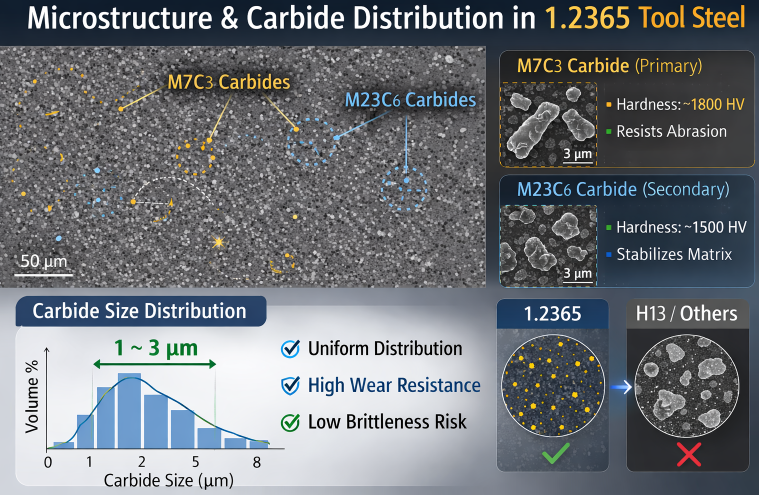
The carbide population in 1.2365 contains both M7C3 and M23C6 types:
- M7C3 carries higher hardness and takes on the primary abrasion load
- M23C6 keeps the matrix balanced — it stops brittleness from building up when carbide volume gets too high
That ratio controls wear rate in copper alloy contact. Raw carbide hardness alone doesn’t.
Now compare that to steels where carbides cluster instead of spread out. Clustered carbides create hard islands sitting in a softer matrix. Abrasive wear targets the soft zones first and removes them. The carbide islands go next. Surface damage builds fast from there.
In 1.2365, molybdenum drives carbide formation at 1–3 µm. That size is small enough to stay spread out across the surface and hard enough to push back against abrasion. The tight spacing blocks wear from cutting a clean path through the steel. The result is a 15–25% lower surface wear rate compared to steels where carbides run two to three times that size.
For mandrels running continuous shifts against copper alloy billets, that wear rate difference shows up as real tool life — more cycles before replacement, less downtime between runs.
Toughness Under Impact
Mandrel fracture isn’t a slow failure. It’s sudden, expensive, and it gives you no warning.
That’s the impact problem. Every pierce cycle delivers a shock load to the mandrel tip. Not gradual pressure — a spike. Steel that can’t absorb that spike doesn’t crack. It fractures. A mandrel that fractures mid-cycle inside a live copper billet causes more than a production stop. That’s the least of what you’re dealing with.
Fine grain structure is what stands between a controlled tool life and a catastrophic one.
Here’s the mechanism. Smaller grains mean more grain boundaries per unit of steel. Each boundary does three things:
- Blocks dislocation movement
- Stops crack propagation
- Breaks up the energy transfer that turns surface stress into a through-fracture
Fine-grained 1.2365 takes a shock load and spreads that energy across thousands of boundaries. It doesn’t follow a straight path to failure.
Vanadium makes this possible. It forms VC carbides at 2–5 nm. Those carbides pin grain boundaries in place under sustained thermal load. No pinning means grains coarsen under heat. Coarser grains mean fewer boundaries. Fewer boundaries mean less resistance to the next impact spike.
The result is a steel that absorbs what the pierce cycle delivers — cycle after cycle — without fracturing.
1.2365 vs. H13/1.2344 vs. W360
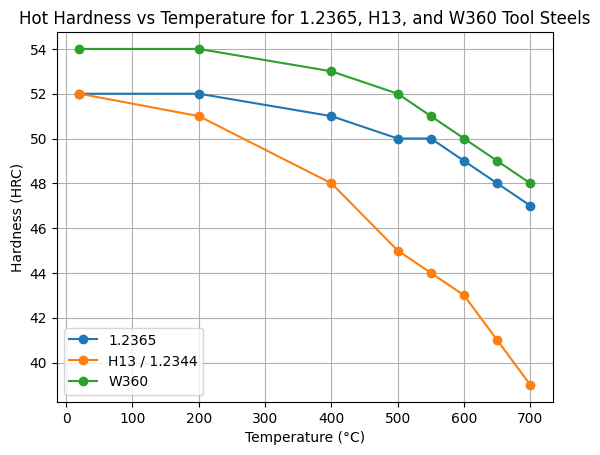
Three steels. One application. The differences are measurable. In copper extrusion, those differences matter.
- H13 tool steel is the standard hot-work tool steel. It is affordable and widely available, commonly used in aluminum extrusion and moderate-temperature tooling. In copper extrusion above 500 °C, however, hardness stability drops faster and thermal fatigue appears earlier.
- 1.2365 tool steel contains higher molybdenum, which improves hot hardness and stability at 500–600 °C. This makes it more reliable for copper extrusion mandrels under repeated thermal cycles.
- W360 tool steel is a premium hot-work steel designed for extreme impact and pressure. It offers excellent toughness but costs more and requires tighter heat-treatment control.
1.2365 lands right between them — and that middle zone is where copper extrusion mandrels actually live.
| Property | 1.2365 | H13 / 1.2344 | W360 |
|---|---|---|---|
| Hot hardness at 500°C | 48–52 HRC | 42–46 HRC | 50–54 HRC |
| Thermal fatigue resistance | Very high | Moderate | High |
| Water cooling tolerance | Excellent | Poor | Good |
| Mo content | 2.5–3.0% | 0.9–1.2% | ~1.5% |
| Carbide distribution | Fine, 1–3 µm | Coarser, 5–10 µm | Fine |
| Sourcing (Germany) | Ready stock | Commodity | Premium lead time |
| Cost position | Mid-range | Low | High |
The table tells a clear story. H13 falls short where it matters most. W360 goes beyond what the job requires — and you pay for that gap. 1.2365 steel for mandrels hits the performance range copper extrusion demands.
No sourcing delays. No price premium. Just the right fit for the job.
German tooling engineers aren’t chasing the best steel on the market. They’re picking the right one for the work.
Heat Treatment Protocol for Copper Extrusion Mandrels
Steel doesn’t leave the mill ready for copper extrusion. The heat treatment shop decides whether that mandrel hits 5,000 cycles or breaks down at 800.
The sequence is precise and unforgiving.
| Process | Temperature | Time / Method | Key Point |
|---|---|---|---|
| Soft Annealing | 750–810 °C | Furnace cool to ≤229 HB | Reduce hardness for machining |
| Stress Relieving | 600–650 °C | 1–6 h | Remove machining stress, prevent quench distortion |
| Preheating | Gradual staged heating | Uniform core temperature | Reduce crack risk |
| Hardening | 1010–1050 °C | ≥1 h per 20 mm thickness | Develop required hardness |
| Quenching | Air quench (standard) | Controlled cooling | Balance hardness and toughness |
| Large Mandrels | Salt bath 500–550 °C | Uniform cooling | Lower cracking risk |
| Tempering | 500–550 °C | Double temper, ~2 h total | Final hardness 50–52 HRC |
What Goes Wrong When the Protocol Gets Cut Short
| Error | What Happens in Service |
|---|---|
| Overheat above 1050°C | Grain growth — gross cracking in the first production cycles |
| Soak under 15 minutes | Soft spots — core cracking under extrusion pressure |
| Single temper only | Retained austenite — quench cracks, dimensional instability |
| Inadequate preheat | Cold cracks post-quench, thermal fatigue sets in fast |
These aren’t edge cases. They’re the failure patterns shops see after someone treated the protocol as optional. 50–52 HRC post-treatment is the benchmark. Hit it with air quench and double temper, and the mandrel is built to run.
German Engineering Standards and the Cultural Preference
- Proven solutions guide tooling choices
In German engineering practice, the idea of Bewährte Lösung means using materials with proven performance in real production, not untested alternatives. - Standards and traceability matter
Tool steels are typically selected according to DIN-aligned specifications and verified material data to ensure predictable performance. - Certification discourages material changes
Industries operating under IATF 16949 or AS9100 avoid unvalidated steels because any change can trigger costly requalification. - Why 1.2365 is widely used
1.2365 is chosen for copper extrusion mandrels because its behavior under heat, pressure, and cyclic loading is already well documented.
Limitations and Where It Falls Short
No material works for every situation. 1.2365 performs well — but only under the conditions it was built for.
Push it beyond those conditions, and the results change fast.
Where 1.2365 runs into trouble:
- Corrosive environments. Cooling water with high chloride content attacks the surface. 1.2365 has no real corrosion resistance. Shops dealing with aggressive water chemistry do better with stainless-grade tooling or dedicated surface coatings.
- Low-volume, low-temperature work. Aluminum extrusion lines running under 450°C don’t need what 1.2365 offers. H13 costs less, machines easier, and handles that duty cycle without issue.
- Machinability constraints. 1.2365 is harder to machine than H13. Complex mandrel geometries with tight tolerances take more time and cost more to produce.
The rule is simple. Your process runs hot, cycles hard, and uses water cooling? 1.2365 belongs in your toolroom. It doesn’t? Pick the steel that fits the job.
Conclusion
Choosing the right steel for copper extrusion mandrels directly affects tool life, dimensional stability, and production cost. H13 remains the economical baseline for many shops, while 1.2365 offers stronger hot-hardness retention for sustained copper extrusion cycles. W360 provides the highest toughness for extreme loads, but its higher cost and stricter heat-treatment requirements mean it is typically reserved for demanding applications.
If you are selecting steel for copper extrusion tooling, focus on operating temperature, cycle frequency, and required tool life — the right material choice will pay back quickly in stability and reduced downtime. For detailed guidance on selecting H13, 1.2365, or W360 for your specific extrusion conditions, consult a tooling specialist before finalizing the material specification.