
A die cracks at 50,000 cycles, and people start pointing fingers. The truth? The alloy chemistry works fine. The melting method causes the real problem.
You need to know the clear differences between ESR and EAF tool steel. This knowledge goes beyond classroom theory. It builds true technical respect on the shop floor. These melting methods act as cheap insurance. They stop sudden, huge failures that halt production lines early Monday morning. You match your mold design directly to the harsh physical stress it faces.
The right choice protects your budget from hidden costs. You avoid:
- Wasting money on scrapped parts.
- Scheduling sudden, costly maintenance.
- Dealing with early tool wear.
These issues drain your profit margins fast. Proper steel selection stops them cold.
What Is EAF (Electric Arc Furnace)
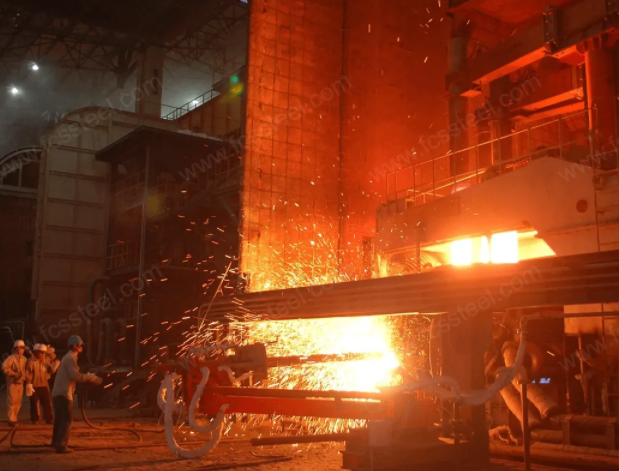
Most tool steel starts its life in an Electric Arc Furnace (EAF). Hitting over 3,000°C, the furnace melts high-quality scrap alongside specific alloys like chromium and molybdenum. But it isn’t just a simple melt. The steel goes through a tight three-step sequence: initial EAF melting, Ladle Furnace refining to lock in your exact chemistry, and Vacuum Degassing to pull out crack-causing hydrogen.
While EAF doesn’t produce the absolute purest metal on earth, it delivers a clean, solid baseline. It’s exactly what you need for most standard hot-work dies, plastic molds, and general tooling applications.
What Is ESR (Electroslag Remelting)
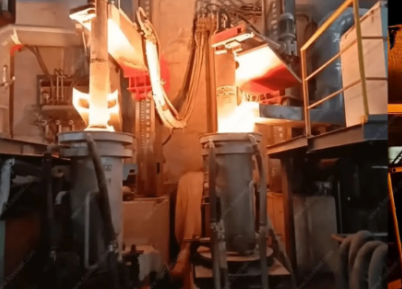
Here is the main difference. EAF melts scrap to make steel. ESR rebuilds that steel. You don’t start from scratch with ESR. Instead, the process takes a solid bar of EAF steel. It melts this bar again, drop by liquid drop. An electrical current heats a slag bath. This heat melts the tip of the steel bar. The drops fall through the slag. The slag works like a sponge. It strips out sulfur. Plus, it soaks up harmful impurities.
The clean metal collects in a water-cooled copper mold. It freezes step-by-step from the bottom up. This steady upward growth prevents center shrinkage. Standard castings often have this shrinkage issue. One catch, though. ESR cannot change your base chemistry. It will not remove hydrogen either. It just serves as a final cleaning step for EAF metal.
Steel Cleanliness & Inclusion Limits
The Baseline: EAF
EAF handles most standard tooling well. Look at the numbers. A good EAF process leaves total oxygen at 15–25 ppm. Average inclusion size sits at 20 µm. The worst cases reach 50 µm. These large 50 µm inclusions cause problems. They start fatigue cracks as cycle counts rise.
The Upgrade: ESR
Put that same steel through an ESR furnace. The numbers change. Oxygen drops to 8–15 ppm. Your average inclusion size drops by half to 10 µm. ESR also clears out 50-80% of the massive inclusions. These are the large pieces that ruin your tooling.
This cleaner metal gives you real strength. You get a 46% boost in room-temperature toughness. Low temperatures show a 30% gain. But watch out. ESR requires strictly controlled slag chemistry to hit these numbers. Poor slag management traps dirt right back into the steel.
Microstructure and Consistency: The Inner Structure
What Happens in EAF
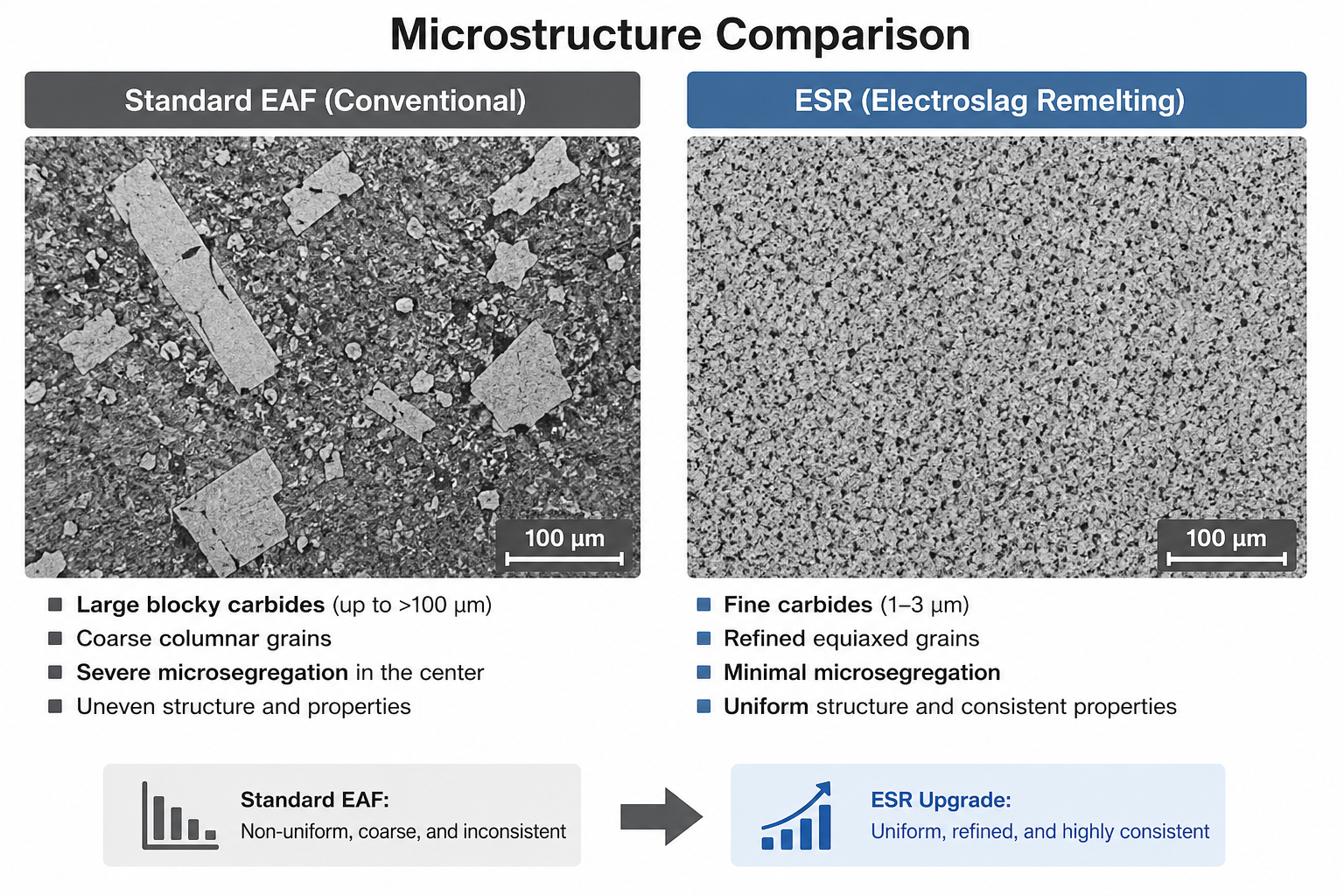
Cleanliness gets the headlines. Microstructure dictates the success of a large die block. EAF cooling is never uniform. Heat escapes the surface fast. The center stays hot for a long time. This slow cooling causes a major issue. Elements like carbon, chromium, and molybdenum pool together in the core.
The result? Massive blocky carbides form at the center. Some of these exceed 100 µm in size. This uneven chemistry ruins heat treatment steps. Look at a thick hot-work block. You see a 3–6 HRC hardness drop. The surface remains hard. The core stays soft.
How ESR Fixes It
ESR uses physics to change the internal structure. Liquid metal freezes from the bottom up in a water-cooled mold. You control the freezing process. Alloys never get the chance to pool. The internal changes alter everything.
Average carbide size shrinks to just 1–3 µm. Those massive 100 µm clusters vanish from the material. You gain two to four times more grains per unit area. The frustrating hardness gap between the surface and the core disappears. This uniform structure keeps the die wear consistent. Predictability skyrockets across your production runs. You cut unexpected fatigue life scatter by up to 50%.
How ESR Changes Microstructure and Consistency
| Structure Metric | Standard EAF | ESR Upgrade |
|---|---|---|
| Macrosegregation Index | 0.3–0.5 | 0.05–0.15 |
| Columnar Grain Width | >10–20 mm | 3–8 mm |
| Average Grain Size | 60–125 µm | 15–45 µm |
| Average Carbide Size | 5–10 µm | 1–3 µm |
| Yield Strength Spread | ±40–60 MPa | ±10–20 MPa |
The takeaway: ESR uses controlled, bottom-up freezing instead of a standard bulk pour. This creates a uniform internal structure. You get half the unexpected fatigue failures. Plus, your die wear stays predictable right from the surface down to the core.
Mechanical Performance
Tooling fails in the real world for three main reasons. A die snaps under an unexpected heavy load. A mold cracks after millions of running cycles. The surface erodes away over time. Look at specific metrics. You can see what that extra ESR price premium buys you on the shop floor.
1. Toughness: Surviving the Impact
Your die must absorb energy without snapping. This matters most in unpredictable environments.
The EAF Baseline: Standard H13 offers 20–35 Joules of impact strength at room temperature. Drop that down to cold conditions (−40°C). The strength falls to 10–15 J. Standard EAF metal is directional. Its transverse strength is half (40–60%) of its longitudinal strength.
The ESR Upgrade: Room temperature impact jumps to 35–55 Joules. This gives you a solid 40–80% improvement. You maintain 20–30 J even in freezing temperatures. The biggest win? Transverse strength equalizes to 70–90% of the longitudinal value. This makes the block tough from every angle.
2. Fatigue Life: Outlasting High Cycles
You need a mold to run day and night. Fatigue limits decide your maintenance schedule.
The EAF Baseline: High-cycle fatigue caps out at 450–550 MPa. Standard melting leaves internal dirt and inclusions. These cause over 80% of fatigue cracks. Your rolling contact life here is just the 1.0x standard baseline.
The ESR Upgrade: Cleaner steel pushes the fatigue limit up to 600–750 MPa. Massive inclusions are gone. Failures from internal dirt drop below 50%. Your parts get a rolling contact life running 1.5 to 3 times longer.
3. Wear Resistance: Holding the Shape
Tool wear goes beyond overall hardness. Consistency across massive steel blocks plays a bigger role.
The EAF Baseline: You heat treat a large section. The hardness drifts by ±2–3 HRC. Things get messy at a microscopic level. The local microhardness spread exceeds 100 HV0.5.
The ESR Upgrade: Uniform freezing guarantees consistency. Hardness variation tightens to ±1–1.5 HRC across large blocks. Local microhardness spread shrinks to 50–70 HV0.5. You lose 15% to 40% less material in dry sliding tests compared to the baseline.
Alloy Retention: What Burns Off and Why It Matters
You pay real money for custom chemistry. Do not let uncontrolled melting burn it off before the steel even cools. Here is exactly what gets lost during production and how those missing elements ruin your die blocks:
| Process Stage | What Gets Lost (Oxidation) | The Real-World Penalty | The Mill’s Required Fix |
|---|---|---|---|
| 1. Standard EAF | Si (10–30%), Mn (10–25%), Cr (5–15%), V (5–20%) |
Shallow Hardening: Losing just 1% Chrome shrinks a large block’s hardened core by 10–15%. | Carburizing Slag: Cuts oxidation drastically, pushing Chrome and Molybdenum recovery past 90%. |
| 2. Open-Air ESR | Additional losses: Ti (5–15%), V (3–8%) |
Poor Hot Wear: A tiny 0.2% Vanadium drop causes a 1 HRC loss in critical red hardness. | Argon-Shielded ESR: Blocks out shop air, raising target chemistry hit rates to a solid 95%. |
3. Why Variance Is Not a Rounding Error
Alloy loss isn’t just a technical footnote; it is a measurable degradation of tool performance:
| Element | Loss Scenario | Performance Impact |
| Vanadium (V) | -0.2% variance | 1 HRC drop in red hardness; reduced tool edge life. |
| Molybdenum (Mo) | -0.3 to -0.5% | Secondary hardening peak shifts; requires re-tempering or acceptance of shortfall. |
| Chromium (Cr) | -0.3 to -0.5% | 10–15% drop in critical quench diameter; shallow hardening in large dies. |
The takeaway for tool steel melting method selection is clear: the EAF–ESR sequence delivers its full metallurgical potential only with active alloy retention management — reducing slag chemistry upstream, plus tight atmospheric control during remelting.
Cost Breakdown
You usually see a 30% to 50% price jump for ESR tool steel. Where does that extra money actually go? The base alloy costs exactly the same. You are strictly paying for the intense secondary processing. Here is the realistic numerical breakdown per ton:
| Cost Area | Standard EAF | ESR Premium |
|---|---|---|
| Raw Materials | Base market price (e.g., $2.50/kg) | $2.50/kg. You just melt the exact same EAF bar again. |
| Energy Use | ~400–500 kWh per ton | ~1,200–1,500 kWh per ton. The power bill roughly triples. |
| Refining Slags | Cheap basic fluxes (< 3% of cost) | High-purity fluorite slags add 10–15% to the processing bill. |
| Time & Labor | 4–6 hours per batch | 24–72 hours to freeze the ingot. Furnace time costs skyrocket. |
You aren’t buying more expensive chrome or molybdenum with ESR. You are literally buying extreme electricity consumption and days of carefully supervised cooling.
EAF Tool Steel: Applications and Scenarios
Not every tool steel problem needs the cleanest possible melt. EAF tool steel dominates the market for a reason. Most tooling applications don’t need inclusion counts below 10 ppm or fatigue limits pushed past 700 MPa. What they actually need is adequate hardness, reliable wear resistance, and a purchase order that doesn’t blow the project budget.
EAF is the straightforward answer for these applications:
- General stamping and blanking dies — running at room temperature, moderate cycle counts, standard sheet material. A grade hitting 58–64 HRC after heat treatment gets the job done.
- Standard injection mold components — cores, cavities, and wear inserts that require dimensional stability and abrasion resistance. Mirror-finish cleanliness or extreme fatigue endurance? Not a priority here.
- High-volume small cutting tools — drills, punches, blades, and form tools where unit cost matters as much as unit life.
ESR Tool Steel: High-Stakes Applications That Justify the Premium
Specifying ESR isn’t a metallurgical preference — it’s a risk calculation. Tool failure costs 5–10 times the steel price. At that point, the premium stops being a budget line. It becomes insurance.
Three hard thresholds trigger the switch:
- Failure cost > 5–10× steel price — large HPDC dies, aerospace forging tools, nuclear components where unscheduled downtime runs $100k–$1M per incident
- Section size ≥ 400–600 mm — H13, P20, NAK80, XPM tool steel: anything thicker needs ESR to hold centerline integrity
- Thermal cycle count > 10⁵–10⁶ — die casting, hot forging, any regime where heat checking leads to scrap
Applications Where ESR Is Non-Negotiable
- Large HPDC dies: Prevents premature cracking in expensive, high-volume molds.
- Aerospace forging dies: Strict industry specs demand it for titanium parts.
- High-gloss plastic molds: Guarantees a flawless, pinhole-free mirror finish.
- Critical bearing steels: Essential to survive extreme fatigue in wind and nuclear power.
How to Specify and Verify True ESR
- Spell it out on the PO: Write down “H13 ESR”, never just “H13”.
- Check the paperwork: The mill test report must explicitly state “EAF + ESR” melting.
- Lock down cleanliness: Demand sulfur ≤ 0.008 wt% and strict ASTM E45/ISO 4967 ratings.
- Enforce toughness ratios: On large blocks, require transverse impact strength to hit at least 70–80% of the longitudinal value.
Final Thoughts:
The choice between EAF and ESR goes beyond basic science. This decision dictates if your die hits its target cycles. Or worse, it causes a total failure right before the weekend. EAF handles regular, daily tooling well. Plus, it keeps your budget intact. Certain jobs demand extreme fatigue resistance. You might also need a steady grain structure. ESR justifies its higher price tag for these strict needs. It pays for itself in long-term reliability.
You can catch a simple spec error fast. This prevents a six-figure production disaster down the road.
Your next move: Pull the maintenance logs on your toughest tooling job right now. Are unexpected fatigue cracks slowing you down? Maybe early wear is tanking your profit margins.Stop paying for constant tool replacements. Match your steel making process to your exact job requirements. Contact us today. You can update that next purchase order with total confidence.