
Every tool that cuts, forms, or shapes another material depends on steel built — at the molecular level — to handle extreme conditions. That steel doesn’t happen by accident. It goes through a carefully controlled production chain, and each stage shapes the final result.
Understanding the manufacturing process of tool steel isn’t just theory. It’s what separates a confident grade selection from a costly procurement mistake.
Each step matters. From the first melt chemistry to the final temper, every production stage leaves its mark on the steel’s properties. You can trace a material’s strength, hardness, and wear resistance back to specific decisions made during manufacturing.
This guide covers the full production chain:
- Primary melting — where the base chemistry begins
- Secondary refining — removing impurities and tightening composition
- Casting — solidifying the alloy into usable form
- Hot work — shaping the steel under heat and pressure
- Heat treatment — locking in the final mechanical properties
Follow the chain, and you’ll see how raw alloy becomes a material precise enough to outlast the work it performs.
What Is Tool Steel
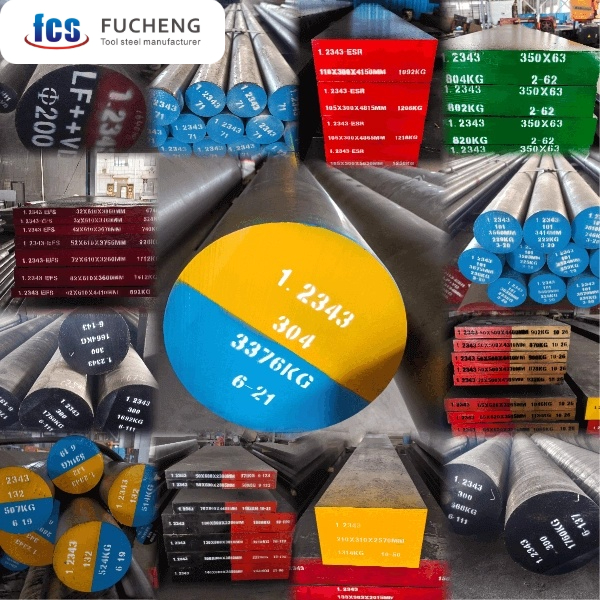
Tool steel is iron built with a specific chemical recipe: 0.5–1.5% carbon, plus chromium, tungsten, molybdenum, and vanadium — each element added to do a particular job.
That composition is not decorative. Carbon drives hardness. Carbide-forming elements — Cr, Mo, W, and V — create hard particles that resist wear and hold their edge under heat. Nickel and cobalt reinforce high-temperature strength where softer steels would fail.
The relationships are direct and unforgiving:
- More carbon → higher hardness, better wear resistance, but less toughness and zero weldability above ~1.0% C
- High Cr + V → dense carbide networks → extreme abrasion resistance (think D2)
- High W/Mo → carbides stable at red heat → high-speed cutting grades like M2
- Low Mn → reduced quench-cracking risk
Composition also controls grade classification. W-series steels are water-hardened, high-carbon, and low-alloy. H-series steels carry heavy Cr/Mo/W loads for hot-work service. High-speed grades push W/Mo combined to 6–18%, so cutting edges stay hard past 540°C.
Get the composition wrong, and heat treatment can’t fix it. The chemistry has to match the job. Nothing else works until that part is right.
1. Primary Melting: Setting the Base Chemistry
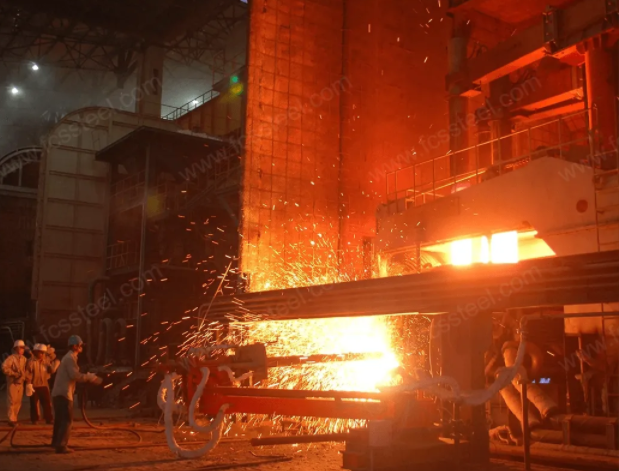
The Electric Arc Furnace (EAF) sets tool steel’s foundational chemistry. You simply cannot fix bad melting downstream.
The process converts carefully selected scrap and ferroalloys into liquid steel at 1,600–1,700°C. Scrap selection isn’t just purchasing; it’s strict metallurgy. Contaminants like copper and tin will never oxidize out. If they enter the furnace, they stay in and ruin the entire batch.
During the rapid melt cycle, operators inject the first round of carbide-forming elements like Cr, Mo, and W to build the base recipe. The EAF’s sole job is raw conversion. It aggressively turns a solid scrap pile into a stable liquid alloy, priming it for the precision of secondary refining.
2. Secondary Refining: Hitting Cleanliness Targets
Raw steel right out of the EAF is simply too dirty for tools. The oxygen is too high, and the inclusions are jagged. Secondary refining steps in to fix this. It is exactly where the gap between standard metal and premium tool steel gets created.
- Ladle Refining: Argon gas actively stirs the liquid pool. At the same time, a tailored slag acts almost like a sponge, pulling out hard aluminum oxide inclusions.
- Calcium Treatment: Sharp inclusions cause stress cracks. They also ruin polished surfaces. Injecting calcium wire reshapes them into soft, round particles that survive heavy loads.
- Vacuum Degassing: Hydrogen is a known threat in thick steel, often causing delayed cracks. Deep vacuum treatment sucks it out.
You can see the dramatic shift in quality right here:
| Parameter | Conventional | Premium (ESR/VAR feed) |
|---|---|---|
| Total oxygen | 15–25 ppm | ≤ 5–10 ppm |
| Max inclusion size | 20–30 μm | < 10–15 μm |
| Hydrogen | 2–3 ppm | ≤ 1.5–2 ppm |
| Sulfur | ≤ 0.015% | ≤ 0.005% |
3. Casting: From Liquid to Solid Structure
Refined liquid steel shrinks by 6–8% as it solidifies. You must manage this volume drop. Your chosen casting method does more than form a shape. It builds the core grain structure. This basic layout affects all future forging and heat treatments.
Here is your direct decision guide for casting tool steel:
| Casting Method | Best Used For | Main Strength |
|---|---|---|
| Continuous | Standard slabs and metal bars | The global standard choice. It gives you maximum efficiency for large volumes. |
| Sand | Huge parts (up to 100+ tonnes) | Supports extreme weights. Slow cooling does create large metal grains. |
| Investment | Surgical tools and precise valves | Forms tricky shapes and thin 2–3 mm walls. You skip extra machining. |
| Centrifugal | Round parts and rings | Spinning pushes flaws to the center. You remove these defects easily. |
4. Advanced Remelting: ESR and VAR Framework
Standard air-melted steel breaks under extreme conditions. You must remelt it to remove microscopic flaws. Here is exactly what these processes do and how to pick the right one.
What They Are
ESR (Electroslag Remelting) ➔ Melts steel continuously through a reactive chemical slag pool.
The Goal: It filters inclusions evenly, creating consistent, uniform strength across massive parts like heavy die blocks.
VAR (Vacuum Arc Remelting) ➔ Melts a steel electrode directly under a total vacuum.
The Goal: It aggressively pulls out trapped gases (H, O, N) to reach absolute maximum cleanliness.
The Decision Framework
Match the process to the exact way your part might fail in service:
Need consistent properties across huge sections? ➔ Choose ESR.
Need the absolute lowest gas and inclusion levels? ➔ Choose VAR (Note: You must machine off the rough outer crust afterward).
Can’t afford a single defect? ➔ Choose VIM ➔ ESR ➔ VAR. Sequential melting costs a fortune, but surgical implants and jet engine disks demand it.
5. Hot Working: Rebuilding the Cast Structure
Raw cast steel contains coarse grains and empty voids. Hot working tears this weak foundation apart and rebuilds it using intense heat and mechanical pressure.
The Core Process Flow:
- Reheat: Bring the section to 1,150–1,230°C so it safely recrystallizes instead of cracking.
- Step-Forge: Hit it from multiple directions, keeping reduction strictly to 10–30% per pass to avoid internal tears.
- Crush the Voids: Push the cumulative area reduction past 60–80%. This physically closes centerline shrinkage.
- Hot Roll: Align the fresh grain flow with the final product shape.
The Structural Impact:
Massive, fragile cast grains shatter into a tight, fine structure (under 100µm). Porosity practically vanishes. As a result, the forged steel gains up to 60% more fatigue strength and triples its impact toughness.
6. Annealing Setup: Prep Your Steel for Machining
Raw hot-worked steel ruins your cutting tools quickly. You have a simple goal right now. Drop the steel hardness below 25 HRC. This speeds up your machine feeds. Plus, it slashes your major tooling costs.
Follow this exact cycle to get a highly machinable structure:
Step 1: Normalize (Heavy forgings) ➔ Heat to 850–900°C ➔ Air cool (This clears out interior forging stress)
Step 2: Anneal Soak ➔ Heat the entire piece to 870–900°C ➔ Soak 2 hours per 25mm of thickness
Step 3: Fast-Track Cool ➔ Cool at 100°F/hr down to 1,000°F ➔ Air cool to room temp (This cuts a slow 24-hour cycle down to just 8 hours. Never halt the slow-cool above 1,200°F)
Step 4: Surface Prep ➔ Mill off 0.25–0.5 mm per face to clear scale and decarb
Step 5: QC Release ➔ Check for ≤ 25 HRC. Verify zero martensite remains.
7. Hardening and Tempering: Setting Final Properties
Annealed steel stays soft on purpose. The final heating stage locks in the rigid working hardness. This specific step gives tool steel manufacturing its true strength.
- Austenitize: Heat carbon grades to 750–900°C. Alloy steels need 800–1,100°C. This high heat melts carbides directly into the main steel structure.
- Quench: Fast cooling locks the structure. Water provides maximum hardness. But water also creates a high cracking risk. Oil remains the standard choice. Air cooling works as the safest method. Hardness hits a peak near 60–65 HRC right after this step.
- Temper: Quenched metal is very brittle. You must reheat the metal to reduce this brittleness. Heat the parts for 1 hour for every 25mm of thickness. High-speed grades need 2 or 3 full heating cycles. Always cool your materials in still air.
Your choice of tempering temperature changes the final working properties.
| Temper Range | Hardness | Best Used For |
|---|---|---|
| 160–300°C | ~60 HRC | Cutting edges, stamping dies |
| 300–500°C | ~45 HRC | Tough springs, automotive parts |
| 500–650°C | 32–45 HRC | Hot-work tooling, structural components |
Conclusion: Ask your supplier about their protective gas methods to stop surface damage. Demand they finish all tempering cycles before the final grinding phase. This firm rule prevents heat burns and unexpected size shifts in your finished parts.
8. Tool Steel Process Differences
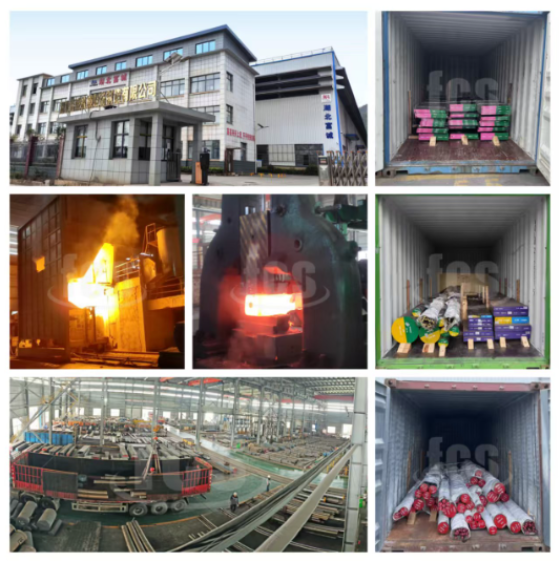
A tool steel category acts as a strict manufacturing blueprint. It is more than just a label.
The melting method and heat treatment shift based on the steel’s daily use. Different jobs require different limits. Check out your core production matrix below.
| Grade | Austenitize (°C) | Quench | Final HRC | Critical Process Rule |
|---|---|---|---|---|
| W-Series | 760–820 | Water | ~60 | This hardens shallow. You face a high risk of cracks and shape changes. |
| O-Series | 790–840 | Oil | 58–62 | This gives you a safer quench. It works well for sections up to ~75 mm. |
| A/D-Series | 950–1,050 | Air | 60–64 | Size shifts very little (±0.05%). Pick this grade for complex dies. |
| S-Series | 900–950 | Oil/Air | 50–58 | Double-temper this steel every time. This creates high impact toughness. |
| H-Series | Varies | Air/Oil | 44–52 | Use the ESR route and heavy forging. You need this step to stop heat cracks. |
| High-Speed | 1,180–1,230 | Vacuum | 64–66 | You must run three separate tempers. Do not skip a single one. |
Conclusion
Every tool steel you’ve ever held passed through the same sequence — primary melting, secondary refining, casting, hot work, annealing, hardening. Each stage removes imperfection and builds in performance. Nothing is skipped. Nothing is accidental.
Understanding the manufacturing process of tool steel explained at this level changes how you specify, source, and troubleshoot. Steel stops looking like a commodity. You start seeing it as the result of dozens of critical decisions — all made long before it reached your machine shop.
Here’s what matters most: process route is the product. An ESR-refined cold work die steel and a standard electric arc furnace grade aren’t just different specs. They’re different objects entirely — with different strengths, different weak points, and different failure modes under pressure.
So put this knowledge to use:
- Review your current tool steel specs against what the application actually demands
- Ask your supplier which manufacturing route their material follows
- Compare grades by process, not just by chemistry or hardness rating
The right process, matched to the right application, is where tool life stops being a complaint and starts being a competitive advantage.