
Every tool steel grade starts as a promise — a specific mix of alloying elements chosen to survive conditions that would destroy ordinary steel. But knowing which elements do what, and why certain combinations outperform others, separates engineers who guess from engineers who specify with confidence.
How alloying elements affect tool steel performance isn’t just metallurgical trivia. It’s the difference between a die that lasts 200,000 cycles and one that fails at 40,000. That gap comes down to chemistry.
So what drives those results? From the foundational role of carbon to the red-hardness partnership between vanadium and tungsten, what follows is a practical breakdown of the chemistry that drives real tool steel behavior.

What Is Tool Steel and Why Alloying Elements Matter
Tool steel is a high-carbon alloy steel. Carbon content runs between 0.5% to 1.5%, depending on the grade. It’s built for the hard demands of cutting, forming, stamping, and shearing.
What sets it apart from structural steel goes beyond hardness. You need a balanced mix of hardness, wear resistance, toughness, and heat resistance — all at once. Ordinary steel can’t hold all four of those properties together.
The alloy package controls everything. Four elements do the real work:
-
Chromium — builds hardness and wear resistance through carbide formation
-
Vanadium — refines the carbide structure and pushes wear resistance higher
-
Molybdenum — keeps steel hard under heat and stabilizes carbides under thermal stress
-
Tungsten — holds the cutting edge together at high temperatures
These elements do two key things. First, they raise hardenability. Second, they form carbides that are harder and more heat-stable than standard cementite. The exact mix — and how concentrated it is — decides everything that follows during heat treatment.
That’s the lever. Change the combination, and you get a completely different tool steel.
Carbon (C): The Foundation of Hardness and Strength
Carbon is the absolute foundation of tool steel. Add more, and the metal gets harder and stronger, but also less forgiving. It sets the baseline that all other alloying elements build upon.
If you don’t have enough carbon, heat treatment simply won’t work—the steel won’t harden properly. However, pushing levels too high creates a different problem. It drastically increases the risk of the steel cracking during quenching or snapping under heavy impact. This is why the carbon level exactly dictates the tool’s primary job.
For instance, shock-resisting grades like S7 keep carbon moderate to survive heavy hits without shattering. On the flip side, tools built for extreme wear resistance, like D2 punch dies, push carbon much higher to hold their edge. Ultimately, carbon sets the maximum hardness ceiling. Get it right, and the rest of your chemistry falls into place.
Chromium (Cr): Wear Resistance, Hardenability, and Corrosion Defense
Chromium is the ultimate multitasker in tool steel chemistry, managing three critical jobs at once: wear resistance, deep hardenability, and corrosion defense.
First, it forms incredibly hard carbides. When a tool is working under heavy load, these carbides act like a tough microscopic shield, taking the friction so the softer base steel doesn’t wear simply away. Second, chromium ensures that thick tools harden all the way to their core, not just on the surface. This is exactly why heavy-duty cold-work steels like D2 rely on high chromium levels to maintain consistent hardness throughout massive shear blades and dies.
Finally, chromium creates a self-healing oxide film that blocks rust and chemical attacks. Push the chromium levels high enough, and you get stainless mold steels like 420 or 440C. These grades are absolute lifesavers when you need to mold corrosive plastics or operate in wet, harsh environments. Simply put, chromium is the single element that extends a tool’s lifespan across multiple different battlefronts.
Molybdenum (Mo): Toughness Booster and Secondary Hardening Agent
Molybdenum delivers a rare benefit in tool steel chemistry. You get a metal that is tougher and harder at the same time. You avoid the usual compromises.
Secondary hardening stands out as its best feature. High heat ruins the strength of most alloys. Molybdenum holds its ground. The steel stays hard at high temperatures. Take high-speed cutting tools like the M-series (such as M2). They need this exact stability so they keep a sharp edge against intense friction.
Deep hardenability is another core benefit. Think of massive steel blocks like large plastic mold bases. The metal hardens from the surface all the way to the core. Molybdenum refines the internal grain structure. Finer grains stop cracks from impact. Adding molybdenum gives you top-tier toughness and heat resistance in one package.
Vanadium (V) and Tungsten (W): The Red Hardness Duo
Red hardness is a specific, measurable thing. It’s the ability to hold hardness above 500–600°C — the temperature range where most tool steels start losing their grip. Vanadium and tungsten are the two elements that protect that grip better than anything else in the alloy toolkit.
Their mechanisms differ. But the two work together.
Vanadium: Fine Carbides With a Toughness Ceiling
Vanadium builds strength through precipitation. Fine V(C,N) carbides form during tempering. They stay stable at service temperatures. That carbide stability is the core value of vanadium in red-hardness applications — not raw hardness, but hardness kept under heat.
The data from 2.25Cr–2W–0.1C steel shows the tradeoff clearly. Raising vanadium from 0.10 to 0.50 wt% pushed yield strength up by ~20%. Go past 0.5 wt%, and the strength gains level off. At the same time, the ductile-brittle transition temperature (DBTT) rises fast. The steel gets stronger and more brittle together.
The sweet spot is ~0.25 wt% V. That’s where strength and impact toughness both peak in this system.
Tungsten: Holding the Edge at Extreme Heat
Tungsten handles the high-temperature load. In M2 high-speed steel — 6.0 wt% W, 1.9–2.1 wt% V, 4.0 Cr, ~0.85 C — this combination holds hardness above 60 HRC at 600°C. That’s the industry benchmark for cutting tool red hardness.
In W-based structural alloys, the numbers go further. W–2V–0.5Y₂O₃ hits a microhardness of ~12 GPa — about 3× pure tungsten — with a peak flexural strength of ~1 GPa at 1273 K. Y₂O₃ pins the grain structure and blocks recrystallization above 1000°C.
The rule is straightforward: for maximum hot-strength, W–2V outperforms W–4V at the peak. More vanadium doesn’t add more strength at that temperature. It only raises embrittlement risk.
Nickel, Manganese, and Silicon: The Crucial Supporting Cast
Let’s be honest, elements like nickel, manganese, and silicon rarely get the spotlight in tool steel specs. But they carry real weight. Nickel gives you a rare combination: it boosts toughness without destroying hardness. You see this clearly in 304 or 316 stainless grades, where it keeps the metal stable while fighting off rust. Manganese is basically your budget-friendly hardening booster. It ensures thicker tools harden straight to the core and keeps harmful sulfur in check. Then there is silicon. Think of it as the ultimate cleaner. It deoxidizes the melt, pulling out hidden impurities before the steel even solidifies, while adding flexibility to spring steels. They might look like minor details on a datasheet. But leave them out? Your tool will likely warp, crack, or just fall apart completely under pressure.
Manganese (Mn): Hardenability on a Budget
Manganese is the most cost-efficient hardenability booster in tool steel chemistry. It lowers the critical cooling rate for martensite formation better than most other common additions — and it does it at low cost.
Standard structural and low-alloy steels run 0.30–1.65% Mn. Quenched-and-tempered grades target 0.70–1.40% for reliable through-hardening. The effect is well-documented: raising Mn from 0.5% to ~1.4% in medium-carbon steels can push through-hardenable section size from surface-only hardening up to 50–75 mm. That’s a major shift driven by a single composition change.
Manganese also speeds up carbon penetration during carburizing. You get faster case depth development at the same cycle time. In production environments, that’s a direct throughput gain.
Its sulfur-control role matters too. Manganese binds sulfur as MnS inclusions, neutralizing the hot-shortness risk from FeS formation at grain boundaries. Free-machining steels use this by design — sulfur gets raised to 0.15–0.35%, with Mn pushed above 1.20% to keep sulfur distributed in a safe, controlled form.
One hard limit to know: in Ni-base superalloys, manganese is a harmful impurity, not a design element. It migrates to grain boundaries, drives damaging phase precipitation, and cuts long-term durability. Vacuum-melted superalloys target Mn in the 0.01–0.10% range for exactly this reason. The same element that strengthens tool steel becomes a problem in high-temperature superalloy applications.
Silicon (Si): Cleanliness, Strength, and a Few Sharp Limits
Silicon earns its place in the melt before the steel even solidifies. As one of the main deoxidizers in steelmaking, additions of 0.15–0.35% Si cut blowholes and inclusions — and that improves fatigue life in high-performance tooling. Silicon also acts as a degasifier, pulling dissolved oxygen and nitrogen out of the melt before they cause microstructural damage.
On the mechanical side, Si raises strength and hardness, though less sharply than manganese. Spring steels push Si to 1.5–2.5% for high strength and temper resistance. At that range, silicon’s solid-solution strengthening effect becomes prominent.
At high temperatures, silicon improves oxidation resistance in stainless and heat-resistant grades. Si-rich stainless steels reach 2–3.5% Si to protect surfaces in demanding heat service.
Two limits matter in practical design:
-
Welding: Si above ~0.30% raises hot cracking risk if carbon is also elevated. For best weldability in resulfurized low-carbon grades, target Si ≤0.10%. You can accept up to 0.30% — but only with tight S and C control, plus proper preheat and post-heat protocols.
-
Hot-dip galvanizing: Si above ~0.04% triggers strong Fe–Zn reactions, producing thicker, darker, rougher coatings. Corrosion protection stays comparable — zinc mass per area is similar — but appearance and coating control suffer. For bright, uniform galvanized finishes, keep Si below 0.03–0.04% and watch phosphorus levels too.
Putting All Three Together
These three elements rarely act alone in a specification. They balance against each other and against the primary alloying package.
A practical framework for high-strength weldable structural steel:
– C: 0.08–0.20% — controls weldability
– Mn: 0.8–1.5% — secures hardenability and tensile strength
– Si: 0.15–0.35% — deoxidizes, adds moderate strength; don’t exceed 0.35% where weldability and surface finish are critical
– Ni: up to 1–2% — adds low-temperature toughness and corrosion resistance
None of these elements stand out in a datasheet. But the steel that holds at 200,000 cycles — versus the one that fails at 40,000 — often comes down to whether these three were dialed in right. Supporting roles. Real consequences.
How Alloying Elements Interact: Synergy vs. Trade-offs
Single-element thinking gets you partway there. The real difference — the gap between a die that survives 200,000 cycles and one that fails — comes from understanding how elements work together. And how they work against each other.
Elements don’t always cooperate. Sometimes two elements boost each other’s strengths. Sometimes pushing one element higher triggers a failure you never expected. Both outcomes are predictable. Neither is random.
When Elements Amplify Each Other
Alloying elements work best as a team. You get better tool steel performance with these top combinations:
-
Carbon + Microalloys (Ti/Nb/V): This mix offers high strength. Also, your tool avoids brittleness completely.
-
Manganese + Carbon: You gain a huge boost to raw strength and flex. This pushes the steel right past normal limits.
-
Chromium + Nickel + Molybdenum: This combo fights off rust well. It keeps impact toughness strong at the same time.
-
Ti + Nb + V: These elements build serious strength together. The particles just need to stay tiny.
Where the Chemistry Turns Against You
Every synergy has a breaking point. Knowing where that point sits matters just as much as knowing the benefit.
Mn above 25–30 wt%, combined with high carbon, causes centerline segregation and cracking during casting. Weldability drops fast. Industrial TWIP steels stay below that limit by design — not because higher Mn wouldn’t add strength, but because the downstream penalties aren’t worth it.
Cr above 25 wt% in Fe-Cr alloys triggers σ-phase embrittlement at 600–900°C. That’s a defined temperature window. Tooling that stays below it may never see the problem. Tooling that cycles through it over and over will.
Mo above 4–5 wt% raises pitting resistance — a real benefit. It also raises segregation risk and promotes harmful intermetallic phases. The gain is real. So is the ceiling.
Microalloying has the same hard limit. Total additions of Ti + Nb + V exceeding 0.15–0.20 wt%, or poor thermomechanical control during processing, produce coarse carbides and nitrides. Weld heat-affected zones turn into embrittlement zones.
The Design Principle
The pattern across all these interactions is the same. Synergy is concentration-dependent. Below the threshold, elements work together. Past it, one or both flip into a destructive mode.
The takeaway for anyone specifying tool steel: don’t optimize a single element in isolation. The element that gives you 50 HRC at 0.5 wt% may cause cracking at 0.9 wt% — not because the element itself changed, but because the system around it did. Chemistry is relational. The alloy that performs is the one whose interactions were planned, not guessed.
Alloying Strategies by Tool Steel Category
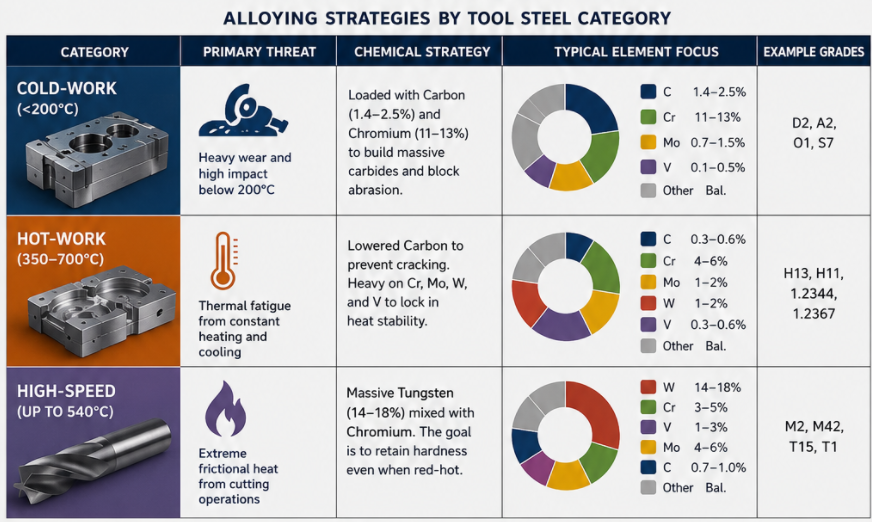
The shop floor environment dictates the chemistry. You can’t just guess. Here is how the three main groupings handle different threats:
|
Category |
Primary Threat |
Chemical Strategy |
|---|---|---|
|
Cold-Work |
Heavy wear and high impact below 200°C. |
Loaded with Carbon (1.4–2.5%) and Chromium (11–13%) to build massive carbides and block abrasion. |
|
Hot-Work |
Thermal fatigue from constant heating (350–700°C) and cooling. |
Lowered Carbon to prevent cracking. Heavy on Cr, Mo, W, and V to lock in heat stability. |
|
High-Speed |
Extreme frictional heat from cutting work (up to 540°C). |
Massive Tungsten (14–18%) mixed with Chromium. The whole point is keeping the edge hard when glowing hot. |
Quick selection logic:
|
Service Condition |
Alloy Priority |
|---|---|
|
Abrasion at room/low temperature |
High-carbon + Cr/Mo/W cold-work chemistry |
|
Repeated heating/cooling, hot metal contact |
Cr–Mo–W–V hot-work balance |
|
High cutting speed, frictional heat |
High W/Cr + carbide formers (HSS) |
The category doesn’t just label the application. It defines the full chemical design philosophy behind the steel.
Choosing the Right Alloying Profile for Your Application
The chemistry decisions made before a die touches metal will determine everything. Does that die outlast its expected lifecycle? Or does it get pulled from production too soon? Picking the right alloying profile isn’t guesswork. It’s a structured process with a clear sequence.
Start with the operating envelope. Define load types, strength targets, temperature range, corrosion exposure, and design life first — before you look at a single grade. Every step after this depends on those constraints being honest and specific.
From there, work through the decision in order:
-
Match process to geometry — extrusion, casting, forging, or plate machining each limits which alloys are viable
-
Rank 4–6 key properties — strength, wear resistance, toughness, weldability, surface finish, cost — and weight each one
-
Score 3–5 candidate grades against those properties using actual datasheet numbers
-
Eliminate hard failures — any grade that misses a non-negotiable requirement comes off the list. No exceptions.
-
Check secondary operations — heat-treat sequence, machinability, coating compatibility
-
Verify against standards — ASTM, EN, and ISO alloy tables confirm what datasheets summarize
Then test. Order trial material. Measure actual mechanicals. Validate under your real process window before you commit to production volume.
The alloy that holds up at 200,000 cycles isn’t the one with the most impressive single-property number. It’s the one whose full profile lines up with the full demand.
Conclusion
Every alloy addition involves a trade-off. You’re balancing hardness against toughness, wear resistance against machinability, heat stability against cost. Knowing how alloying elements affect tool steel performance isn’t just background knowledge. It’s what separates a tool that lasts a full production run from one that fails halfway through.
There’s no universal “best” composition — that’s the core takeaway. Carbon sets the hardness ceiling. Chromium and molybdenum build durability. Vanadium and tungsten keep everything stable under extreme heat. But none of these elements work alone. Their real strength comes from how they interact with each other.
So ask the right question before your next material selection: What does this tool need to survive?
Match the alloying profile to the application — not the other way around. That one shift in thinking puts better tools in your hands, every time.