
Introduction: The Substitution Trap
Swapping tool steel for alloy steel looks like a clear win on paper — lower material costs, easier sourcing, near-identical appearance on the shelf. But industrial tooling doesn’t fail on paper.
The real question isn’t whether alloy steel can replace tool steel. It’s whether that substitution sets you up for a catastrophic production halt six months later. The cost savings vs. failure risk calculation is almost never as clean as your procurement spreadsheet suggests.
This breakdown cuts through the metallurgical noise. You get a practical, grade-specific framework for knowing where the swap is safe, where it’s reckless, and how to make the call — before it costs you more than you saved.
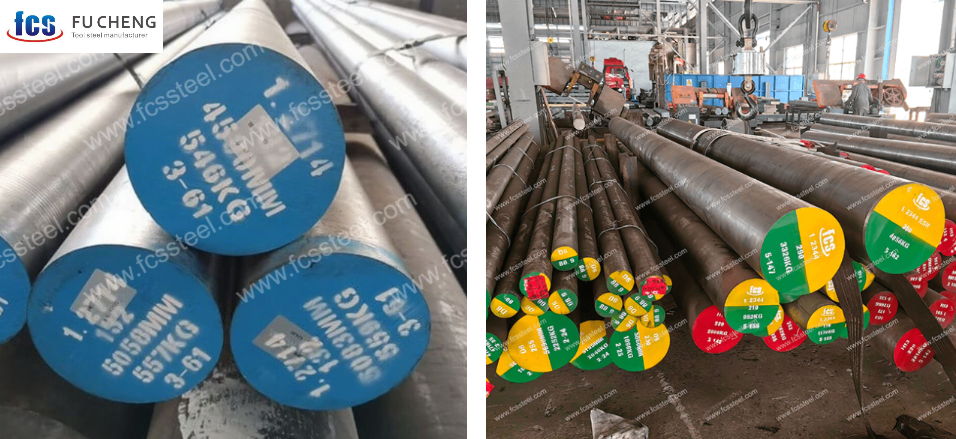
Alloy vs. Tool Steel: Core Differences
Alloy steel was built for structural work: bridges, pipelines, automotive frames. Its alloying elements — chromium, nickel, molybdenum, manganese — deliver toughness, fatigue resistance, and weldability. Carbon content stays moderate and plays a secondary role. The goal is simple: a material that bends before it breaks.
Tool steel does a different job. It needs to cut, punch, press, and hold an edge under conditions that would rapidly degrade structural steel.
That difference shows up at the compositional level:
Chemical “DNA” Breakdown
|
Element |
Role in Industrial Tooling |
Alloy Steel (e.g., 4140) |
Tool Steel (e.g., D2/H13) |
|
Carbon (C) |
Hardness & Carbide formation |
Medium (~0.4%) |
High (0.5% – 2.3%) |
|
Chromium (Cr) |
Depth of hardening & Wear |
Lean (~1.0%) |
Rich (3.0% – 12.0%) |
|
Vanadium (V) |
Extreme abrasion resistance |
Trace / None |
Critical (1.0% – 5.0%) |
|
Tungsten (W) |
High-temperature stability |
None |
High (Up to 18% in HSS) |
|
Molybdenum (Mo) |
Toughness & Heat strength |
Minor (0.2%) |
Significant (1.0% – 5.0%) |
-
Alloy Steels (e.g., 4140) utilize medium carbon and lean chromium to achieve a martensitic structure focused on toughness and fatigue resistance. They excel in structural roles but fail under high-abrasion or thermal loads because they lack hard stable phases.
-
Tool Steels (e.g., D2, M2) are “over-alloyed” with high carbon and heavy refractory elements like Vanadium, Tungsten, and Molybdenum. These elements trigger a secondary hardening mechanism, precipitating a dense network of ultra-hard carbides (VC, M6C). This micro-structure provides the Red Hardness and Abrasive Wear Resistance necessary for industrial cutting and stamping.
The Verdict: While Alloy Steel offers cost-effective ductility for mold bases, only Tool Steel’s complex chemistry can withstand the extreme “metal-on-metal” stress of high-volume production.
Technical Properties Compared
|
Property |
Alloy Steel (AISI 4140) |
Tool Steel (AISI D2) |
Tool Steel (AISI H13) |
Performance Impact |
|
Max Working Hardness |
28–32 HRC (Pre-hard) |
58–62 HRC |
48–54 HRC |
Resistance to surface indentation. |
|
Carbide Volume |
Very low carbide content |
High carbide volume (chromium-rich carbides) |
Moderate carbide content (vanadium-based) |
Primary defense against abrasion. |
|
Thermal Stability |
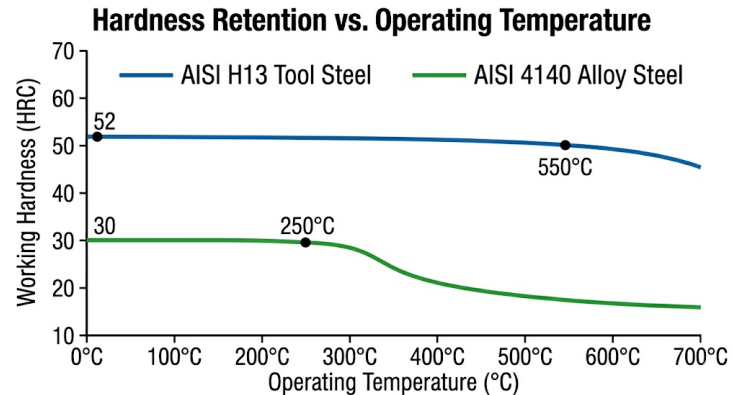
4140: Performance degrades above ~250°C |
D2: Limited thermal stability above ~200°C |
H13: Maintains hardness above ~500–550°C |
Hardness retention during friction. |
|
Wear Resistance |
Low |
Extremely High |
Medium-High |
Number of cycles before regrinding. |
|
Toughness (Charpy) |
High (~40-50 J) |
Low (~10-15 J) |
High (~20-30 J) |
The data reveals that Alloy Steel provides structural toughness but lacks the carbide density and red-hardness of Tool Steel, leading to rapid softening and abrasive wear under high-stress cycles.
Total Cost of Ownership (TCO)
| Cost Factor | Alloy Steel (e.g., 4140) | Tool Steel (e.g., D2/H13) | The “Hidden” Impact |
|---|---|---|---|
| Upfront Material | 30% – 50% Savings | Baseline (1.0x) | The only place where Alloy Steel wins. |
| Machining/Labor | Lower (Easier to cut) | Higher (Needs specialized tooling) | Short-term gain for the machine shop. |
| Maintenance (MTBF) | Low. Regrind every 150k cycles. | High. Validated for 500k+ cycles. | Alloy requires 3x more press teardowns. |
| Scrap Rate | Increases as edge deforms. | Stable until end-of-life. | Alloy steel tools lose precision early. |
| Unplanned Failure | High Risk. Sudden breakage. | Low Risk. Predictable wear. | One hour of downtime = 1 year of steel savings. |
| 12-Month TCO | Extremely High. | Optimized. | The “Substitution Trap” revealed. |
Real-World Failure Risks
In industrial tooling, failure is a cumulative countdown. While HSLA alloys mimic tool steel’s yield strength, they suffer from high “fatigue scatter.” Research on ASTM A440 proves that fatigue life shifts unpredictably based on cleanliness, residual stress, and environment. Alloy substitutes lack the refined carbide microstructure needed to suppress crack initiation, leading to random failures rather than predictable wear.
Furthermore, in chemically active environments, low-alloy grades can become susceptible to Stress Corrosion Cracking (SCC) in specific environments (e.g., chlorides or corrosive media). Without tool steel’s Chromium-passivation, subsurface micro-cracks propagate unnoticed until a production peak triggers a catastrophic break.
Ultimately, substituting for upfront savings replaces a “planned maintenance” model with “unpredictable downtime,” erasing all theoretical margins.
Tool steels are built to reduce that scatter. Their controlled carbide microstructure and heat treatment response produce consistent, predictable fatigue curves.Alloy steel substitutes don’t deliver that consistency.
The Performance & Reliability
|
Failure Scenario |
Alloy Steel (e.g., 4140) |
Tool Steel (e.g., D2 / H13) |
Performance Gap |
Simple Mechanism |
|
High-Cycle Fatigue |
Unpredictable. Fails at random intervals. |
Consistent. Long, predictable service life. |
Reliability. Alloy steel has 10x higher scatter. |
Micro-purity: Tool steel has fewer internal inclusions. |
|
Abrasive Wear |
Rapid Wear. Surface loses shape quickly. |
High Endurance. Stays sharp for 100k+ cycles. |
Durability. Tool steel lasts 5x–10x longer. |
Hard Carbides: Tool steel is packed with “micro-armor.” |
|
Thermal Exposure |
Softens >250°C. Deforms under heat. |
Stable >540°C. Maintains “Red Hardness.” |
Heat Strength. Essential for high-speed runs. |
Secondary Hardening: Alloy elements lock the structure. |
|
Stress Corrosion |
Vulnerable. Prone to sudden cracking. |
Resistant. Withstands coolants/moisture. |
Safety. Prevents “infant mortality” of tools. |
Passivation: Higher Chromium shields the metal. |
|
Impact Loading |
Deformation. Molds may bend or dent. |
Rigidity. Holds precision under pressure. |
Accuracy. Maintains tight product tolerances. |
Elastic Limit: Tool steel handles higher stress levels. |
Expert Verdict: Service Life vs. Cost
In the Industrial Tooling sector, the difference between these materials is essentially Predictability.
-
Alloy Steel is a “Structural” material. It is built to hold weight, not to fight friction or heat. Using it in a high-demand tool often leads to unplanned downtime.
-
Tool Steel is a “Performance” material. Its chemistry is specifically tuned to resist the cumulative damage of industrial cycles.
Expert Insight: “The ‘material savings’ from alloy steel are usually lost during the first hour of unplanned production downtime. Tool steel isn’t just an expense; it’s production insurance.” — Ref: “Tool Steels: Metallurgy and Application,” 5th Edition.
4 Safe Substitution Zones for Alloy Steel
Not every tooling application needs the full performance of tool steel. Some do. Many don’t — and knowing the difference is where smart procurement earns its keep.
The safe substitution zones are not guesswork. Four specific thresholds define them: hardness demand, operating temperature, impact load, and wear rate. Stay inside those boundaries, and alloy steel delivers 85%+ of the performance at a fraction of the cost. Cross them, and the failure scenarios above become your problem.
Here’s where the substitution holds up:
- Hardness at or below 55 HRC: You might not need the extreme 60-62 HRC of D2. Alloys like 4140 typically operate in the 28–32 HRC range (pre-hardened), and can reach higher hardness with heat treatment, though with reduced toughness.This gives you a great base for most standard cold-work jobs. You get reliable performance without the extra cost.
- Operating temps below 400°C: Keep your heat under this mark. Alloy options hold onto over 90% of their strength here. They handle hot punches and normal heat cycles well. Consistent shape retention becomes much easier for your team.
- Impact toughness above 15J: Alloys take a clear win in this category. Grades like 90MnV8 push past 20J. They beat standard tool steels easily. Choose these for your thin punches and shear blades. Your tools resist chipping much better.
- Wear volume under 0.1mm³/Nm: Alloy swaps work great for everyday wear and tear. Push past this wear limit. You must transition to D2 at that point. That upgrade prevents rapid tool failure. High friction zones demand extra hardness from your steel.
Real applications where this substitution has been proven:
-
Cold forging dies: SKD11 → Cr12MoV at loads under 200MPa, section thickness under 50mm, life exceeding 500,000 cycles
-
Shear blades: O2 → 9Mn2V, delivering 80% of tool steel edge retention at 10,000 cuts
-
Gauges and precision fixtures: L1 → Cr2, with dimensional stability holding ±5μm across 20–100°C range
Here’s the cost threshold that makes this work: tool steel exceeds 2× the alloy price, and the performance match clears 85%. At that point, substitution makes sense. Drop below that performance match, and you’re trading short-term savings for future failure costs — which is the same pattern the earlier TCO breakdown lays out.
Grade-Specific Substitution Matrix
To ensure a safe transition from expensive Tool Steels to cost-effective Alloy candidates, apply these four filters: Hardness Ceiling, Thermal Exposure, Impact Demand, and Wear Volume.
1. Cold-Work Substitutions
|
Original Grade |
Candidate Substitute |
Technical Thresholds & Verdict |
|
D2 |
Cr12MoV / Cr5Mo1V |
Verdict: Conditional. Works only if section thickness is <50mm and contact stress is <200MPa. Delivers 85% of D2’s wear resistance at ~50% cost. |
|
O2 |
9Mn2V / 90MnV8 |
Verdict: Recommended. Superior toughness (20J vs. O2’s 10-15J). Ideal for punches <10mm. Edge retention holds 80% over 10,000 cuts. |
2. Hot-Work Substitutions
|
Original Grade |
Candidate Substitute |
Technical Thresholds & Verdict |
|
H13 |
4Cr5MoSiV1 |
Verdict: Temperature Dependent. Excellent below 400°C (90%+ strength retention). Critical for die casting inserts. Above 400°C, H13 is non-negotiable. |
3. Precision and Gauging Substitutions
|
Original Grade |
Candidate Substitute |
Technical Thresholds & Verdict |
|
L1 |
Cr2 |
Verdict: High Compatibility. Dimensional stability remains within ±5μm (20–100°C). Perfect for gauges and fixtures with zero performance loss. |
Here’s the decision rule that applies to every grade pairing: alloy steel clears 85% performance match and tool steel exceeds 2× the alloy price — substitution earns its place. Break either condition, and the cost savings vs. failure risk math turns against you — fast.
General Application Guide
|
Application Area |
Best Fit Material |
Why? (The Logic) |
|
Mold Base / Holder |
Alloy Steel (4140) |
High toughness & lower cost for non-contact parts. |
|
Stamping Punch / Die |
Tool Steel (D2/M2) |
Extreme hardness needed to resist edge wear. |
|
Die Casting Inserts |
Tool Steel (H13) |
Superior resistance to thermal fatigue (heat checking). |
|
Jigs & Fixtures |
Alloy Steel (8620) |
Sufficient strength with excellent machinability. |
|
Plastic Injection (Glass-Filled) |
Tool Steel (S136) |
Hard carbide network resists abrasive erosion from fibers. |
-
Alloy Steel = Support. It builds the “body” of the tool. It’s about CAPEX savings.
-
Tool Steel = Performance. It forms the “interface” where the work happens. It’s about Operational Reliability.
Final Verdict for Buyers
In tooling applications, materials rarely fail because they are too weak — they fail because they are mismatched to the wear, heat, or cycle conditions.
Capital tooling purchases move through four stages: perception → evaluation → preference → choice.
| Decision Filter | Alloy Steel (e.g., 4140) | Tool Steel (e.g., D2 / H13) | Engineering Verdict |
|---|---|---|---|
| Hardness Demand | Safe ≤ 55 HRC | Required > 55 HRC | Alloy steel lacks the lattice stability for extreme hardness. |
| Operating Temp | Safe < 250°C | Required > 400°C | Tool steel’s “Red Hardness” prevents thermal softening. |
| Impact Toughness | Priority > 15J | Lower (~10-15J) | Alloy steel is superior for structural shock absorption. |
| Wear Volume | Low (< 0.1mm³/Nm) | High Resistance | Tool steel’s carbide network is mandatory for abrasive loads. |
| Production Volume | < 5,000 cycles | > 50,000 cycles | Tool steel ensures predictable MTBF and lower TCO. |
Need a Material Review?
A cheaper alloy grade might hold up in your specific press or mold. Or it might crack. Don’t gamble your production line to find out.
You don’t have to figure out the cost and risk alone. Send us your blueprints or operating temps. You can even share a photo of a tool that broke on the job. Our metal experts will review your exact conditions. We give you straight answers. You learn exactly where alloy steel cuts costs. We also point out where you need tool steel. This protects your machines from downtime.