
Introduction
Let’s be honest. The wrong steel destroys your budget. It ruins your reputation too. A high-load part might crack under pressure. A custom blade could rust out after one week outdoors. Nobody wants that nightmare.
You must choose between tool steel, stainless steel, and carbon steel. Look beyond the price tag. You decide how your project survives everyday use. Carbon steel gives you raw structural strength. Stainless steel fights off water and moisture. Tool steel handles heavy impacts and keeps a sharp edge.
Pick the right material. Your build succeeds. A wrong guess wastes your money. You have to start over. We will skip the formal metallurgy jargon. Let’s review the real differences between these three materials. This helps you specify the right steel the first time.
The Basics: Definitions and Core Differences
Steel is not a single thing. It never was.
All three types start from the same place — iron and carbon. What gets added after that is what splits them apart. Think of it like a recipe: same base ingredients, three very different results.
Here’s what sets each one apart:
Tool Steel:
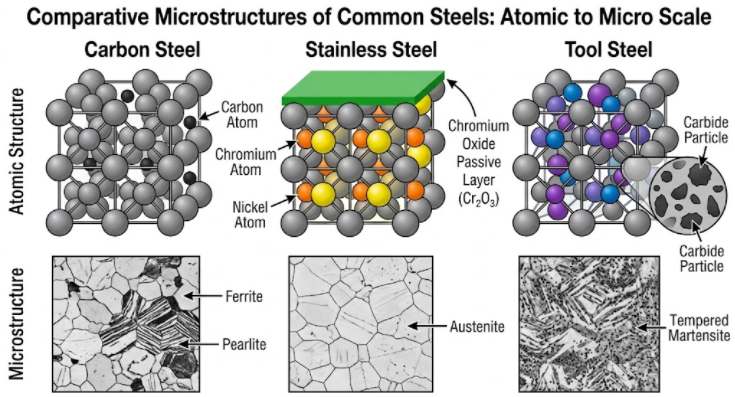
It is built for punishment. High carbon content gets combined with alloys like vanadium, molybdenum, and tungsten. That pushes hardness up to around 60 Rockwell C. You’ll find it in axes, drill bits, and machine tools that take repeated impact and heat. Ochsenkopf axes and Wiha screwdriver bits are solid real-world examples. The catch: that hardness brings brittleness. At very high hardness levels, tool steel sacrifices ductility — it resists deformation but becomes more prone to brittle fracture.
Stainless Steel:
It solves the rust problem by adding at least 10.5% chromium to the mix. That chromium builds an invisible oxide layer on the surface — a passive shield against moisture. Nickel and molybdenum often join in too. The result: a steel that performs well in kitchens, surgical suites, and pipelines. It’s harder to sharpen than carbon steel, but it needs almost no maintenance to stay in good shape.
Carbon Steel:
It is the purest version of the formula. Primarily iron and carbon (0.05–2.1%), with small amounts of manganese and silicon, but no significant alloying elements. That simplicity pays off in sharpness and toughness. Carbon steel takes an edge fast and holds it well — which is why you’ll still find it in hunting knives and car springs. The tradeoff? It rusts. Skip the oil and the cleaning, and you’ll see surface rust form overnight.
Head-to-Head Property Comparison
Six properties. Three steels. The numbers decide.
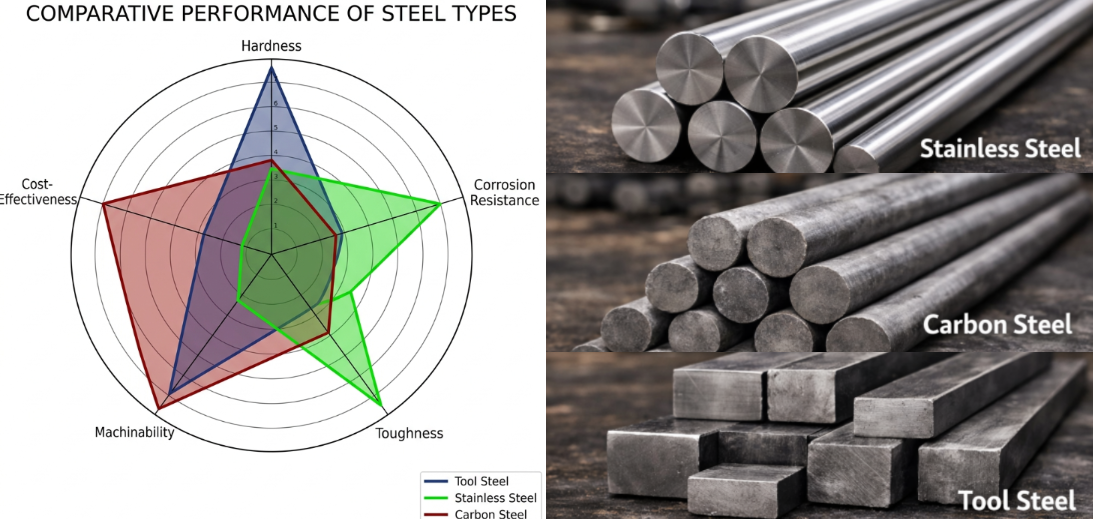
Steel Property Comparison Table
| Property | Tool Steel | Stainless Steel | Carbon Steel |
|---|---|---|---|
| Hardness (HB) | 210–620 | 137–595 | • Annealed: 120–200 HB • Hardened (high carbon): up to ~600 HB |
| Corrosion Resistance | Low | High (≈200× vs non-Cr) | Poor |
| Toughness (Elongation) | 5–25% | 12–40% | 10–32% |
| Machinability | Low | Medium | High (low carbon) |
| Price | High | Medium–High | Low |
| Maintenance Cost | High | Low | High |
Chemical Composition Breakdown
Tool Steel
| Element | Carbide Type | Performance Benefit | Impact on Steel |
|---|---|---|---|
| Vanadium (V) | VC | Excellent wear resistance, edge retention | Improves tool life |
| Tungsten (W) | WC | Extreme hardness, high-temperature stability | Maintains hardness under heat |
| Molybdenum (Mo) | Mo₂C | Enhances toughness, resists thermal fatigue | Prevents cracking under stress |
| Property | Description |
|---|---|
| Carbon Content | Typically ≥0.55–0.65% |
| Core Strength Source | Carbide formation rather than carbon alone |
| Key Advantage | High hardness + heat resistance + wear resistance |
| Typical Grades | H13 (1.2344), D2 (1.2379), M2 (1.3343), SKD11, SKD61 |
Key Insight:
Tool steel performance comes from carbide engineering, not just carbon content.
Stainless Steel
| Type | Composition | Representative Grades | Key Characteristics |
|---|---|---|---|
| Austenitic | 16–20% Cr, 8–14% Ni | 304, 304L, 316, 316L, 321 | Non-magnetic;Excellent corrosion resistance;Very ductile |
| Ferritic | 16–18% Cr, low Ni | 409, 430, 439, 441 | Magnetic;Moderate corrosion resistance;Lower cost |
| Martensitic | 12–14% Cr | 410, 420, 440C, 1.4021 | Hardenable;Higher strength;Lower corrosion resistance |
Key Insight:
Chromium forms a self-healing oxide layer (Cr₂O₃) that protects against corrosion.
Carbon Steel
| Type | Carbon Content | Representative Grades | Key Traits |
|---|---|---|---|
| Low Carbon | 0.05–0.30% | 1018, 1020, A36, 420J2 | • Soft • Ductile • Excellent weldability |
| Medium Carbon | 0.30–0.60% | 1045, 1050, 4140, AUS6 | • Balanced strength • Good toughness |
| High Carbon | 0.60–2.00% | 1060, 1095, 52100, SK5 | • High hardness • Low ductility (brittle) |
Key Insight:
More carbon → higher hardness, but lower toughness and weldability.
Hardness & Strength
Hardness measures resistance to deformation. Toughness measures resistance to fracture. A steel can score high on one and fall apart on the other. Not as a figure of speech — it can break apart for real.
Mechanical Properties Comparison Table
| Material Type | Representative Grade | Hardness (HRC) | Strength |
|---|---|---|---|
| Tool Steel | D2 (and similar) | 60–65+ | Tensile strength ≥ 2,145 N/mm² |
| High-Strength Alloy Steel | 6150 | 45–55 | Yield strength: 1,359–1,407 MPa |
| Mid-Range Alloy Steel | 4140 | 22–50 | Yield strength: ~945 MPa |
| Stainless Steel (Austenitic) | 304 | 20–30 | Relatively low strength (not hardness-focused) |
| Low-Carbon Steel | 1018 | <25 | Yield strength: ~502 MPa |
Tool steel wins the hardness bracket. It’s not close.
The Trade-Off in Plain Terms
| Tool Steel | Stainless | Carbon Steel | |
|---|---|---|---|
| Hardness | HRC 60–65+ | HRC 20–30 | HRC varies (up to 65) |
| Tensile Strength | 2,145+ N/mm² | ~770 N/mm² | Scales with carbon |
| Brittle Risk | High above HRC 58 | Low | Moderate |
| Best Load Type | Wear, abrasion | Impact, shear | Balanced |
The rule holds: hardness up, toughness down. No steel maxes both. Your job is to decide which failure mode you can least afford — then pick the steel that fits that answer.
Corrosion Resistance: Surviving Moisture
Rust doesn’t ask permission. Leave carbon steel in a humid room overnight, and the iron matrix starts reacting right away — no coating, no chromium, nothing between it and the moisture.
That’s the core split between these three steels. Stainless resists. Carbon and tool steel surrender — unless you intervene.
How the Passive Layer Works
Stainless steel’s secret is structural, not cosmetic. That minimum 10.5% chromium reacts with oxygen to build a Cr₂O₃ passive film across the entire surface. The film is self-healing. Scratch it, and it reforms. The result: corrosion rates below 0.1 mpy (mils per year) — even after 2,400 hours submerged in boiling water.
Carbon steel running through river water at pH 8–8.5? It can reach 20–30 mpy in mildly alkaline water environments (pH 8–8.5) That’s not slow degradation. That’s an active attack.
Tool steel lands in the middle. It performs better than raw carbon steel. But it still lacks enough chromium to build a reliable passive layer. Moisture reaches the iron matrix. Rust follows.
Real-World Industrial Applications
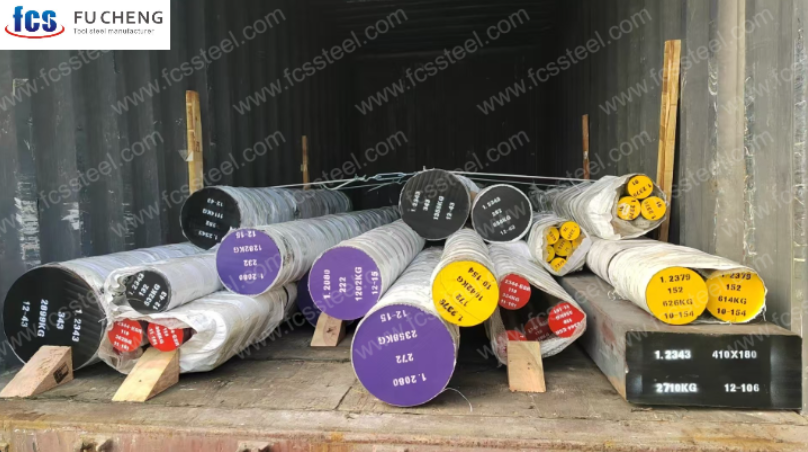
1. Tool & Die Steel (The Industrial Master)
Tool steels are designed to survive high heat and extreme abrasion without losing their shape.
- Cold-Work Steel (D2 / SKD11): Used for metal stamping dies, industrial shears, and thread-rolling tools that cut or shape other metals at room temperature.
- Hot-Work Steel (H13): Essential for aluminum die-casting and hot-forging. It resists “thermal fatigue” (cracking from repeated heating and cooling).
- High-Speed Steel (M2): The go-to material for drill bits, milling cutters, and power-saw blades that generate intense friction heat during use.
2. Stainless Steel (The Shield)
Stainless steel is defined by its Chromium content, which provides a self-healing protective layer.
- 304/316 Grades: These are the “hygiene kings.” Applications include commercial kitchenware, pharmaceutical piping, and surgical instruments. 316 is specifically used in marine environments to resist salt-water pitting.
- 400 Series (Martensitic): Used for professional cutlery and turbine blades. It is magnetic and can be hardened to hold a razor-sharp edge.
3. Carbon Steel (The Structural Backbone)
Carbon steel is categorized by its carbon content, which dictates its strength-to-weight ratio and weldability.
- Low Carbon (Q235 / 1020): Used for mass-scale construction, such as I-beams, pipelines, and automotive body panels. It is favored for its ease of welding.
- Medium Carbon (45# / 1045): The standard choice for mechanical power transmission. You will find it in gears, crankshafts, and heavy-duty bolts.
- High Carbon (1095): Used where extreme hardness is required but corrosion is not a concern, such as railway tracks, high-tension wires, and heavy-duty springs.
💡 Quick Selection Tip: When choosing, ask yourself: Does it need to be cheap (Carbon), clean (Stainless), or sharp (Tool)? If the part will be submerged in water, go 316 Stainless. If it’s hitting another piece of metal 1,000 times an hour, go D2 Tool Steel.
Machinability and Hidden Costs
| Feature | Carbon Steel (12L14 / Low-C) | Stainless Steel (304 / 316) | Tool Steel (M2 / D2) |
| Machinability Rating | 190% (Industry Leader) | 35% – 45% (Challenging) | Under 39% (Extremely Difficult) |
| Thermal Conductivity | High (Efficient heat removal) | ~14–16 W/m·K | Low (High cutting resistance) |
| Tool Wear Factor | Minimal (Long tool life) | High (Work-hardening) | Extreme (High abrasion) |
| Cycle Time | Short (High speed & feed) | Long (Half the speed of carbon) | Longest (Slowest feed rates) |
| Raw Material Cost | $ (Commodity Pricing) | $$$ (Alloy Premium) | $ (Specialty Alloy) |
| Hidden Costs | Low machine & tool spend | High tooling & coolant spend | High setup & heat treat costs |
| Production Fit | Prototype to High-Volume | Mid to High-Volume | Low-Volume, High-Value |
How to Choose the Right Steel
The 3-Step Selection Filter
1. Environment: The “Rust” Trigger
Moisture dictates the material chemistry. If it’s wet or coastal, corrosion resistance is non-negotiable.
Wet/Marine: Go with Stainless 316L (High Nickel/Molybdenum).
Corrosive but Budget-Conscious: Use Galvanized S355 (Zinc coat >50µm).
Dry/Inland: Stick to Carbon Steel. It cuts raw material costs by 40% while maintaining a yield strength above 250 N/mm².
2. Use Case: The “Force” Trigger
Are you cutting, loading, or sliding?
Cutting/Forming: You need hardness. Use D2 Tool Steel (Target 58–62 HRC).
Load-Bearing: You need yield strength. S460 offers 460 N/mm², but watch for “size effect” (strength drops as thickness exceeds 100mm).
Wear/Friction: Use 4140 (Chromium-Molybdenum). Its tensile strength (>95 ksi) handles fatigue far better than plain carbon.
3. Budget: The “Hidden Cost” Trigger
The invoice price is just the beginning.
Carbon Steel (S275): Usually <$1/kg. The cheapest upfront.
Stainless/Alloys: 2–3× the base price.
The Math: Always calculate Total Cost of Ownership (TCO). High-cost Tool Steel or Stainless often pays for itself by eliminating frequent coating cycles, maintenance, or premature failure.
💡 Expert “Red Flags” to Avoid
The “Over-Engineering” Trap: Don’t use Tool Steel just because it’s “stronger.” Its low Ductility means it can shatter like glass under a sudden impact where Carbon Steel would simply bend.
The Machining Tax: Remember that Stainless 304 has a 45% machinability rating. This means you aren’t just paying for the metal; you are paying for double the labor hours and half the tool life.
Welding Woes: If your design requires extensive welding, stick to Low Carbon Steel (Q235/1020). Tool steels are notoriously difficult to weld and prone to “under-bead cracking.”
Conclusion
The right steel makes or breaks your project—it really is that simple. Go with tool steel for extreme wear, stainless to fight rust, and carbon steel when you need cost-effective structural strength.
Still second-guessing your material specs? Don’t risk a field failure or burned-out tooling. Send us your drawings, load conditions, or operating environment. Our metallurgy team will review the details and lock in the exact grade you need.
Ready to do it right the first time?
Send your specs for a free material assessment and quote today →