
Introduction
Miscalculate your steel weight, and your freight quote can swing by thousands of dollars. Carriers don’t estimate—they charge strictly by the pound or kilogram.
Knowing how to calculate steel weight for shipping cost estimates isn’t just back-office paperwork; it is pure margin protection. If your dimensions are off, you pay the penalty directly out of your own profit.
This guide strips away the guesswork. You will get the exact formulas for every major steel profile, including plates, bars, and tubes. More importantly, we’ll show you exactly where buyers bleed money on density rates and dimensional weight traps. Use these standard calcaulations to lock in your freight costs before the final invoice hits your desk.
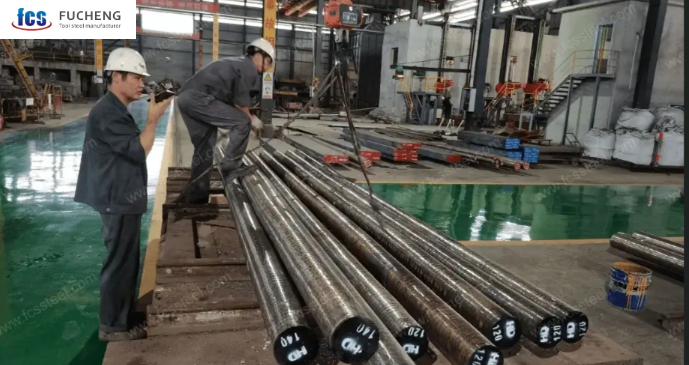
Why Steel Weight Accuracy Impacts Shipping Costs
Miscalculating steel weight isn’t just a minor error—it’s a direct hit to your profit margins. Here is exactly where you lose money:
- The scale always wins: Carriers charge the higher number between your estimated Bill of Lading and their scale. You absorb the difference every time.
- The DIM weight trap: Parcel carriers (UPS/FedEx) measure volume. If the dimensional weight exceeds the actual weight, your shipping rates spike automatically.
- The LTL double penalty: Carriers will re-weigh shipments to apply higher density rates, but they never adjust your freight class downward to save you money.
💡 Pro Tip: Always calculate both the actual and dimensional weight before the truck pulls away—because the carrier definitely will.
The Universal Steel Weight Formula
1. The Core Calculation Logic
Weight = Length × Cross-Sectional Area × Material Density
2. Steel Material Density Constants
Apply the correct density value based on your material and measurement system:
| Material Type | Metric System | Imperial System |
|---|---|---|
| Mild & Carbon Steel (A36, 1018) | 7850 kg/m³ (7.85 g/cm³) | 490 lb/ft³ (0.2836 lb/in³) |
| Stainless Steel (304, 316) | 8000 kg/m³ (8.00 g/cm³) | 500 lb/ft³ (0.2890 lb/in³) |
Pro Tip: Stainless steel is dense. Always add 2–5% to your base calculation for stainless shipments. Overlooking this simple metallurgical difference on a multi-ton LTL pallet guarantees an invoice dispute.
Steel Weight Calculation by Shape
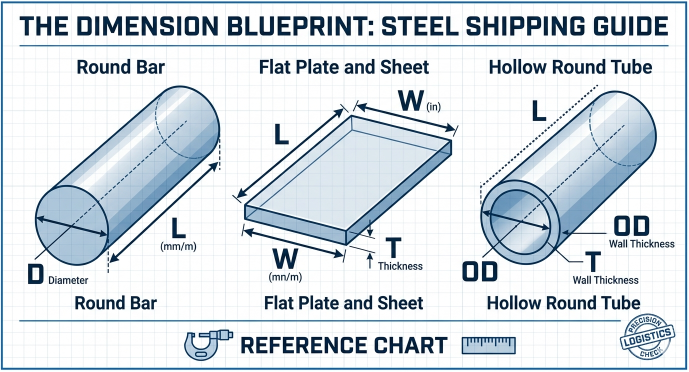
1. Round Bar
| System | Fast Formula | Example |
|---|---|---|
| Metric | D(mm)² × L(m) ÷ 162 = kg | 12mm bar, 6m → 5.33 kg |
| Imperial | D(in)² × 0.167 × L(in) = lb | 1″ bar, 12″ → 2.0 lb |
Pitfall Warning: Metric units often cause math errors. You must use millimeters for diameter (D) and meters for length (L).
2. Flat Plate & Sheet
| System | Fast Formula | Example |
|---|---|---|
| Metric | L(m) × W(m) × T(mm) × 7.85 = kg | 2m × 1m × 10mm → 157 kg |
| Imperial | L(in) × W(in) × T(in) × 0.2836 = lb | 48″ × 96″ × 0.25″ → 328 lb |
Pitfall Warning: Thickness determines weight directly. Double the thickness, and your shipping costs double.
3. Hollow Tube
| Shape | Fast Formula (Imperial) | Example |
|---|---|---|
| Round | (OD² − ID²) × 0.2227 × L(in) = lb | 2″OD, 1.75″ID, 120″ → 25.1 lb |
| Square | [Side² − (Side − 2×Wall)²] × L(in) × 0.2836 = lb | 2″x2″, 0.125″W, 240″ → 63.8 lb |
Pitfall Warning: Hollow tubes easily trigger the DIM (dimensional weight) trap. You often end up paying freight for the empty air inside.
4. Structural Angle
| Method | Fast Formula / Shortcut | Example |
|---|---|---|
| Formula | [(Leg1 + Leg2 − T) × T] × L(in) × 0.2836 = lb | Only for non-standard cuts |
| Table | Chart Method: Standard lb/ft value × Length(ft) = lb | 6″×6″×0.5″, 1ft → 19.6 lb |
Pitfall Warning: Manual formulas miss the root radius weight of the angle. Check standard charts instead of calculating by hand. Charts give you exact numbers instantly.
Fast Reference & Real-World Quoting Template
Don’t have time to run the math? Use this cheat sheet for the most common carbon steel sizes (Based on a density of 7,850 kg/m³).
Quick Weight Reference Chart
| Profile | Specification | Unit Weight | Commercial Ref (m per Ton) |
| Round Bar | 6 mm | 0.222 kg/m | 4504 m/t |
| Round Bar | 10 mm | 0.617 kg/m | 1621 m/t |
| Round Bar | 12 mm | 0.888 kg/m | 1126 m/t |
| Round Bar | 25 mm | 3.850 kg/m | 260 m/t |
| Steel Plate | 2.0 mm (T) | 15.70 kg/m² | 63.7 m²/t |
| Steel Plate | 10.0 mm (T) | 78.50 kg/m² | 12.7 m²/t |
| Flat Bar | 40 × 5 mm | 1.57 kg/m | 637 m/t |
Pro Shortcut:For round bars, remember:kg/m ≈ D² ÷ 162.It’s the fastest way to double-check a supplier’s quote on the fly.
The 3-Step B2B Quoting Strategy
Calculating the weight is only half the job. To protect your margins and look like a pro to your clients, use this “Three-Step Audit” before sending any freight estimate:
- Identify Unit Mass: Match your size to the reference table or formula.
- Calculate Theoretical Total: Multiply unit weight by the total length/quantity.
- Apply the “Logistics Buffer”: Never quote raw math. Always add 3–5% for pallets, strapping, and mill tolerances.
✅ Use This Email Template for Clients:
Product: 20 pcs of 12 mm Round Bar (6 m each)
Weight Breakdown:
0.888 kg/m × 120 m = 106.56 kg
Freight Estimate:
106.56 kg × $2.20/kg = $234.43
Note: Final shipping cost is based on actual scale weight.
This estimate includes a 3% buffer for export-grade packaging and pallets.
Step-by-Step: Steel Shipping Weight SOP
Follow this standard procedure to lock in your billable weight without guessing.
Step 1: Measure & Round Up
Measure the absolute longest points of your package. Carriers don’t do fractions. Always round up to the next whole inch (e.g., 11.1″ becomes 12″).
Step 2: Compare Actual vs. DIM Weight
Find your volume (L×W×H) and divide by 139 (common UPS/FedEx international divisor; domestic services may vary) to get your Dimensional (DIM) weight. Compare it to your scale weight. The carrier will always charge the higher number.
| Cargo Type | Dimensions (in) | DIM lbs | Actual lbs | Billable |
|---|---|---|---|---|
| Solid Steel Plate | 30 × 12 × 12 | 31 | 450 | 450 |
| Hollow Pipe Crate | 24 × 18 × 18 | 56 | 35 | 56 |
| Small Mixed Box | 12 × 9 × 7 | 6 | 5 | 6 |
Step 3: Add a 3–5% Buffer
Never quote raw math. Industry mill tolerances and heavy-duty packaging add hidden pounds. Pad your final number by 3–5% before sending quotes to absorb weigh-in surprises and prevent invoice disputes.
Dimensional (DIM) vs. Actual Weight: The Core Rules
The core principle is simple: carriers bill you for whichever number is higher—the actual scale weight or the calculated DIM weight. For LTL shipments (over 150 lbs), density-based NMFC freight class takes over. Ocean freight ignores DIM entirely and bills on actual kilograms.
The Density Redline
For standard shipments, one single number tells you if DIM is a financial threat:
- 🟢 Safe (Density > 0.08 lb/in³): Actual weight governs. Dense solid steel like bars, plates, and structural profiles (usually around 0.28 lb/in³) clears this easily.
- 🔴 Warning (Density < 0.08 lb/in³): DIM weight governs. Hollow tubes, loose bundled pipes, or over-boxed parts trigger this trap. You end up paying freight rates for empty air.
The Practical Fix
If your shipment falls into the warning zone, the solution is purely mechanical. You shrink the billable weight by shrinking the package:
- Eliminate void space: Redesign or cut down crates to hug the exact dimensions of your cut pieces.
- Configure tighter bundles: Nest angles together or strap pipes tighter to reduce the overall width and height profile.
- Verify before booking: Always calculate both the actual and DIM weight manually before the freight leaves your shipping floor.
Steel Shipping Modes: LTL vs. FCL Strategies
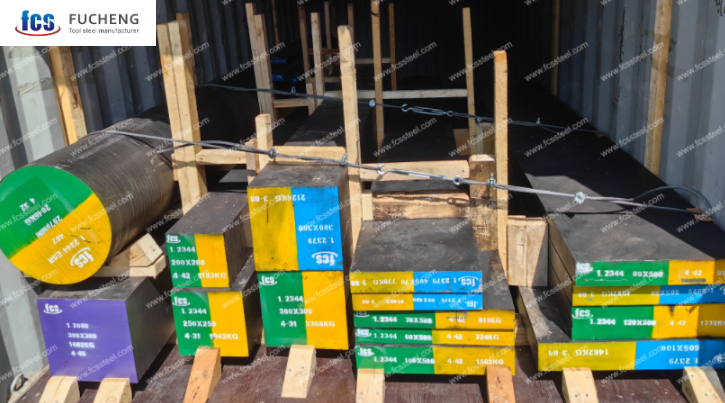
Once you have the total weight, your next move dictates whether you make a profit or just break even. The gap between shipping methods is where most “hidden” costs live.
The Critical Pivot: LTL vs. FCL Rates
Let’s look at a 5,000 kg (approx. 11,000 lbs) shipment. Most buyers default to LTL, but the math tells a different story:
LTL (Less-than-Truckload): You are at the mercy of density-based freight classes. With fuel surcharges and handling, you could be looking at a $15,000 bill.
FCL (Full Container Load): A 20ft container has a flat rate. Even if it’s half-empty, the cost often hovers around $4,500.
The Takeaway: If your weight exceeds 15,000 lbs, stop looking at LTL rates. Containerization is the only way to cut costs by up to 80%.
Avoiding Hidden Freight Accessorial Fees
These are the fees carriers “forget” to mention until the invoice hits:
- Liftgate Fees: Mandatory if the delivery site lacks a loading dock and the pallet is over 1,500 lbs.
- Residential Surcharges: Massive markups if the destination isn’t zoned as purely industrial.
- Re-weight/Re-class Fees: If your BOL weight is off, carriers will hit you with a penalty plus the price difference.
How to Negotiate Like a Pro
- Lead with Scale Tickets: Present a certified weight ticket before they ask. It kills their excuse to re-weigh your load and charge “adjustment fees.”
- Density Advantage: If you are shipping heavy plates, demand a “commodity rate” rather than a standard class rate. Your cargo is easy to stack and hard to damage—use that as leverage.
Common Calculation Mistakes
Sloppy math kills margins for most steel buyers. Bad deals are rarely the main problem. You lose money in a few specific spots:
📏 Rounding down: Carriers always round up. You log 11.1″. They charge you for 12″. This eats away at your profit.
🏷️ NMFC misclassification: You might pick the wrong density class. This forces you to pay top shipping rates. Find the exact class to save your cash.
💸 Hidden accessorials: Base quotes often exclude liftgates and oversized handling. These missing fees cause 30% of bill shocks. Ask for full costs upfront.
📦 The hollow DIM trap: Do you pack tubes with too much space? You just pay freight costs to ship empty air. Pack your items tight.
⛽ Outdated fuel surcharges: Diesel prices change every week. Last month’s estimate holds no value today. Check the current fuel rates.
The Fix: Check your quotes line by line. Do this before the truck hits your dock.
Your 30-Second Pre-Shipment Checklist
Sloppy math ruins freight budgets. Stop paying extra fees. Run this simple check on your next booking:
- Run the DIM test: Compare your actual box weight against the DIM weight. A density drop under 0.08 lb/in³ forces an immediate repack.
- Include a buffer: Wood crates, straps, and mill tolerances add real pounds. Pad your base numbers by 3–5% to cover this extra material.
- Document everything: Keep your scale tickets and photos on file. You need this hard proof to reverse a carrier’s re-weigh fee.
Go pull your last freight invoice right now. Check your first estimate against the final bill from the carrier. See a gap? Save this page. Apply these standard formulas on your next quote. Keep your profit margins off the shipping dock. Skip these freight headaches. Contact FCS today. We fill your steel orders with absolute precision. You get clear shipping estimates and zero hidden surprises.