
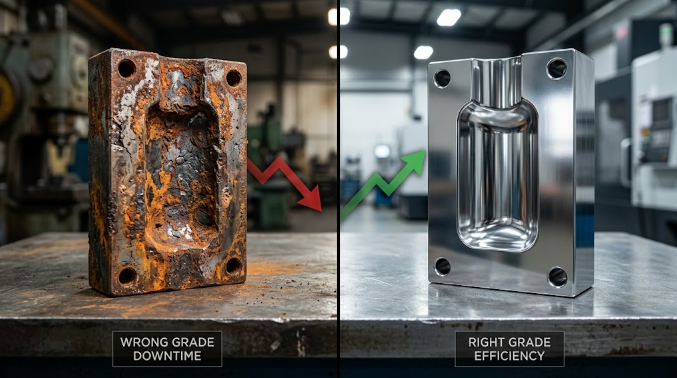
The wrong steel grade in a corrosive environment doesn’t just speed up wear. It drains your operation through unplanned downtime, early part failure, and replacement costs that pile up fast.
Specifying material for plastic injection molds that fight acidic resins? Picking tooling that needs to survive harsh chemical exposure? The gap between the right and wrong corrosion resistant steel grade comes down to two things: what’s happening at the metallurgical level, and which trade-offs you’re willing to accept.
This guide covers it all — stainless vs. tool steel grade comparisons, real-world application matching, and a clear decision framework you can put to work right away.
Why Steel Resists Corrosion
Corrosion resistance is a built-in metallurgical property, not an external coating. It relies on Spontaneous Repassivation—the ability of the steel to form and repair an invisible Chromium Oxide (Cr2O3) layer (1–3 nm thick) that stops electrochemical attack cold.
- The Passive Film (Cr₂O₃) Threshold: For a stable passive film to form, the alloy must contain a minimum of 10.5% Chromium. Once this threshold is met, the oxide layer forms spontaneously within seconds of oxygen exposure. In higher-spec grades (18–25% Cr), this film becomes significantly denser and more resistant to oxidizing acids.
- Synergistic Alloying Data:
- Chromium (Cr): The base of the film. Increasing Cr from 18% to 25% can double the stability of the passive layer in acidic media.
- Molybdenum (Mo) 2–6%: Essential for resisting Pitting. It specifically targets chloride-induced breakdown. Adding just 2% Mo (the difference between 304 and 316) increases pitting resistance by nearly 30% in salt spray tests.
- Nitrogen (N) 0.1–0.5%: A potent enhancer that accelerates the repassivation rate. It carries a 16x multiplier in resistance formulas compared to Chromium.
- Nickel (Ni) 8–20%: Stabilizes the Austenitic structure. While it doesn’t form the film, it prevents Stress Corrosion Cracking (SCC), which typically occurs in austenitic grades at temperatures above 60°C in chloride environments.
The PREN Metric (Pitting Resistance Equivalent Number): Engineers use this mathematical model to predict performance in chloride-rich media (e.g., seawater at 19,000 ppm chloride):
PRE = %Cr + 3.3×%Mo + 16×%N
- 304 (PREN ~19): Fails in stagnant seawater within weeks.
- 316 (PREN ~24): The baseline for marine environments.
- 254SMO (PREN >40): Handles full immersion in high-temperature seawater.
Carbon Control & Sensitization (The <0.03% Rule): Keeping Carbon <0.03% (L-grades) is critical for welded sections. In standard grades (up to 0.08% C), welding heat between 550–850°C causes Chromium to bond with Carbon. This creates Chromium Carbides and depletes the adjacent matrix of Chromium. This “Sensitization” leaves grain boundaries vulnerable to rapid decay, whereas 316L/304L ensures the Chromium remains free to protect the steel.
Stainless Steel Grades for Industrial Corrosion Resistanc
Industrial Stainless Steel: Grade Selection Matrix
| Family | Key Grade | Yield Strength | PREN | Chloride Limit | Engineering Logic |
|---|---|---|---|---|---|
| Austenitic | 304 | ~210 MPa | ~19 | < 200 ppm | Industry baseline. High weldability; no PWHT required. |
| Austenitic | 316 | ~290 MPa | ~24 | < 1,000 ppm | 2-3% Mo doubles pitting resistance vs 304. Marine standard. |
| Martensitic | 410 | > 1,000 MPa | ~15 | Negligible | Hardens via heat treat. Use for wear in steam/mild air. |
| PH Steel | 17-4PH | 860–1,300 MPa | ~20 | Moderate | Dial-in strength via Aging. Best for load + corrosion. |
Selection Logic & Benchmarks
- The Chloride/Temperature Threshold:
- The choice between 304 and 316 is driven by the Critical Pitting Temperature (CPT). 304’s CPT is ~10–15°C, while 316 pushes this above 25°C, making 316 mandatory for warm brine or coastal exposure.
2. 17-4PH Aging Strategy: Machined in “Condition A,” then aged to final properties to maintain dimensional control:
-
- H900: Yield ~1,170 MPa. Max strength, lowest SCC resistance.
- H1025: Yield ~1,000 MPa. Optimal balance for aerospace/valves.
- H1150: Yield ~860 MPa. Max ductility; corrosion resistance approaches 316 levels.
- Weldability Constraints:
-
- 300-Series: Excellent; use “L” grades to prevent sensitization.
- 400-Series: Poor; prone to cracking. Requires preheat and post-weld heat treatment (PWHT).
- 17-4PH: Readily weldable, but requires post-weld aging to restore properties.
Tool Steel Grades with Meaningful Corrosion Resistance
Tool Steel Corrosion & Performance Matrix
| Grade | Cr % | Primary Role | Key Engineering Trade-off |
|---|---|---|---|
| D2 | ~12% | Cold-work dies. High hardness (HRC 60+). | “Semi-stainless”; Chromium is trapped in carbides, leaving the matrix prone to pitting in wet conditions. |
| A2 | ~5% | General tooling. Superior dimensional stability. | Better rust resistance than carbon steel, but fails rapidly in chloride or humid environments. |
| H13 | ~5% | Hot-work/Die casting. Stability up to 760°C. | Protects against thermal oxidation (scaling), not aqueous or electrochemical corrosion. |
| P20 | ~2% | Standard molds. Mirror finish (Ra <0.2μm). | Designed for polishability, not chemical resistance; unsuitable for corrosive resins. |
| 420SS | ~13% | Corrosive molding. Resists HCl gas from PVC. | True stainless mold steel; provides acid protection but sacrifices ultra-high polish quality. |
Critical Selection Logic
- The Chromium Trap: In high-carbon grades like D2, much of the 12% Chromium is tied up in carbides. This prevents the formation of a continuous passive film, meaning it cannot substitute for 316 in liquid service.
- Thermal vs. Aqueous: H13 is specialized for high-temperature cycles. Its Chromium content is optimized to slow surface scaling at 500°C+, not to resist moisture at room temperature.
- The Polish Balance: For medical or food-grade plastics, P20 is the standard for surface finish. However, if the resin releases halogens (e.g., flame retardants), move to 420SS or 17-4PH to prevent cavity etching.
Head-to-Head Grade Comparison:
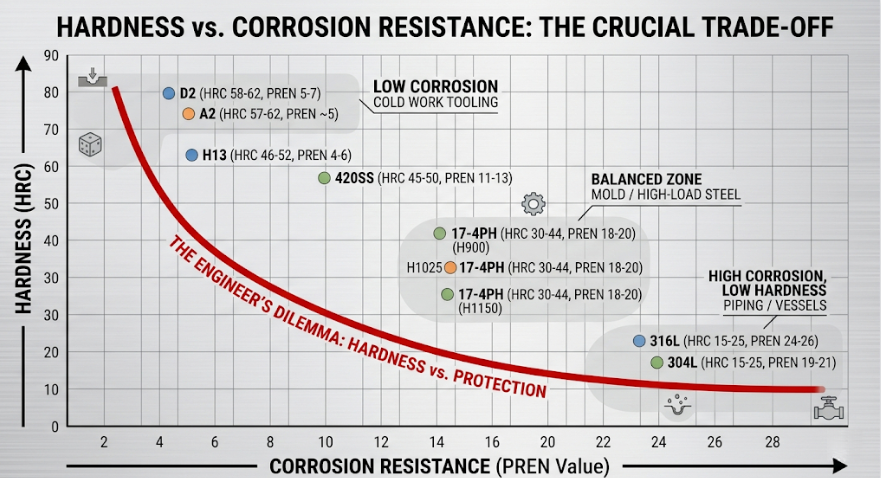
Six grades. One table. The numbers don’t lie — but they do need some unpacking.
| Grade | PREN | Hardness (HRC) | Weldability | Relative Cost |
|---|---|---|---|---|
| 304 | 19–21 | 15–25 (annealed) | Excellent | 1.0× |
| 316 | 24–26 | 15–25 (annealed) | Excellent | 1.3× |
| 410 | 11–13 | 45–50 (hardened) | Fair | 0.8× |
| 17-4PH | 18–20 | 30–44 (H900–H1150) | Good | 2.5× |
| D2 | 5–7 | 58–62 | Poor | 1.5× |
| H13 | 4–6 | 46–52 | Fair | 1.2× |
The pattern is clear: hardness goes up as corrosion resistance goes down. You can’t max out both at once.
Material Selection:
In engineering, there is no “perfect” grade—only the right trade-off. Choosing the wrong material doesn’t just impact the budget; it dictates the failure schedule. Here is how leading industries match material properties to environmental demands.
Industrial Grade-to-Environment Mapping
| Industry | Environmental Challenges | Primary Requirements | Recommended Grade | Engineering Logic |
|---|---|---|---|---|
| Marine | High Chlorides (19k ppm), Salt Spray | Pitting & Crevice Corrosion Resistance | 316L / 254SMO | 316L offers the best balance for general marine use; Super-austenitics (PREN >40) are required for full immersion. |
| Chemical & Pharma | Low pH Acids, Chlorides, Welding Risks | Intergranular Corrosion Resistance | 316L | Low carbon (<0.03%) prevents sensitization during welding, extending service life by 2–3x over 304. |
| Food & Medical | Microbial Adhesion, Harsh Cleaning | Surface Finish (Ra ≤ 0.4–0.8μm) | 304 / 316L | Material choice is driven by “Clean-in-Place” (CIP) compatibility and electropolishing capability. |
| Aerospace | Salt Spray + High Structural Loads | Yield Strength & Fatigue Life | 17-4PH (H900) | Delivers ~1,170 MPa yield (5x higher than 304) without sacrificing essential corrosion resistance. |
| Oil & Gas | H2S/CO2, Abrasive Wear, High Pressure | Stress Corrosion Cracking (SCC) Resistance | 17-4PH (H1150) | High-temperature aging (H1150) optimizes the grade for sour service and high-pressure pump shafts. |
| Hot Tooling | Thermal Cycling (up to 900°C) | Red Hardness & Thermal Stability | H13 | Standard stainless fails at 500°C+; H13 maintains stability and builds a protective oxide scale. |
The Engineer’s Decision Logic
To select the correct spec, evaluate your application against these three critical benchmarks:
- Chemical vs. Mechanical Threat: If the primary failure mode is chemical (pitting/acids), prioritize the 300-series or Super-austenitics. If the threat is mechanical (yield/fatigue), move toward 17-4PH.
- Thermal Thresholds:
- < 200°C: Standard corrosion/mechanical rules apply.
- 200°C – 500°C: Use 17-4PH for high-strength stability.
- > 500°C: Transition to H13 or tool steels; electrochemical resistance is secondary to thermal stability.
- Fabrication Constraints: For welded assemblies, always specify the “L” (Low Carbon) variants to prevent grain boundary depletion and premature joint failure.
Tooling & Die Selection: Balancing Wear and Chemical Attack
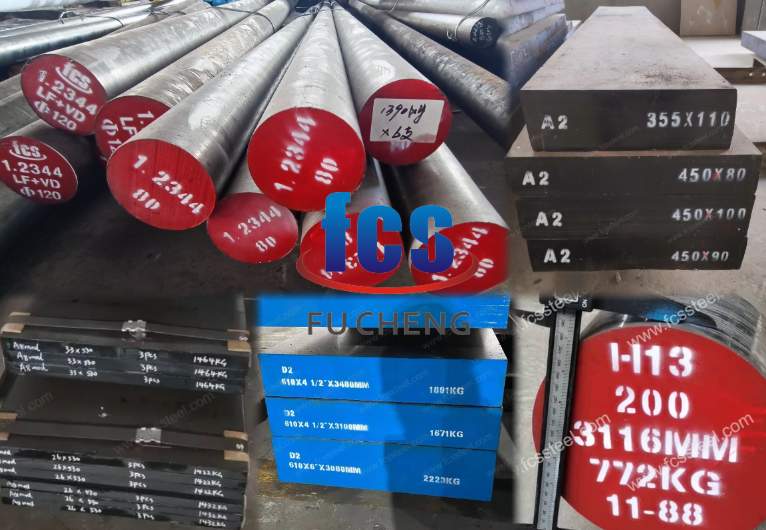
In high-volume production, dimensional drift is often caused by micro-corrosion rather than mechanical wear. Selecting the right substrate and surface treatment is critical to maintaining tolerances in aggressive environments.
Tooling Grade & Treatment Selection Matrix
| Application | Environment / Threat | Recommended Material | Surface Treatment | Engineering Advantage |
|---|---|---|---|---|
| Stamping Dies | High humidity, acidic lubricants | D2 / A2 | Hard Chrome / TD Coating | TD treatment increases lubricant resistance by 300%; extends life 2–4x. |
| Die Casting | Molten Al (700°C), thermal scaling | H13 | Gas/Plasma Nitriding | Nitriding creates a 1,000+ HV “white layer,” cutting Al erosion by 60%. |
| Plastic Injection | HCl gas (PVC), Flame retardants | 420SS / 17-4PH | PVD (CrN / DLC) | 420SS resists acid pitting; 17-4PH prevents Stress Corrosion Cracking (SCC). |
| Cutting Tools | Machining Ti-alloys, Halide polymers | Cemented Carbide | TiAlN / AlTiN Coating | Carbide exhibits 90% less flank wear than HSS in corrosive alloy machining. |
Key Technical Takeaways
- The Carbon Trap: In D2, high carbon locks chromium into carbides, leaving the matrix vulnerable. Surface treatments are mandatory in non-dry environments.
- The pH Factor: For PVC molding, cavity pH can drop to 2–4. Only high-chromium grades like 420SS can maintain the Ra 0.05μm mirror finish required.
- Thermal Protection: H13 relies on nitriding to shift the pitting potential (+0.3V), preventing the molten metal from “soldering” to the die surface.
How to Select the Right Corrosion Resistant Steel Grade
Step 1 — Define your corrosive medium. Check chloride levels, pH, and operating temperature before you open a grade chart. Coastal environments within 3–100 meters of saltwater require at least 316/316L (PREN ~24). Drop below pH 2 in acid service — 316 holds there. 304 has already failed at that point.
Step 2 — Set your mechanical floor. Corrosion resistance does nothing if the part yields under load. High-strength parts in harsh media need duplex grades. Duplex delivers on both fronts.
Step 3 — Factor in fabrication. Welded assemblies in 304 or 316 require post-weld annealing. Skip that step, and you introduce intergranular attack at every heat-affected zone. That’s where most field failures begin.
Step 4 — Calculate lifecycle cost, not purchase price. A 317L or 904L specification costs more upfront. In chloride service above 1,000 ppm, grades below PREN 30 start pitting fast. The replacement cycle burns through the savings quickly.
Severe chloride exposure — seawater immersion, marine splash zones — calls for a different tier entirely. Super duplex 2507 (PREN 41) and super ferritic 447 push corrosion rates below 0.1mm/year. Standard 316 can’t hold at that threshold. The lifecycle math runs 2–5× in favor of the higher-PREN grade once you factor out maintenance costs.
Surface Treatments That Enhance Corrosion Resistance
Even optimal steel grades develop microscopic weak points and trap contaminants during machining. Post-processing treatments eliminate these vulnerabilities by upgrading the outer layer:
- Passivation (Chemical Immersion): Acid baths restore the surface by forming a dense, protective chromium oxide layer. Benefit: Significantly extends part lifespan and rust prevention in neutral environments.
- Electropolishing (Surface Stripping): Removes the outermost microscopic metal layer, highly concentrating chromium at the surface. Benefit: Delivers a premium smooth finish and maximum protection for sensitive medical or subsea applications.
- PVD & CVD Coatings: Vapor deposition applies ultra-hard chemical layers (like TiN or CrN) directly onto the tool. Benefit: Gives non-stainless tool steels high passive stability, dramatically reducing wear and chemical attack.
- Controlled Heat Treatment: Adjusting the aging or tempering temperature alters the metal’s internal ferrite microstructure. Benefit: Allows engineers to perfectly balance mechanical strength with heightened corrosion resistance.
In high-volume production, dimensional drift is often caused by micro-corrosion rather than mechanical wear. Selecting the right substrate and surface treatment is critical to maintaining tolerances in aggressive environments.
Tooling Grade & Treatment Selection Matrix
| Application | Environment / Threat | Recommended Material | Surface Treatment | Engineering Advantage |
|---|---|---|---|---|
| Stamping Dies | High humidity, acidic lubricants | D2 / A2 | Hard Chrome / TD Coating | TD treatment increases lubricant resistance by 300%; extends life 2–4x. |
| Die Casting | Molten Al (700°C), thermal scaling | H13 | Gas/Plasma Nitriding | Nitriding creates a 1,000+ HV “white layer,” cutting Al erosion by 60%. |
| Plastic Injection | HCl gas (PVC), Flame retardants | 420SS / 17-4PH | PVD (CrN / DLC) | 420SS resists acid pitting; 17-4PH prevents Stress Corrosion Cracking (SCC). |
| Cutting Tools | Machining Ti-alloys, Halide polymers | Cemented Carbide | TiAlN / AlTiN Coating | Carbide exhibits 90% less flank wear than HSS in corrosive alloy machining. |
Key Technical Takeaways
- The Carbon Trap: In D2, high carbon locks chromium into carbides, leaving the matrix vulnerable. Surface treatments are mandatory in non-dry environments.
- The pH Factor: For PVC molding, cavity pH can drop to 2–4. Only high-chromium grades like 420SS can maintain the Ra 0.05μm mirror finish required.
- Thermal Protection: H13 relies on nitriding to shift the pitting potential (+0.3V), preventing the molten metal from “soldering” to the die surface.
Conclusion
Picking the right corrosion resistant steel grade isn’t a gamble. It’s an engineering decision backed by a clear process.
Chemistry tells you what a grade can handle. Your application tells you what it must handle. This guide gives you a framework to bridge that gap. Use it whether you’re specifying stainless for a tough industrial setting or choosing a tool steel that holds its shape through thousands of corrosive injection cycles.
Three things to take away from this:
- Chromium content sets the baseline. But it doesn’t tell the full story on its own.
- Surface treatments boost your protection. And they do it without driving up costs.
- The cheapest grade upfront isn’t always the cheapest choice. Over a full production lifetime, that math often flips.
So put this to work. Pull up your application requirements. Run them against the grade comparison matrix. Make a selection you can back up with data — not just habit.
The right steel doesn’t just resist corrosion. It resists failure.