
What Is a Tool Steel Grade Equivalent
A tool steel grade equivalent chart maps material designations across national standards like AISI, DIN, JIS, GB, and GOST based on overlapping chemistry and heat treatment responses. But here is the catch: “equivalent” doesn’t mean identical. Two grades are generally regarded as equivalent when their chemical composition ranges, heat-treatment response, and intended engineering applications are sufficiently aligned.
We generally split these matches into two levels. You have your “similar chemistry” matches where key elements closely align. Then you have “potential substitutions” where mechanical properties look good, but the actual chemical makeup differs.
Honestly, that second group is where most sourcing mistakes happen. A potential substitute always requires extra heat treatment validation. It is never a simple drop-in replacement.
Key Differences Between Standards You Must Know
Global Tool Steel Standards: Strategic Comparison Matrix
|
Standard (Region) |
Naming Logic |
Quality Focus |
Procurement Priority |
|
AISI / ASTM (USA) |
Functional/Series |
Performance |
Verify impact toughness specs |
|
DIN / EN (Germany/EU) |
W.-Nr. (e.g., 1.2344) |
Process Control |
Verify exact heat-treat recipe |
|
JIS (Japan) |
Application-based |
Purity/Precision |
Audit consistent alloy purity |
|
GOST (Russia/CIS) |
Component-based |
Limit Performance |
Request ESR/refined process |
|
GB / T (China) |
Composition-coded |
Composition Compliance |
Mandatory MTC verification |
Cold Work Tool Steel
|
AISI / UNS |
DIN Grade |
Material No. (W.-Nr.) |
JIS |
GB |
GOST |
|---|---|---|---|---|---|
|
D2 / T30402 |
X153CrMoV12 |
SKD11 |
Cr12MoV |
Х12М |
|
|
D3 |
X210Cr12 |
SKD1 |
Cr12 |
Х12 |
|
|
D6 |
X210CrW12 |
SKD2 |
Cr12W |
— |
|
|
O1 / T31501 |
90MnCrV8 |
SKS3 |
9Mn2V |
— |
|
|
A2 / T30102 |
X100CrMoV5 |
1.2363 |
SKD12 |
Cr12Mo1V1 |
— |
Standard references: EN ISO 4957:2018 / JIS G4404:2010 / GB/T 1299-2014 / GOST
A Note on DC53 vs. Standard Grades
DC53 isn’t charted here—it’s a proprietary Daido grade. It upgrades D2/SKD11 with double the toughness, but strictly demands manufacturer-specific heat treatment.
Hot Work Tool Steel
|
AISI / UNS |
DIN Grade |
Material No. (W.-Nr.) |
JIS |
GB |
GOST |
|---|---|---|---|---|---|
|
H13 / T20813 |
X40CrMoV5-1 |
SKD61 |
4Cr5MoSiV1 |
4Х5МФ1С |
|
|
H11 / T20811 |
X38CrMoV5-1 |
SKD6 |
4Cr5MoSiV |
4Х5МФ1С-ТВ |
|
|
H10 / T20810 |
32CrMoV12-28 |
1.2365 |
SKD7 |
3Cr3Mo3V1 |
3Х3М3Ф |
|
H21 |
X30WCrV9-3 |
1.2581 |
SKD5 |
3Cr2W8V |
3Х2В8Ф |
Standard references: EN ISO 4957:2018 / JIS G4404:2010 / GB/T 1299-2014 / GOST 5950-2000
Plastic Mold & Stainless Tool Steel
|
AISI / UNS |
DIN Grade |
Material No. (W.-Nr.) |
JIS |
GB |
GOST |
|---|---|---|---|---|---|
|
P20 |
40CrMnMo7 / 40CrMnNiMo8-6-4 |
1.2311 / 1.2738 |
— |
3Cr2Mo / 3Cr2MnMo |
— |
|
420SS / S42000 |
X20Cr13 / X30Cr13 |
1.4021 / 1.4028 |
SUS420J2 |
2Cr13 / 3Cr13 |
20Х13 / 30Х13 |
|
420H |
X40Cr14 |
1.2083 |
SUS420J2 (Mold variant) |
4Cr13 / 40Cr13 |
40Х13 |
|
440C / S44004 |
X105CrMo17 |
1.4125 |
SUS440C |
9Cr18Mo |
95Х18 |
Standard references: EN ISO 4957:2018 / EN 10088-1/2 / JIS G4303 / GB/T 1299-2014 / GB/T 1220 / GOST 5950-2000 / GOST 5632
High Speed Steel
|
AISI / UNS |
DIN Grade |
Material No. (W.-Nr.) |
JIS |
GB |
GOST |
|---|---|---|---|---|---|
|
M2 / T11302 |
HS6-5-2C |
1.3343 |
SKH51 |
W6Mo5Cr4V2 |
Р6М5 |
|
M35 / T11335 |
HS6-5-2-5 |
1.3243 |
SKH55 |
W6Mo5Cr4V2Co5 |
Р6М5К5 |
|
T1 / T12001 |
HS18-0-1 |
1.3355 |
SKH2 |
W18Cr4V |
Р18 |
Standard references: EN ISO 4957:2018 / JIS G4403:2012 / GB/T 9943-2008 / GOST 19265-73
Cold-Work Tool Steels: Engineering Substitution Logic
Cold-work tool steels carry more substitution risk than most engineers expect. The differences hide inside narrow composition windows, not broad category labels. Each recognized counterpart across DIN/EN, JIS, GB, and GOST comes with specific element deviations that matter before you sign a purchase order.
Quick-Check: Engineering Realities
D2 Family (D2/1.2379/SKD11): The tightest cluster and the safest cold-work swap. Action: On large high-wear forming dies, verify Vanadium (V) content. Some 1.2379 specs allow V to drop to 0.70%, whereas D2 holds ~1.10%. That carbide volume fraction gap dictates performance.
D3 Family (D3/1.2080): D3 runs higher Carbon (up to 2.35%) and Chromium (13.50%) than the European 1.2080. Action: For small, high-abrasion parts, D3 offers a wear edge. For large-section dies, the conservative 1.2080 is the safer choice to mitigate quench cracking.
D6 Family (D6/1.2436): Tungsten (~1%) is the functional fingerprint. Action: Verify Tungsten (W) content to ensure temper resistance and red hardness match your requirements.
A2 to 1.2363: The composition is close, but Molybdenum (Mo) tolerance matters at scale. American A2 can run Mo to 1.40%, while DIN 1.2363 holds ~1.00%. Action: Confirm cross-section size and target hardenability before committing to the 1.2363 substitute.
O1 to 1.2510: The lowest-risk swap on this list. Action: Monitor residual element control and the Carbon upper limit; both affect dimensional distortion during oil quench.
Hot-Work Tool Steels: The Vanadium Filter
Hot-work tool steels face brutal conditions—repeated thermal cycling, sustained high-temperature loads, and mechanical impact. A wrong cross-reference cuts tool life and risks die integrity.
Engineering Selection Logic
H11 and H13 look nearly identical, but Vanadium (V) changes the entire performance profile. Match on V first—everything else is secondary.
H11 / 1.2343 / SKD6 (V: 0.25–0.50%): Lower vanadium enhances toughness and crack resistance. Best for: Large dies and tooling exposed to severe impact and thermal shock.
H13 / 1.2344 / SKD61 (V: 0.80–1.20%): Higher vanadium provides hot hardness and wear resistance. Best for: Sustained-heat applications like high-cycle pressure die casting and hot extrusion.
Procurement Note: When sourcing GB or GOST equivalents, always filter by V level on the Mill Test Certificate (MTC). If V is below 0.50%, you are in H11 territory; above 0.80%, you are in H13.
Plastic Mold Steels: Functional Fit
Mold steel success is dictated by hardness uniformity and surface finish capability (SPI) rather than just chemistry.
Engineering Selection Logic
P20 Family (P20/1.2311 vs. 1.2738/718): 1.2738 adds ~1% Nickel (Ni) to the 1.2311 base. Action: Request Ni verification on the MTC. Without Ni, hardness uniformity across large sections drops, and polishability suffers significantly.
NAK80: A proprietary Ni-Cu-alloyed precipitation-hardening steel. Action: Match by application (Optical/Mirror SPI A-1), not by composition.
Corrosion Resistance (1.2083/1.2316): When the resin fights back, Cr content is the line of defense.
-
1.2083 (13% Cr): Standard choice for transparent parts.
-
1.2316 (15-17% Cr + Mo): The mandatory upgrade for flame-retardant resins or corrosive off-gases.
High-Speed Tool Steels (HSS): Cobalt is the Performance Ceiling
High-speed steel selection follows a simple hierarchy based on Cobalt (Co) content:
M2 / 1.3343 (The Workhorse): No Cobalt. Provides the best balance of cost and toughness for general-purpose drills, taps, and milling cutters.
M35 / 1.3243 (Performance Upgrade): ~5% Cobalt. Action: The Cobalt addition lifts hot-strength to 600–620°C. Use only for stainless steel or high-strength alloy production; otherwise, the trade-off in grinding difficulty is unnecessary.
T1 / 1.3355 (Legacy): High Tungsten (18%). Action: Replace with M2 unless your tooling design specifically mandates the legacy W-base composition.
Procurement Shortcut
Always validate the Mill Test Certificate (MTC). Whether it is Cold-Work, Hot-Work, or HSS, if the supplier cannot prove the critical alloy elements—Vanadium, Nickel, or Molybdenum—the “equivalent” grade is a liability to your process integrity. In critical cases, perform a PMI (Positive Material Identification) check before the steel hits your machine shop floor.
The Substitution Trap: Three Pillars of Risk
“Equivalent” is a dangerous word in procurement. Charts suggest interchangeability, but metallurgical reality often differs. To avoid costly failures, audit these three pillars before substituting:
-
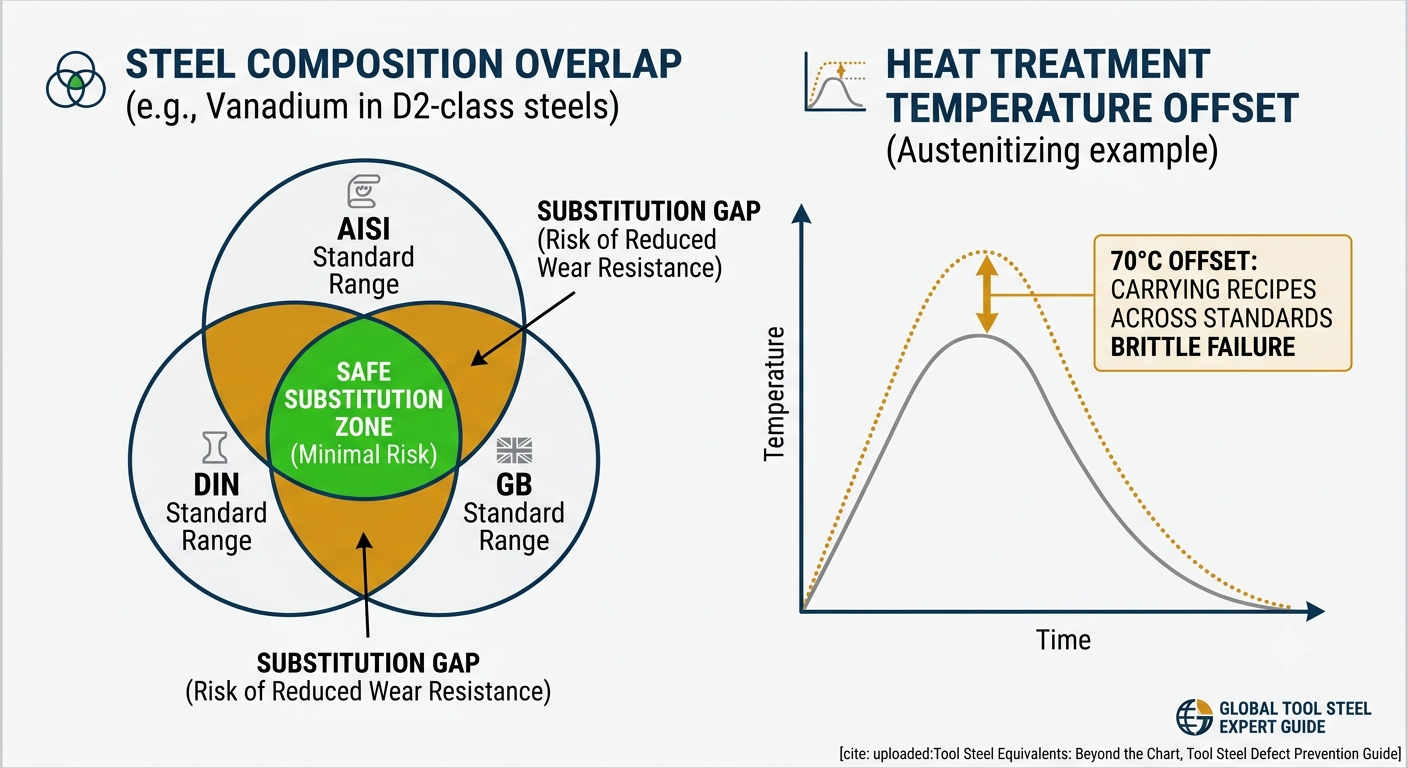
Composition Windows: Names don’t equal chemistry. AISI D2 vs. GB Cr12MoV is a prime example: Vanadium (V) content differs by a factor of 6–10. On high-cycle dies, this creates a 20–30% gap in wear life. They share a name, not a performance profile.
-
Heat Treatment: Never borrow the “recipe.” Austenitizing temperatures across the D2/1.2379/Cr12MoV group can spread by 70°C. Using the wrong parameters sacrifices toughness, leading to premature brittle fracture. Always use data specific to the material standard you purchased.
-
Mechanical Acceptance: Hardness is not quality. An HRC-only check ignores fracture toughness. ASTM 4140 vs. EN 42CrMo4 shows the danger: one may require stringent Charpy impact (KV) testing while the other remains silent.
Use charts as a search tool, not a safety guarantee. Validate your choice technically to avoid a failure analysis report.
The three-check rule before any substitution:
– Compare composition windows element by element — don’t stop at the grade name
– Source heat treatment data from the actual standard — don’t carry parameters across standards
– Confirm the acceptance spec includes impact criteria — hardness alone is not enough
A cross-reference table tells you where to start. These three checks tell you whether you can finish.
Conclusion
Tool steel standards don’t have to feel like five different languages at once. Use the right grade equivalent chart — one that covers AISI, DIN, JIS, GB, and GOST — and you can make solid substitution decisions, avoid material mismatches, and talk to suppliers anywhere without confusion.
The real takeaway? Grades don’t match across standards, not in full. Chemical compositions may overlap, but heat treatment requirements and tolerances can shift in ways that cause real production problems. Always check the spec sheet. The grade name alone isn’t enough.
Ready to use this? Bookmark this tool steel grade equivalent chart as your go-to cross-reference. The next time a supplier quotes you a DIN 1.2379 instead of your AISI D2, you’ll know what you’re getting — and whether it works for your job.
Know your steel. Own your process.