
Introduction:
In high-strength hot heading, choosing 1.2365 (32CrMoV12-28) isn’t just a premium upgrade—it is your production insurance policy.
When a die face strikes under 1,000 tons while surface temperatures spike to 600°C in milliseconds, standard H13 tool steel often fails like wax. It loses its geometric “shoulder,” softens, and collapses. Even if it survives the pressure, relentless thermal cycling breeds a “spider-web” of heat-checking cracks that force immediate line stops.
1.2365 dominates because of its metallurgical “sweet spot”: 3% Molybdenum (Mo) for red hardness and 3% Chromium (Cr) for rapid heat dissipation. It doesn’t just endure the heat; it manages it.
Below are the four hard-coded reasons why 1.2365 remains the definitive spine of high-volume, zero-defect operations.
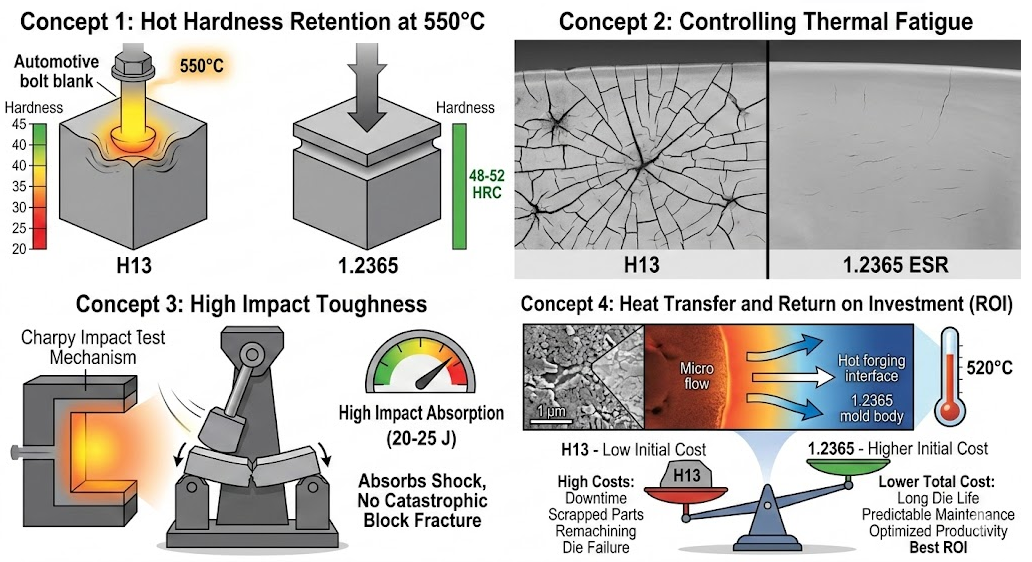
Why 1.2365 Dominates Hot Heading
Hot heading dies operate in a “metallurgical paradox.” They must withstand massive compressive loads while surface temperatures spike to 600°C in milliseconds. This rapid cycling creates intense thermal shock—expanding under heat and contracting under cooling. Most steels fail here, either softening and losing geometry or cracking under the stress.
1.2365 steel closes this gap by balancing two conflicting needs: Hot Hardness and Impact Toughness. In the automotive hot stamping market—projected to hit $35 billion by 2029—the data is undeniable:
Table 1: High-Strength Hot Heading Requirements vs. 1.2365 Performance
| Critical Requirement in Hot Heading | Typical Failure Mode in Standard Tool Steels | 1.2365 Technical Capability | Production-Level Performance Impact |
|---|---|---|---|
| Hot hardness at 500–600°C | Softening, edge collapse, mushrooming | Retains ~48–52 HRC at 550°C (properly tempered) | Maintains cavity geometry; reduces re-machining frequency |
| Extreme compressive strength | Plastic deformation under press load | Compressive strength >2000 MPa (Q&T condition) | Withstands high-tonnage presses without die collapse |
| Thermal fatigue resistance | Surface checking and crack propagation | High Mo + V content forms stable carbides | Slower crack growth under rapid thermal cycling |
| Impact toughness under dynamic load | Corner chipping, block fracture | Charpy impact energy ~20–25 J(ESR grade) | Absorbs shock loads during heading strokes |
| Dimensional stability (±0.03 mm tolerance) | Drift in cavity accuracy | Uniform hardenability, low residual stress | Maintains precision beyond 20,000 cycles |
| Deep hardenability for thick dies | Soft core, hardness gradient | Superior hardenability vs. standard H13 | Consistent martensitic structure across section |
| Wear resistance under high contact stress | Cavity wear, tolerance loss | High Cr-Mo-V carbide strengthening | Slower dimensional wear rate |
| Resistance to coolant-induced thermal shock | Sudden cracking | Balanced elongation buffer | Reduces catastrophic die block failure risk |
Table 2: Typical Mechanical & Thermal Properties of 1.2365 (Quenched & Tempered)
| Property | Typical Value |
|---|---|
| Hardness (Room Temperature) | 50–54 HRC |
| Hot Hardness at 550°C | ~50 HRC |
| Tensile Strength | 1600–1900 MPa |
| Compressive Strength | >2000 MPa |
| Charpy Impact Toughness | 20–25 J |
| Thermal Fatigue Resistance | High (superior to conventional H13) |
| Recommended Working Temperature | Up to 600°C |
| Microstructure | Tempered martensite + stable alloy carbides |
Why This Matters in Real Production
Hot heading dies operate in millisecond thermal spikes combined with massive compressive force. The true cost driver is not steel price — it’s:
- Production downtime
- Re-machining cycles
- Scrap due to tolerance drift
- Complete die block replacement
By maintaining ~50 HRC at elevated temperature while preserving impact toughness, 1.2365 effectively doubles functional die life compared to conventional H13 in high-load applications.
For high-cycle automotive or structural fastener production, it is no longer considered an upgrade — it has become the baseline material for stable, repeatable output.
Reason 1: Hot Hardness Retention (>550°C)
1.2365 tool steel retains hardness above 550°C because of a strong secondary hardening mechanism. Its ~3% molybdenum forms ultra-fine Mo₂C carbides during tempering at 500–600°C. These nano-scale precipitates pin dislocations and block slip, preventing the rapid strength loss typical of low-alloy steels.
Chromium and molybdenum also slow carbon diffusion, delaying carbide coarsening at elevated temperature. The carbides remain fine and dispersed, preserving strengthening efficiency instead of collapsing into soft, coarse particles.
Vanadium adds thermal stability through VC carbides that resist dissolution and pin grain boundaries, limiting grain growth at high temperature.
Together, secondary carbide precipitation, diffusion control, and grain-boundary anchoring allow 1.2365 to maintain compressive strength and resist geometric yielding in hot-working conditions beyond 550°C.
1.2365 Tempering Selection for Hot Heading Dies
| Tempering Temperature | Hardness Trend | Performance Under Hot Heading Load | Recommendation |
|---|---|---|---|
| 500–520°C | Higher hardness, lower toughness | Strong compressive resistance but higher crack risk | ❌ Not recommended |
| 540–560°C | Balanced hardness and toughness | Stable under full forming load and thermal cycling | ✅ Best range (550°C preferred) |
| 580–600°C | Gradual hardness drop | Increased edge wear during long runs | ⚠ Only for moderate load |
| Above 600°C | Significant softening | Plastic deformation risk under high pressure | ❌ Not suitable |
Why 550°C Works Best
Typical final hardness after double temper: 48–52 HRC
Strong hot hardness retention at working surface temperatures (~500–600°C)
High resistance to compressive yielding during impact forming
Maintains die geometry under repeated production cycles
Compared to AISI H13, 1.2365 generally maintains hot hardness more consistently in heavy-load hot heading applications.
Practical Shop Recommendation
- Use double tempering
- Minimum 2 hours per cycle
- Target final hardness: 50 ±2 HRC
- Transfer directly to tempering while still warm after quench (do not allow full room-temperature cooling)
Reason 2: Controlling Thermal Fatigue
1.2365 doesn’t rely on a single trick to stop heat checking. It survives by deploying a metallurgical “Three-Punch Combo” that minimizes thermal stress and locks cracks in the embryonic stage:
- Fast Heat Dissipation (Lower Cr): unlike H13, the reduced chromium content boosts thermal conductivity. This pulls heat away from the surface instantly, lowering the thermal gradient (ΔT) so the steel expands less.
- Strong Matrix (High Mo): The Molybdenum-rich structure creates a rigid matrix. It resists the microscopic plastic deformation that eventually tears open into a crack.
- Clean Structure (ESR): Electro-Slag Remelting removes sulfur and non-metallic inclusions. These impurities usually act as “stress risers”—the starting line for every crack.
What the Crack Data Tells Us
Research confirms that thermal fatigue isn’t linear—it accelerates. Cracks start at microscopic defects (<0.5 mm) and propagate rapidly once established. This is the critical difference in production: H13 often fails from “internal betrayal” where cracks spawn from impurities deep in the block.
By removing these initiation sites, 1.2365 forces the die to fail only through natural surface wear. You get predictable maintenance cycles instead of catastrophic, mid-shift die splitting.
Reason 3: High Impact Toughness
Hot heading dies don’t just wear out. They snap. 1.2365 gives you a safety net. It owes this to superior metallurgical cleanliness. Standard H13 contains coarse carbides. These acts as “stress risers” or starting points for cracks. 1.2365 is different. You get a fine, uniform structure instead.
How It Works: The steel gets high Fracture Toughness(K₁c) because it lacks internal defects. A heading stroke creates massive impact. The clean matrix soaks up that energy through micro-yielding. It does not snap or separate. Even at 50 HRC, the steel stays ductile enough. This stops a surface crack from spreading through the block.
Impact Resistance Comparison (Standard Die Hardness)
| Property | H13 (Standard) | 1.2365 (Optimized) | Real-World Consequence |
|---|---|---|---|
| Charpy Impact (V-Notch) | 12–18 Joules | 20–28 Joules | It takes heavy hammer blows without shattering. |
| Fracture Mode | Brittle (Sudden) | Ductile (Gradual) | You get warning signs before failure. Operators stay safer. |
| Crack Sensitivity | High at corners | Low | It resists cracks at sharp corners and deep spots. |
Reason 4: Superior Thermal Conductivity
Thermal conductivity acts as the die’s internal cooling pump. In high-speed hot heading, heat accumulates faster than standard steels can dissipate it. If heat gets trapped at the surface, the result is inevitable: extreme thermal expansion, localized stress spikes, and rapid heat checking.
1.2365 offers a structural advantage: unlike H13, which loses conductivity as it heats up, 1.2365 maintains efficient heat transfer even at 600°C. This ensures heat exits the tool face before it causes irreversible damage.
Thermal Conductivity Comparison (at 600°C Working Temp)
| Steel Grade | Conductivity (W/m·K) | Impact on Hot Heading |
|---|---|---|
| H13 (1.2344) | ~27.0 | Traps heat; accelerates surface cracking. |
| 1.2365 | ~33.0 | Rapid heat removal stabilizes die geometry. |
| 1.2367 | ~30.0 | Good, but often limited by lower toughness. |
Why This Statistic Defines Profitability:
- The “Safe Zone” Value: For high-load hot heading, target a conductivity of >32 W/m·K. 1.2365 hits this mark, keeping the surface skin temperature below the critical softening point.
- Faster Cycle Times: Because the steel sheds heat faster, you can reduce dwell time between strikes without overheating the die, directly increasing parts-per-hour output.
- Cooling System Synergy: Efficient internal transfer reduces the need for aggressive, super-chilled coolant. This lowers the thermal shock gradient (Delta-T) between the steel surface and the core, preventing catastrophic block failure.
Critical Heat Treatment Protocol
- Step-Heating: Heat to 400°C → Hold (30 min per 25mm) → Ramp to 550–650°C.
Reason: Equalizes temperature to prevent thermal stress cracks. - Critical Welding Rule: Keep temp >300°C constantly.
Reason: Dropping below this triggers immediate process failure. - Hardening: Austenitize at 1010–1050°C → Quench (Air/Oil/Warm Bath).
Target: 44–54 HRC for optimal durability. - Tempering Sequence (Double/Triple Required):
1. Cool to 100–150°C → Hold 1–2 hours (Pass Ms point).
2. Immediate Temper at 520–550°C (Stabilize structure).
Reason: Converts brittle retained austenite into tough martensite. - Post-Weld Cooling: Furnace cool at ≤2°C/min.
Reason: Prevents hydrogen trapping and delayed checking. - Peening: Perform only above 350°C.
Reason: Peening below this temp adds stress instead of relieving it.
Steel Grade Comparison: 1.2365 vs. Alternatives
Finding the “ultimate” die steel isn’t about chasing the highest theoretical numbers—it’s about ROI. While H13 serves as the budget baseline, it notoriously softens and cracks under aggressive hot heading loads. On the other end, super-grades like QRO 90 offer extreme performance but at a cost that often kills the project margin.
1.2365 (32CrMoV12-28) dominates the middle ground. It vastly outperforms H13 in thermal stability (Red Hardness) while maintaining better toughness than the more brittle 1.2367. This balance makes it the calculated choice for high-volume production: it survives the heat without breaking the budget.
| Steel Grade | Red Hardness (>550°C) | Heat Checking Resistance | Toughness | Overall Value |
|---|---|---|---|---|
| H13 (1.2344) | Low | Moderate | Good | Basic Entry |
| 1.2365 (Ultimate Choice) | High | Excellent | Excellent | Best ROI |
| 1.2367 | Very High | High | Moderate | Expensive |
| QRO 90 | Extreme | Extreme | High | Premium Niche |
Conclusion
Every hot heading die fails — the question is whether it fails on your timeline or the steel’s.
1.2365 gives you a clear answer. It holds hardness at 550°C. It shrugs off thermal fatigue cracking. It absorbs impact without fracturing. And it works with your cooling system, not against it. You won’t find that combination in standard H13. This is a steel built for one of the harshest environments in metal forming.
Still running H13 on high-cycle hot heading? You’re not saving money. You’re trading material cost for downtime — and downtime costs more.
The next step is simple:
- Pull your current die failure data
- Cross-reference it against the property benchmarks covered here
- Talk directly with your steel supplier about 1.2365 specification and heat treatment requirements
The right steel doesn’t just extend die life. It raises the ceiling on what your production line can do.