
Introduction
That phone call from a furious customer holding a shattered die is a nightmare for any tool steel stockholder. You check the paperwork, only to realize the truth too late. Some suppliers still play games with Mill Test Certificates (MTCs)—refusing to provide original documents, hiding behind vague specs, or handing you a forged PDF.
When substituted steel fails on the shop floor, you pay the price in claims and damaged reputation. Importing tool steel goes beyond negotiating a good price; you need to know exactly what slips through between your purchase order and the container seal.
Below, we break down the five critical quality risks you must check before importing. You’ll learn how to spot fake chemistry, catch internal defects, and reject bad batches before you wire that final payment.
Understanding the Tool Steel MTC
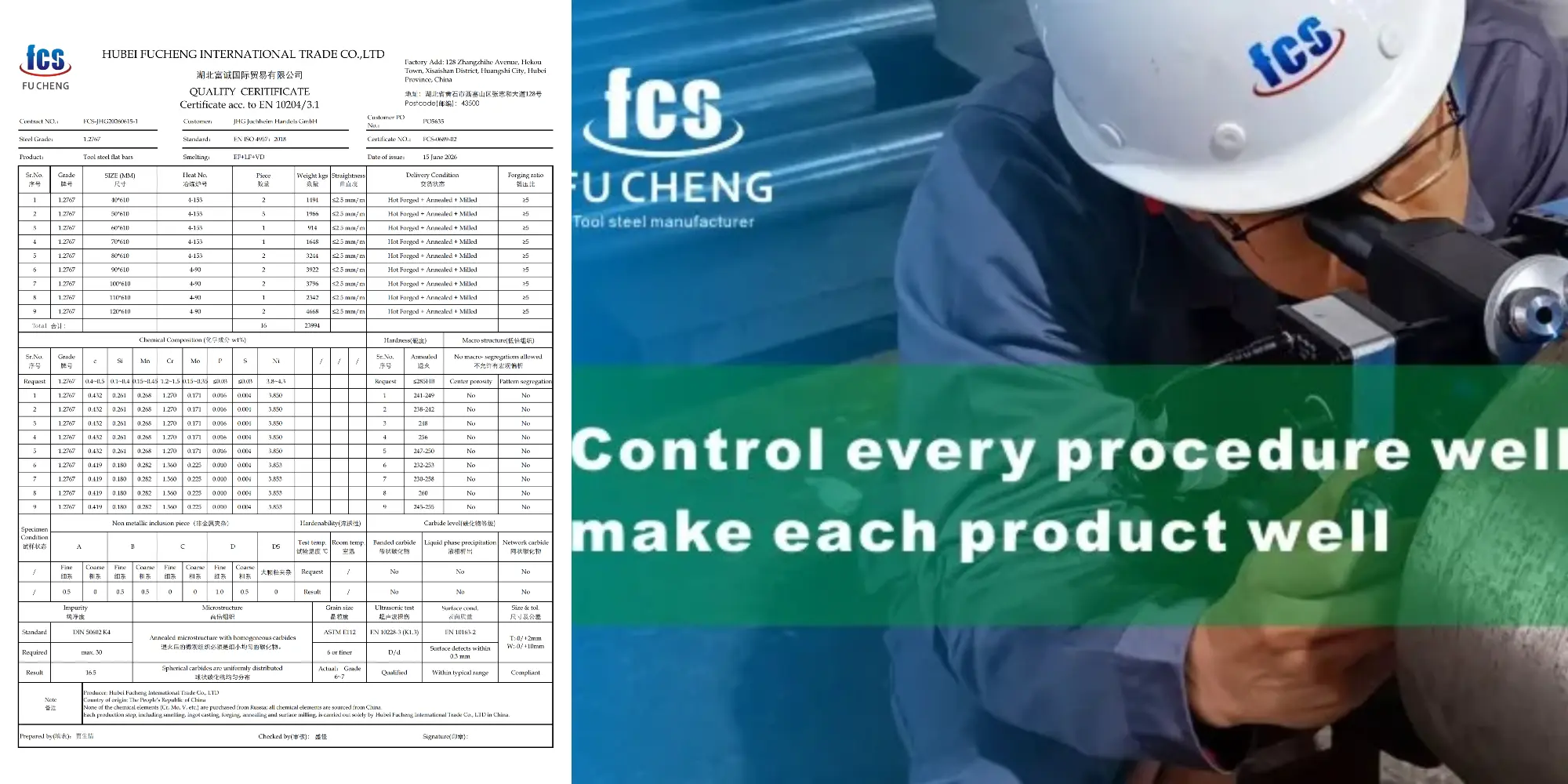
An MTC is your steel’s passport. A vague or incomplete certificate is a massive red flag. Here is exactly what a qualified tool steel MTC must include:
- Heat Number: The absolute foundation of traceability. This must perfectly match the physical stamp on your steel blocks.
- Chemical Composition: Your primary defense against grade substitution, verifying you are getting pure D2 or H13, not a cheaper alloy.
- Melting Method (e.g., ESR or EAF): Dictates the steel’s fundamental purity. Premium die blocks require specific melting routes.
- Delivery Condition: Specifics like annealed hardness confirm the material is ready for your CNC machining.
- Internal Testing Data: UT (Ultrasonic Testing) standards, grain size, and non-metallic inclusion ratings prove the steel won’t shatter under stress.
How to Spot Fake MTCs
If a supplier drags their feet on providing the original MTC, they likely have something to hide. Common frauds include tweaking a PDF to make a basic alloy look like premium D2, or reusing an old heat number for an untested batch.
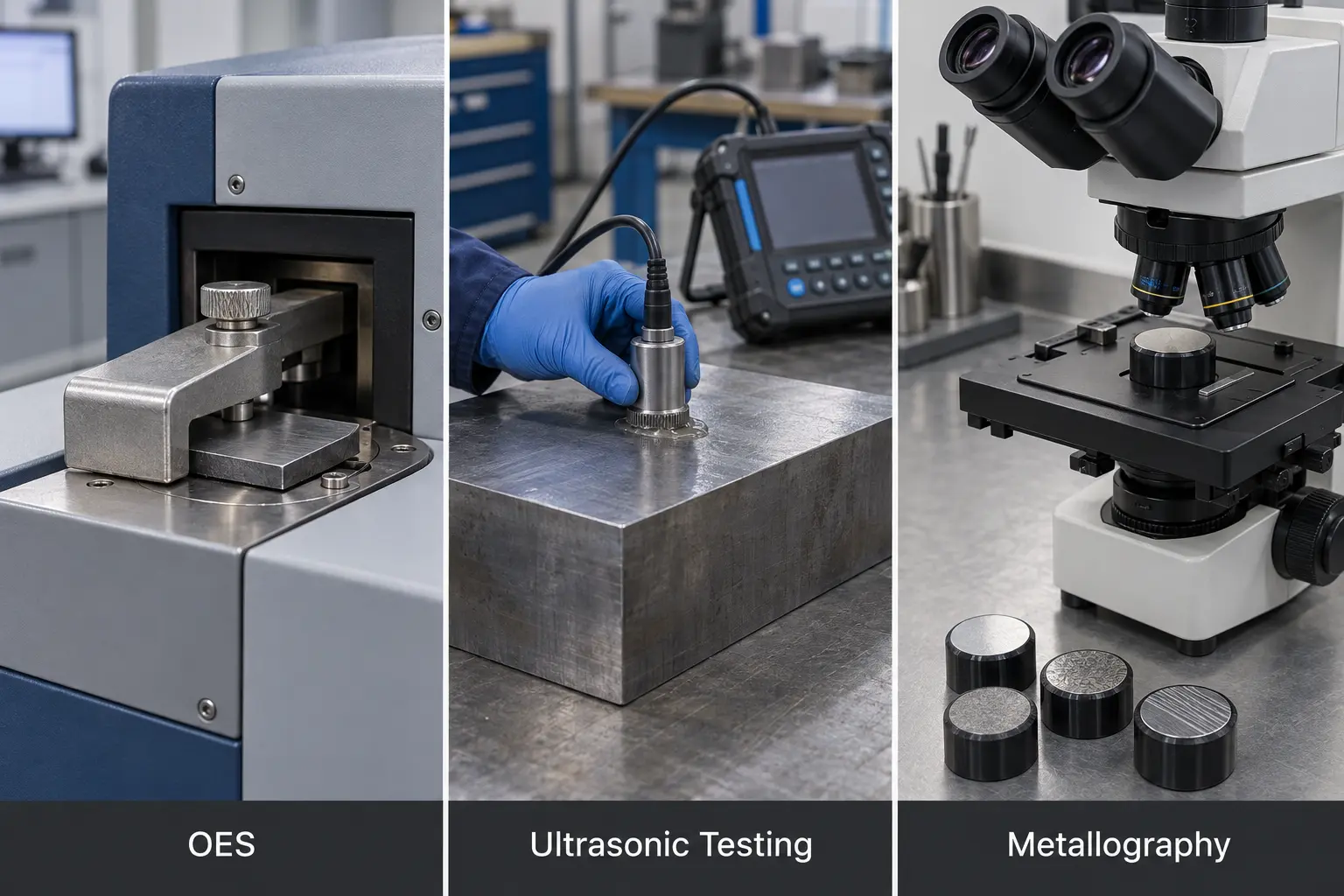
Always start with the heat number. If it doesn’t match the hard stamp on your block, stop right there. Since paper can be faked, the only foolproof verification is insisting on third-party PMI testing before the container seals. A defensive supplier is a dead giveaway.
MTC Verification Checklist
If a certificate misses these specific details, you are accepting blind risk.
| Critical Checkpoint | Specific Details You Must Verify |
|---|---|
| 1. Traceability | The Heat Number must 100% match the physical hard stamp. No exceptions. |
| 2. Chemical Composition | Check core elements (C, Cr, Mo, V) against ASTM/DIN standards. Sulfur (S) and Phosphorus (P) must be ≤ 0.030%. |
| 3. Melting Method | Look for EAF+LF+VD for standard tool steel, or ESR for premium mold/die blocks. |
| 4. Delivery Condition | Verify annealed hardness (e.g., ≤ 255 HB for D2) to protect your tooling. |
| 5. Internal Cleanliness | Must list passed UT standards (e.g., SEP 1921 class C/c) and inclusion ratings. |
Risk 1: Grade Substitution & Fake Chemistry
Grade substitution is rampant. The most common scheme? Swapping genuine D2 (requiring ~1.0% Mo and ~1.0% V) with Cr12MoV, a lower-tier alloy with only ~0.4% Mo and 0.2% V. This quiet swap saves the supplier up to 30%, but the truth comes out when the die shatters under heavy stress.
The “mid-batch swap”—sneaking cheaper alloys into the second half of your order—happens constantly. Never rely solely on paper. Lock down exact ASTM/DIN chemistry limits in your PO, forbid “equivalent” grades, and insist on third-party PMI testing (using OES) before shipping.
Risk 2: Internal Defects & Poor Cleanliness
Tool steel can look flawless outside while hiding a ticking time bomb inside. For large blocks, elemental segregation is the ultimate killer. Poor shroud sealing during casting adds oxygen, feeding massive non-metallic inclusions.
Reputable mills fix this using “soft reduction” during solidification, cutting centerline segregation and porosity by up to 80%. Don’t settle for a basic chemistry sheet. Mandate third-party Ultrasonic Testing (UT) to standards like SEP 1921 class C/c.
Risk 3: Surface Cracks & Decarburization
Surface cracks are usually symptoms of deep decarburization, which strips surface hardness and kills fatigue resistance. This happens when mills lose temperature control—steel held at 750–850°C is extremely susceptible to carbon loss.
Standard heat treatment won’t fix a decarburized layer; you have to waste machining time grinding it away. Test rigorously using transverse sections etched with nital per EN ISO 3887, and measure surface carbon loss with ASTM E1077.
Risk 4: Batch Inconsistency & Traceability
Final QC won’t fix a melting error made three weeks ago. Lock down your supply chain with these rules:
- Mandate Lot Segregation: Stop factories from secretly mixing different production runs to save costs.
- Cross-Check Paperwork: Match physical batch numbers against lab reports line by line.
- Know Your AQL Limits: Standard AQL 2.5 does not guarantee defect-free steel. It only works if the supplier’s true process average is sound.
- Audit for Proof: Missing WIP labeling or documented batch testing means they have no real process control. Walk away.
Risk 5: Heat-Treatment & Hardness Failures
A simple Rockwell hardness number tells you almost nothing about what is happening deep inside the core. Hidden decarburization triggers false surface readings, while unseen under-tempering leaves a block dangerously brittle.
FCS tool steel goes beyond surface testing to protect your margins:
- Deep Metallographic Analysis: We analyze the internal structure after quenching—verifying carbide distribution and residual austenite. If the core is compromised, it doesn’t ship.
- Grade-Specific Precision: We hit exact contract specs. Our 1.2083 (420SS) tool steel consistently delivers 53–56 HRC, and our 1.2550 tool steel hits a strict 58–62 HRC.
- Custom Process Control: We adjust heat-treatment parameters based on your specific mold size and service conditions, proving uniformity through metallography.
Conclusion
The moment the container seal snaps shut, the risk is entirely yours. Paperwork can be faked, and standard tests won’t reveal internal flaws. Don’t wait for a shattered die to realize you trusted the wrong mill.
We verify the chemistry, internal structure, and heat treatment before the metal ever leaves our dock. Ready for tool steel you can actually trust? Contact FCS today with your exact specifications, and let’s protect your next shipment.