
Introduction: Tool Steel Standards Explained
International tool steel standards confuse many buyers. Mismatched names make sourcing hard. But here is the simple fact: DIN 1.2365 works exactly like AISI H10 and JIS SKD7 steel.
These Chromium-Molybdenum-Vanadium hot work steels are built the same way. The material handles extreme heat well. You get resistance to thermal fatigue, and it stays hard above 500°C. So, shops choose them for heavy forging dies and extrusion tools. They also handle aggressive water cooling without issues.
We connect the dots for you. Check our precise cross-reference tables, chemical details, and property comparisons. Need to swap materials or check supplier specs? You get the exact technical data right here. Make your choices with confidence.
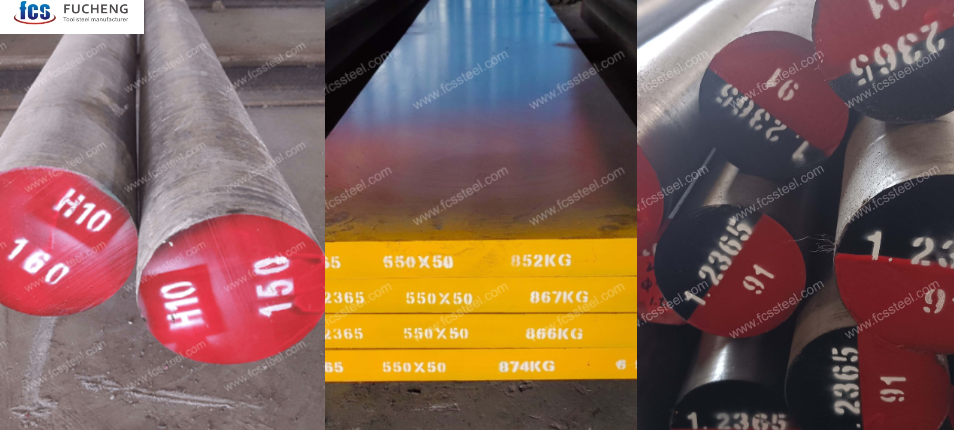
Global Equivalents Cross-Reference Guide
Different countries use different naming systems for the same steel. The material composition stays the same, but the designation changes based on regional standards.
Quick Reference: Global Equivalent Grades
| Standard | Designation | Alternative Code |
|---|---|---|
| DIN (Germany) | 1.2365 | X32CrMoV3-3 / 32CrMoV12-28 |
| AISI (USA) | H10 | T20810 |
| JIS (Japan) | SKD7 | – |
| BS (UK) | BH10 | – |
| AFNOR (France) | 32DCV28 | (partial match via composition) |
| GB (China) | 4Cr3Mo3SiV | – |
You can swap these grades for hot work applications. They use the same chromium-molybdenum-vanadium alloy system. You get matching performance in thermal fatigue resistance and high-temperature hardness retention.
Understanding the Naming Logic
Each standard follows its own naming convention:
- DIN 1.2365: Numeric material code. The alternative name “32CrMoV12-28” shows the chemistry. It contains 0.32% carbon, chromium, molybdenum, and 0.12-0.28% vanadium.
- AISI H10: “H” means hot work category. “10” is the sequence number in this series.
- JIS SKD7: “S” stands for tool steel. “K” means special steel. “D” indicates die steel. “7” is the grade number.
- AFNOR 32DCV28: This describes composition. It has 0.32% carbon. “D” marks chromium. “C” marks molybdenum. “V” marks vanadium. “28” represents vanadium range.
- GB 4Cr3Mo3SiV: Chinese standard lists major elements. It has 0.4% carbon, 3% chromium, 3% molybdenum, plus silicon and vanadium.
Ask international suppliers for both the local designation and the material number. This prevents confusion during procurement and quality inspection.
Chemical Composition: DIN 1.2365 vs. AISI H10 vs. JIS SKD7
DIN 1.2365, AISI H10, and JIS SKD7 have small chemical differences. These changes impact how your tool performs on the job.
Element-by-Element Breakdown
Here’s the full composition comparison:
| Element | DIN 1.2365 | AISI H10 | JIS SKD7 |
|---|---|---|---|
| C (Carbon) | 0.35-0.45% | 0.35-0.45% | 0.28-0.35% |
| Si (Silicon) | 0.80-1.25% | 0.80-1.25% | 0.10-0.40% |
| Mn (Manganese) | 0.20-0.70% | 0.20-0.70% | 0.15-0.45% |
| Cr (Chromium) | 3.00-3.75% | 3.00-3.75% | 2.70-3.20% |
| Mo (Molybdenum) | 2.00-3.00% | 2.00-3.00% | 2.50-3.00% |
| V (Vanadium) | 0.25-0.75% | 0.25-0.75% | 0.40-0.70% |
| P (Phosphorus) | ≤0.030% | ≤0.030% | ≤0.030% |
| S (Sulfur) | ≤0.030% | ≤0.030% | ≤0.030% |
Key Chemical Differences & Performance Impact
- DIN 1.2365 / AISI H10 (High C & Si)
- Carbon (0.35-0.45%): You get maximum base hardness. It resists wear during long runs.
- Silicon (0.80-1.25%): Forms a protective oxide layer. Heat resistance improves above 500°C.
- Chromium (3.0-3.75%): Boosts deep hardenability. Works perfectly for water-cooled dies.
- JIS SKD7 (Lower C, Optimized V)
- Carbon (0.28-0.35%): Less carbon means more ductility. The tool won’t snap under heavy hammer blows.
- Silicon (0.10-0.40%): Prioritizes impact toughness over oxidation resistance.
- Molybdenum (2.50-3.00%): Tighter range ensures consistent heat treatment results every time.
Performance Impact Summary
| Standard | Best For | Key Advantage |
|---|---|---|
| AISI H10 | Die casting, water-cooled tools | Best heat resistance (high Si/Cr) |
| DIN 1.2365 | General hot work, extrusion | Balanced properties, easy to find |
| JIS SKD7 | Impact forging, heavy-duty dies | Best toughness (lower C, optimized V) |
Mechanical & Physical Properties Comparison
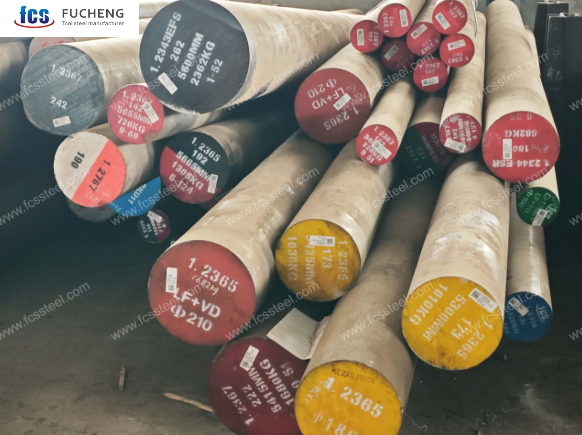
DIN 1.2365, AISI H10, and JIS SKD7 share a Chromium-Molybdenum-Vanadium base. So, their baseline mechanical and physical values look much the same. But small chemical tweaks change how they handle stress.
1. Mechanical Properties (Strength & Hardness)
| Property | DIN 1.2365 / AISI H10 | JIS SKD7 |
|---|---|---|
| Working Hardness (HRC) | 50 – 54 HRC | 48 – 52 HRC |
| Delivery Hardness | Max 229 HB (Soft Annealed) | |
| Yield Strength (Rp0.2) | ≥ 780 MPa | ≥ 730 MPa |
| Tensile Strength (Rm) | ≥ 1000 MPa | ≥ 980 MPa |
| Elongation | ≥ 12% | ≥ 15% (Higher Toughness) |
| Elastic Modulus | 207 GPa (at 20°C) | |
📝 Note on Differences:
- JIS SKD7 uses less Carbon (0.28-0.35%) than DIN/AISI (0.35-0.45%). You get lower peak hardness, but better elongation and impact toughness. It flexes rather than snaps under hammer blows.
- DIN 1.2365 / AISI H10 focus on heat resistance and wear strength. They offer more strength but less ductility.
2. Physical Properties (Thermal Behavior)
| Property | Condition | Common Value (All Grades) |
|---|---|---|
| Density | 20°C | 7.85 g/cm³ |
| Thermal Conductivity | 20°C 600°C |
33.0 W/m·K 32.0 W/m·K |
| Specific Heat Capacity | 20°C | 460 J/kg·K |
| Thermal Expansion (Coefficient 10⁻⁶/K) |
20 – 100°C | 11.7 |
| 20 – 300°C | 12.7 | |
| 20 – 500°C | 13.5 |
📝 Note on Thermal Nuance:
DIN 1.2365 and AISI H10 hold more Silicon (0.80-1.25%) than JIS SKD7 (0.10-0.40%). That silicon creates a protective oxide layer. It gives you better oxidation resistance at high temperatures (red-hot conditions). Base conductivity figures stay similar.
Heat Treatment Process
Heat treatment decides if your tool succeeds or fails under pressure. The process changes 1.2365 tool steel from soft stock into a hardened die. This die resists thermal fatigue and wear. All equivalent grades—DIN 1.2365, AISI H10, JIS SKD7, and BS BH10—follow the same heat treatment steps. Only minor regional differences exist.
| Process Step | Temperature Range (°C) | Target Property / Result |
|---|---|---|
| Soft Annealing | 750 – 790°C | Max 229 HB (Machinable State) |
| Stress Relieving | 600 – 650°C | Removes machining tension |
| Hardening | 1010 – 1050°C | 52 – 56 HRC (After Quench) |
| Tempering | 538 – 650°C | 50 – 52 HRC (Working Hardness) |
Process Summary & Key Differences
The goal here is simple: convert the steel’s structure to resist “thermal checking” (cracks caused by rapid heating and cooling). Double tempering is mandatory. The first cycle secures maximum hardness, while the second stabilizes the dimensions so your die doesn’t warp during production.
Are all grades treated equally? Mostly, yes, but with small nuances:
- AISI H10 & DIN 1.2365: Due to higher carbon and silicon, these respond well to the higher end of the austenitizing range (1040°C). This maximizes heat resistance for water-cooled applications.
- JIS SKD7: With slightly lower carbon, this grade favors the lower temperature range (~1020°C). This approach preserves its superior impact toughness, making it ideal for hammer forging where flexibility beats pure hardness.
Performance & Key Advantages
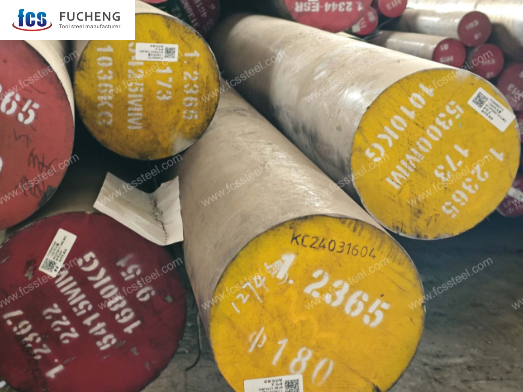
All global versions of 1.2365 tool steel work the same in hot work jobs. DIN 1.2365, AISI H10, JIS SKD7, or BS BH10 – they all share core traits. The chromium-molybdenum-vanadium mix gives identical heat fatigue resistance, hot hardness, and strength across all standards.
Comparative Performance Matrix
| Feature | DIN 1.2365 / AISI H10 (High Carbon/Silicon) |
JIS SKD7 (Lower Carbon/Silicon) |
|---|---|---|
| Wear Resistance | Excellent. Higher carbon (0.40%) creates harder carbides for abrasive jobs. | Good. Slightly softer matrix wears faster in high-volume runs. |
| Impact Toughness | Good. Can handle standard press loads. | Superior. Lower carbon structure flexes under hammer blows without snapping. |
| Heat Checking Resistance | Very High. High Silicon forms a protective oxide layer at >500°C. | High. Resists cracking well, but oxidation starts sooner than H10. |
| Softening Resistance | High. Holds ~50 HRC up to 600°C due to Silicon stability. | Moderate-High. Begins to soften slightly earlier under sustained heat. |
| Water Cooling Safety | Safe for Both. High thermal conductivity (~32 W/m·K) allows water cooling unlike Tungsten steels. | |
Summary: 1.2365 Series vs. Tungsten Steels
Regardless of which equivalent you choose, this entire family beats older Tungsten-based hot work steels (like H21) in three ways:
- No Brittle Failures: Tungsten steels snap under shock; 1.2365 grades absorb usage.
- Water Cooling: You can water-cool 1.2365/H10 dies mid-cycle. Do that to H21, and it cracks instantly.
- Surface Quality: Better resistance to thermal fatigue means fewer “lizard skin” cracks on your die surface.
Which Standard Fits Your Application
Industries pick specific standards based on where they are and what works:
1. European makers prefer DIN 1.2365 for water-cooled forging tools and extrusion dies. This standard leads in automotive and heavy machinery work. Common uses: closed-die forging, mandrels, die holders, and dummy blocks.
2. American plants specify AISI H10 for hot punches, aluminum die casting dies, and forging jobs that need water cooling. Aerospace and metal processing sectors depend on this grade for high-temp strength with low distortion during heat cycles.
3. Japanese toolmakers use JIS SKD7 in heavy impact forging work. The carbon content (0.28-0.35%) runs lower compared to other versions. This boosts shock absorption. SKD7 works great for gripper dies, header dies, and punches that take repeated hits plus thermal cycling.
All three standards hold 50-52 HRC working hardness. They polish well for smooth die surfaces. Pick based on supplier location and local material certifications. Performance stays the same no matter where you buy.
Material Selection Guide: Choosing 1.2365
Know your operating conditions first. That’s how you pick the right hot work tool steel. 1.2365/H10/SKD7 performs best in specific scenarios where other grades fail.
1. Temperature Range: The Primary Decision Factor
Use 1.2365/H10/SKD7 for working temperatures ≤500-550°C. The steel keeps 50-52 HRC hardness across this range. Hot strength stays consistent. The molybdenum content (2.25-3.00%) stops softening during continuous thermal cycling.
Above 600°C, go with H13/SKD61. These grades hold hardness better at extreme temperatures. H13 works best for large die casting molds. It also handles tools facing sustained heat above 550°C.
Impact and Pressure Loading Applications
High-impact forging needs 1.2365/H10/SKD7. The toughness beats all chromium-based hot work steels. Your tools survive:
- Hammer forging of aluminum and magnesium parts (44-48 HRC working hardness)
- High-pressure die operations where shock loads hit again and again
- Fast-cycle forging where dies take thermal and mechanical stress at the same time
Elongation of ≥14% absorbs impact energy. This stops brittle fractures that crack H11 and H13 under similar conditions. The fine grain structure cuts fatigue failure during millions of cycles.
2. Water Cooling Capability: A Decisive Advantage
Need water cooling? Go with 1.2365/H10/SKD7. Thermal conductivity of ~32 W/m·K sits 23% higher than H11/H13 (~26 W/m·K). Heat moves away from die surfaces faster.
The steel handles aggressive water spray during operation. No thermal fatigue cracking occurs. Tungsten-based hot work steels break under the same cooling stress.
Water cooling works great for:
- High-speed aluminum forging dies (cycle times under 10 seconds)
- Brass and copper extrusion tooling
- Pressure casting molds for non-ferrous metals
- Hot punches in water-cooled environments
3. Cost Efficiency Through Extended Tool Life
Machinability rates at 90-95% of 1% carbon steel. You machine complex features faster than H11 or H13. This cuts pre-hardening labor costs by 10-15%.
Deep hardenability reaches ~5 inches (127mm). Large cross-sections harden uniformly. You avoid soft cores that cause early die failure.
Superior thermal conductivity plus toughness extends mold life 30-50% longer than H11 in impact applications below 550°C. Lower replacement frequency means fewer production stops.
4. Skip 1.2365/H10/SKD7 in These Cases
Avoid this grade for:
- Sustained temperatures above 600°C – H13/SKD61 performs better
- Massive die blocks needing extreme hardenability – H13 has superior depth hardening
- Static loading with minimal thermal cycling – Standard chromium steels cost less
Match the steel to your exact working conditions. Temperature, cooling method, and impact level make the difference.
Machinability and Processing
Machining 1.2365 (or AISI H10/JIS SKD7) is straightforward if you follow the correct sequence. In its annealed state (max 229 HB), it machines roughly 10-15% faster than H13 tool steel.
Processing Steps
Step 1: Soft Machining
Perform all rough milling, drilling, and turning while the steel is annealed. Standard high-speed steel (HSS) or TiN-coated carbide tools work perfectly.
Step 2: Stress Relieving (Crucial)
After removing heavy stock, heat the part to ~650°C. This releases internal tensions and prevents the die from warping during the final hardening.
Step 3: Hardening
Heat treat the tool to your target working hardness (typically 50-52 HRC).
Step 4: Finish Machining
Once hardened, switch methods. Use EDM (Electrical Discharge Machining) for complex details or precision grinding for final dimensions. Do not attempt standard milling at this stage.
💡 Pro Tip: Avoid Grinding Burns
When grinding the hardened steel, always use distinct coolant flow. Dry grinding or insufficient cooling creates surface heat spikes. This leads to “grinding burns”—micro-cracks that are invisible to the eye but will cause the die to fail prematurely under load.
Conclusion
DIN 1.2365, AISI H10, and JIS SKD7 are functionally interchangeable. Sharing the same chromium-molybdenum-vanadium chemistry, they all deliver superior thermal fatigue resistance and impact toughness compared to tungsten-based steels.
The choice between them typically comes down to regional availability rather than performance differences. For high-stress applications like forging dies and extrusion tools, any of these grades offers reliable performance. Focus on proper heat treatment to maximize tool life, and verify specific delivery conditions with your supplier to ensure the material meets your exact production requirements.