
A hot stamping die that cracks ahead of schedule costs thousands of dollars. Downtime piles up. Replacement parts drain the budget. Production targets get missed.
For automotive manufacturers running high-volume press-hardening lines, that’s not a risk worth taking. Most trace the problem back to one root cause: the wrong tool steel.
That’s why so many hot stamping operations have moved to 1.2365 tool steel. It delivers longer die life — especially in applications where H13 loses performance above 600°C.
Below, you’ll find six specific metallurgical and performance reasons behind that shift. These are the details that help you pick a material you can stand behind at 50,000 cycles — no second-guessing required.
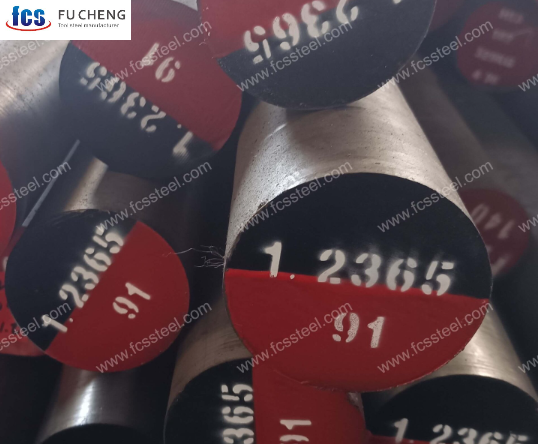
Why Hot Stamping Dies Fail
Die failure in hot stamping isn’t random. It follows a pattern. Once you see the pattern, the material selection problem becomes clear.
End-of-life analysis on hot stamping dies processing 22MnB5 AlSi-coated blanks shows the same cluster of failure mechanisms every time: adhesive wear, impact wear, abrasive wear, and crack propagation — all concentrated in high mechanical stress zones. Thermal fatigue takes the blame most often. But the data tells a different story. The real killers are mechanical stress and plastic deformation. These forces eat away at hardness long before any visible cracking shows up.
Here’s what that looks like in numbers. A new die enters service at 59 HRC in low-stress regions. By end-of-life, hardness in high-stress contact zones can collapse to 20 HRC. That’s not surface damage. That’s overtempering — driven by repeated blank contact at temperatures reaching 190°C. Hardness drops. Wear speeds up. Heat transfer degrades. Then you start seeing hot spots — the slow quench signature of a die that’s losing the fight.
The cascade runs like this:
- Coating buildup and erosion slow the quench rate
- A slower quench creates inconsistent part hardness
- High mechanical stress regions build up compressive residual stresses and tensile crack starting points
- Cracks near blank contact positions grow — sometimes pulling material clean out of the die face
Generic steels like H13 are not built for this environment. They weren’t made for the thermal and mechanical extremes of press-hardening 1500+ MPa UHSS. The quench rates, the coating erosion, the friction instability — H13 handles them for a while, then makes them worse.
Advanced tool steels change the equation. Grades built for hot stamping hold thermal conductivity stable — dropping less than 10% between 400°C and 600°C. They also keep friction coefficients from breaking down during the critical first 500 seconds of coating interaction. That stability is the difference between a die running 800,000+ cycles on a rear anti-collision beam and one that’s back on the maintenance bench at a fraction of that count.
Material choice isn’t one variable among many. It’s the variable everything else depends on.
Reason 1: Superior Hot Hardness Above 600°C
At 650°C, H13 isn’t failing with a bang. It’s just quietly giving up.
That distinction matters. Catastrophic failure is easy to spot. Gradual softening is different — it hides in your scrap rates and rework hours. By the time anyone checks the die, the damage is already done.
Here’s the physics. H13 gets its hot hardness from secondary carbide precipitation. Think of it as a network of Mo, V, and Cr carbides. These form during tempering above 500°C. They hold the steel’s internal structure together under heat. It works well — up to a point.
That point is 540°C. Hot stamping dies regularly hit surface temperatures well above that. Push past 540°C, and those carbides start breaking down back into the steel matrix. The internal support structure disappears. The steel softens.
The numbers tell a clear story:
| Tempering Temperature (°C) | H13 Hardness (HRC) |
|---|---|
| 500 | 56 |
| 550 | 54 |
| 600 | 51 |
| 650 | 43–38 |
From peak hardness to 38 HRC in just 150°C. That’s not a cliff — it’s a slope. But your die rides that slope every single cycle.
1.2365 is built for a different altitude. Its alloy makeup — Mo at 2.6–3.0%, V at 0.4–0.7% — produces heat-stable MC and M6C carbides. These resist breakdown past 650°C. The result: 5–10 HRC higher hardness retention at temperatures where H13 is already losing ground.
That hardness gap leads straight to dimensional stability. Softened H13 die faces under stamping pressure produce 0.1–0.5 mm geometry deviations per 1,000 cycles. Door rings and B-pillars carry tolerances of ±0.2 mm. So that deviation isn’t acceptable variation — it’s a failed part.
Industry data is clear on the outcome:
– H13 dies running at 650°C start missing dimensional requirements past 10,000 cycles
– Premium-grade steels like 1.2365 hold tolerances past 20,000 cycles under the same conditions
Half the cycle count. That’s what choosing the wrong steel actually costs you.
Reason 2: Enhanced Thermal Fatigue Resistance
Thermal fatigue doesn’t announce itself. It builds up cycle after cycle — silently — until your die surface looks like a road map of hairline cracks.
That’s heat checking in action. A hot blank contacts the die face. Surface temperatures spike. Cooling water runs through the channels. Temperatures drop. The steel expands. The steel contracts. Run that sequence tens of thousands of times, and cyclic thermal stress will exceed the material’s fatigue threshold. Micro-cracks form at the surface and push inward. Plastic deformation makes it worse — it speeds up the whole process.
The Numbers Behind the Damage
Thermal fatigue research points to one clear finding: the worst damage hits early.
Controlled cycle testing — heating from 20°C to 750°C at 25°C/min, holding for 5 minutes, then cooling — shows that modulus of elasticity and tensile strength drop fastest within the first 0–10 cycles. Not after thousands of cycles. The first ten.
That early drop sets the whole trajectory. A material that loses strength fast in the opening cycles carries that structural weakness through every stamping event that follows.
Low-cycle thermal fatigue benchmarks show the full scale of the problem:
- Materials running at low frequency reach failure in fewer than 10,000 cycles
- Crack initiation from constrained thermal expansion can start before 50,000 cycles
For a high-volume hot stamping line, 10,000 cycles is not a die life. It’s a short production run at best.
Why 1.2365 Outperforms Standard Grades
1.2365 is not immune to thermal cycling. No steel is. But its alloy composition — with higher molybdenum content as the key factor — gives it a more stable microstructure under repeated thermal shock than standard hot work steels.
The Mo-rich carbide network resists grain boundary weakening. That weakening is what drives micro-crack growth. So a denser carbide structure slows the whole process down. Test cycles of 65 seconds at 700°C followed by 15 seconds of water cooling reflect real production conditions. Under that kind of stress, a stable carbide structure means cracks start later and grow slower.
Slower crack growth means more cycles before your die needs maintenance. In high-volume automotive production, that’s not a minor gain. It’s the difference between a die that pays for itself and one that doesn’t.
Reason 3: Wear Resistance Under Heat & Pressure
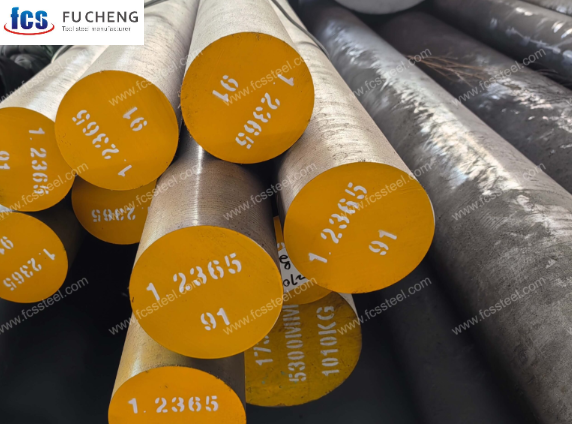
Contact pressure in a hot stamping die isn’t gentle. Blanks hit the die face at 150–300 MPa while still sitting at 600–900°C. That combination — extreme heat, extreme pressure, sustained contact — ranks among the most aggressive wear environments in industrial metalworking.
Most tool steels don’t hold up. They soften under the heat, lose surface hardness, and the contact pressure does the rest. Material transfers. Surfaces gall. Wear builds into a feedback loop that’s hard to stop once it starts.
Understanding High-Temp Wear
High-temperature wear doesn’t follow the same rules as room-temperature sliding wear. The mechanics shift entirely.
Above a certain heat range, adhesive wear takes over. Metal-to-metal contact under pressure pulls material from one surface to another. The harder and more heat-stable the die face, the less material it gives up. But there’s a second factor: oxide layer behavior.
Studies on high-temperature wear show the same pattern again and again. Above certain temperature thresholds, protective oxide layers form on contact surfaces. These oxides act as a partial lubricant. They cut the friction coefficient. They slow adhesive wear. The steels that benefit most are the ones with Cr, Mo, and V in their alloy mix — which is exactly what 1.2365 brings.
The Role of Oxide Layers
1.2365’s composition — Cr at 2.7–3.2%, Mo at 2.6–3.0%, V at 0.4–0.7% — isn’t a coincidence. Each element does specific work under high-contact-pressure conditions.
At operating temperatures, Cr and Mo oxides build up in the wear track first. They form a thin, hard, heat-stable layer between the die face and the blank. That layer absorbs friction energy that would otherwise go straight into surface damage.
The results are measurable:
- Lower friction coefficient at elevated temperatures compared to ambient conditions
- Less adhesive wear volume across sustained high-pressure contact cycles
- More consistent die surface geometry held over higher cycle counts
Steels without this oxide-forming chemistry lose surface material bit by bit. Each cycle removes a little more. The die geometry drifts. Part tolerances slip. The die doesn’t fail all at once — it degrades cycle by cycle, until it can no longer produce a conforming part.
Production Benefits
In high-volume press-hardening operations, wear resistance under contact pressure isn’t a secondary spec. It’s a primary cost driver. A die face that holds its geometry under 150–300 MPa at 600°C+ runs longer between maintenance intervals. You get more conforming parts per campaign before the die needs attention.
That’s what 1.2365’s alloy chemistry delivers at this exact intersection of heat and pressure — where other grades bleed away die life one cycle at a time.
Reason 4: Higher Thermal Conductivity
The part strength you get out of a press-hardening line depends on one thing: quench rate.
That’s not theory. It’s metallurgy. 22MnB5 boron steel needs to cool at >20°C/s to complete its martensitic transformation. Drop below that rate — even for a moment — and pearlite starts forming where martensite should be. Tensile strength falls. Crash performance drops. The part that was supposed to carry 1,500 MPa won’t.
The die material between that hot blank and your cooling channels controls that rate. Full stop.
Conductivity: 1.2365 vs. H13
1.2365 runs at 32–34 W/m·K across the full 20–700°C operating range. That number stays stable throughout production. H13 starts at ~87 W/m·K at room temperature, then drops to ~64 W/m·K at elevated service temperatures — and keeps falling from there.
The result: 1.2365 holds a 15–20% conductivity advantage over H13 at the temperatures that count in production.
That gap translates straight into quench speed. For thinner sheet gauges, switching to higher-conductivity die steel cuts total cooling time by 37.5–43.7%. That’s not a small gain. That’s a structural shift in what your line can produce.
Designing for Faster Quench
Speed through the 800–500°C critical window is everything for 22MnB5. That’s the range where martensite forms — or doesn’t.
A die that moves heat fast enough keeps the CCT curve in your favor. Pearlite formation gets blocked. Martensite fraction stays above 95%. That microstructure is what delivers:
- 1,180 MPa proof strength off the press
- 1,280 MPa after 170°C/20-minute bake hardening
- >1,500 MPa tensile strength — the threshold for structural UHSS in modern body-in-white
Thicker blanks are less forgiving. Without the conductivity advantage, thicker sheets produce a pearlitic-martensitic mix — partial transformation, inconsistent properties, parts that miss spec.
Channel Design That Follows the Conductivity
Higher conductivity opens up more options on the tooling design side. For dies at ≤100mm section thickness, 1.2365’s heat transfer capacity supports more aggressive water-cooling channel placement — closer to the die face, without weakening the structure.
That combination — high-conductivity steel plus optimized channel geometry — locks the quench rate into the zone 22MnB5 demands. Every cycle. Not just at the start of a campaign, but through the full production run.
Reason 5: Toughness & Shock Resistance
A chipped die rib doesn’t fail slowly. It fails in one cycle — and takes the production schedule with it.
That’s brittle fracture under thermal shock. The damage gives you no warning signs. Cold startup, a coolant leak, an emergency stop — any of these events can push a temperature gradient of 200–400°C across a die face in seconds. Steel that can’t absorb that energy doesn’t bend. It breaks.
Ductility as a Shield
1.2365 carries elongation ≥14% — compared to H13’s typical 10–12%. That gap looks small on a datasheet. On the production floor, it delivers 20–30% higher fracture energy absorption under cyclic load.
That difference hits hardest at the geometry details: thin ribs under 5mm, deep-draw flanges, sharp transitions. These features concentrate stress. Steel with limited ductility hits its fracture point right at the features you can least afford to lose.
Real-World Shock Scenarios
Cold die startup (ΔT 200–400°C)
H13 can spread cracks 2–5mm from the thermal shock front. 1.2365 keeps that spread to under 0.5mm. Same event. Very different outcome.
Coolant leak (sudden −50°C surface drop)
The elongation buffer lets the steel yield at the surface without fracturing. That controlled yield saves the die block — which costs $10,000–$50,000 to replace.
Emergency stops (300°C gradient in seconds)
Steels that can’t absorb rapid thermal shock see scrap rates climb 40% per production run. 1.2365’s toughness profile shuts down that failure mode before it starts.
The Grain Structure Behind It
Fine grain size is what makes this work structurally. Steels with grain size under 100nm produce 50% fewer cracks than coarser-grained materials above 500nm — H13’s typical range. Under temperature swings above ΔT 350°C, crack density drops 30–60% with finer grain structure. Fewer places for cracks to start. Slower spread once they do. You get more cycles before any intervention is needed.
The distortion numbers back that up:
| Property | 1.2365 | H13 Equivalent |
|---|---|---|
| Heat treat distortion | <0.1% | 0.2–0.5% |
| Thermal cycling warp (100 cycles, 20–550°C) | ±0.05mm/100mm | ±0.15mm/100mm |
| Net-shape accuracy post-HT | 0.02–0.05mm tolerance | Requires 0.1–0.3mm post-machining |
That dimensional stability cuts post-heat-treatment machining costs by 25–35%. Plus, deep-draw features hold ±0.03mm accuracy without a remachining cycle.
One threshold worth tracking: elongation below 10% in service puts 3D geometry features at real fracture risk. That’s your signal to pull the die for inspection — before a catastrophic chip forces the call.
Reason 6: Proven Industry Track Record
The automotive hot stamping market doesn’t lie. It hit $25 billion in 2024. It’s heading toward $35 billion by 2029 — a 6% CAGR. One demand is pushing that growth: stronger parts, lighter bodies, no compromise on crash performance.
That growth didn’t happen with mediocre tooling.
Every B-pillar, every crash rail, every door ring in a modern BIW structure forms on a die that earned its place. The engineers who spec those dies don’t run experiments on the production floor. They use proven materials — grades that already held up through full-volume campaigns on 1,500 MPa UHSS.
1.2365 has that record. H13 breaks down above 600°C. The industry already knows this. Scrapped dies and missed cycle targets tell the story.
The five reasons covered earlier don’t stand alone. They build on each other:
- Hot hardness retention — the die holds its strength at temperature
- Thermal fatigue resistance — it handles repeated heating and cooling without cracking
- Wear performance under contact pressure — surface holds up under load
- Conductivity advantage on quench rate — heat moves out faster
- Fracture toughness under thermal shock — no sudden failure from temperature spikes
These properties stack. A die that holds hardness longer also wears less. A die that moves heat out faster runs cooler at the surface. Better toughness cuts emergency shutdowns — and fewer shutdowns mean fewer of the exact thermal shock events that crack a weaker steel.
Hot stamping is the fastest-growing segment in automotive stamping. The tooling behind it has to keep up.
1.2365 keeps up. At 650°C, in high-volume production, against AlSi-coated 22MnB5 blanks — it delivers where H13 stops.
That’s not a spec sheet claim. Look at where the market is moving. Advanced hot work grades are gaining ground for a reason. A production decision tied to $35 billion in annual output doesn’t leave room for guessing at materials. Manufacturers go with what works — and the data points to 1.2365.
Comparison: 1.2365 vs. H13/1.2344
Start with your operating temperature. Everything else follows from there.
Both steels share similar carbon and silicon content. But they split apart at the alloy elements that drive hot stamping performance.
H13/1.2344 packs in chromium (5.00–5.50%) and vanadium (0.80–1.20%). That mix builds strong wear resistance through hard V carbides. Chromium at that level also adds corrosion protection. Below 550°C, H13 is a capable, cost-effective workhorse.
1.2365 takes a different path. It cuts chromium (down to 3.00–3.75%) and drops some vanadium. In return, you get far more molybdenum — up to 3.00%. That Mo-heavy makeup is what pushes its hot hardness and thermal fatigue resistance above 600°C. The trade-off is clear: less wear resistance from V carbides, but more structural stability at the temperatures hot stamping runs at.
5 Key Decision Variables
| Decision Factor | Choose 1.2365 | Choose H13/1.2344 |
|---|---|---|
| Operating temperature | >600°C | 400–550°C |
| Cycle frequency | >500 cycles/hr | Medium frequency |
| Part material | UHSS / press-hardening steel | Al, Mg, non-ferrous die casting |
| Cooling system | Water-cooled channels | Air or oil cooling |
| Cost priority | Lower long-run downtime cost | Lower upfront tooling cost |
Best Use Cases
1.2365 is built for high-cycle hot stamping — any application running above 100,000 cycles at temperatures past 600°C. UHSS press-hardening is its home ground. High temper resistance stops heat-checking. Mo-driven hot hardness holds tight tolerances where H13 has already begun to soften.
H13 fits die casting and hot forging best. It handles heavy mechanical impact loads well, and operating temperatures stay under 550°C in those processes. Its higher chromium content also makes it the better pick in environments where corrosion is a concern.
One note on cost: 1.2365 carries a higher upfront price. ESR melt processing adds to that bill. But in high-cycle hot stamping, you recover that cost through less downtime and longer tool life. H13 costs less to buy. Above 600°C, it costs more to run.
Technical Specifications: 1.2365 for Automotive Hot Stamping Dies
Numbers don’t argue. Here’s what 1.2365 looks like on paper — the full specification, laid out flat.
Chemical Composition
| Element | Range |
|---|---|
| C | 0.28–0.35% |
| Si | 0.10–0.40% |
| Mn | 0.15–0.45% |
| Cr | 2.70–3.20% |
| Mo | 2.50–3.00% |
| V | 0.40–0.70% |
| P | ≤0.03% |
| S | ≤0.02% |
The Mo column matters most. At 2.5–3.0%, it’s what sets 1.2365 apart from every standard hot work grade on the market.
Mechanical & Physical Properties
- Working hardness: 50–52 HRC (up to 55 HRC depending on application)
- Annealed hardness: max 229 HB
- Modulus of elasticity: 207 GPa at ambient → 165 GPa at 600°C
- Density: 7.78–7.88 g/cm³ at ambient → 7.65 g/cm³ at 600°C
- Machinability: 90–95% of 1% carbon steel
Thermal Conductivity Across Operating Range
| Temperature (°C) | Conductivity (W/m·K) |
|---|---|
| 20 | 32.6 |
| 350 | 32.0–34.5 |
| 500 | 30.1 |
| 600 | 29.7 |
| 700 | 32.4 |
Stable across the full range. That consistency keeps quench rates predictable at cycle 1 and cycle 100,000.
Heat Treatment Parameters
- Austenitize: 1,000–1,050°C, hold 15–30 min
- Quench: oil, air, or hot bath at 500–550°C
- Post-quench hardness: ~52 HRC
- Tempering: 450–650°C, run multiple cycles
| Temper (°C) | Resulting Hardness (HRC) |
|---|---|
| 100–200 | >52 |
| 500 | 50–52 |
| 550–600 | 48–50 |
| 650 | ~45 |
Procurement note: Specify ESR melt, ASTM E112 grain size ≥6.0, and Mo content at the high end of the range. This matters for high-cycle hot stamping jobs where demands are tough.
Conclusion
Die failure isn’t a maintenance problem — it’s a material selection problem.
Your hot stamping operation runs at 650°C, cycle after cycle. H13 can’t keep up. It softens under heat, cracks under fatigue, and costs you in downtime, rework, and shorter die life. 1.2365 tool steel handles this thermal load. It holds hardness where H13 softens. It resists fatigue where other steels crack. It conducts heat fast enough to improve your quench rate.
Six reasons. One clear answer.
Evaluating tool steel for your next hot stamping die program? Dealing with premature wear on your current tooling? 1.2365 deserves a serious look. Spec the same material again, and you’ll get the same results.
Talk to a tool steel specialist about whether 1.2365 fits your application. The conversation is free. The cost of choosing wrong isn’t.