
Distortion doesn’t announce itself. It shows up after hardening, after finishing — sometimes after the part is already in the customer’s hands. For a steel as capable as 1.2365, that’s a painful way to lose work you’ve already put in.
The good news: distortion is not random. Every instance traces back to decisions made at a specific stage — forging, annealing, austenitizing, quench selection, or tempering. Each step leaves a mark.
This guide covers 1.2365 steel heat treatment from the ground up. You get a practical, stage-by-stage framework for minimizing distortion — without giving up the hardness and toughness this alloy was built to deliver.
Why Distortion Happens in 1.2365
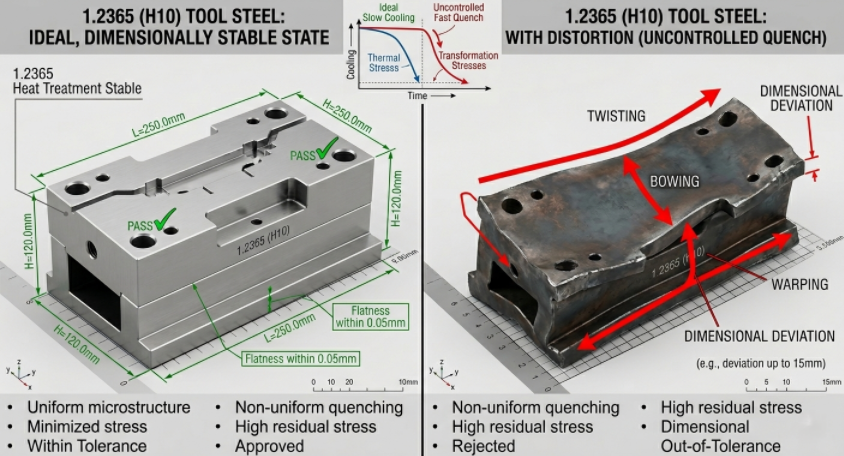
1.2365 steel holds a real contradiction — the same alloying choices that make it exceptional also set the stage for distortion.
The chemistry explains it. At 2.00–3.00% Mo (close to triple H13 steel‘s level) combined with 2.70–3.75% Cr and 0.25–0.75% V, you get a microstructure built for hot-work punishment. Those stable carbide networks resist softening under thermal fatigue. But during austenitizing, uneven carbide precipitation becomes a problem — especially in thin sections where thermal gradients build fast and leave no room for error.
Three distortion risks sit close to the surface:
- Grain growth sensitivity — Vanadium keeps austenite grains refined (ASTM ≥6.0). Push heating beyond 1100°C, and that refinement breaks down. Coarse grains lead to unpredictable martensite transformation. That means warping.
- Deep hardenability — This steel hardens through the core via air cooling. Good for uniformity, but the volume expansion from martensite conversion creates measurable ovality in cylindrical tools.
- Thermal shock in thin dies — Aggressive water quenching causes uneven martensite expansion across the cross-section. The warping this produces resists post-process straightening. No correction fully fixes it.
Mandatory Pre-Treatment: Stress Relief
Residual stress builds up silently. Forging and rough machining add it to the steel. Hardening is where it all catches up with you. The only way to get ahead of it is stress relief — applied at the right stages.
For 1.2365, there are two stages that matter.
- The first is after forging or initial processing — before any machining begins. Hot working locks internal stress into the steel. Skip this step, and those stresses grow with every pass of the cutter. The process is simple: heat to 600–650°C, hold for 2–6 hours in a neutral atmosphere, then furnace cool. Don’t rush the cool-down. A slow drop in temperature is what releases the stress — a fast exit does not.
- The second is after rough machining — before finish work and before hardening. Most shops skip this one. That’s a mistake. Machining adds its own stress layer to the steel. Quench over that layer, and the stress turns into distortion. Hold at 600–650°C for 1–2 hours, then furnace cool again.
A few practical notes on cooling:
- Furnace cool is the standard for precision tooling. It reduces residual stress across complex shapes and keeps distortion low.
- Air cool after a 1-hour hold is an option, but it carries more residual stress risk. Use it where speed matters more than tight precision.
One more thing to add to your workflow: leave a machining allowance after stress relief. Forging history and heat treatment both affect the final shape. That extra material gives you room to correct any shift and hit your finished dimensions on target.
Soft Annealing: The Microstructure Foundation
Soft annealing is the foundation of stability. It’s not just about softening the steel; it’s about creating a uniform globular cementite structure that ensures predictable hardening later.
| Process Parameter | Specification / Action | Critical Engineering Reason |
|---|---|---|
| Temperature Range | 750–810°C | Target window for spheroidization. |
| Process Adjustment | • Coarse/Banded: 800–810°C (Extended soak)• Normalized: 750–780°C | Higher heat is needed to break down coarse carbides; lower heat preserves already fine structures. |
| Upper Limit Rule | Do NOT overshoot AC1end | You must retain fine undissolved cementite as nucleation sites. Lose these, and you get pearlite (failure) instead of spheres. |
| Cooling Rate | Furnace cool max 10–22°C/hr down to 600°C, then air cool. | Controlled cooling drives the transformation. Large batches need core temperature verification to avoid gradients. |
| Final Target | ≤229 HB | Ensures machinability and uniform response to hardening. |
Note on Distortion: Any lamellar pearlite left in the microstructure creates uneven carbon distribution during austenitizing. This inconsistency shifts the martensite start temperature locally, causing volume expansion to happen out of sync—guaranteeing distortion.
The Risk of Incomplete Annealing
The failure chain is direct. Residual carbide networks create non-uniform carbon distribution in the matrix. During austenitizing, carbide-rich zones dissolve at different rates. This produces inconsistent austenite carbon content across the cross-section. That inconsistency shifts the martensite start temperature (Ms) from point to point. Transformation runs in sequence rather than all at once. Volume expansion is uneven. The part distorts.
Incoming material with carbide banding — elongated stringers from forging — needs extra steps. Normalize and temper before annealing. Banding creates directional distortion that spheroidizing alone can’t fix. The normalize breaks up the structure first. Then soft annealing builds it back clean.
Forging Best Practices
Forging gives the steel a memory. Any stress you build in now stays put. It waits for the quench to release it as warping. Use these rules to remove that risk.
- Heat Slow, Soak Well (1037–1093°C)
Go slow on the ramp-up. A fast soak leaves uneven heat across the part. Get the core and surface to the exact same temperature. Do this before the first hammer blow. - Respect the Hard Floor (898°C)
Stop forging right away if the temperature drops below this mark. Working it cold harms the internal structure. That stress locks in. It turns into warping later. - Choose the Right Cooling Method
Complex Shapes: Bury them in lime, mica, or dry ash. This covering helps thin and thick parts cool at the same speed.
Simple Shapes: Cool in the furnace at ~22°C/hr. Go down to 538°C, then let air cool it. - Anneal Right Away
Don’t let the steel sit after forging. Go straight to a 750–790°C soft anneal. This resets the structure to a stress-free base. Do it before you cut anything. - Align the Flow Lines
Make sure grain flow follows the die shape. Bad flow lines make the steel pull apart during the quench. Round parts might end up oval.
Hardening Phase 1: Preheating Strategy
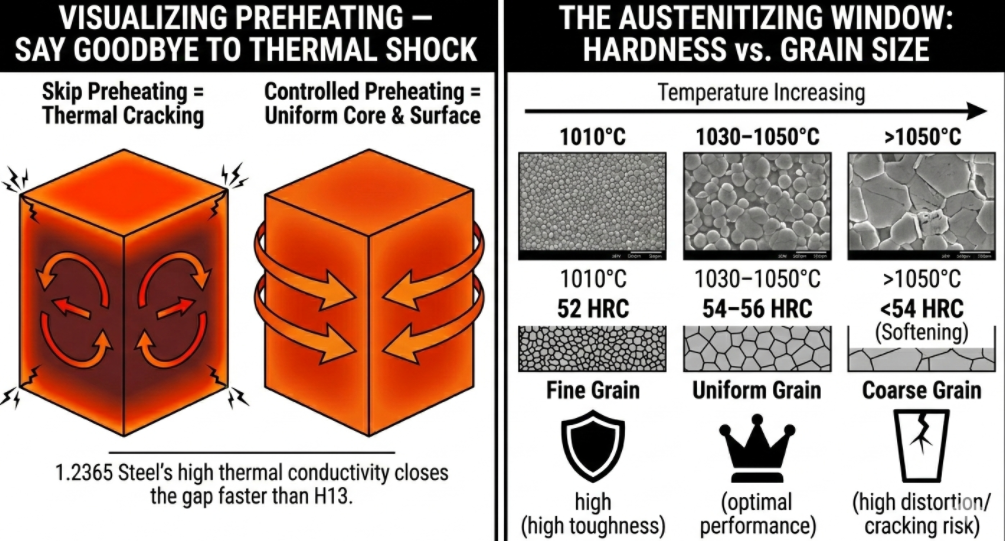
Thermal shock is silent violence. One moment the steel is cold. The next, heat is hammering the surface while the core hasn’t moved yet. That temperature gap — surface racing ahead of core — is where cracks start and distortion locks in. It’s a structural failure that begins before hardening even starts.
Preheating fixes this. Not as a formality. It’s a direct intervention that keeps surface and core moving together.
The sequence runs three stages, and each one has a specific job:
- 400°C — Burn off the machining-induced stresses still sitting in the surface layer
- 600°C — Let the temperature equalize. Surface and core need to reach the same point before you push any higher
- 800°C — Final equalization hold before the steel moves into austenitizing range
Skip or compress any stage. The gradient between surface and core builds back fast. By the time you reach hardening temperature, the damage is done.
Managing the Furnace Environment
Your equipment choice directly shapes the outcome.
A controlled atmosphere furnace is the right tool for preheating. It stops oxidation and decarburization before either gets a foothold. Running an open furnace? Use charcoal or anti-decarburization agents to protect the surface through the heating cycle.
Salt bath enters at the hardening stage — a 500–550°C quenching bath — where it cuts surface decarburization during the shift from austenitizing temperature to quench.
One material property worth noting: 1.2365’s thermal conductivity peaks at 34.4 W/(m·K) at 350°C — higher than at room temperature. Heat moves through the cross-section faster than it does in most tooling steels during the preheat window. The gradient between surface and core closes quicker. That’s why controlled preheating on this steel delivers results that H13 simply can’t match.
Hold the sequence. Hold the rate. The hardening stage that follows has no tolerance for thermal shock carried over from this one.
Hardening Phase 2: Austenitizing
Austenitizing is where the steel’s potential gets unlocked — or destroyed. Everything preheating built — equalized temperature, stress-free surface, uniform core — can unravel here in minutes. The margin for error is narrow. Misjudge it, and the damage is permanent.
The working window is 1010–1050°C. That 40-degree spread isn’t wide. Your position inside it determines hardness, toughness, and how much distortion you’ll be fixing afterward.
- 1010°C — Minimum for full through-hardness. Oil or salt bath quench required. Hardness lands around 52 HRC. Wear resistance is lower, but grain structure stays tight.
- 1030–1050°C — The tooling standard. Even heating across the cross-section is not optional here. Hardness climbs to 54–56 HRC. Wear resistance goes up. So does grain growth risk — and with it, distortion on parts with complex geometry.
Push above 1050°C and the trade-off breaks down. You gain nothing that the lower end of the range doesn’t already give you.
Optimizing Hold Time & Equalization
The soak timer doesn’t start when the furnace hits temperature. It starts after the cross-section equalizes. That distinction matters more than most shops admit.
Use 1 minute per millimeter of section thickness as your equalization baseline. A 20mm section needs 20 minutes to equalize. Add 15–30 minutes of soak time on top of that. For sections over 50mm, measure core temperature. Don’t assume it’s ready.
Don’t stretch the soak to cover uncertain equalization. Holding beyond 30 minutes dissolves carbides past the threshold that protects hardness. The steel softens. Distortion follows.
Atmosphere Control
Decarburization during austenitizing shifts the surface stress state. That shift drives distortion. A neutral or protective atmosphere — vacuum furnace, argon, nitrogen, or salt bath — cuts that variable out of the equation.
Pack hardening at 982–1037°C is a valid option without controlled atmosphere equipment. It’s a fallback, not a first choice.
| Temp (°C) | Hardness (HRC) | Primary Risk |
|---|---|---|
| 1010 | 52 | Lower wear resistance |
| 1030–1050 | 54–56 | Grain growth, distortion |
The full sequence:
1. Preheat to 760–815°C
2. Austenitize at 1010–1050°C — equalize at 1 min/mm, then hold 15–30 min
3. Quench into oil or salt bath at 500–550°C
4. Final hardness: 52–56 HRC depending on temperature selected
The quench stage comes next — with no delay. Grain size, carbon uniformity, surface integrity — all of it was set right here.
7. 1.2365 Steel Quench Medium Selection
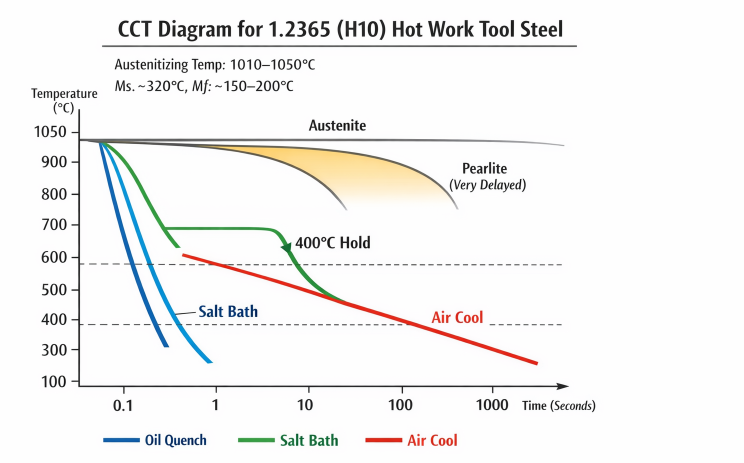
Pick the wrong quench medium and everything before this point becomes worthless. The careful preheating, precise austenitizing, controlled atmosphere — all of it gone. Quench selection is where distortion gets decided. Not managed. Decided.
Three options exist. Each one forces a clear trade-off between what you gain and what you give up.
1.2365 Steel Quench Medium Selection
| Quench Medium | Recommended Section Thickness | Geometry Suitability | Hardness Result | Microstructure Variation | Distortion Level | Key Notes |
|---|---|---|---|---|---|---|
| Air Quench | ≤ 100 mm | Complex / asymmetric | 52–56 HRC | < 5% | Low | Best balance of hardness + stability for medium sections. Core hardness drops if >100 mm. |
| Oil Quench | All thickness (incl. >100 mm) | Simple / symmetric | ≥ 52 HRC (full section) | 10–15% | +20–30% vs air | Higher cooling speed ensures core hardness, but distortion rises on complex parts. Use 500–550°C hot oil to reduce stress. |
| Salt Bath (Martempering) | > 100 mm | Complex geometry | 52–56 HRC (uniform) | Very low | 20–50% less than direct quench | 500–550°C isothermal hold equalizes temperature before martensite formation. Best dimensional control option. |
Quick Selection Rule:
- Thin & complex → Air
- Thick & simple → Oil
- Thick & complex → Salt bath martempering
For ESR-grade 1.2365 in heavy die casting applications, salt bath martempering doubles tool life. Less cracking. Tighter distortion control across the full quench cycle drives that result directly.
1.2365 Steel Tempering Protocol
The quench is done. The steel sits at 52–65°C — still warm, still stressed, and at real risk of cracking. This moment separates a finished tool from a ruined one.
Get it into the tempering furnace right away. Don’t let it reach room temperature. Martensite at full brittleness, left without relief, will crack on its own. One delay is all it takes.
Temperature range: 450–570°C, targeting a final hardness of 38–54 HRC. The secondary hardening peak sits near 540°C. That’s where Cr, Mo, and V carbides form back into the matrix and push hardness up again after the initial quench drop. This peak is why 1.2365 behaves differently from simpler steels. Work with it, not around it.
Target Hardness vs. Temperature
| Temper Temp (°C) | Approx. HRC |
|---|---|
| 500 | 49 |
| 550 | 50 |
| 600 | 48 |
| 610 | 45 |
| 650 | 41 |
Notice the curve. Hardness doesn’t drop in a straight line — it peaks first, then falls. Where you temper depends on what the application needs.
Why Multiple Cycles Are Mandatory
Stick to two cycles minimum. Working with complex tooling? Three or four is the smart play. Each round mimics a step the last one couldn’t finish. You transform the stubborn leftovers from the previous cycle. Then, you relieve the fresh stress that change just caused.
| Cycle | Temperature Setting | Critical Function |
|---|---|---|
| Cycle 1 | ~610°C (30°C above secondary hardness peak) |
Transformation. Turns most of the retained austenite into martensite. Note: Let it air cool to room temp before the next round. |
| Cycle 2 | Same as Cycle 1 | Stabilization. Catches any austenite Cycle 1 missed. It also tempers the new martensite formed during your first cool-down. |
| Cycle 3 | ~560°C (30–50°C below Cycle 1) |
Stress Relief. Pure stress reduction for complex shapes. You clear out tension spots at sharp corners and section changes. |
Every cycle balances the stress between the surface and the core a little more. You want the toughness 1.2365 promises? Triple tempering gets you there. The alloy chemistry can’t do the job alone.
Benchmark reference for 1.2365/H10 tooling: 550–650°C, 2–4 cycles at 2–4 hours each, finishing between 38–54 HRC. Peak toughness sits at the higher end of that temper range — where residual stress is lowest and the microstructure has had full time to stabilize.
Conclusion
Distortion in 1.2365 steel isn’t random. It comes from decisions you made earlier. Pre-treatment, ramp speed, and quench medium—every step helps or hurts. Engineers with stable tools don’t use magic. They just follow the rules. They don’t cut corners where it counts.
You have the framework. Don’t overhaul the shop floor tonight. Audit your process against our points. Find the weak link. Maybe preheat is fast. or you skip the second temper. Fix that first. One real fix beats ten vague changes.