
Introduction:
Choosing between 1.2365 and 1.2367 steel matters more than you might think. The right choice can boost your production efficiency and save money. The wrong one? You get a tool that just does the job without any real benefits.
Both are German-grade cold work tool steels. They’ve proven themselves in tough applications. But here’s the thing—their chemical makeup and performance differ in ways that matter for your manufacturing needs.
Are you a tool designer? You need to balance wear resistance with toughness. Production manager? Total cost of ownership is your focus. Purchasing specialist? You want the best material for the job. Understanding the differences in this 1.2365 vs. 1.2367 steel comparison helps all of you.
This guide covers the details. You’ll find chemical composition breakdowns. We explain mechanical properties. Real-world applications show how each steel performs. Plus, we include cost-benefit analysis so you can pick the right steel for your tooling needs.
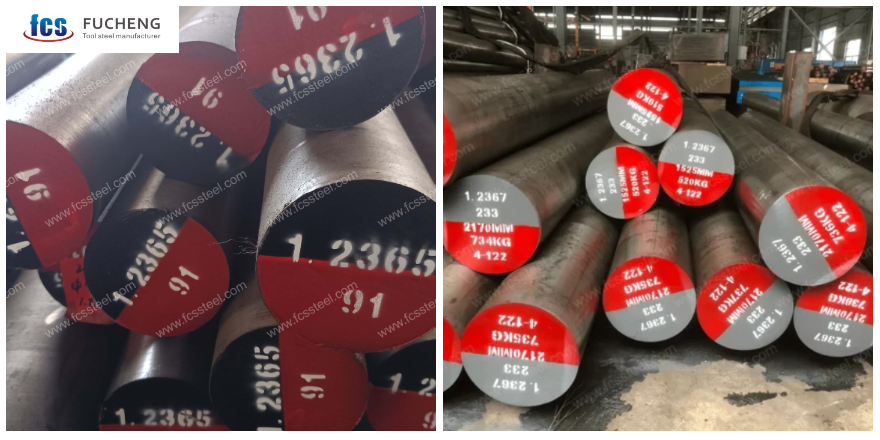
What Are 1.2365 and 1.2367 Tool Steels?
Think of these two materials as siblings in the hot work tool steel family. They share the same Chromium-Molybdenum-Vanadium foundation, but they are tuned for different purposes.
1.2365 steel (often linked to AISI H10) is designed with thermal management in mind. Because it has a slightly lower alloy content, it excels at moving heat quickly through the material. This makes it a fantastic choice for tools that rely on rapid water cooling. It prioritizes toughness and thermal conductivity, typically operating in the 50-52 HRC hardness range.
1.2367 steel (an upgrade to the standard AISI H11) takes a stiffer approach. It contains higher Chromium levels, which significantly boosts its wear resistance and high-temperature strength. While it doesn’t transfer heat quite as fast as 1.2365, it holds its shape and hardness much better under extreme thermal stress, reaching up to 54 HRC. It is built for heavy-duty jobs where abrasive wear is the main enemy.
The main trade-off is simple: 1.2365 is your heat-transfer specialist, helping keep molds cool. 1.2367 is your endurance athlete, fighting off wear and heat checking in the toughest environments.
Chemical Composition:
The chemical makeup separates these two steels in one clear way: chromium content. 1.2367 packs 4.7-5.2% chromium. 1.2365 sits lower at 2.8-3.0%. That 2% gap sounds small. But it shifts performance in specific directions.
Here’s the full breakdown:
| Element | 1.2367 (X38CrMoV5-3) | 1.2365 (32CrMoV12-28) |
|---|---|---|
| Carbon (C) | 0.35 – 0.40% | ~0.32% |
| Chromium (Cr) | 4.70 – 5.20% | 2.8 – 3.0% |
| Molybdenum (Mo) | 2.70 – 3.30% | 2.5 – 3.0% |
| Vanadium (V) | 0.40 – 0.70% | 0.2 – 0.5% |
| Silicon (Si) | 0.30 – 0.50% | 0.30 – 0.60% |
| Manganese (Mn) | 0.30 – 0.60% | 0.30 – 0.50% |
| Phosphorus (P) | ≤0.030% | ≤0.030% |
| Sulfur (S) | ≤0.030% | ≤0.030% |
Why Chromium Matters
Check the 2% gap in chromium content. 1.2367 has 5% and 1.2365 has 3%. This difference triggers three changes:
- More Carbides: That extra chromium adds about 15% more carbide volume. It builds an internal “shield”. This gives you three times the wear resistance of standard grades.
- Hot Strength: The steel stays hard above 600°C. So, your tool won’t “wash out” or deform. It holds its shape even during long contact with hot metals.
- The Trade-off: Chromium slows down heat transfer. 1.2367 fights heat damage. But 1.2365 moves heat away faster. With less chromium, the heat flows freely.
Both steels keep impurity limits strict. Phosphorus and sulfur stay at ≤0.030% maximum. Many 1.2367 producers use EFS (Electro-Slag Remelting) or ESR processes. This delivers even cleaner steel. High-cycle applications need this. It stops fatigue failures before they start.
Key Performance Showdown:
Forget the complex physics data. Here is how these two steels actually compare on the shop floor.
| Performance Metric | 1.2365 Steel | 1.2367 Steel | The Winner |
|---|---|---|---|
| Working Hardness | 50–52 HRC | 52–54 HRC (Max 62) | 1.2367 is harder. |
| Wear Resistance | Standard | High (3× better longevity) | 1.2367 resists abrasion best. |
| Thermal Conductivity | Excellent (Moves heat fast) | Moderate (Holds heat) | 1.2365 cools molds faster. |
| Toughness | Very High | Good | 1.2365 resists cracking better. |
| Heat Checking Resistance | Good | Superior | 1.2367 handles thermal fatigue better. |
Mechanical Properties:
| Property | 1.2365 Steel | 1.2367 Steel |
|---|---|---|
| Working Hardness (HRC) | 46 – 50 | 50 – 54 (Max 62) |
| Annealed Hardness (HB) | ≤ 229 | ~ 235 |
| Yield Strength (MPa) | ~ 1000 – 1100* | 1200 – 1400 |
| Tensile Strength (MPa) | ~ 1200 – 1300* | 1400 – 1600 |
*Estimated values dependent on specific heat treatment cycles.
What These Numbers Mean for Your Tools
Think of Hardness (HRC) as your shield against scratches and wear. The 2-4 point gap in 1.2367 might look small, but in operation, it significantly resists the abrasive action of sliding metals like brass or copper.
Yield Strength is your tool’s resistance to permanent deformation. Since 1.2367 handles higher pressure (up to 1400 MPa) before bending, it keeps your mold cavity accurate longer, even under heavy forging loads. If your current molds are slowly losing their shape or dimensions over time, the lower yield strength of your current steel might be the culprit. Switch to 1.2367 to fix it.
Thermal Performance:
Heat management makes the difference between these two steels in die and mold work. 1.2367 delivers 30.8 W/m·K thermal conductivity at 20°C. 1.2365 measures lower at 18.68 W/m·K at 25°C. This 60% gap in conductivity affects how each steel manages heat stress during production.
Temperature changes performance even more. At 350°C, 1.2365 reaches 20.91 W/m·K. 1.2367 maintains 28.5-34.2 W/m·K at 500°C. Push it to 600°C and you still get strong conductivity at 29.3-34.9 W/m·K. Better heat transfer gives you 30% better heat removal in real mold operation. Peak temperatures stay lower. Heat differences across the tool stay smaller. Your dies last longer.
Temperature-Dependent Conductivity Data
| Temperature (°C) | 1.2367 (W/m·K) | 1.2365 (W/m·K) |
|---|---|---|
| 20-25 | 25.0-30.8 | 18.68 |
| 350 | — | 20.91 |
| 500 | 28.5-34.2 | — |
| 600 | 29.3-34.9 | — |
| 700 | — | 24.88 |
1.2365 has lower conductivity. This creates higher heat resistance. Heat builds up faster. Internal stress grows. This opposite relationship is key in fast-cycle work. Die casting and extrusion molds go through constant heating and cooling. 1.2367’s better heat flow cuts down on heat fatigue damage.
Heat-Checking Resistance Advantage
1.2367 beats 1.2365 in heat fatigue resistance by a large margin. ESR-refined 1.2367 shows three times higher cross-direction strength versus standard grades. Heat-checking—those surface cracks from repeated heat cycles—shows up much later in 1.2367 tools.
Aluminum, magnesium, and zinc die casting dies prove this point. 1.2367 tools run longer before needing service. Precision molds need size stability. 1.2367’s low heat expansion means less warping. Parts stay in spec even after millions of cycles. Choose 1.2367 for high-heat precision jobs where heat performance controls tool life.
Heat Treatment Roadmaps: 1.2365 vs. 1.2367
| Steel Grade | Step 1: Prep / Hardening | Step 2: Quenching | Step 3: Tempering / Finishing | Target Hardness |
| 1.2365 (Toughness) | Stress Relief: 600–650°C → Hardening: 1030–1050°C | Oil or Air | Standard Cool | 50–52 HRC |
| 1.2367 (Wear Resistance) | Hardening: 980–1050°C | Oil Only | Tempering: 500–520°C (Secondary Peak) | 52–54 HRC |
The Critical Difference & The Payoff
1. The Process Difference:
It comes down to the tempering strategy. 1.2367 targets a specific “secondary hardening” peak at 500-520°C. This triggers the formation of special carbides that boost hardness—a step 1.2365 typically skips in favor of maximizing toughness.
2. The Final Result:
1.2365 becomes a “Shock Absorber”: It finishes slightly softer but significantly tougher. It acts like a spring, absorbing impact without snapping.
1.2367 becomes an “Armor Plate”: It finishes with a stiffer, harder internal structure. It resists surface scratching and wear perfectly but has less “give” under heavy impact.
Application Scenarios:
Real-world performance sets these two apart. Don’t just grab the expensive option. Match the steel to your mold’s failure mode. Tools cracking from shock? Look at 1.2365. Wearing out or seeing “heat checks”? Go with 1.2367.
1.2365 Steel: The Cooling & Toughness Specialist
Heat removal giving you a headache? Tools breaking under impact? Use this grade.
Water-Cooled Die Casting Molds (Thin-Wall)
Why it works: You get high thermal conductivity (approx. 30% better than standard grades). It moves heat away fast. This stops overheating in thin sections. Your cycle times speed up.
High-Speed Drop Forging Dies
Why it works: Toughness comes before pure hardness here. Hammers strike fast. 1.2365 absorbs that shock without snapping. It keeps high-impact lines safer.
Large Press Dies & Die Holders
Why it works: Excellent hardenability means the tool stays tough to the core, not just on the surface. This gives you the structural support needed for heavy pressing.
1.2367 Steel: The High-Heat Endurance Athlete
Heat and abrasion destroy standard steels. Pick this grade for those harsh spots.
Copper & Brass Extrusion Dies
Why it works: You extrude these metals at extreme temps (>600°C). 1.2367 adds extra chromium. It stays hard when hot and fights the “washing out” effect. Softer dies just fail.
High-Volume Die Casting (Al/Mg/Zn)
Why it works: It fights off heat checking (thermal fatigue). 1.2365 cools faster, but 1.2367 handles stress longer. It survives expansion and contraction. Your part surfaces stay clean for millions of shots.
Hot Shear Blades & Punches
Why it works: Tests show it outlasting standard Cr12 steel by 3 times when punching 0.5mm stainless. You get a carbide-rich structure. It fights abrasive wear and edge chipping.
Precision Forging Molds (Engine Blocks/Gearboxes)
Why it works: Dimensions stay stable. High yield strength holds up at high temps. Your mold cavity will not deform under the massive pressure of forming steel parts.
Decision Framework
| Choose 1.2367 For: | Choose 1.2365 For: |
|---|---|
| Wear resistance outweighs heat transfer | Heat transfer is critical |
| Die-casting Al/Mg/Zn alloys | Thin-wall forming with water cooling |
| Copper/brass extrusion dies | High-speed forging dies |
| Hot forging with high impact | Cold forming applications |
| Shear blades need maximum life | Temperature stability matters most |
The data makes it clear. 1.2367 wins in wear-heavy applications. Its proven track record shows over three times longer life in demanding punching work. 1.2365 delivers where heat transfer and toughness control your process outcomes.
Cost-Benefit Analysis: 1.2365 vs. 1.2367 Steel
Don’t let the sticker price fool you. Let’s look at the raw numbers.
1. The Upfront Investment (Material Cost)
| Material Grade | Market Price (Per Ton) | Cost Gap | Example 10-Ton Mold Cost |
|---|---|---|---|
| 1.2365 | $530 – $600 | Baseline | $5,500 |
| 1.2367 | ~$630 | +10% to 20% | $6,300 |
2. The Real Payoff (Tool Life & ROI)
Here is where the extra chromium in 1.2367 pays for itself.
| Metric | 1.2365 Performance | 1.2367 Performance | The Bottom Line |
|---|---|---|---|
| Expected Life | 1 Million Cycles | 3 Million Cycles | 3x Longer Life |
| Cost Per Cycle | $0.0055 | $0.0021 | 62% Cost Reduction |
💡 Pro Tip: The “1.7x Rule”
You break even as soon as 1.2367 lasts 1.7 times longer than 1.2365. Since real-world data shows it often lasts 3 times longer in wear-heavy applications, the extra upfront cost is negligible compared to the profit from uninterrupted production.
Selection Decision Tree: Quick Comparison Matrix
Use this quick reference to match the steel grade to your specific production environment.
| Decision Factor | Condition / Requirement | Recommended Steel | Key Data & Reason |
|---|---|---|---|
| Operating Temperature | < 600°C with Water Cooling | 1.2365 | Higher thermal conductivity moves heat fast; keeps dies cooler. |
| > 600°C (e.g., Brass Extrusion) | 1.2367 | Extra 2% Chromium maintains superior hot strength. | |
| Wear Type | Adhesive / Abrasive Wear | 1.2367 | Hardness up to 52–54 HRC resists galling and surface damage. |
| Thermal Shock Risk | High | 1.2365 | High toughness resists cracking during rapid cooling. |
| Production Volume | High Volume (> 2 Million Cycles) | 1.2367 | Extends tool life by 3×; justifies higher material cost. |
| Low Volume / Budget Focus | 1.2365 | Lower raw material cost ideal for short runs. | |
| Upgrade Compatibility | Replacing 1.2365 Tools | 1.2367 | 100% compatible. Direct drop-in replacement (adjust heat treatment). |
Upgrade Compatibility: 1.2365 to 1.2367
Direct replacement works in every application. 1.2367 handles all 1.2365 jobs—extrusion containers, forging cores, die casting molds. No design changes needed. Just adjust your heat treatment for the +2 HRC bump. Monitor heat buildup since heat transfer drops a bit.
Use EFS or ESR refined material for best results. The risk? None on record. Engineers created 1.2367 as a 1.2365 alternative with better wear resistance. bit.
Which Steel Fits Your Floor?
Choosing between 1.2365 and 1.2367 steel? Forget which material is “better” on paper. Focus on fixing your specific production problems instead.
- Dealing with abrasive wear or heat checking? Especially in high-volume runs? The investment in 1.2367 pays off. You get 3x longer tool life.
- Struggling with cracking? Need faster cooling cycles? 1.2365 gives you the toughness and conductivity. It keeps your lines moving safely.
Want to boost your tooling ROI?
Don’t guess. Send us your tool drawings or failure examples. Our metallurgists will recommend the exact grade and heat treatment plan for you.