
Huangshi, China — FCS Tool Steel has reached a new stage of manufacturing development with TÜV NORD ISO 9001:2015 Quality Management System Certification and the preparation of its Phase II factory expansion, including a new 5,500-ton hydraulic forging press.
Founded in 2007, FCS manufactures special steel in Huangshi, Hubei Province, with production covering steelmaking, refining, ESR, forging, heat treatment, machining and inspection. The company currently operates at approximately 25,000 tons of annual production capacity. Following the completion and commissioning of Phase II, planned annual capacity will increase to approximately 50,000 tons.
The expansion is focused on manufacturing capability rather than capacity alone. The new forging press will increase the available forging force for larger sections and higher reduction ratios, while the TÜV NORD-certified quality management system strengthens process control and traceability as production volume increases.
Phase II: 5,500-Ton Hydraulic Forging Press
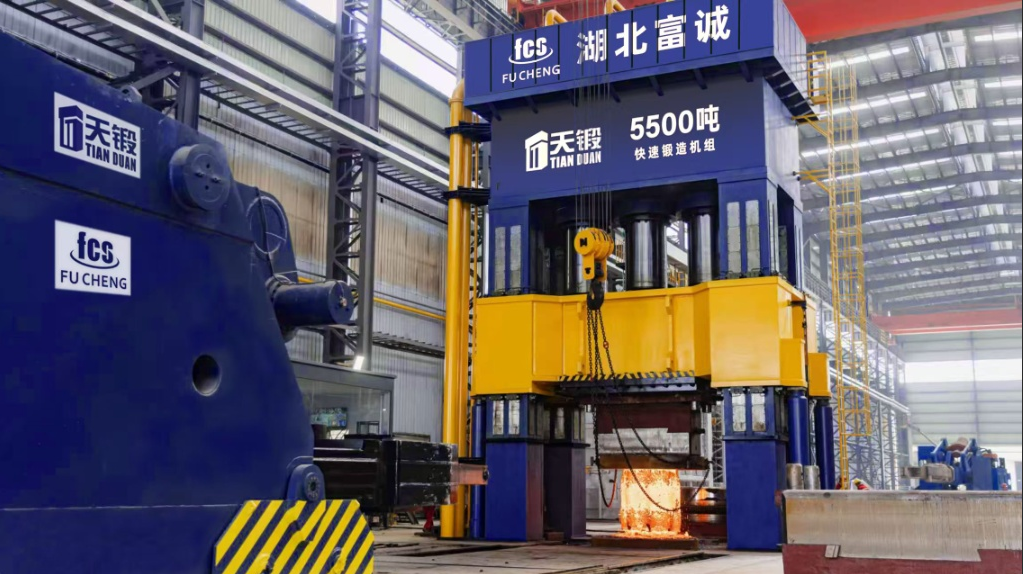
The 5,500-ton hydraulic forging press is the central equipment investment in Phase II.
Forging is a critical stage in special steel production because deformation affects the breakdown of the cast structure and the uniformity of the forged section. Higher forging force gives greater flexibility in processing larger sections and applying the required reduction during forging.
The new press will expand FCS’s capability for large forged round bars, flat bars and blocks while increasing overall production capacity. It will also provide greater flexibility in the production of tool steels where internal structural quality is an important requirement.
Once Phase II enters production, the additional forging capability will support FCS’s planned 50,000-ton annual manufacturing capacity.
Integrated Metallurgical Process
FCS’s production route integrates primary melting, secondary refining, remelting, forging and subsequent processing. Depending on the grade and technical specification, the route can include:
EF → LF → VD → ESR → Forging → Heat Treatment → Machining → Inspection
Electric Furnace melting is followed by LF and VD refining for metallurgical control. For applicable grades, Electroslag Remelting (ESR) is used to improve steel cleanliness and structural uniformity before forging.
FCS also applies EFS (Extra Fine Structure) refinement technology to selected products. Combined with controlled forging, the process is designed to refine and homogenize the internal structure of the steel.
The manufacturing system covers cold work tool steel, hot work tool steel, plastic mold steel, die and forging steel, and high-speed tool steel.
Internal Quality and Inspection
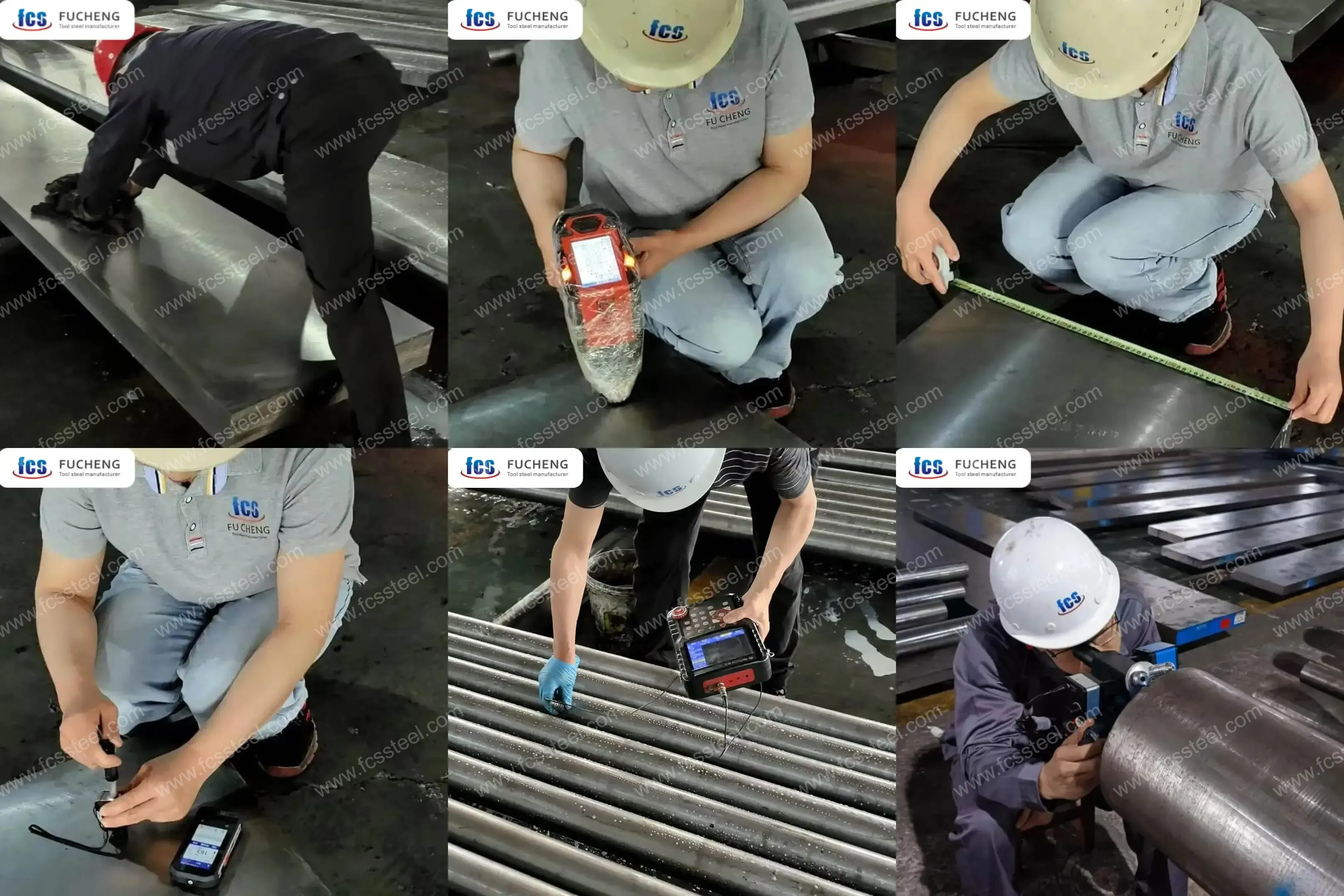
Internal steel quality is controlled through both metallurgical processing and inspection.
For applicable products, FCS provides 100% Ultrasonic Testing (UT) according to SEP 1921 requirements. UT is used to detect internal discontinuities that cannot be identified through surface inspection.
Quality inspection can include chemical composition verification, XRF grade identification, ultrasonic testing, hardness testing, metallographic examination, dimensional inspection and surface inspection. EN 10204 3.1 inspection documentation is available where specified.
The combination of controlled refining, ESR where required, forging, EFS refinement and ultrasonic inspection establishes multiple control points between steelmaking and finished product.
TÜV NORD ISO 9001:2015 Certification
The Phase II expansion is accompanied by a corresponding development of FCS’s quality management system.
FCS has obtained TÜV NORD ISO 9001:2015 Quality Management System Certification, establishing a formal framework for process control, documentation, monitoring, traceability and continual improvement.
For a manufacturing operation, ISO 9001 applies to the management of processes rather than replacing product inspection. As production capacity increases from approximately 25,000 tons toward the planned 50,000-ton level, maintaining consistent procedures and traceable production records becomes an integral part of the manufacturing system.
The certification therefore forms part of FCS’s broader manufacturing upgrade, alongside new forging capacity and existing metallurgical and inspection processes.
Carbon Management and European Compliance
FCS is also strengthening its carbon-related management and compliance capabilities for international steel supply.
This development is particularly relevant to the European market, where carbon emissions associated with imported steel are becoming increasingly connected with supply-chain reporting and regulatory requirements under the EU Carbon Border Adjustment Mechanism (CBAM).
Carbon-related compliance is separate from ISO 9001. ISO 9001 addresses quality management, while carbon assessment, verification or certification addresses emissions-related data and environmental information.
For steel manufacturing, reliable carbon information depends on defined production boundaries, controlled data collection and documented calculation or verification procedures. These requirements are becoming increasingly relevant to international steel supply chains as carbon information moves closer to the product and importer level.
FCS is therefore developing its quality and carbon-related management capabilities as separate but complementary parts of its international compliance framework.
The specific scope and methodology of any TÜV-related carbon assessment or certification are subject to the applicable TÜV documentation.
Special Steel Product Portfolio
FCS’s manufacturing range covers five major special steel categories:
|
Product Category |
Representative Grades |
|---|---|
|
Cold Work Tool Steel |
1.2379, D2, SKD11, 1.2436, Cr12, Cr12MoV, 1.2510 |
|
Hot Work Tool Steel |
1.2344, H13, SKD61, 1.2343, H11, 1.2581, 1.2713, 1.2714 |
|
Plastic Mold Steel |
1.2083, 1.2316, S136 |
|
Die & Forging Steel |
1.2713, 1.2714 and related grades |
|
High-Speed Tool Steel |
W18Cr4V, T1, W6Mo5Cr4V2, M2, SKH51 |
Products can be supplied as round bars, flat bars, plates, blocks, ground bars, turned bars and machined sections, according to grade, dimensions and agreed technical requirements.
FCS works with major international standards including GB, ASTM, DIN/EN, JIS, GOST and KS. Final grade designations and equivalence are confirmed against the applicable standard and purchase specification.
The Next Stage of FCS Manufacturing
The Phase II project brings increased forging capacity and a higher annual production target together with an established metallurgical and quality-control system.
The key developments are clear: a 5,500-ton hydraulic forging press, planned annual capacity of approximately 50,000 tons, ESR and EFS processing, 100% UT for applicable products, and TÜV NORD ISO 9001:2015 certification.
For FCS Tool Steel, this is the next stage of its manufacturing development: increasing production scale while maintaining control over the processes that determine the quality and traceability of special steel.