
Pick the wrong tool steel, and you’ll find out the hard way—usually mid-run, when your blanking die starts chipping or your forming punch won’t hold an edge past a few thousand cycles. That’s the trap with 1.2510 and 1.2842: both are oil-hardening cold work steels, both show up on the same supplier spec sheets, and both get recommended for “precision tooling” without much explanation of why one beats the other for your specific job.
Hardness numbers alone won’t tell you which grade to buy. You need to know how each alloy behaves under load, where their compositions diverge, and which failure modes each one resists better. That’s what we’re breaking down here—starting with the metallurgical basics, moving into real application scenarios for both grades, and ending with a decision framework that goes beyond the Rockwell rating so you can match the steel to the job, not the other way around.
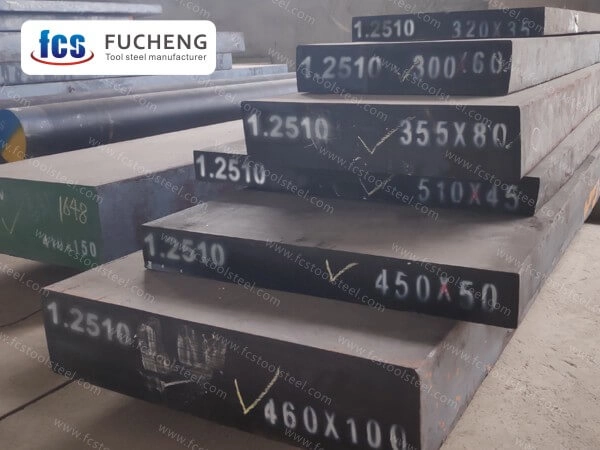
1.2510 vs 1.2842: Comparing Core Material Properties
Chemistry tells you everything before you even touch the metal. 1.2510 (equivalent to O1) runs on a manganese-chromium-tungsten backbone—roughly 0.95% carbon, 1.0-1.2% manganese, 0.5-0.7% chromium, and a small tungsten addition that sharpens wear resistance without wrecking machinability. 1.2842 (the O2 cousin) skips tungsten entirely and leans harder on manganese, sitting around 0.95% carbon with 1.5-1.8% manganese and similar chromium levels. That manganese bump changes how the steel responds to oil quenching—deeper hardenability, but at a cost we’ll get to.
Annealed Hardness: Where Machining Reality Kicks In
Before hardening, these two grades don’t behave alike on the machine floor. 1.2510 sits soft at roughly 121 HBW annealed. 1.2842 comes in noticeably tougher—220-230 HBW in the same condition. That’s not a small gap. It means 1.2842 chews through tooling faster during rough machining, demands more spindle torque, and generally slows down cycle times before you’ve even hardened the part.
Heat-Treated Hardness: The Numbers That Matter for Precision Tooling
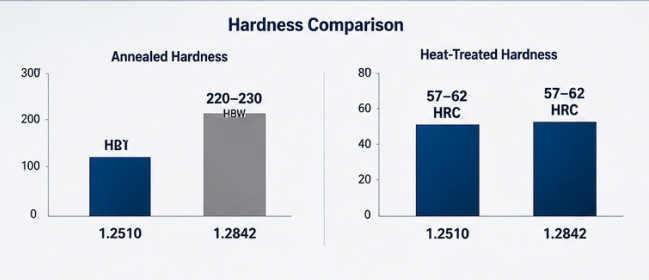
Post-hardening, the two grades converge more than you’d expect from their annealed states. 1.2510 hardens above 62 HRC, with a practical working range of 57-62 HRC for most tooling applications. 1.2842 tops out at the same 62 HRC ceiling, with an identical typical working band of 57-62 HRC. So on paper, hardness alone won’t split these two apart.
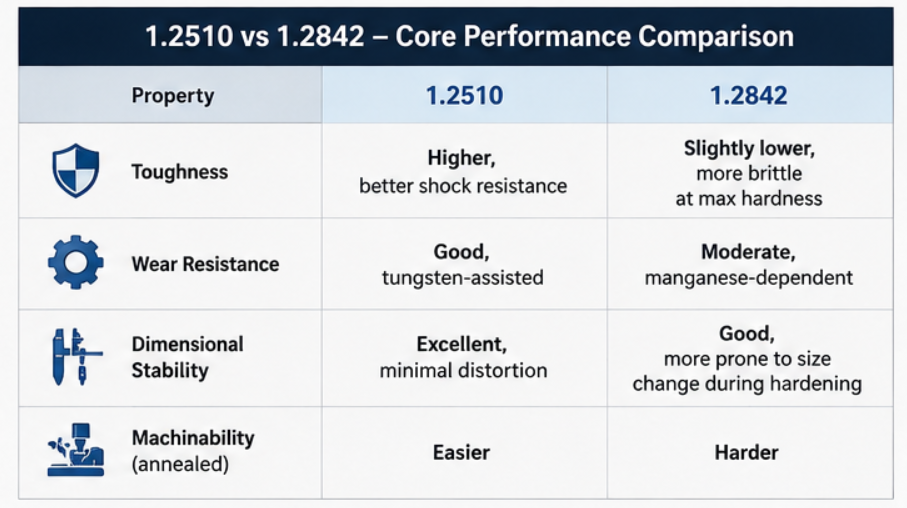
Core Performance Comparison
|
Property |
1.2510 |
1.2842 |
|---|---|---|
|
Toughness |
Higher, better shock resistance |
Slightly lower, more brittle at max hardness |
|
Wear Resistance |
Good, tungsten-assisted |
Moderate, manganese-dependent |
|
Dimensional Stability |
Excellent, minimal distortion |
Good, but more prone to size change during hardening |
|
Machinability (annealed) |
Easier |
Harder |
The takeaway: hardness numbers overlap, but everything around them doesn’t.
1. Detailed Application Scenarios for 1.2510 Steel
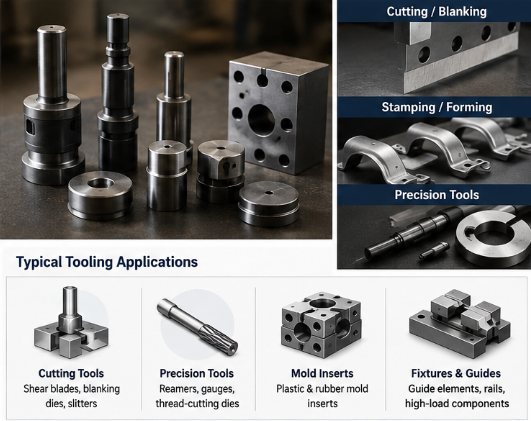
Shops running high-volume cutting operations use 1.2510 because it holds an edge without snapping under repeated impact. That toughness pays off across four application categories, and each one asks something different from the steel.
Cutting and Stamping Tools
Blanking dies, small shear blades, and mechanical cutting tools benefit most from 1.2510’s shock resistance. Punch presses running thousands of cycles per shift need a steel that won’t chip when the blade hits a hard spot in the stock. The tungsten-boosted wear resistance keeps edges sharp longer, and the toughness prevents the micro-fractures that lead to catastrophic blade failure mid-run.
Reamers, Gauges, and Thread-Cutting Dies
Precision measuring tools and thread-cutting dies demand dimensional stability above almost everything else. 1.2510 distorts very little during hardening, which makes it the go-to for reamers and gauges where a few microns of drift ruins the part. Manufacturers producing thread-cutting dies report consistent hole tolerances batch after batch — something you don’t always get with higher-manganese alternatives.
Plastic and Rubber Mold Inserts
Mold shops building inserts for plastic and rubber components favor 1.2510 for its polish retention and resistance to thermal cycling stress. Injection molding operations report fewer surface defects over extended production runs, especially on cavity inserts that see repeated heating and cooling.
High-Load Precision Components
Guide elements, fixtures, and rail components under heavy load use 1.2510’s combination of hardness and shock absorption. These parts rarely fail from wear alone. They fail from fatigue cracking under cyclic stress, and that is exactly where 1.2510’s toughness earns its reputation.
1.2842 Steel: Detailed Application Scenarios
Manganese-heavy chemistry gives 1.2842 a different job list than its tungsten-alloyed sibling. Where 1.2510 handles impact, 1.2842 handles bulk: larger tools, deeper sections, and parts that need consistent hardness all the way through.
Blanking and Stamping Dies for Thicker Stock
1.2842 performs well in punching and blanking operations on sheet stock up to roughly 6mm thick. Beyond that range, its slightly lower toughness starts working against it, so shops running heavier gauge material pair it with reinforced die sets or step down to a tougher grade. Shear blades and punch tooling built from 1.2842 show solid wear resistance in mid-volume runs. Replacement cycles tend to land shorter than what 1.2510 delivers under identical load – expect more frequent regrinds as cycle counts climb into the tens of thousands.
Threading and Gauging Tools
Taps, thread-cutting dies, and precision gauges built from 1.2842 hold tight tolerances when the part geometry doesn’t demand extreme dimensional stability. Shops manufacturing thread gauges report accuracy comparable to 1.2510 on smaller diameters, though larger tooling sees more size drift during oil hardening, something worth accounting for when specifying stock allowance.
Guide Rails, Bushings, and General Cold Work Tooling
Guide rails, bushings, collets, and broaches benefit from consistent through-hardness on thicker cross-sections – something 1.2510’s shallower hardening struggles to match. Manufacturers building large-format cold work tools lean on 1.2842 because the manganese content carries hardness deeper into the core, not just the surface skin.
For anyone choosing between 1.2510 and 1.2842, section thickness decides the call before wear resistance does.
Core Material Selection: Key Decision Factors Compared
Wear rate, fracture risk, machining cost, and raw material price decide the argument. Lining those up side by side answers which grade wins for most shops.
Wear Resistance: Where Tungsten Earns Its Keep
Shop floor testing on blanking operations puts 1.2510 ahead in raw wear life, mostly because of that tungsten addition. Tools running abrasive stock—silica fillers, coated sheet, or high-carbon strip—show measurably slower edge degradation with 1.2510 versus 1.2842 under matched load cycles. 1.2842 still performs fine on cleaner materials, but the wear rate climbs faster once abrasive content enters the mix.
Toughness and Fracture Risk
Impact testing tells a different story. 1.2510 absorbs shock loads better, which matters most in stamping operations with inconsistent stock feed or occasional overload spikes. 1.2842, sitting slightly more brittle at peak hardness, shows a higher fracture rate in applications with unpredictable loading—progressive dies feeding irregular blanks, for example. Tools in constant, predictable cyclic loading environments rarely notice the difference.
Machining Difficulty and Scrap Rate
Annealed hardness numbers translate directly into shop floor pain. 1.2842’s 220–230 HBW versus 1.2510’s 121 HBW means longer cycle times, faster tool wear on your cutting inserts, and critically a higher scrap rate on complex geometries where dimensional control matters during rough machining. Heat treatment complexity follows the same pattern: 1.2842’s deeper hardenability demands tighter quench control to avoid the size drift.
Cost Factors: Material Price vs. Total Cost of Ownership
Raw 1.2842 stock often prices slightly lower per pound than 1.2510. That advantage evaporates fast once you factor in machining time, tooling wear, and rejection rates. For precision tooling with tight tolerance windows, 1.2510’s higher upfront cost usually nets a better total cost of ownership across the tool’s working life.
Precision Tooling Steel Selection Guide: How to Avoid Deciding on Hardness Alone
Two steels can share the same Rockwell spec and still behave nothing alike once they’re cutting metal for a living. Treating 62 HRC on a spec sheet as a guarantee of matched performance is a mistake. 1.2510 and 1.2842 prove that identical hardness numbers hide very different failure modes underneath.
Build a selection framework around the job
Match the steel to three variables before you match it to hardness. For high-cycle stamping with inconsistent feed, 1.2510’s shock resistance is the better fit. For thicker cross-sections that need through-hardness, go with 1.2842. For tight dimensional tolerances, 1.2510’s lower distortion during quenching works well. If you skip this framework, you’re choosing precision tooling steel based on a single number that doesn’t predict wear rate, fracture risk, or dimensional drift.
Verify material certificates
Request mill certs on every batch. Confirm chemistry against the 0.95% carbon, manganese, and chromium ranges specific to each grade. Batch-to-batch variation happens more often than suppliers admit, and a slightly off manganese content changes hardenability enough to shift your working range outside spec.
Run small-batch trials before full production
Order a sample lot. Machine it, harden it, test it under your actual load conditions—not the supplier’s generic data sheet. A short pilot run costs less than discovering mid-production that your blanking die chips at cycle 4,000 instead of holding to 40,000. For precision tooling, that verification step separates informed buyers from expensive guesswork.
Recommendation by Application: 1.2510 or 1.2842?

The choice comes down to precision versus bulk, and it splits by tool type.
Choose 1.2510 for High-Precision Cutting, Gauging, and Blade Tools
Plug gauges, thread gauges, precision blades, and cutting inserts live and die by dimensional consistency. One gauge manufacturer ran plug gauges under 25mm diameter and tracked dimensional drift under 3 microns across a 500-piece batch using 1.2510. A parallel trial with 1.2842 stock on the same tooling showed noticeably wider variance batch to batch. That gap comes straight from alloy content: lower manganese gives shallower hardening and more predictable size change. If your part tolerance window is measured in microns rather than thousandths of an inch, 1.2510 removes a variable you don’t want fighting you during quench.
Choose 1.2842 for General Stamping Dies and Bulk Cold Work Tooling
General-purpose progressive dies, blanking punches on mixed-thickness stock, and cold work tools with a larger cross-section favor 1.2842’s deeper hardenability. A stamping shop running dies on 4mm-5mm strip stock reported consistent through-hardness on their die blocks: no soft cores, no uneven wear pattern across the working face. That’s the manganese doing its job, carrying hardness past the surface into the body of a thicker tool.
Boundary Cases: Splitting the Difference
Some jobs need both toughness at the cutting edge and mass hardenability deep in the body. Three workarounds appear on shop floors:
-
Composite tooling: a 1.2510 cutting insert set into a 1.2842 die block gives edge toughness without sacrificing bulk through-hardness.
-
Segmented dies: split a large die into smaller 1.2510 sections rather than one solid 1.2842 casting.
-
grade upgrade: move to a higher-alloy cold work steel like D2 (1.2379) when neither O1 nor O2 chemistry covers both requirements.
Fast Answers to Common Selection Questions
Q: Can 1.2842 replace 1.2510 on a precision reamer?
Only on smaller diameters. Larger reamer bodies see more size drift during oil hardening with 1.2842.
Q: Does 1.2510 handle thick stock blanking?
Yes, up to a point. Beyond about 6mm, through-hardness becomes the bottleneck, not toughness.
Conclusion
Choosing between 1.2510 and 1.2842 comes down to how your tool performs under real-world stress. 1.2510 gives you sharper edges and better wear resistance for high-precision cutting work, while 1.2842 handles the toughness and shock absorption that heavy-impact applications need. Get this wrong, and you get premature failure, wasted downtime, or tools that can’t hold up.
Match the steel to your specific application—load type, impact frequency, precision tolerance—instead of picking the bigger spec sheet number. That skill separates good toolmakers from great ones.
Before your next order, revisit your application requirements against what we’ve covered here. Talk to your supplier about your actual use case, not just the alloy code. The right steel choice today saves you money, time, and headaches tomorrow.