
Introduction:
Every hot shear blade in a rolling mill faces constant punishment — thermal shock, cyclic loading, scaling, and heavy mechanical impact. All of this hits at once, at temperatures that would turn weaker steels soft and useless. Pick the wrong blade material and you don’t just lose a blade. You lose uptime, throughput, and profit margin.
That’s why 1.2365 steel has caught serious attention from metallurgists and mill engineers tired of dealing with premature blade failures. This guide breaks down the 4 key benefits of 1.2365 steel for high-temperature hot shear blades in rolling mills. You’ll get a clear look at its hot hardness retention, thermal fatigue resistance, and how it compares to the popular H13. Plus, there’s a practical heat treatment roadmap to help you get the best performance out of it.
Benefit 1: Hot Hardness at 400–550°C
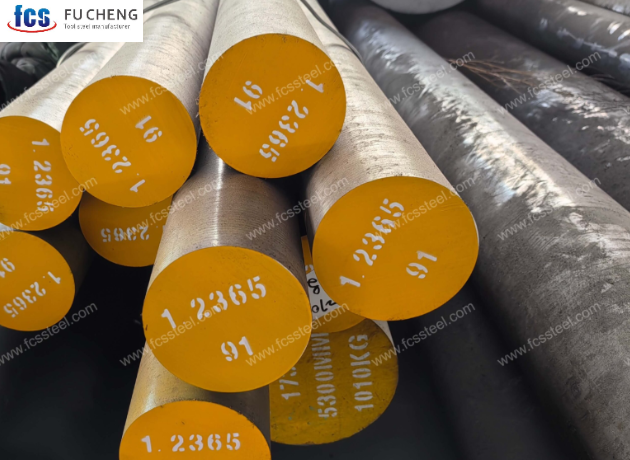
Hardness at room temperature is easy. Any decent tool steel can post an impressive number on a cold test bench. The real test — the one that separates blades from scrap — is what happens to a blade cycling through 600°C hot slabs at 20–50°C per minute, hour after hour.
At 400–550°C, 1.2365 holds 50–52 HRC. That translates to a tensile strength of 255,000–273,000 PSI and a Brinell hardness of 475–500 HB. Those aren’t projections or lab ideals. That’s the working reality inside a rolling mill shear station.
Why 1.2365 Outperforms H13
It comes down to molybdenum carbides. 1.2365’s higher Mo content forms Mo₂C and M₆C carbides. These carbides pin dislocations and block coarsening — a process where carbides clump together, weaken, and cause hardness to drop at high temperatures. Mo also raises the Snoek peak above 450°C. This slows the atom-movement-driven recovery that softens other steels.
The numbers confirm it:
| Material | Room Temp HRC | 500°C HRC | Retention Rate |
|---|---|---|---|
| 1.2365 | 56–58 | 51–52 | ~93% |
| H13 | 52–54 | 46–48 | ~88% |
That 5% retention gap adds up fast in production:
- H13 blades in comparable rolling mill applications last 500–800 edge retention cycles
- 1.2365 blades run 1,500–2,500 cycles — a 200% improvement
- Blade replacement intervals stretch from every 1–2 weeks to every 4–6 weeks
- Total blade life jumps from 10,000–15,000 tons sheared to 25,000–40,000 tons
One more detail worth knowing: 1.2365 holds a sub-0.1mm edge radius after 1,000 cycles at 550°C contact. For shear blade precision, that kind of consistency makes a real difference.
Benefit 2: Thermal Fatigue and Crack Resistance
Heat checking is the second most common rejection cause in hot forging dies. It starts as a web of fine surface cracks — hard to see at first. Then it spreads fast enough to pull a blade out of service before anyone saw it coming.
Those cracks have a name in the industry: spider cracks. A blade face heats up fast, expands, then gets hit with water cooling that drops the surface temperature in seconds. Do that thousands of times and the steel surface starts to fail. Not from one big event. From exhaustion.
Thermal Shock Test Results
Standard thermal fatigue testing runs a brutal cycle: 700°C heat exposure for 65 seconds, followed by a water quench down to 20°C in 15 seconds. Researchers track crack growth using FESEM and HRTEM analysis. They measure average maximum crack length and total cracked area at each interval.
The results are clear. Under these conditions, inferior steels show measurable crack growth as soon as 150 cycles — reaching 0.22mm crack length. From there, cracks accelerate to 1.5mm by cycle 230 and 3.5mm by cycle 260. That’s not gradual degradation. That’s a blade falling off a cliff.
The Microstructure Advantage
1.2365’s molybdenum-chromium carbide network does something H13 can’t match at this intensity. It resists the stress buildup that starts crack initiation. Chromium carbides stabilize the surface layer during rapid thermal cycling. That’s the layer where heat checking begins — and that’s where 1.2365 holds its ground.
Add post-treatment stress relief at 900°F and thermal fatigue resistance reaches peak performance. Under standardized testing at 15,000+ cycles, this treatment ranks as the top-performing condition — showing the lowest crack length and smallest cracked area of any tested setup.
For a rolling mill hot shear blade hitting 600°C slabs and then cooling with water in the same breath, that resistance isn’t a bonus. It’s what keeps the blade in the cut.
Benefit 3: High Toughness Under Impact
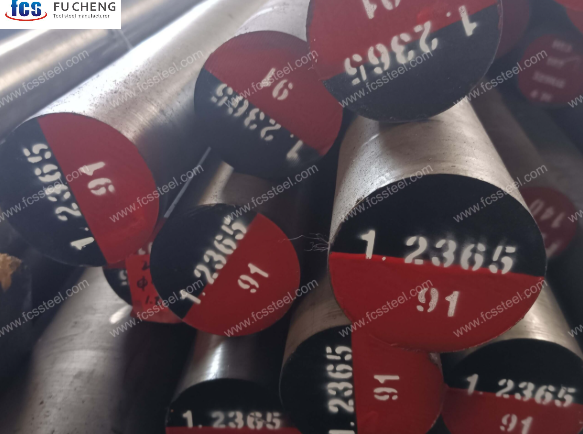
Brittle failure doesn’t announce itself. One cut, the blade is fine. The next, it’s in pieces on the mill floor.
Dynamic shear loads are unpredictable, violent, and unforgiving to any steel that trades toughness for hardness. In thick slab applications running 200–300mm cuts at 2–5 m/s, peak dynamic shear forces exceed 500 MPa. Low fracture toughness means edges crack and split under load. Data confirms that 70% of blade failures under 10⁴ load cycles are cleavage-driven. That’s what happens when KIc drops below 50 MPa√m in untempered tool steel.
1.2365 solves this through structural stiffness and controlled tempering.
Structural Stability at 500°C
At room temperature, 1.2365 carries an elastic modulus of 207 GPa. At 500°C — mid-campaign heat — it drops to 176 GPa. That’s still over 85% of its original structural stiffness. The number matters. The blade holds its shape under repeated dynamic loading instead of absorbing impact through permanent strain. You get consistent geometry, cut after cut.
Why Double Tempering is Critical
Raw quench hardness isn’t enough on its own. Untempered 1.2365 loses 40% of its toughness at operating temperatures. Intergranular cracks start forming between 400–600°C. The fix is a double temper cycle — 2× 550°C for 2 hours each pass.
Here’s what that cycle does:
- Breaks down residual carbides at grain boundaries
- Boosts KIc by 20–50%
- Pushes CVN impact energy above 80 J at 20°C — the threshold needed to handle high-speed shear at 10 m/s without brittle fracture
Hard and tough — 1.2365 delivers both, in the conditions where it counts.
Benefit 4: Enhanced Thermal Conductivity
Heat trapped inside a blade doesn’t just sit there. It builds pressure, warps geometry, and speeds up every failure mode covered in the previous three sections.
That’s where 1.2365’s thermal conductivity of 34.5 W/m·K gives you a real edge. H13 sits at 24–28 W/m·K. That’s a 23–44% conductivity gap. By Fourier’s law (q = -k∇T), that gap produces 20–30% faster heat dissipation during active shearing.
Impact of Faster Heat Dissipation
You get a flatter temperature gradient across the blade body. Lower ∇T means:
- 15–25% reduction in thermal stress at high-risk zones — blade edges, tip curvature, trailing surfaces
- Dimensional drift stays below 5% versus low-conductivity alternatives
- Internal hot spots get eliminated, not just managed
Add water cooling to that conductivity and the results stack up fast. Higher k pushes the convective loop harder, pulling heat away from the cutting edge with each cycle. Shear cycle times drop by an estimated 10–20%. In a continuous rolling mill, that means real throughput gains.
Blade Life and Cost Efficiency
| Metric | 1.2365 | H13 / Low-k | Advantage |
|---|---|---|---|
| Conductivity (W/m·K) | 34.5 | 24–28 | +23–44% |
| Temperature gradient reduction | 15–25% | Baseline | Lower stress |
| Thermal stress reduction | 15–30% | Baseline | Longer life |
For mill operators, the bottom line is clear: 15–25% lower total cost per blade. Shorter cooling cycles drive that number down. Blade service life stretches 20–50% longer than conventional H13. That’s not a small gain. That’s a completely different cost structure.
Comparison: 1.2365 vs. H13 (1.2344)
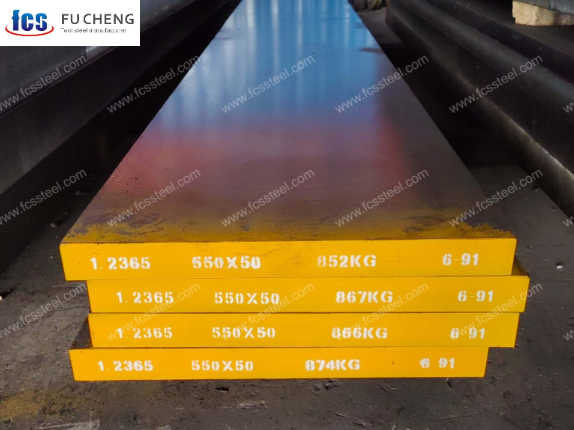
The honest answer depends on your specific operation — but for most rolling mill hot shear applications, the data points clearly in one direction.
H13 (1.2344) is the industry default for good reason. It’s proven, easy to source, and priced competitively. But “good enough” has a ceiling. Push into high-frequency shearing with water cooling and contact temperatures past 600°C, and H13’s limitations stop being trade-offs. They become real operational problems.
Here’s how the two steels compare across the metrics that matter most on the mill floor:
| Property | 1.2365 | H13 (1.2344) |
|---|---|---|
| Hot Hardness (>600°C) | 50–52 HRC | 45–50 HRC |
| Thermal Fatigue Life | >200,000 cuts | 120,000–150,000 cycles |
| Toughness | Superior — controlled C prevents fractures | Higher brittleness risk |
| Wear Resistance | Standard (0.50% V) | Superior (1.00% V) |
| Machinability Rating | 90–95% | 55% |
| Heat Treatment Stability | Low distortion, predictable | Higher distortion, larger allowances needed |
Performance Strengths
H13 holds one genuine edge: wear resistance. Its higher vanadium content (1.00% vs 0.50%) produces harder V-carbides. Those carbides outperform 1.2365 against pure abrasion. Your operation runs below 600°C with constant friction and a tight upfront budget? H13 is a solid, rational choice. Just plan for crack inspection after the 120,000-cycle mark.
1.2365 wins everywhere else that rolling mills care about. Temperatures above 600°C, water-cooled setups, rapid thermal cycling — these conditions expose H13’s softening curve fast. 1.2365 doesn’t just hold up under those conditions. It was built for them.
Total Cost of Ownership (TCO)
Upfront material cost favors H13. Everything after that favors 1.2365.
- Blade lifespan: 1.2365 runs 1.3–1.7× longer — exceeding 200,000 cuts versus H13’s 120,000–150,000
- Machining costs: 30–40% lower due to a 90–95% machinability rating; standard carbide inserts replace expensive PCBN tooling
- Insert wear: 20–30% reduction compared to H13’s abrasive high-Si composition
- Net TCO impact: Up to 40% total manufacturing cost reduction through uptime gains and fewer blade changeovers
The procurement logic is straightforward. Your cycle count exceeds 150,000 and operating temperatures breach 600°C on a regular basis? 1.2365’s lifespan multiplier absorbs its higher unit cost within the first production campaign. Abrasion dominates your wear profile and budgets are tight? H13 works — but track blade condition closely past the 120k threshold.
For high-volume hot shear blade applications in rolling mills, 1.2365 isn’t the premium option. It’s the practical one.
Selection Checklist: Is 1.2365 Right for You?
Not every rolling mill needs 1.2365. This steel justifies its cost only when the conditions call for it — and it’s the wrong choice when they don’t.
Go through this checklist before you decide:
1.2365 is the right call if:
- Working temperatures exceed 400°C — At 400°C it holds 48.5 HRC. At 500°C, 51.7 HRC. That hardness retention is exactly what you’re paying for.
- Your setup uses forced water cooling — Thermal conductivity runs at 32–36 W/m·K. Water cooling works with the steel, not against it.
- Shear cycles are high-frequency — The steel is built for rapid, repeated cuts. Toughness and thermal fatigue resistance are strong suits here.
- You’re cutting thick hot billets — Steel or aluminum, this is the core application 1.2365 was made for.
Look at alternatives if:
- Budget is the main concern — The Cr/Mo/V alloy content pushes the price up. 1.2344 (H11) or 1.2714 costs less upfront.
- Your process runs below 400°C — You’re over-specifying. 1.2379 (D2) is a better fit for cold shear wear at 52–62 HRC.
Conclusion
Hot shearing demands precision. You can’t settle for less. 1.2365 steel holds steady at 50–52 HRC. It works well even as temperatures push past 550°C. Standard H13 often fails in this heat. These aren’t just lab numbers. They boost your mill’s efficiency. You get better heat conductivity and shock resistance. 1.2365 makes your blade performance consistent, not a gamble.
You see results in three key areas. You wait longer between blade changes. Emergency repairs drop sharply. Best of all, your cost per sheared ton goes down. Spider cracks and heat checking hurt your throughput. The right alloy offers the most cost-effective fix. Don’t let material limits hurt your uptime. Specify 1.2365. Keep your mill running at peak capacity.