
1. SKD61 Chemical Composition & Function
| Element | Content (%) | Function |
|---|---|---|
| C | 0.32–0.45 | Hardness, toughness balance |
| Cr | 4.75–5.50 | Hardenability, heat & wear resistance, corrosion protection |
| Mo | 1.10–1.75 | Heat strength, wear resistance, prevents softening at high temps |
| V | 0.80–1.20 | Wear & toughness, carbide stabilization |
| Si | 0.80–1.20 | Strength, hardness |
| Mn | 0.20–0.50 | Hardenability, reduces brittleness |
| P | ≤0.03 | Reduces brittleness |
| S | ≤0.03 | Prevents hot-shortness |
| Ni | ≤0.30 | Toughness, dimensional stability |
| Cu | ≤0.25 | Stability, corrosion resistance |
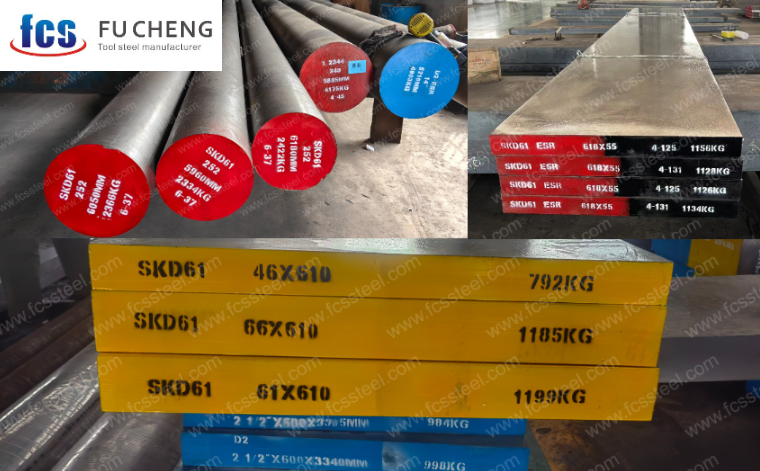
2. Mechanical Properties
| Property | Typical Value / Range | Notes |
|---|---|---|
| Hardness (HRC) | 40–52 | Most dies 42–48 HRC; higher = wear resistance, lower = impact resistance |
| Brinell Hardness (HB) | 207–335 | Soft annealed for machining; hardened after quenching/tempering |
| Tensile Strength (Rm) | 1200–1590 MPa | Higher tempering → lower strength, higher toughness |
| Yield Strength (Rp0.2) | 1000–1380 MPa | Lower tempering → higher yield, higher tempering → more toughness |
| Elastic Modulus | 207 GPa | Stable under heat ≤500°C |
| Poisson’s Ratio | 0.27–0.30 | Lateral contraction under tension |
| Elongation (A%) | 9–15% | Higher tempering → more ductility |
| Cross Section Reduction (Z%) | 50–53% | Shows plastic deformation capacity |
| Impact Toughness (Charpy) | 13.57–24.44 J | Higher tempering → higher toughness, lower hardness |
| Specific Heat Capacity | 460–500 J/kg·K | Controls heating/cooling behavior |
3. Machinability & Processing Performance
| Property / Process | Performance / Notes |
|---|---|
| Machinability | 65–70% vs standard tool steels; easier after annealing (207 HB) |
| Deep Hole Drilling | Up to 9.8 m for internal cooling channels |
| Heat Treatment | Quench 1020–1050°C, triple temper 550–680°C for peak strength |
| Annealed Hardness | 207 HB for easy pre-machining |
| Polishing | Achieves mirror finish on dies |
| Production Forms | Plate, sheet, coil, flat bar, round bar, strip, wire, forgings |
4. Applications
| Application | Details / Industries |
|---|---|
| Die Casting Dies | Aluminum & non-ferrous metals, withstand 600°C |
| Hot Extrusion Dies | Aluminum profiles, maintains shape under heat & pressure |
| Forging Dies | Absorbs hammer blows & thermal stress |
| Bolt Heading Dies | Forms fasteners under repeated loads |
| Hot Shearing Blades | Cuts heated metal bars cleanly |
| Mandrels & Punches | Hot-forming tools, stable dimensions & wear resistance |
| Industries | Automotive, aerospace, heavy manufacturing, general hot-work tooling |
5. SKD61: The Leading Steel for General Hot Working and Forging Molds
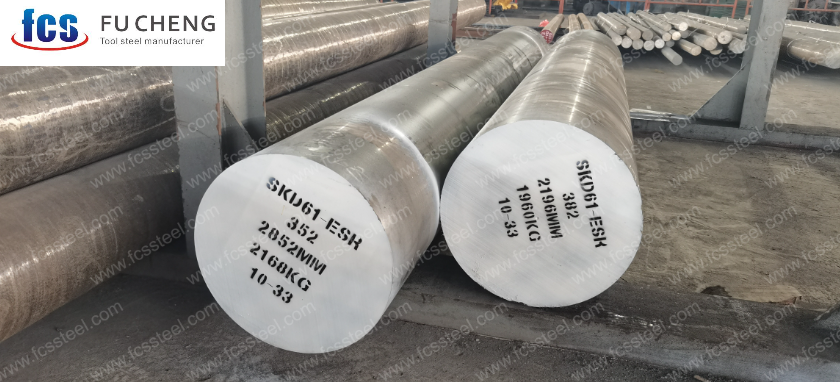
General Hot Working and Forging Molds:
SKD61 leads hot work tooling worldwide. Its fine, evenly spread carbides give you strong toughness and stable dimensions. Complex dies keep their accuracy under heavy production loads. Large forging molds won’t warp during heat cycles. The martensitic structure forms after quenching and tempering, creating a fine grain base that handles tough hot work jobs without breaking.
Vacuum degassing and electric slag remelting clean the steel before it reaches your shop. High purity means fewer flaws. You get steady performance across production batches. Dies last longer. Scrap rates drop. SKD61 is the top pick for general hot working and forging molds. Automotive, aerospace, and heavy manufacturing plants rely on it.
Hardness vs Tempering Temperature
| Tempering Temperature (°C) | Hardness (HRC) | Impact Toughness (J) | Notes |
|---|---|---|---|
| 540 | 52 | 13.57 | Maximum surface wear resistance, lower toughness |
| 550 | 50 | – | Moderate hardness, balance wear and toughness |
| 565 | 48 | 24.44 | Balanced hardness and impact toughness |
| 580 | 44 | – | Lower hardness, higher toughness |
| 620 | 45 | High | Suitable for extrusion dies and die casting inserts |
Standard Heat Treatment Process
| Step | Temperature (°C) | Duration / Notes | Purpose |
|---|---|---|---|
| Preheat | 600–850 | – | Prevent thermal shock |
| Austenitizing | 1000–1050 | Hold for uniform heating | Full austenitic transformation |
| Quenching | – | Air, oil, or polymer depending on section | Hardening |
| Tempering | 500–650 | Triple cycle, ~2h per cycle | Refine carbide network, reduce internal stress |
| Annealing (Softening) | 840–860 | 2–4 hours, slow cooling 30–50°C/h | Improve machinability, reduce stress |
Machinability and Annealed Properties
| Property | Value | Notes |
|---|---|---|
| Hardness (annealed) | 170–207 HB | Soft state for easier machining |
| Machinability | 65–70% of W1 steel | Turning, milling, drilling improved |
| Carbide Structure | Small, round carbides in ferrite | Uniform cutting, better heat treatment results |
| Cooling Rate | 30–50°C per hour to 500°C, then air cool | Prevents internal stress |
6. Product Features / Additional Characteristics

Worldwide SKD61 Compatibility:
SKD61 meets global standards—JIS SKD61, AISI H13, and DIN 1.2344.This means worldwide compatibility and reliable sourcing. The density of 7.7–8.03 × 10³ kg/m³ helps you calculate die weight accurately. You need this for press setups and handling equipment. Melting temperature sits at 1370–1400°C. That’s far above service conditions. Your structure won’t break down during extreme heat
Stable Resistivity and Versatile Forms:
Electrical resistivity measures 0.7 Ω·mm²/m.This value stays stable for industrial uses where electromagnetic properties count. The steel ships in multiple product forms—plate, sheet, coil, flat bar, round bar, strip, wire, and forgings. You get what fits your manufacturing needs. No custom orders required.
Dimensional ranges cover most die sizes:
Round bars span 1–2000 mm diameter. Square bars run 10–1000 mm. Plates and sheets offer 0.08–800 mm thickness with 10–1500 mm width. Tubing comes in OD φ4–410 mm with wall thickness 1–35 mm. This range cuts material waste. You won’t deal with oversized blanks.
Strong thermal fatigue resistance:
It sets SKD61 apart from lower-alloy hot work grades. Other steels crack faster under repeated heating and cooling. SKD61 lasts longer in die casting, extrusion, and forging. Surface temperatures swing between shots in these processes.
Corrosion Resistance:
Chromium levels at 4.75–5.50% protect SKD61 from oxidation during hot work. A thin oxide film forms on die surfaces. This layer blocks attacks from molten aluminum, magnesium, zinc, and copper alloys.
Die casting puts tooling under chemical stress. Plus, temperatures change fast. SKD61 handles both. You won’t see the surface damage that ruins cheaper steels.