
When a job demands precision, low-cost tooling, and a steel that machinists have trusted for over a century, 1.2510 / AISI O1 tool steel usually tops the shortlist. It’s the classic oil-hardening grade that toolmakers reach for when they need sharp edges, dimensional stability, and predictable heat-treat results without breaking the budget. But reliable doesn’t mean simple — get the composition, hardening temperature, or tempering schedule wrong, and you’ll end up with a blade that chips instead of cuts.
This guide breaks down what makes O1 tick: its chemistry, how it behaves under stress and heat, where it genuinely outperforms alternatives like A2 or D2 tool steel, and where it falls short. Whether you’re specifying material for a die, a punch, or a custom knife blank, you’ll walk away knowing how to work with 1.2510/O1 and where to source it.
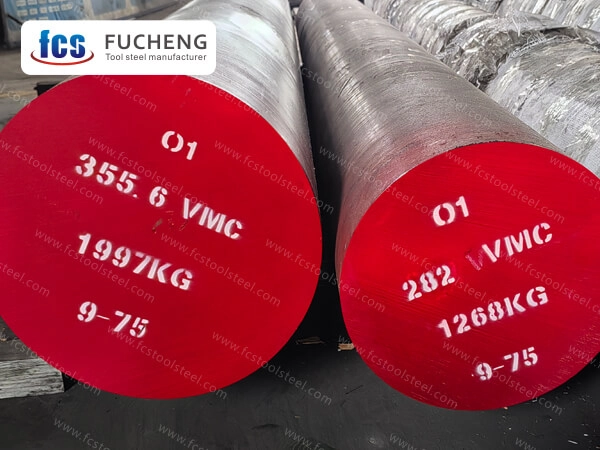
What is 1.2510 / AISI O1 Tool Steel
Metallurgists know it by several names. 1.2510 is the DIN/W-Nr. designation. AISI O1 (UNS T31501) is the American tag. Depending on where you source material, you might see 100MnCrW4 or SKS3 on the mill certificate. They’re all the same oil-hardening cold-work tool steel.
Chemical composition drives everything this steel does:
|
Element |
Content Range |
Notes |
|---|---|---|
|
Carbon (C) |
0.85–1.00% |
|
|
Manganese (Mn) |
1.00–1.40% |
|
|
Chromium (Cr) |
0.40–0.60% |
May vary depending on specification |
|
Tungsten (W) |
0.40–0.60% |
|
|
Silicon (Si) |
0.20–0.40% |
|
|
Phosphorus (P) |
≤0.03% |
Tighter specifications further reduce P content |
|
Sulfur (S) |
≤0.03% |
Tighter specifications further reduce S content |
The carbon-manganese-tungsten combo gives O1 high hardness after quenching, good dimensional stability, and a machinability window forgiving enough for shop-floor work.
Heat treatment, in brief:
-
Anneal: 740–780°C, furnace-cooled → ≤212 HBW
-
Harden: 780–820°C, oil quench
-
Temper: 150–250°C
Post-hardening, expect 63–65 HRC. Tempered working hardness is 58–62 HRC.
AISI O1 Mechanical & Physical Properties
O1 is often compared to D2 (Cr12MoV). D2 offers higher wear resistance, but O1 is tougher and easier to machine. Here are the baseline mechanical properties.
Table 1: D2 Hardness & Tempering Benchmark
|
Condition / Process |
Hardness Range |
Performance Focus |
|---|---|---|
|
Annealed |
217–255 HBW |
Standard supply target is 220–235 HBW. |
|
As-Quenched |
63–65 HRC |
Pre-tempering peak hardness. |
|
Low-Temp Temper (149–177°C) |
61–64 HRC |
Locks in maximum wear life. |
|
Mid-Temp Temper (260–288°C) |
58–60 HRC |
Balances wear resistance and toughness. |
|
High-Temp Temper (480–515°C) |
58–60 HRC |
Double tempering improves dimensional stability. |
|
Extreme Temper (537°C) |
~54 HRC |
Increases crack resistance but reduces wear performance. |
Table 2: Mechanical Strength Indicators (Heat-Treated)
|
Property |
Typical Range |
|---|---|
|
Tensile Strength |
2000–2200 MPa |
|
Yield Strength |
1800–2000 MPa |
|
Compressive Yield Strength |
275–319 ksi |
O1’s simpler carbide structure wears out faster than D2’s chromium and vanadium carbides in abrasive jobs. But if your tooling needs sharp, chip-resistant edges, O1 provides the necessary toughness.
O1 Tool Steel Heat Treatment & Hardening Guide
Get the sequence wrong, and perfect chemistry won’t save your part. O1’s reputation for predictable results comes down to hitting your marks during heating, quenching, and tempering. Table 4 breaks the entire process down so you don’t miss any critical windows on the shop floor.
Table 4: Step-by-Step O1 Heat Treatment Guide
|
Process Stage |
Temperature Range |
Timing / Duration |
Critical Best Practices |
|---|---|---|---|
|
1. Austenitizing (Heating) |
802–816°C |
Rule of thumb: Soak for ~2 hours per inch of section thickness. |
O1 has a narrow hardening window compared to alloy steels like 42CrMo4. Don’t rush the soak, or thick sections will end up with a soft core hiding under a hard shell. |
|
2. Quenching |
Oil Bath: 25–60°C |
Pull parts from the oil once they drop to 52–93°C (125–200°F). |
Many shops slip up here. Never use water or air. If your oil is too cold, the steel might crack. If the oil is too warm, you undercut your target hardness. |
|
3. Tempering |
177–260°C |
Start immediately (within 90 minutes max of pulling from quench). |
Treat tempering as part of the quench itself. Do not leave it until after lunch. This range drops the 63–65 HRC as-quenched peak down to a tough, workable 58–62 HRC. |
Perfect temperatures won’t save a part with poor geometry. Review this defect prevention checklist before turning on the furnace:
-
Heat uniformly by tracking the actual section size, not by watching the clock.
-
Make sure your quench severity matches the steel’s hardenability (again, use oil).
-
Round off corners and add fillets where possible. Sharp geometry invites stress cracks.
-
For complex, distortion-prone parts, consider staged quenching instead of a direct dunk.
Follow this sequence, and O1 delivers what it is famous for: no surprises, no chipped edges, and zero soft spots.
O1 Steel Performance: Machinability & Stability
O1 tool steel relies on a specific balance of properties. Rather than chasing extreme hardness or wear resistance, it provides reliable performance for short to medium-run applications. Here is how it performs across key metrics:
-
Hardness and Deformation Resistance: O1 achieves a working hardness of 60–64 HRC in cold-work applications. This allows the steel to resist plastic deformation under contact stresses of 2–3 GPa, preventing edges from rolling or chipping during standard die and blade work.
-
Abrasion and Wear Resistance: Under Taber abrasion testing (CS-17 wheel, 1000 cycles, 1 kg load), O1 typically shows a 12–20 mg mass loss. While it won’t match the 8–15 mg loss of High-Speed Steels (HSS) in high-volume stamping, it provides plenty of wear life for tools that see intermittent use or routine sharpening.
-
Dimensional Stability: When properly heat-treated, O1 is highly stable. It holds dimensional changes between -0.05% and +0.05% at 58+ HRC. To maintain this precision, you must keep retained austenite levels below 10 vol.%.
-
Machinability: This is where O1 excels. Supplied in the annealed state (200–260 HB), its specific cutting force runs 1600–2400 N/mm², meaning you can machine it efficiently with standard tooling. After hardening, conventional cutting stops working, requiring grinding or EDM finishing.
Compared to alternatives like A2, O1 delivers predictable machining and tight tolerances without the higher material costs associated with extreme-alloy grades.
Common Applications for 1.2510 / O1 Tool Steel
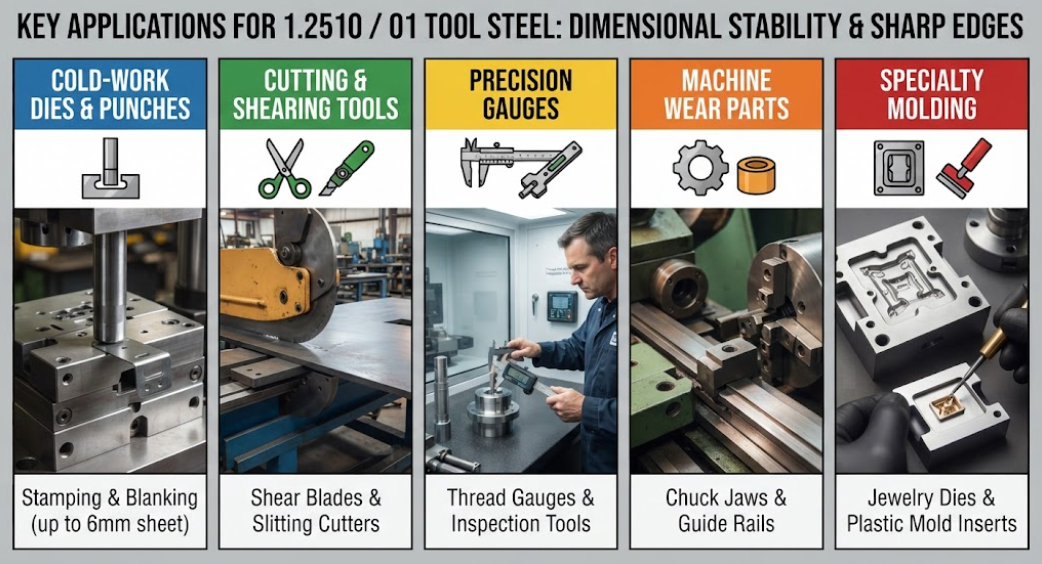
Walk through any die shop, and you’ll spot O1 doing the quiet, heavy-lifting work. It isn’t meant for million-part stamping runs. Instead, it earns its keep in short to medium-run cold-work tooling where dimensional stability and a clean, sharp edge matter more than raw abrasion life. Here is exactly where shops put it to use:
-
Cold-Work Dies and Punches: This is O1’s bread and butter. It is the go-to grade for blanking, stamping, and trim dies handling sheet metal up to 6 mm thick. You will also see it heavily specified for bending, swaging, and deep-drawing dies, as well as cold punches and knock-out pins.
-
Cutting and Shearing Tools: Because it holds a sharp edge without chipping under moderate impact, O1 is widely used for shear blades, rotary knives, and slitting cutters processing metal, paper, plastic, and wood. It is also a standard choice for threading tools like taps, thread dies, and thread roll dies.
-
Precision Gauges and Measuring Tools: Heat-treat O1 correctly, and it simply does not move. That dimensional stability at 57–62 HRC makes it perfect for master plug gauges, thread gauges, calipers, and custom inspection templates where post-quench warping means a scrapped part.
-
Machine Wear Parts: Beyond cutting and forming, O1 fills the gap for general industrial wear components that need a hard surface but cannot afford the brittleness of higher-alloy steels. Common applications include guide rails, heavy-duty bushings, chuck jaws, cam rollers, and collets.
-
Specialty Molding and Precision Components: For highly detailed work requiring easy initial machining, toolmakers rely on O1 for jewelry embossing dies, automotive hinge punches, tube expander rolls, master cavity sinking hobs, and small precision inserts for plastic injection molds.
O1 vs Alternative Tool Steels (O2, A2, D2)
Picking the right tool steel usually comes down to one question: what will fail first—the edge, the shape, or the budget? O1, O2, A2, and D2 all comfortably hit that 57–62 HRC hardness band, so looking at hardness numbers alone won’t tell you much. The real differences show up in toughness, wear life, and how much the part actually moves during heat treatment.
Here is how they stack up against each other:
Table 3: Tool Steel Selection Matrix
|
Steel Grade |
Key Characteristics & Chemistry |
The Trade-off |
Ideal Applications |
|---|---|---|---|
|
O1 |
Excellent machinability, solid toughness, and predictable oil-hardening. |
Lower wear resistance compared to higher-alloy grades like D2. |
Short-run dies, gauges, and cutting tools where easy machining matters. |
|
A2 |
Air-hardening for superior dimensional stability. (Contains ~1.0% C, 5% Cr, 1% Mo). |
Trades away some of O1’s toughness. Harder to machine. |
Precision dies, moderate impact tooling, and parts where holding tight tolerances through heat-treat is critical. |
|
D2 |
Unmatched wear resistance thanks to high carbon (~1.5%) and high chromium (11–13%). |
Noticeably lower toughness. There is a real risk of chipping under heavy impact loads. |
High-volume blanking dies, punches, and shear blades running abrasive materials. |
|
O2 |
Performs similarly to O1, relying heavily on Manganese for hardenability. |
Highly spec-sensitive. Chemistry varies wildly between ASTM and DIN standards. |
General tooling, but only after confirming the exact standard on the mill cert. |
A quick warning about O2: It sounds like a close cousin to O1, but never buy it on the label alone. The name is extremely spec-sensitive. For example, an ASTM A681-style listing puts O2’s Manganese at 1.40–1.80%, while a regional 9Mn2V standard pushes it to 1.90–2.10%. It’s technically the same grade name, but a different steel entirely. Always verify the mill cert before swapping it into an O1 process.
How to Select & Source 1.2510/O1 Steel for Your Project
Sourcing decisions live or die on the mill cert. Before you sign a purchase order, confirm the chemistry range, hardness target, and equivalent designation. If a supplier quotes “1.2510,” “100MnCrW4,” “AISI O1,” or “SKS3,” you’re looking at the same steel — but only if the cert backs it up.
Match the hardness to the job. 57–62 HRC is the sweet spot for punches, gauges, knives, and blanking dies that need toughness alongside wear resistance. 63–65 HRC is for parts chasing maximum wear life, where a little brittleness is an acceptable trade.
When to Choose O1 (And When to Avoid It)
O1 earns its place when the part needs small heat-treatment distortion plus good machinability before hardening. Fixtures, cutting edges, and dies that must hold tight tolerances after quench all fit this profile.
Skip O1 if the job involves extreme abrasive wear or demands corrosion resistance. This is a moderate-wear steel — density sits around 7.85 g/cm³, annealed hardness lands at ≤212–230 HB depending on mill spec, and that’s not the same league as high-chromium specialty grades. Send those jobs to D2 or a stainless tool steel instead.
Conclusion
1.2510 / AISI O1 tool steel gives you dimensional stability, easy machining, and a sharp edge. It delivers these results without the extra cost of A2 or D2. Stop spending your tooling budget on over-specification.
If you build short-run dies, gauges, or precision cutting tools, O1 delivers predictable heat-treat results and tough, chip-resistant edges. Sourcing is the main challenge. Inconsistent chemistry can crack in the quench or warp out of tolerance. Require verified mill certificates to confirm your exact steel grade.
Contact us today with your specifications for a quick quote on certified 1.2510 / O1 tool steel.