
Introduction:
Buying hot-forging die steel in volume means balancing material cost with the demands of the application. When is standard-quality H13 tool steel sufficient? When does another grade—or an ESR or EFS option—justify the additional cost? Grade names and hardness figures alone cannot answer those questions.
A large hammer die and a small precision-forging insert place different demands on steel. The hammer die must withstand repeated heavy impacts, while the insert may need to retain fine details as its working surface heats and wears. Understanding these differences is the starting point for choosing suitable material.
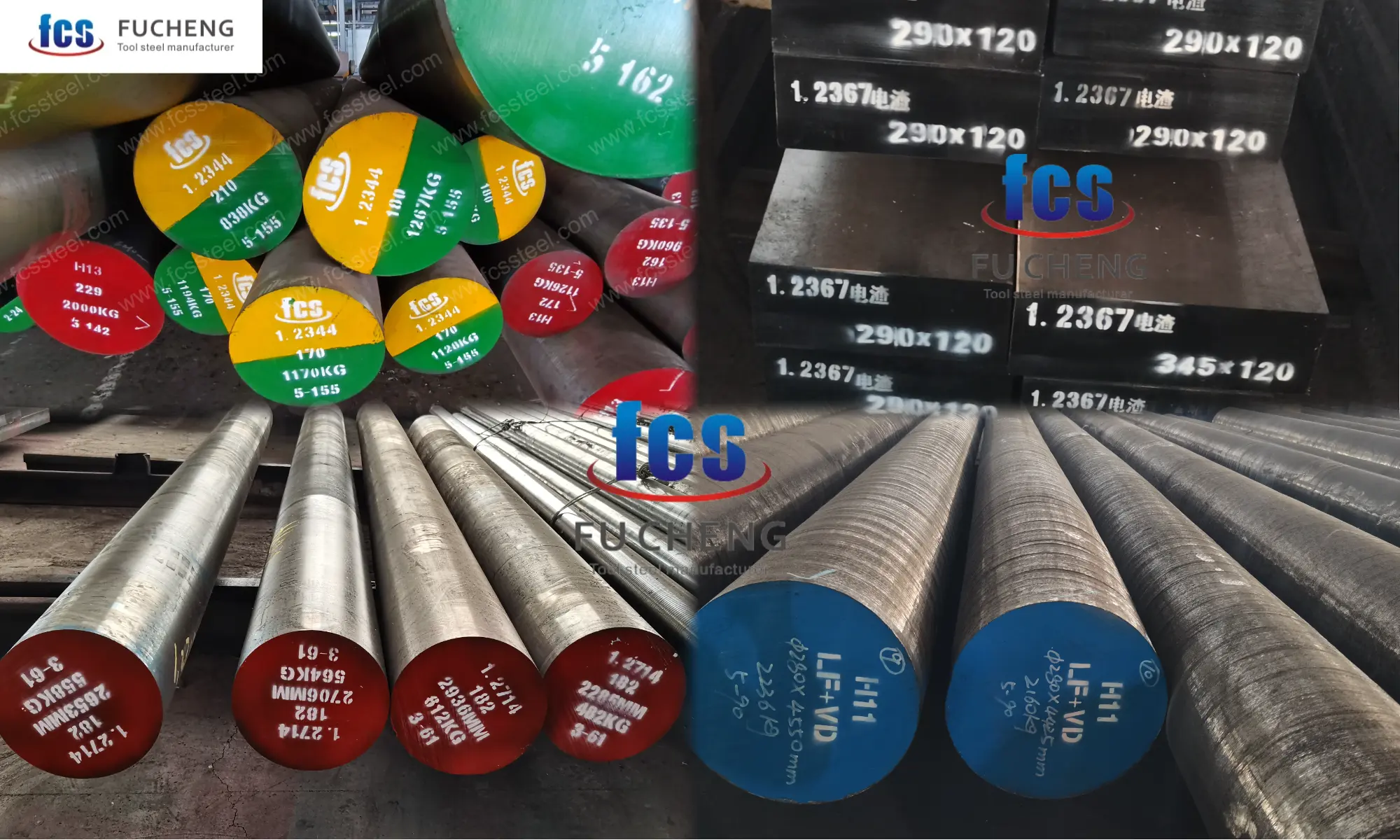
Drawing on 19 years of supplying tool steel to global stockholders, distributors, and volume importers, FCS examines three factors behind bulk material selection: steel grade, metallurgical quality, and delivery condition. This guide explains how those factors affect the choice between H13, H11, 1.2714, and 1.2367 tool steel for hot forging dies.
Match the Steel to the Forging Application
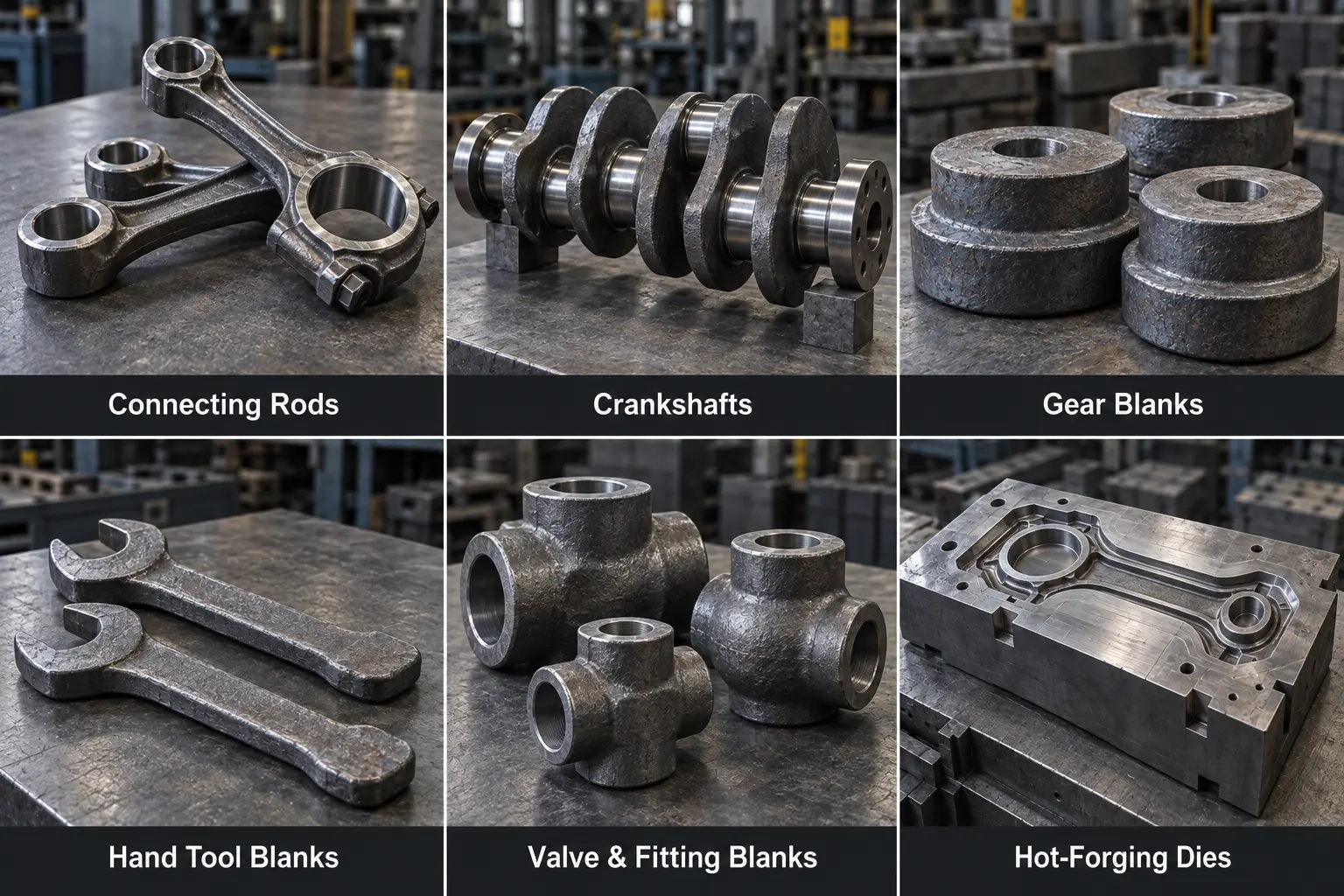
Hot forging produces parts such as connecting rods, crankshafts, gear blanks, hand-tool blanks, and selected valve or fitting components. The product name provides context; the forging method, die size, and contact conditions determine the material requirements.
|
Application or Operating Condition |
Main Material Requirement |
Grades to Evaluate |
When to Consider a Quality Upgrade |
|---|---|---|---|
|
General press-forging dies for steel components |
Balance of hot strength, wear resistance, and toughness |
H13 / 1.2344 family |
Complex cavities, costly downtime, or stricter consistency requirements |
|
Crack-sensitive dies under substantial mechanical loading |
Toughness alongside adequate hot strength |
H11 / 1.2343 family |
Demanding transverse properties or tighter internal-quality requirements |
|
Large hammer-forging die blocks |
Impact toughness and hardenability through a large section |
1.2714 |
Deep cavities, repeated resinking, or critical internal soundness |
|
Highly loaded forging inserts with softening or deformation concerns |
Hot strength and resistance to temper softening |
1.2367 and other suitable high-performance hot-work grades |
High thermal exposure combined with demanding quality requirements |
|
Short production runs with established, stable tooling performance |
Sufficient properties at an acceptable total cost |
The proven grade for the application |
Upgrade only where a defined technical or economic benefit exists |
These are starting points for selection, not automatic substitutions. A change in forging equipment, billet material, or die geometry can change the preferred choice.
What Hot Forging Demands from the Steel
Four properties deserve particular attention.
Hot strength helps the cavity resist permanent deformation under pressure at elevated temperature. Room-temperature hardness alone does not describe this capability.
Resistance to temper softening helps the steel retain useful properties during repeated thermal exposure. A die that starts hard but softens quickly can lose dimensional accuracy.
Toughness helps resist crack propagation and sudden fracture. It matters in impact-loaded tooling, large blocks, and geometries with concentrated stresses.
Resistance to hot wear and thermal fatigue helps preserve the working surface. Wear removes material; repeated heating and cooling can generate heat-checking cracks. They are different damage mechanisms and need different attention.
Comparing the Main Grade Options
H13: A Practical Starting Point for General Hot Work
H13 tool steel is a chromium-molybdenum-vanadium hot-work steel used where heat resistance, wear resistance, and toughness must be balanced.
It is a useful starting point for conventional press-forging dies and inserts. Before moving to another grade, establish whether the limitation is the alloy’s performance or the quality and treatment of the particular material being used.
H13 tool steel and H13 ESR can share the same nominal chemistry. The reason to evaluate ESR is improved metallurgical quality, rather than an assumption that the material will simply achieve a higher HRC.
H11: Worth Evaluating When Toughness Carries More Weight
H11 tool steel belongs to the same broad chromium hot-work family as H13. It is often evaluated where toughness is particularly important.
The two grades differ in their alloy balance. For example, FCS’s published composition tables list vanadium at 0.30–0.60% for H11 and 0.80–1.20% for H13 tool steel. That is a useful distinction, but it should not be treated as a complete explanation of their performance: processing, microstructure, hardness, and heat treatment also matter.
A cracked H13 die does not automatically prove that H11 is required. It makes toughness and the actual cause of cracking worth reviewing.
1.2714: A Candidate for Large, Impact-Loaded Dies
The appeal of 1.2714 tool steel lies in its toughness and hardenability, which make it relevant to large forging die blocks and hammer-forging applications.
For a large block, surface hardness is only part of the requirement. The material deeper inside the section matters, particularly when cavities extend into the block or the die will be resunk.
FCS’s published 1.2714 tool steel composition includes 1.50–1.80% nickel. Its product listing specifies annealed delivery at ≤241 HBS. These describe the raw material; the finished die requires an application-specific treatment and hardness target.
1.2367: An Option for More Demanding Thermal Duties
Where softening and plastic deformation limit die life, a different alloy balance may be more useful than simply increasing the initial hardness.
1.2367 is a higher-molybdenum hot-work grade worth evaluating for such duties. Its published composition contains 2.70–3.30% molybdenum, compared with 1.10–1.75% in FCS’s H13 tool steel table. Molybdenum contributes to tempering resistance, but the benefit depends on the complete composition and heat treatment.
The buying question is whether improved performance under the actual thermal load justifies the additional material and processing cost.
Delivery Hardness and Working Hardness Are Different
A die maker buying steel for machining usually needs the delivery condition stated clearly. Final working hardness belongs to a later processing stage unless hardened material is specifically ordered.
|
FCS Product |
Published Delivery Condition |
Published Maximum Delivery Hardness |
|---|---|---|
|
H13 tool steel |
Annealed |
≤229 HBS |
|
H11 tool steel |
Annealed |
≤229 HBS |
|
1.2714 tool steel |
Annealed |
≤241 HBS |
|
1.2367 tool steel |
Annealed |
≤235 HBS |
The annealed hardness values above are FCS delivery specifications; the hardness test method and reporting designation should be confirmed in the order.
For stockholders buying large blocks and long bars, hardness is only part of the acceptance criteria. Internal quality matters when the material is cut, while reliable identification keeps each piece traceable through storage and resale. FCS supports these requirements through three production and inspection controls:
-
Heavy-section forging: A 5,500-ton forging press provides the capacity to work large H13 and 1.2714 blocks, with the forging process designed to promote consolidation toward the core.
-
Hydrogen control: Vacuum degassing (VD) controls hydrogen to ≤2 ppm, helping reduce the risk of hydrogen-related internal cracking.
-
Piece-by-piece identification: Every bar and block undergoes OES chemical composition verification before dispatch. Each piece carries a stamped heat number linking it to the corresponding EN 10204 3.1 material test certificate.
These controls address material quality and traceability at delivery. The finished die’s working hardness is a separate requirement, selected for the forging application and achieved through subsequent heat treatment.
Why the Same Grade Can Perform Differently
A chemistry certificate confirms composition against the agreed specification. It does not describe every feature inside the steel.
|
Material Feature |
Why It Matters |
Useful Evidence |
|---|---|---|
|
Non-metallic inclusions |
Larger or unfavorably distributed inclusions can contribute to crack initiation |
Inclusion ratings with a defined sampling method |
|
Segregation and carbide distribution |
Local differences can produce uneven response to heat treatment and loading |
Appropriate metallographic and macrostructure assessment |
|
Grain structure |
The relevant grain size and its uniformity influence mechanical behavior |
Grain-size results with the test condition identified |
|
Internal discontinuities |
Internal defects can compromise a heavily loaded die block |
Ultrasonic testing to an agreed method and acceptance level |
|
Properties through the section |
Surface results may not represent the core or transverse direction |
Tests from specified locations and orientations |
Standards help make these comparisons meaningful. ASTM E45 provides methods for assessing inclusion content, while ASTM E112 covers average grain-size measurement. E45 explicitly does not establish acceptance limits for a steel grade; the required limits still need to be specified.
A metallographic result and an ultrasonic report answer different questions. Neither should be used as a substitute for the other.
When ESR or EFS Is Worth Considering
ESR: Pay for Controlled Metallurgical Quality
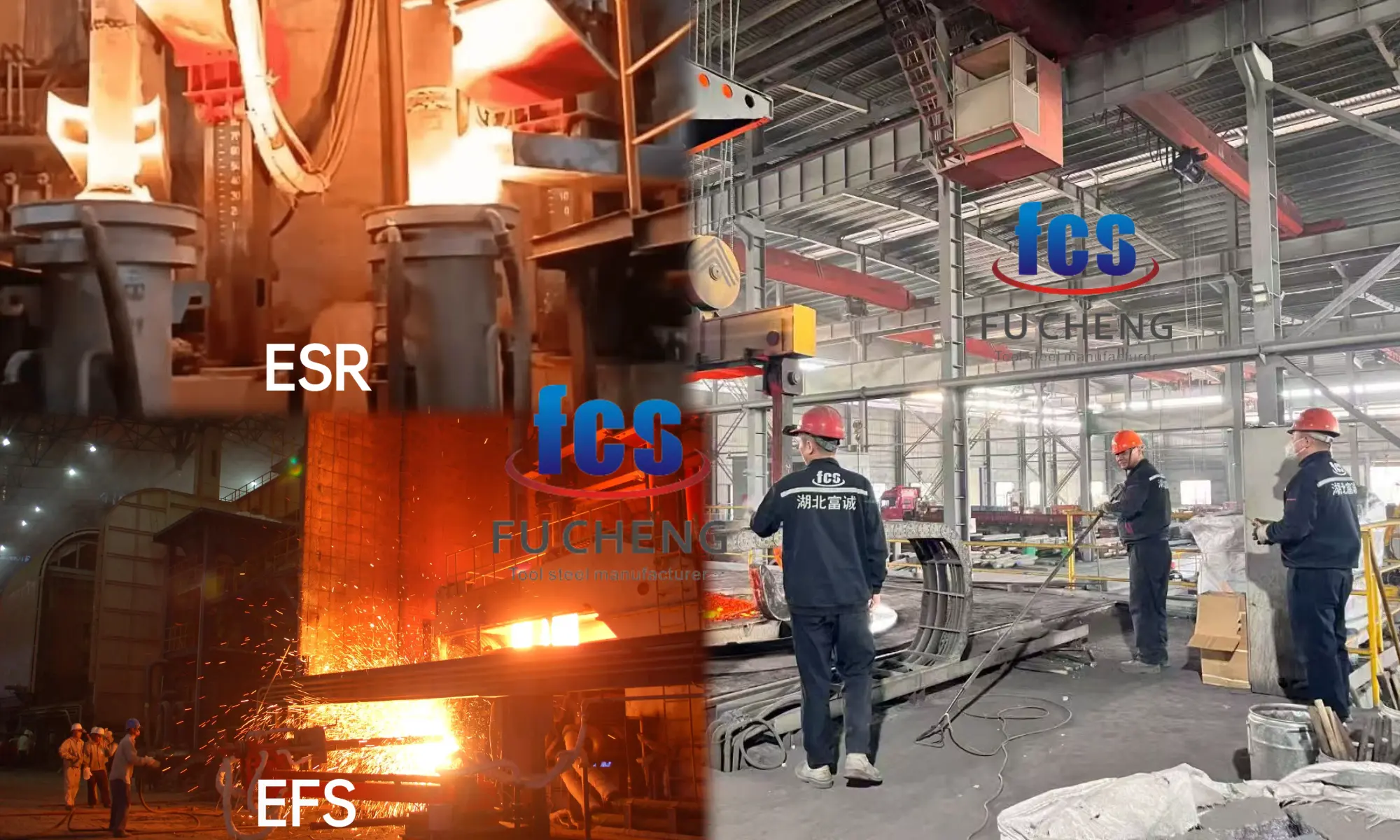
Electroslag remelting adds a refining and controlled-solidification stage. It can improve cleanliness and homogeneity, making it relevant when internal quality and toughness consistency are important.
The process still needs control. In an eight-ingot H13 tool steel study, researchers Gang Du, Jing Li, and Zhong-Bing Wang found that changing ESR operating conditions changed the removal of large inclusions. Their work supports a practical purchasing point: the ESR label should be accompanied by meaningful quality results.
ESR deserves closer consideration when the die is expensive to machine, replacement disrupts production, or the specification requires tighter internal quality.
EFS: Look at the Defined Structure Requirements
EFS means Extra Fine Structure in the relevant tool-steel product terminology. FCS describes EFS as a microstructure-refinement process. It is not a separate steel grade, and the name alone does not establish a universal grain-size or toughness guarantee.
For an EFS purchase, establish what the offered product controls: structure, uniformity, carbide distribution, or specified mechanical properties. Compare the supporting results under equivalent test conditions.
ESR and EFS describe different aspects of material production and quality. They should not be presented as interchangeable labels or fixed steps in a universal ranking.
Upgrade the quality route when the grade is suitable but tighter metallurgical control is needed. Reconsider the grade when its hot strength or softening resistance is insufficient. The two decisions may also be made together.
Compare Cost per Usable Die Life
The cheapest steel per kilogram is not necessarily the cheapest tooling material. Equally, a premium material is not automatically economical for a short run.
A useful comparison is:
Tooling cost per acceptable forging = total die-related cost ÷ acceptable forgings produced
Include material, machining, heat treatment, repair, and attributable changeover or downtime costs. Compare materials in the same application before claiming a saving.
A premium option has a stronger economic case when machining represents a large investment or premature replacement is expensive. If an established material already completes the required production reliably, an upgrade needs a clear reason.
Compare quotations on the same dimensions, delivery condition, quality route, inspection requirements, and surface condition. Otherwise, a price difference may reflect different supply scopes rather than different value.
Request a Bulk Quotation
FCS supplies tool steel to stockholders, distributors, and volume importers worldwide. Orders range from 25–26 MT Full Container Loads (FCL) up to 2,000 MT breakbulk shipments.
For a fast mill-direct quote, please share your procurement details:
-
Grades and Tonnage: Target grades (e.g., H13, 1.2714, 1.2367) and total volume.
-
Dimensions: Specific sizes for forged blocks or long bars.
-
Technical Specs: Delivery condition, ESR/EFS needs, and inspection standards.
-
Logistics: Your destination port.