
Introduction:
D6 versus D3 tool steel – this choice affects your project’s performance and budget. Both are high-carbon, high-chromium steels. They look similar at first. But their unique properties create very different results in actual use.
D6 steel hardens all the way through. This makes it perfect for thick tooling sections. D3 steel resists wear better. It works great for high-volume stamping jobs.
You’re designing precision dies, cold-forming tools, or stamping equipment? Know the key differences. Look at their chemical makeup. Check how they respond to heat treatment. Compare their cost versus performance. This knowledge helps you avoid expensive errors. Plus, you get better value from your tooling budget.
This comparison covers the hardness and toughness balance. We explain machining challenges too. You’ll get practical insights to pick the right material for your specific needs.
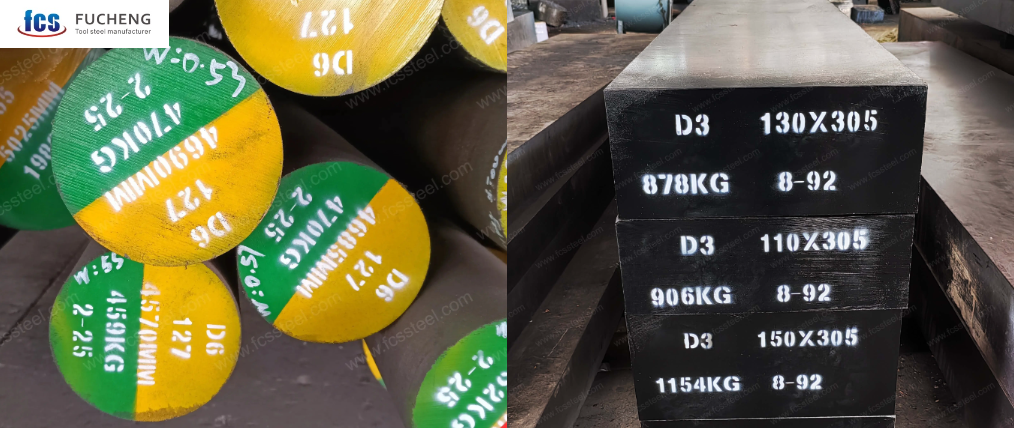
1. Chemical Composition
Here is the side-by-side comparison based on the specific elements mentioned:
| Element | D6 Content | D3 Content | Performance Impact |
|---|---|---|---|
| Carbon | 2.20% | 2.15% | Higher carbon in D6 boosts hardening potential and dimensional stability. |
| Tungsten | Included (Key Element) | 0% (None) | The presence of Tungsten makes D6 an air-hardening steel with better abrasion resistance. |
| Chromium | 12.00% | 12.25% | Both use high chromium to form protective M7C3 carbide networks. |
| Vanadium | Minimal / None | 0.25% | Affects carbide fineness and grain structure. |
D6 has more carbide volume than D3. High carbon, chromium, and tungsten combine to create this. D6 produces more M7C3 type carbides than D3.
The result? D6 reaches 62-63 HRC hardness after tempering at 300-350°F. D3 hits an optimal 58-60 HRC at 450-500°F temper ranges.D6’s air-hardening comes from its tungsten-rich composition. For sections over 6 inches thick, you need 4-6 hour soak times at austenitizing temperature. This ensures proper through-hardening.
2. Wear Resistance
Both steels fight wear exceptionally well. Each one shines in different work conditions. Know their differences to get longer tool life and lower replacement costs.
| Feature | D6 Tool Steel | D3 Tool Steel | Wear Type |
|---|---|---|---|
| Working Hardness | 55–62 HRC (Exceeds standard D2) | 57–62 HRC (Optimized at 57–58 HRC) | Surface Hardness |
| Carbide Structure | Dense M7C3 networks creating a compact shield against fine particles | Large chromium carbides massively distributed in the matrix | Microstructure |
| Real-World Performance | Outperforms both D2 and D3 in pure abrasive settings | Lasts 50,000–200,000 strokes on 1–3 mm sheet metal | Lifespan |
| Compressive Strength | 1320 MPa, maintains edge under constant load | ~1300 MPa, resists surface deformation | Load Support |
| Best Application | Severe abrasion; excellent for fiberglass/mineral-filled materials | Sliding wear; superior resistance to metal-to-metal sliding/galling | Primary Use |
The catch is toughness. D3 has the weakest impact resistance among cold work steels – only 28-77 J unnotched Izod at 62 HRC. Jobs needing impact above 30 J can cause edge cracking and early failure. D6 handles impact somewhat better than D3. Still less tough than D2, though.
D6 wins with better through-hardening power. Thick parts harden the same way throughout. No soft spots in the core. Heat treatment keeps dimensions stable. D6 runs longer than D3 in jobs with heavy abrasion and low shock
3. Heat Treatment: D6 Stability vs. D3 Hardness
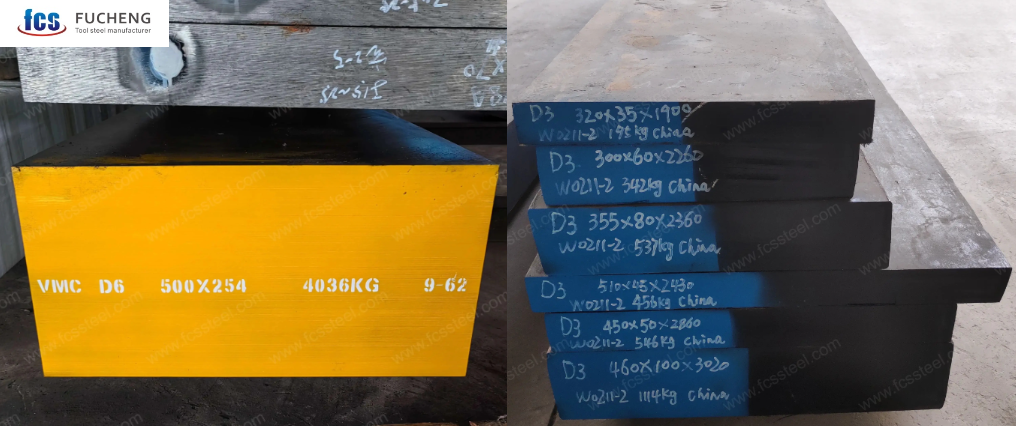
D6: The Air-Hardening Stability Champion
| Item | D6 Tool Steel |
|---|---|
| Hardening type | Air hardening |
| Austenitizing temperature | 950–980 °C |
| Quenching method | Still air |
| Through-hardening capability | Excellent, including thick sections |
| Typical hardness | 60–62 HRC |
| Hardness with deep cryogenic treatment | 64–66 HRC |
| Dimensional stability | Very high |
| Cracking / distortion risk | Low |
| Process complexity | Low |
D3: The Oil-Quenching Hardness Specialist
| Item | D3 Tool Steel |
|---|---|
| Hardening type | Oil hardening |
| Austenitizing temperature | 927–954 °C |
| Quenching method | Oil quench, then air cool |
| Through-hardening capability | Moderate |
| Typical hardness range | 58–63 HRC |
| Wear-optimized hardness | 62–63 HRC |
| Dimensional stability | Medium |
| Cracking / distortion risk | High in thick sections |
| Process complexity | High |
D6 tool steel:
D6 is optimized for stable through-hardening with minimal process risk. Its air-hardening mechanism avoids the thermal shock associated with liquid quenching, allowing hardness to develop uniformly across thick cross-sections. Dimensional change after heat treatment is typically very small, which is critical for precision dies and tools with tight tolerance requirements. Double tempering further stabilizes the microstructure, improving impact resistance without sacrificing hardness. As a result, D6 often requires less post-heat-treatment grinding and correction, reducing overall manufacturing time and cost.
D3 tool steel:
By contrast, D3 is more sensitive to heat treatment parameters due to its oil-quenching requirement. Rapid cooling generates high internal stresses, especially in large or complex components. To reduce cracking risk, multi-step preheating and extended soak times are necessary, particularly for sections above 150 mm. Even with careful control, distortion and residual stress remain concerns, often leading to additional finishing work after heat treatment.
While D3 can achieve high surface hardness for wear-intensive applications, this comes at the expense of process complexity and higher heat treatment costs, especially in thick-section tooling.
4. Hardness & Toughness: The Trade-Off
| Metric | D6 Tool Steel | D3 Tool Steel |
|---|---|---|
| Optimal Tempering Temp | 500–600°C (High temp / Secondary Hardening) |
200–250°C (Low temp for Max Hardness) |
| Working Hardness | 60–62 HRC Stable throughout the section. |
60–64 HRC Optimized for surface abrasion. |
| Impact Strength (Izod) | Medium Uniform structure prevents core cracking. |
Very Low (28–77 J) The weakest of most cold-work steels. |
| Stress & Failure Risk | Low Risk (Air Cooled) Minimal internal stress triggers. |
High Risk (Oil Quenched) Brittle carbide clusters create snap-points. |
In Short: The “Glass Jaw” Effect
Both steels are hard, but they handle stress differently:
- D3 has a “glass jaw.” It is extremely hard on the surface (up to 64 HRC) but internally stressed from oil quenching. One hard impact or a material jam, and it tends to shatter rather than chip.
- D6 is more predictable. Because it hardens via air cooling, it lacks those internal stresses. It’s not “tough” like S7 shock steel, but it won’t spontaneously crack in thick sections like D3 does.
5. Machinability: How to Budget for Processing Costs
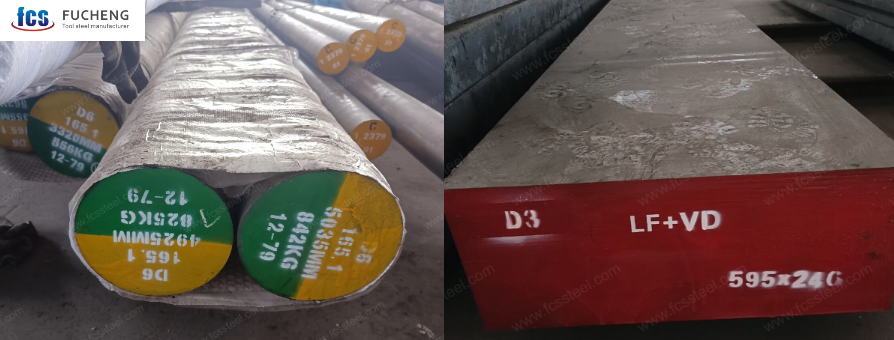
Shop efficiency often matters more than material specs. Here is how these two steels behave on the machine floor.
The Processing Battle:
| Feature | D6 Tool Steel (The “Tool Eater”) | D3 Tool Steel (The Standard) |
|---|---|---|
| Machinability Rating | Poor / Difficult | Medium / Manageable |
| Cutting Speed | Slows to 70-90 m/min. Dense carbides (1700 HV) chew up cutting edges quickly. | Runs 15-20% Faster. Standard carbide inserts handle the roughing cuts much better. |
| Grinding Effort | High. Needs special wheels. The wheel loads up fast and needs frequent dressing. | Standard. Grinds to final size with predictable wheel wear and shorter cycles. |
| Tooling Requirement | Carbide Essential. HSS cutters will fail in minutes. | Carbide Recommended. Can use coated HSS for light finishing. |
The Economic Reality: Where the Money Goes
D6 costs more to shape, but D3 costs more to treat. Here is how the math works out:
Machining Penalty (D6 loses): Expect D6 parts to cost 20-35% more to machine due to slower speeds and higher insert consumption.
Heat Treat Savings (D6 wins): D6 recovers some cost here. Air quenching is cheaper and simpler than D3’s complex oil quenching and double tempering cycles.
The Break-Even Verdict:
- If you are making disposable, short-run tools, the machining cost of D6 makes it too expensive. Stick with D3.
- If the tool must handle high abrasion (>30% fiber), the extra machining cost of D6 is negligible compared to the 300% increase in tool life.
6. Optimal Application Scenarios
D6: Built for Deep Hardening
- Glass-fiber–reinforced plastics (>30% GF):Extremely hard M7C3 carbides (~1700 HV) resist severe fiber and mineral abrasion far better than conventional cold-work steels.
- Plastic pelletizing blades (UHMWPE, PEEK, HDPE composites):Dense carbide network protects cutting edges from continuous abrasive wear, delivering significantly longer service life.
- Thin sheet punching (< 2 mm thickness):Excellent through-hardening ensures uniform 60–62 HRC without soft cores, reducing edge cracking in long punches.
- High-precision cutting knives (paper, plastic, wood):High compressive strength and stable microstructure provide long-term edge retention under continuous contact pressure.
- Tools requiring tight dimensional control after heat treatment:Air hardening minimizes distortion, making D6 suitable for precision dies with minimal post-grinding.
- PVD-coated cold-work tooling (TiN, TiAlN):Stable base hardness supports hard coatings applied below 500 °C, improving surface wear resistance without substrate failure.
- ESR-grade tooling with combined wear and toughness demand:Reduced inclusion content and refined carbides improve toughness while maintaining extreme abrasion resistance.
D3: Built for Surface Wear
- Low-impact, high-compression cold-work applications:Large chromium carbides perform well under steady contact pressure without shock loading.
- Forming rolls and drawing dies:Consistent compressive stress favors D3’s wear resistance in sliding and rolling contact.
- Powder compaction and lamination dies:High hardness and abrasion resistance support long production runs under uniform load.
- Blanking and stamping punches (moderate geometry):When impact is limited, D3 maintains sharp edges over extended stroke counts.
- Bending rolls and seaming operations:Constant force applications match D3’s mechanical profile well.
- Cold trimmer dies:Wear resistance is prioritized over impact toughness, making D3 a suitable choice.
- Applications requiring hardness tuning:Can be run at 62–63 HRC for maximum wear resistance or tempered down to 58–60 HRC for improved toughness balance.
Application Boundaries (Both D6 and D3)
- Not suitable for high-impact or shock-loaded tooling
- Not a replacement for S1, S7 tool steel, or other shock-resistant grades
- Not suitable for hot-work applications such as forging or die casting
- Thick sections require careful stress control; D3 in particular demands extended tempering soak times
7. Cost-Performance Analysis
| Metric | D3 (Budget Option) | D6 (Premium Option) | The Bottom Line |
|---|---|---|---|
| Raw Material Cost | $2.50 – $4.50 / kg | $7.50 – $12.00 / kg (100–170% Premium) | D6 has huge “sticker shock” — it costs double upfront |
| Service Life (Abrasion) | 1,000 cycles (Baseline) | 3,000 – 4,000 cycles (3×–4× longer life) | One D6 die replaces three D3 dies |
| Break-Even Point | N/A | ~667 cycles | After just 667 parts, D6 becomes effectively “free” vs repeated D3 replacement |
| Total Ownership Cost | Stagnant at $0.003 / cycle | Drops to ~$0.0033 / cycle rapidly | D6 saves 40–60% over the full tool life |
Ceramic tile compaction proves this point. D6 cuts total ownership cost by 40–60% compared to D3. Fewer replacements mean less downtime. Production keeps running. D3’s cheaper price can’t compete with frequent tool changes in mineral-filled materials. One D6 die replaces three D3 dies over the same production period.
8. Final Decision Matrix:
Don’t overthink it. Use this checklist to match your project needs with the right steel immediately.
| Decision Factor | ✅ Choose D6 Tool Steel If… | ✅ Choose D3 Tool Steel If… |
|---|---|---|
| Work Material | You are cutting abrasive materials (Glass fiber >30%, ceramics, reinforced plastics). | You are stamping metals (Steel, aluminum, brass) where sliding friction (galling) is the main issue. |
| Tool Thickness & Shape | Your tool section is thick (>150mm) or has a complex geometry that might warp during quenching. | Your tool is thin and simple. D3 works fine for straightforward shapes that withstand oil quenching stresses. |
| Budget Priority | Long-term Value. You have the budget for higher material costs but need the tool to run for months without stopping. | Upfront Savings. You have a tight manufacturing budget and need a cost-effective solution for standard runs. |
| Availability | You can wait 2-4 weeks. D6 is often a custom order item. | You need it tomorrow. D3 is a standard stock item in most warehouses. |
Conclusion
The choice between D6 vs D3 ultimately comes down to your tolerance for risk versus your budget.
Stick with D3 if you are running standard stamping jobs on thin metals. It remains the industry standard for a reason: it’s affordable, readily available, and fights sliding wear exceptionally well. For simple geometries where oil quenching won’t crack the steel, D3 is the smart, economical play.
Upgrade to D6 the moment your tooling exceeds 50mm in thickness or faces abrasive, glass-filled materials. The higher upfront cost is deceptive. By eliminating heat-treatment distortion and tripling your wear life, D6 often ends up being the cheaper option per part produced.
Don’t just buy steel by the kilogram; buy it by the cycle. If you can’t afford downtime, you can’t afford to skip D6.