
Introduction:
Selecting the wrong material between D6 steel and 440C steel isn’t just a specification error; it’s a production liability.
Treat D6 like stainless, and it rusts overnight. Push 440C too hard in abrasive environments, and edges collapse. Standard datasheets miss these real-world nuances. This guide breaks down the critical trade-offs: massive compressive strength versus necessary corrosion immunity.
We analyze eight strict performance metrics and hidden ownership costs, giving you the data to prevent expensive tool failures and optimize your specific manufacturing ROI.
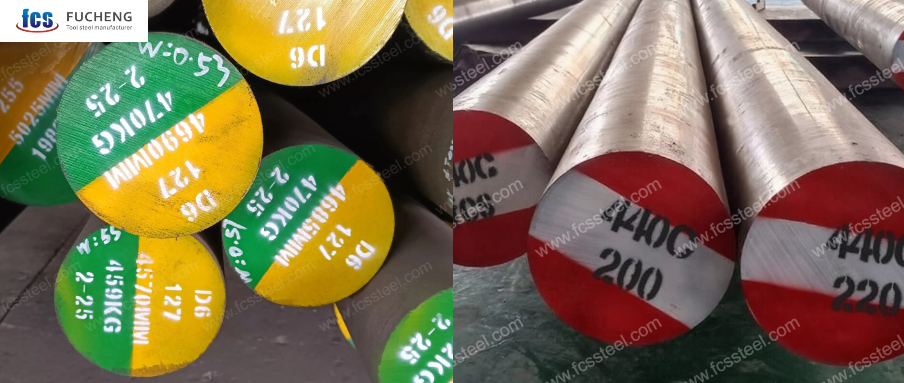
1. Chemical Composition (D6 vs 440C)
The primary differentiator between these two legends lies in their chemical “soul.” D6 focuses on Carbide Volume, while 440C focuses on Matrix Passivation.
| Element | D6 (1.2436) High-Tungsten | 440C (1.4125) Stainless | Technical Impact |
|---|---|---|---|
| Carbon (C) | 2.0% – 2.2% | 0.95% – 1.20% | D6 has 3x the carbon to fuel massive carbide networks. |
| Chromium (Cr) | 11.5% – 12.5% | 16.0% – 18.0% | 440C keeps >12% “free Cr” for rust protection. |
| Tungsten (W) | 0.7% – 1.2% | None | Tungsten in D6 refines complex M₇C₃ carbides. |
| Molybdenum (Mo) | Trace | 0.75% | Mo in 440C prevents “pitting” in saltwater. |
The Master’s Insight: In D6, the carbon is so high that it “hungry-eats” most of the Chromium to form carbides. This is why D6 is not stainless. In 440C, the lower carbon leaves enough Chromium to form a self-healing oxide layer.
2. Carbide Architecture (Microstructure Analysis)
D6:The Wear-Fighting Mechanism
Two carbide types dominate D6’s microstructure:
- M7C3 carbides (primary phase) – These chromium-rich formations give exceptional wear resistance. Their hardness hits 1300-1800 HV.
- Vanadium carbides (secondary, at V ≤1%) – These refine grain boundaries. Plus, they boost edge retention in cutting applications.
Tungsten plays a critical role here. It promotes finer carbide distribution compared to D3 steel. D3 lacks tungsten completely. Laboratory stamping tests show D6 maintains 1.5-2x longer edge retention than D3 under identical high-load conditions.
440C: Finer but Less Aggressive
440C’s structure uses M23C6 (Cr23C6) carbides as the main phase. These carbides spread evenly through the martensitic matrix. They’re uniform and smaller than D6’s M7C3 networks. Secondary M7C3 phases appear in eutectic regions. But they take up less space. This carbide mix delivers HRC 58-60 working hardness.
For bearing applications, it can reach up to 64. Wear resistance hits about 75% of D6’s benchmark. The trade-off? You get surgical-grade corrosion protection.
D6 beats 440C in pure abrasion tests. Its coarser, high-volume M7C3 carbides score 100 on the wear index. 440C scores 75. But those aggressive carbides use up matrix chromium. Medical instrument makers accept the wear trade-off. They need tools that survive sterilization cycles and body fluids without pitting.
3. Heat Treatment Protocols
A tool is only as good as its heat treatment. If you treat D6 like 440C, it will shatter; if you treat 440C like D6, it will rust.
D6 Protocol: The “Stability” Path
- Preheating (650–800°C): Mandatory. D6’s dense carbides expand at different rates than the matrix. Slow heating prevents “thermal shock” cracks.
- Austenitizing (950–980°C): This range dissolves the carbides just enough to achieve HRC 62-64.
- Triple Tempering (150–200°C): High carbon = high Retained Austenite. You must temper 3 times to ensure the steel doesn’t “grow” or warp during production.
440C Protocol: The “Defense” Path
- Austenitizing (1010–1070°C): Higher heat is needed to “activate” the Chromium for stainless properties.
- Cryogenic Treatment (-196°C): Essential for 440C. It converts unstable austenite into hard martensite, pushing hardness to a stable 60 HRC.
- Tempering (<370°C): “Avoid tempering 440C between 425°C and 565°C. This is the ‘sensitization zone’ where chromium precipitates, causing the steel to lose its stainless properties and become brittle.
4. Core Performance Comparison: 8 Quantitative Metrics
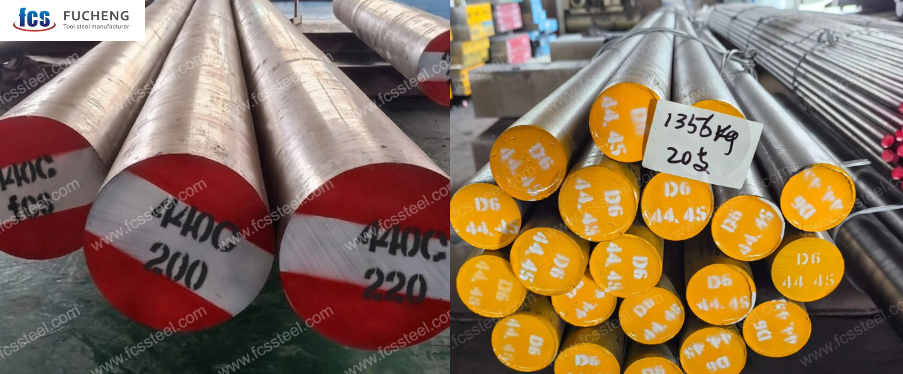
D6 and 440C take different approaches to metallurgy. Here is a strict performance breakdown based on material properties. We stripped away external variables to give you the raw data.
Metric1. Hardness Potential (HRC)
D6 (High-Tungsten):You get maximum hardness with this alloy. Oil quench and temper it, and D6 hits 62–64 HRC. The 0.7-1.2% tungsten content stops grains from growing. So, it keeps that peak hardness even in thick pieces. It acts as a true “hard” cold-work steel.
440C (Stainless):This steel pushes the limit for stainless. Standard heat treatment gets you to 58–60 HRC. “Professional cryogenic processing can push 440C to 60–62 HRC. While this matches D6’s hardness, 440C still lacks the massive carbide volume needed to sustain that edge under high-abrasion loads. It lacks the carbon density for that kind of stability. Instead, you get a good balance of hardness and corrosion resistance.
Metric2. Abrasion Resistance
D6 (High-Tungsten):D6 eats up abrasion. With 2.2% carbon, it creates huge volumes of M7C3 and Tungsten carbides. Tests show it offers 30-40% better wear resistance than standard high-carbon steels. It resists “sliding wear” very well. This makes it perfect for brick molds or ceramic pressing.
440C (Stainless):440C uses chromium carbides to stop wear. It is hard, but has fewer carbides than D6. It resists wear well for a stainless material. But put it under heavy abrasive loads like sand, and it wears down 2x faster than D6. Use it for metal-to-soft-material contact instead.
Metric3. Edge Retention
D6 (High-Tungsten):A dense carbide network supports the cutting edge. Even under heavy loads like blanking thick steel, D6 keeps a sharp edge for long runs. You must design the edge with extra support, though. This prevents the coarse carbides from causing micro-chips.
440C (Stainless):You get a “razor” edge for slicing jobs like knives or surgical tools. But industrial punching causes problems. The edge wears out faster because the metal deforms at a tiny level. It misses that massive tungsten-carbide structure that D6 uses to keep edges rigid.
Metric4. Corrosion Resistance
D6 (High-Tungsten):D6 gives you zero stainless properties. It has ~12% chromium, but the high carbon ties almost all of it up in carbides. Expect rust in humid spots. You must oil or plate it heavily to stop this.
440C (Stainless):Pick this one for wet environments. It has ~17% chromium and 1% carbon. This leaves enough “free chromium” to form a protective layer. It blocks rust from fresh water, steam, weak acids, and blood. Industry views this as the standard for hard, rust-proof tooling.
Metric5. Toughness (Impact Strength)
D6 (High-Tungsten):Watch out, D6 is brittle. The carbides that fight wear also create break points. Impact values stay low, often under 20 Joules. It fails under shock loading. A misfeed in a stamping press will likely crack or shatter a D6 die.
440C (Stainless):440C isn’t “shock-resistant,” but it beats D6 here. A finer grain and less carbon give it a little flex. It handles the snap-force of parts like bearings or valves better. Still, compare it to lower-alloy tool steels, and it seems brittle.
Metric6. Compressive Strength
D6 (High-Tungsten):This is D6’s best feature. It takes massive static loads without bending. Strength goes over 2500 MPa. Choose this for cold-forming dies. Your tool won’t change shape by even a micron, even under tons of pressure.
440C (Stainless):440C is strong, with yield strengths near 1900 MPa (at 59 HRC). But it falls short of D6. Put it under extreme pressure, like coin minting, and it risks deforming. It will “mushroom” sooner than D6.
Metric7. Machinability
D6 (High-Tungsten): Machining this is hard work. Even when soft, big carbides destroy standard drill bits and cutters. You need to slow down. Cut machining speeds by 40-50% compared to oil-hardening steels to save your tools.
440C (Stainless): We rate this as “Fair.” It feels gummy in the annealed state but cuts cleaner than D6. You still need carbide tools, but you can feed it faster. Expect to machine 20-30% faster than D6. This lowers your fabrication costs.
Metric8. Dimensional Stability
D6 (High-Tungsten): D6 hardens in air and barely moves. Heat treat it, and you see very little distortion (often < 0.05% change). This makes it safe for complex die sections. You can’t grind those much after hardening, so stability matters.
440C (Stainless): Stability is good, but you must use deep cooling (cryo). Without cryo, 440C parts might grow over time or lose their size. Process it right, and it holds tolerance well. Just know it is a bit less predictable than D6.
D6 wins 4 out of 8 metrics:pure hardness, abrasive defense, and edge rigidity under heavy load and wear performance.
440C takes 3 categories: rust resistance, toughness, and impact strength. They tie on max hardness. Pick D6 for dry conditions where wear destroys tools faster than rust. Pick 440C for wet conditions, chemicals, or sterilization cycles.
5. Engineering Benchmarks: Quantitative Comparison
While descriptions provide context, engineering requires raw numbers. Below is the master data set for stress analysis and tool design.
| Property | D6 (1.2436) | 440C (1.4125) | Master’s Verdict |
|---|---|---|---|
| Max Hardness | 62–64 HRC | 58–62 HRC(w/ Cryo) | D6 edge is more stable. |
| Compressive Strength | >2600 MPa | ~1900 MPa | D6 resists “mushrooming.” |
| Ductility (Elongation) | 1.16%(Brittle) | 2.0% – 14%(Flex) | 440C survives slight shock. |
| Through-Hardening | Superior(>60mm) | Limited(<25mm) | D6 for thick/massive dies. |
| Dimensional Stability | <0.05% Change | Moderate Risk | D6 for high-precision dies. |
| Thermal Conductivity | 20.5 W/(m·K) | 24.2 W/(m·K) | 440C sheds heat faster |
In Short: The Mechanical Trade-off
- Choose D6 if your tool fails due to deformation or surface wear. It is a “Stiff & Hard” armor for high-pressure, dry environments.
- Choose 440C if your tool fails due to pitting or snapping. It is a “Flex & Shield” material for wet, corrosive, or high-vibration tasks.
6. Industrial Application Scenarios
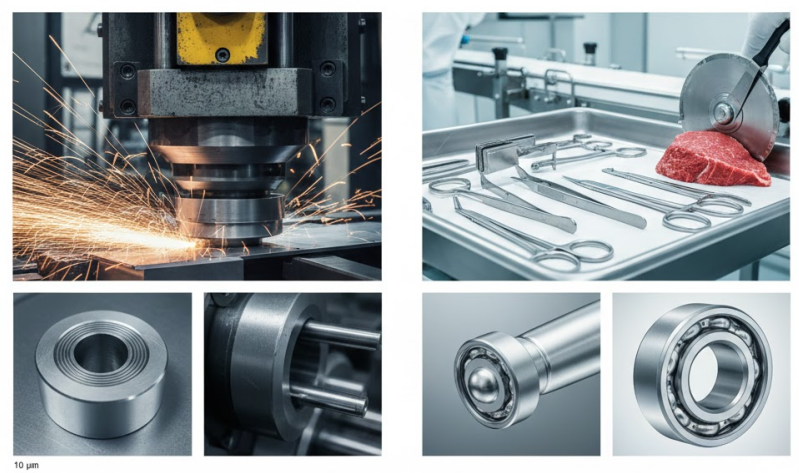
(D6): Heavy-Duty Wear Armor (440C): Surgical-Grade Corrosion Shield
Your choice comes down to the environment: D6 dominates in dry, high-load abrasion, while 440C is essential for corrosive or hygienic settings.
D6: The Heavy-Duty Wear Specialist
Designers choose D6 for “dry” cold-work applications where massive compressive strength (>2500 MPa) and wear resistance are non-negotiable.
- High-Stress Stamping Dies: Critical for automotive body panels and silicon steel laminations where softer steels would deform.
- Deep Drawing & Forming: Used in wire-drawing dies and thread rolling tools that face extreme surface pressure.
- Abrasive Processing: The standard for brick molds, ceramic liner plates, and crushing hammers handling mineral-filled materials.
- Shearing Blades: Ideal for cold-shearing thick gauge metals where edge collapse is a primary failure mode.
440C: The Corrosion-Resistant Expert
440C is the only viable option when high hardness (HRC 58-60) must coexist with moisture, acids, or sterilization.
- Medical Instruments: Scalpels, dental drills, and forceps that must survive repeated autoclave sterilization cycles.
- Food Industry Blades: Cutting tools for acidic fruits or meats that require strict hygiene compliance and rust prevention.
- Marine Applications: Ball bearings, valve seats, and diving knives exposed to saltwater environments.
- Precision Components: Fuel system nozzles and flow meters handling corrosive fluids.
In short
- Select D6 (1.2436) steel when your enemy is Abrasive Wear. In a dry, heavy-load factory, D6’s tungsten-reinforced armor is unmatched.
- Select 440C Stainless when your enemy is Corrosive Decay. In the wet, acidic world of food or medicine, 440C provides the necessary hardness with total environmental immunity.
7. Cost-Benefit & ROI Analysis
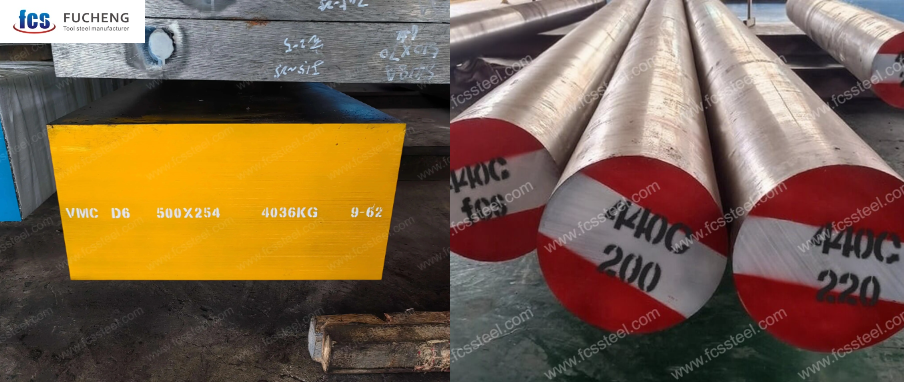
D6 demands a higher upfront investment but pays off in extreme production volumes. 440C saves money by eliminating secondary treatments like plating.
| Cost Factor | D6 (High-Tungsten) | 440C (Stainless) |
|---|---|---|
| Raw Material | High ($12–$18/kg) Due to Tungsten/Carbon content |
Moderate ($8–$12/kg) Standard high-chrome pricing |
| Machining Cost | Very High 40-60% slower; consumes more tooling |
Medium 20-30% faster throughput than D6 |
| Maintenance | High Requires oiling or chrome plating |
Zero Built-in rust protection |
| Best ROI Case | High-volume stamping (500k+ parts) | Medical/Food/Marine environments |
The Verdict on Value:
Choose D6 for “Uptime ROI.”
Yes, fabrication costs hurt. You will spend 40% more on machining labor compared to standard tool steels. But if your press downtime costs $2,000/hour, D6 pays for itself quickly. By tripling the interval between sharpenings, it keeps machines running longer. It effectively lowers the cost-per-part over a 5-year cycle.
Choose 440C for “Maintenance Savings.”
Its value isn’t just in the lower purchase price. 440C removes hidden costs. You don’t need to pay for hard chrome plating (which can flake off). You don’t need daily oiling crews. For food or medical tools where contamination causes product recalls, 440C offers the safest, lowest-liability investment.
8. Beyond Limits: When D6 and 440C Fail
If D6’s brittleness causes “chipping bombs” or 440C softens against 35% glass-fiber abrasives, you’ve hit the limits of conventional melting.
- The PM Solution: Upgrade to M390 or Elmax. Powder metallurgy refines carbides into a micro-matrix, offering D6-level wear with 3x the toughness and superior 440C corrosion defense.
- The Hybrid Path: Use M2 (SKH-51) Substrate paired with a PVD (TiAlN) coating. The HSS core prevents deformation, while the ceramic shield defies rust.
Master’s Tip: High-tier PM steel requires -196°C cryogenics; without it, you’re just paying for performance you’ll never unlock.
Conclusion
There is no universal winner. Choose D6 for high-load abrasion; it withstands the brutality of dry stamping where others fail. Choose 440C when moisture or hygiene dictates lifespan. But the alloy is only half the battle. Consult your heat treater early. Proper processing is what actually unlocks the 200–400% tool life extension and secures your long-term ROI.