Let’s be real. Processing high-fiber plastics hits your equipment hard. You install fresh blades. But soon, glass fibers and carbon particles grind through the edges like sandpaper. You get dull knives. Then, your machine stops, and pellet quality drops. This hurts your bottom line.
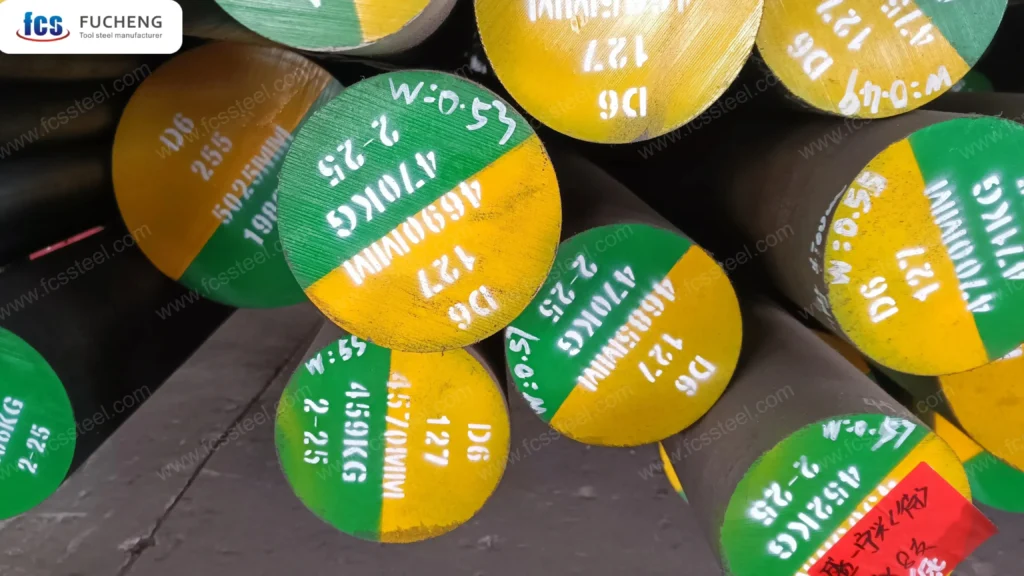
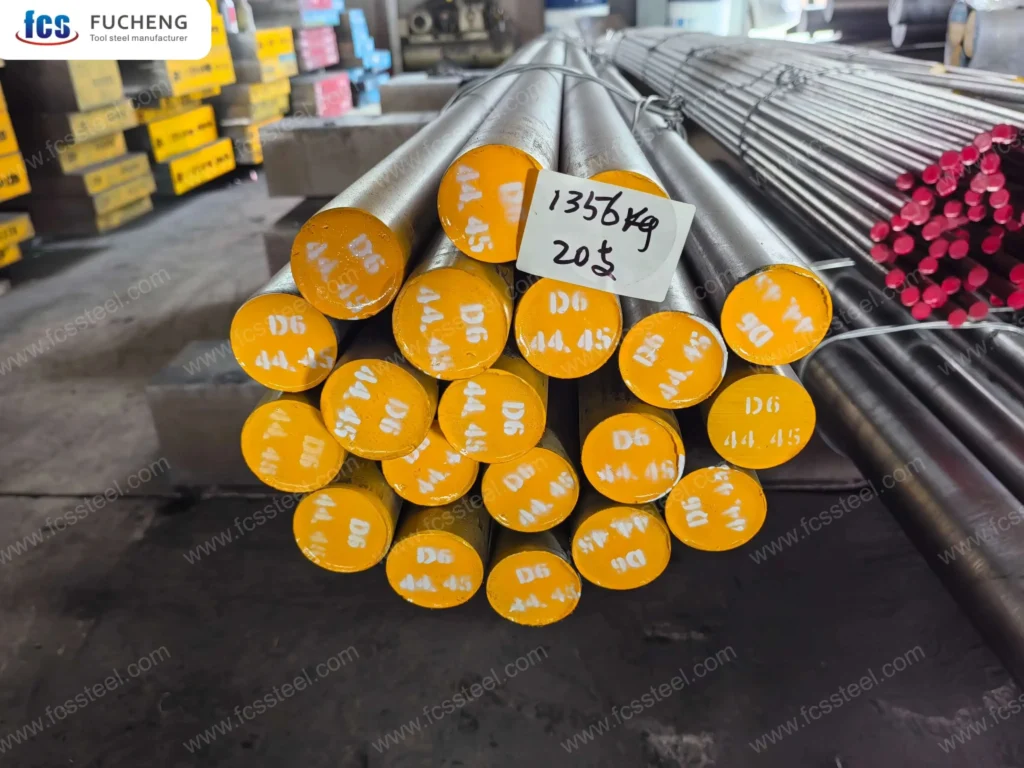
D6 tool steel solves this problem. Standard alloys often fail in hours. D6 uses a packed carbide structure to withstand abrasive mixes. It acts like armor for your equipment. Don’t accept frequent blade changes as just “part of the job.” Switch to D6. You get better wear resistance. Your line keeps running.
1. Composition and Carbide Structure for Wear Resistance
D6 tool steel packs 2.00–2.20% carbon with 11.50–12.50% chromium. This combination creates the hardest carbide networks in pelletizing blade materials. Add 0.60–0.90% tungsten. You get a steel built to outlast abrasive fiber-filled plastics.
The Chemical Blueprint Behind Extreme Wear Resistance
The 12% chromium content forms chromium-rich M7C3 carbides throughout the steel matrix.Heat-treated correctly, they lock into a dense network. This network resists the grinding action of glass fibers and mineral fillers.
Carbon at 2.1% works with chromium to build this protective structure. The tungsten fraction adds secondary hardening through solid solution strengthening. Friction generates heat during pelletizing operations. The blade stays hard anyway.
Minor elements matter too. Manganese (0.20–0.40%) and silicon (0.10–0.40%) support the formation process. They also maintain final microstructure integrity.
Carbide Architecture: Size, Shape, and Distribution
Standard D6 contains carbides up to 100 µm in the longitudinal direction and 20 µm transverse. This creates a significant aspect ratio. Slower ingot casting solidification produces banded structures.
Standard D6 can show large primary carbides up to 50 µm, but ESR (Electroslag Remelting) grade D6 refines this significantly to a more uniform size.
The ESR process cuts inclusions by more than 50%. It disperses carbides in fine web or ribbon patterns. No major segregation appears. Impact toughness jumps by a factor of 1.5. You get much tighter performance consistency across production batches.
Superior Through-Hardening: D6 achieves uniform hardness in thick sections with a simpler heat treat, avoiding the cracking risks of D3.
vs. D7 steel
Optimized Toughness
Less Brittle: While D7 is harder, D6 offers a safer balance—it’s easier to machine and won’t chip as easily under high-stress production.
The Manufacturing Reality
D6’s hardness and carbide content make machining and grinding harder than D2 or lower-alloy steels. You need carbide tooling and specialized grinding wheels. Production costs run higher. But pelletizing operations running fiber concentrations above 30%? The extended blade life justifies the initial investment.
3. Balancing Hardness and Toughness
The 60-62 HRC Sweet Spot
Getting the hardness right takes balance. You want 60–62 HRC for pelletizing blades. Why? Go harder (63+ HRC), and you might stop scratches. But the edge gets brittle. It acts like glass. One hit on a hard polymer clump, and it chips.
Go softer? The edge won’t hold up against glass fibers. D6 at 60–62 HRC gives you a solid mix. The carbide network stays rigid. It slices right through abrasive fillers. Plus, the steel matrix stays tough. It absorbs startup shocks and won’t snap. This range keeps your blades sharp for weeks. Not just days.
Edge Retention vs. Chipping Risks
The 60-62 HRC range hits the sweet spot for most pelletizing work. This hardness pairs sharp edge life with impact resistance. Blades take continuous stress from fiber-filled compounds without early cracking.
Aluminum cold extrusion punches and elastic steel plate bending prove this range works. Tempering at 500-600°C for 1 hour per 25.4 mm of thickness improves the structure. A second tempering cycle boosts toughness. Hardness stays stable through the process.
Higher hardness (62-64 HRC) blocks fiber scratches and wear better. Cut retention improves 3-4 times versus low-alloy steels. But dynamic loads during startup or material surges? Lower hardness (55-60 HRC) handles these shocks better.
4. How Fibers Destroy Blades (And How D6 Wins)
Glass and carbon fibers break free from polymer matrices during pelletizing. These hard particles become grinding agents. They scrape blade surfaces non-stop. The wear mode switches from simple adhesion to three-body abrasion. Rigid fibers act as tiny cutting tools. They work between blade edges and plastic compounds.
Why Different Fibers Wear Differently
Flexible chain fibers like UHMWPE and PET fail in different ways than rigid aramid fibers. UHMWPE fibers conduct heat at just 0.4–0.5 W/(m·K). PET thermal conductivity sits even lower at 0.15–0.24 W/(m·K). Heat builds up in the cutting zone. These materials don’t release energy well.
PET’s glass transition happens at 70–80°C. Friction heat from pelletizing pushes fiber surface temps past this point. The fiber structure breaks down. Surface softening speeds up wear. Stress builds at weak points. The blade edge dulls faster under high-speed cutting cycles.
Rigid chain fibers with benzene ring structures last longer. PPTA and PAR aramid fibers stay intact under heat stress at abrasion rates below 1 Hz. Their rigid structure resists heat damage during normal pelletizing speeds.
Controlling Microplastics and Dust
Blades grinding against fiber-filled compounds create microplastic debris. Fragment counts jump 5–30 times higher compared to non-abraded material. Fibril production explodes by more than 200 times in both fleece and interlock fabric processing.
Most microplastic fibers measure 200–800 µm in length. Fibrils range from 30–150 µm with diameters of 2.4–4.9 µm. These particles reach inhalable sizes for airborne pollution. Production facilities need good ventilation to protect workers.
The Carbide Shield Against Abrasion
D6 tool steel for pelletizing blades fights fiber abrasion through its dense M7C3 carbide structure. These chromium-rich carbides measure 1700 HV. That’s harder than glass fibers (500–600 HV) and carbon fibers (up to 1000 HV). The carbide network creates a wear-resistant barrier. Fibers can’t break through.
Glass fiber content above 30% causes standard blade steels to wear faster. Fiber dropout increases volume loss rates. D6’s 12% chromium composition keeps protective carbide spread across the entire blade surface. Edge sharpness lasts longer even as fibers grind against it.
The steel’s 60 HRC hardness resists mechanical stress from fiber contact points. Each fiber contact creates focused pressure. D6’s strength of 1320 MPa absorbs these impacts without tiny cracks. The blade surface stays intact through millions of cutting cycles.
UHMWPE composites cause the most abrasive wear among fiber types. PEEK and HDPE compounds create moderate abrasion. D6 handles all these materials well. Its carbide volume beats wear particle hardness across all types.
5. Our 4-Step Hardening Process
To get D6 blades that actually last against glass fibers, you can’t just toss them in an oven. We follow a strict recipe to transform raw steel into a production workhorse without making it brittle:
Vacuum Heating: We bring the steel to 980°C in a controlled vacuum. This prevents surface oxidation (scale) and carbon loss. You get a blade that is hard all the way to the precise cutting edge, not just in the core.
Precise Quenching: Rapid cooling locks the heavy carbide structure in place. We aim for an initial hardness of 64–66 HRC to establish maximum potential strength.
Deep Cryogenic Freeze: This is the secret weapon. We freeze the blades between -70°C and -196°C. It forces the steel microstructure to settle completely, ensuring your blades won’t warp or “drift” in size during hot production runs.
Double Tempering: Hardness without toughness is useless. We temper twice at ~200°C to relieve internal stress. This hits the 60 HRC sweet spot—hard enough to resist abrasion, but tough enough to prevent chipping.
💡Key Takeaways
To achieve Maximum Wear Resistance against high-fiber plastic compounds, the D6 treatment must prioritize Carbide Stability and Stress Relief:
The 3x Life Rule: Skipping the minimum 2-hour soak or the second tempering cycle can reduce blade life by 40–60% due to premature chipping or soft zones.
Dimensional Integrity: Cryogenic treatment is non-negotiable for blades over 76 mm to prevent “size drift” during high-heat pelletizing runs.
Precision Quenching: Oil quenching is the gold standard for D6 pelletizing blades to prevent the micro-cracks that water or brine quenching might cause.
Consistency is King: Hardness variance across the blade should never exceed 2 HRC. Any larger gap indicates a failed heat treatment that will lead to uneven wear.
6. Advanced Surface Protection
Heat-treated D6 blades reach 60 HRC hardness. Surface coatings take protection even further. PVD (Physical Vapor Deposition) coatings with TiN or TiAlN compounds boost surface hardness past 3000 HV. This three-layer defense blocks fiber particles. These particles can scratch hardened carbide networks.
D6 Blades: Coating & Stability Matrix
Process
Core Parameters
Performance Advantage
PVD Stacked Coating
TiN/TiAlN (<500°C)
Boosts surface to 3000+ HV without softening the 58-62 HRC base.
Air-Hardening
950–980°C Quench
Minimizes warping to <0.05%, keeping gap tolerances within 0.01 mm.
Cryo-Settling
-196°C + 1 Week Rest
Eliminates retained austenite; prevents “size drift” during the first month.
Stress Design
No Sharp Corners
Counters low 1.16% ductility to prevent cracking under impact loads.
💡 Key Takeaways
Fiber Defense: For >35% glass fiber, use Stacked TiN/TiAlN. Multi-layer coatings dissipate fiber impact energy far better than single-layer TiN.
Zero Post-Machining: Choose PVD over CVD/TD. It preserves the exact blade geometry, allowing for immediate installation without re-grinding.
The “Master’s Rest”: Always allow one week of room-temperature resting post-cryo. This stabilizes the martensitic structure, ensuring long-term cutting precision.
Brittleness Warning: Hardened D6 is highly brittle (1.16% ductility). Use high-coolant grinding and avoid internal sharp angles to prevent catastrophic fracture.
7. Geometry: Designing for Survival
Edge angles decide how long D6 tool steel for pelletizing blades lasts under fiber attack. Wrong geometry creates stress points. Glass fibers hit blade edges at high speeds. These weak spots crack first.
Finding the Perfect Edge Angle
30-45° edge angles with 0.05-0.1mm micro-chamfers cut chipping rates fast. The angled bevel spreads impact force across more carbide structure. Sharp 90° edges push stress into narrow zones. M7C3 carbides can’t handle these focused loads. Micro-fractures start within the first 100 operating hours.
The chamfer works as a stress buffer. Fiber particles hit the chamfered surface first. Impact energy fades before reaching the main cutting edge. Blades without chamfers lose edge sharpness 60% faster in compounds above 30% glass fiber content.
Shredder and crusher blades need custom honed bevels.
A 35° primary angle with 0.05mm chamfer works well for most pelletizing operations. Rotary blades cutting abrasive mineral fillers perform better at 40-45° angles. Match the geometry to your fiber type and concentration.
Choosing the Right Blade Shape
Form
Thickness (mm)
Width (mm)
Best Application
Flat Bars
10-120
30-610
Shredder blades for continuous cutting
Plates
20-200
Up to 1000
Crusher knives for heavy-duty size reduction
Round Bars
16-200 dia.
–
Rotary blades for pelletizing dies
Thicker sections above 100mm need stress relief at 650-700°C after machining. This step removes leftover tension from cutting operations. Skip it? Internal stresses add to service loads. Cracks start sooner.
8. Troubleshooting: When to Switch
Are you forced to rotate or swap blades every 100 operating hours? That is a clear sign your current steel is failing. If you are dealing with constant micro-chipping, finding excessive plastic dust (fines) in your output, or seeing “tails” on your pellets, you have a material problem, not a process problem. Standard D2 or D3 simply cannot handle that level of abrasive load. Switch to D6 immediately to stop the chipping and stabilize your production quality.
Conclusion
Running high-fiber compounds shouldn’t mean changing blades every shift. D6 tool steel changes the game by using a dense carbide network to fight off abrasive wear that destroys standard alloys. It’s not just about spending a bit more on steel; it’s about saving thousands in lost production time and maintenance costs.
Ready to fix your wear problems? Don’t just order generic replacement parts. Demand D6 with certified heat treatment protocols from your supplier. Your production efficiency—and your profit margin—depends on getting these details right.