
Introduction:
Modern ceramic tile manufacturing puts extreme stress on equipment. High-mineral formulations meet intense compaction pressures. This has turned die selection into a critical performance issue.
Production engineers face real problems. Compaction dies wear out faster than expected. Dimensional inconsistencies plague production runs. D6 steel solves these challenges.
This isn’t about picking just another tool steel. D6’s unique metallurgical properties make it essential for high-mineral ceramic tile compaction dies.
You might be evaluating materials to cut downtime. Maybe you want better tile dimensional precision. Or you’re checking the cost-performance ratio of premium tool steels. This analysis covers the technical realities. You’ll see optimization strategies and practical limits. We separate theoretical material specs from real production results.
1. Why D6 Resists Wear Better in High-Mineral Applications
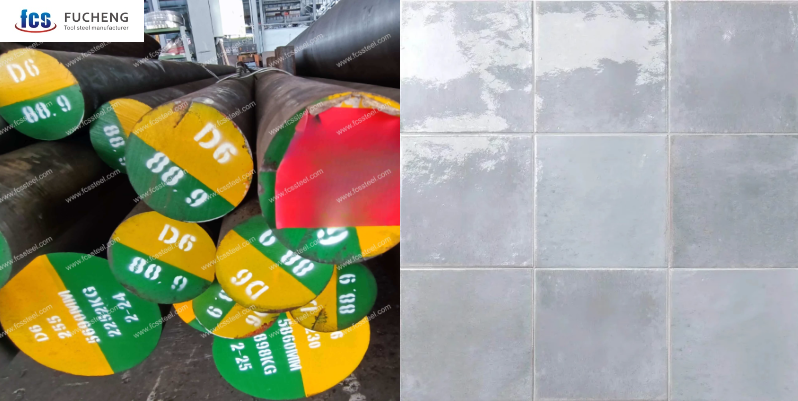
D6 steel reaches hardness levels between 54-61 HRC after hardening and tempering. Heat treatment pushes this range higher—up to 55-62 HRC. This hardness gives compaction dies the wear resistance they need for forming high-mineral ceramic tiles.
D6’s strength comes from high carbon and chromium content. These elements create chromium-rich carbides throughout the steel. These hard carbides protect against abrasive mineral particles. Ceramic powder with hard minerals presses against the die surface. The carbides resist material removal much better than softer steel.
Performance Comparison:D6 vs. Other Tool Steels
| Tool Steel Grade | Key Alloying Elements | Wear Resistance | Toughness & Stability | Comparison Against D6 |
| D6 (1.2436) | High Cr + Tungsten (W) & Mo | Superior | Balanced | Benchmark: Excellent carbide density and high-pressure stability. |
| D2 (1.2379) | High Chromium (Cr) | Moderate | Good | Inferior: Lacks the dense, Cr-rich tungsten carbide protection. |
| D3 (1.2080) | Lower Alloy Content | Low | Moderate | Significant Gap: D6 offers 3–4x higher wear resistance than D3. |
| D7 (1.2376) | High Vanadium (V) | Extremely High | Low (Brittle) | Specialized: Higher wear but too brittle for many tile die shapes. |
How D6 Performs in Production
- Refuses to Deform (1,320 MPa): With a compressive strength of 191 ksi, D6 holds its shape against extreme pressure. While other steels yield, D6 ensures the die cavity remains dimensionally consistent, cycle after cycle.
- Consistent Core Hardness: It’s not just surface deep. The addition of Tungsten and Molybdenum ensures completely uniform hardening. You get the same dense carbide protection in the die’s center as you do on the face, even in thick sections.
- Cryogenic Performance Boost: Real-world testing shows that deep freezing (cryogenic treatment) pays off. It eliminates retained austenite and spreads carbides evenly, significantly raising abrasion resistance in pin-on-disk tests.
- Optimized Density (7.67 g/cm³): It hits the “Goldilocks” zone—dense enough for high structural rigidity, yet light enough for your maintenance crew to handle safely during setup.
2. Withstanding Extreme Compaction Pressures (20,000+ psi)
Porcelain tile production needs compressive strength over 20,000 psi. This number sets the standard for high-strength ceramic tiles. Getting this strength means applying intense force during pressing.
Compaction dies take these extreme pressures head-on. The die material must handle forces that compact ceramic powder into dense bodies. Water absorption below 0.5% marks waterproof porcelain tiles per ASTM C373. Getting this density needs heavy pressure transferred through the die structure.
Pressure Transfer and Die Stress
D6 steel delivers 1,320 MPa (191,400 psi) compressive strength. This handles the stress points in high-mineral ceramic tile forming. Engineering practice uses safety factors of 2-4x the working stress for mold uses. D6’s strength creates good margins even under peak pressure cycles.
The die experiences uneven stress during compaction. Powder compression creates higher pressure zones at corners and edges. Dies made from weaker materials deform in these areas over time. Even small deformation disrupts powder density uniformity.
Impact on Tile Quality
Density variations in the compacted tile body cause firing defects. Cracks develop in areas where powder packed loosely. Warping happens when one section shrinks at a different rate than another during firing. These problems trace back to poor die performance under pressure.
ANSI A137.1 sets minimum breaking strength at 250 lbf for floor porcelain tiles. Wall tiles drop to 125 lbf minimum. Dies that deform reduce these values. Tiles fail quality tests because the die couldn’t keep its shape under compaction forces.
Substrate materials show the pressure reality. Patching compounds for tile installation require 25 MPa (3,500 psi) minimum compressive strength per ASTM C109/C109M. Stone veneer reaches 160 kg/cm² (2,273 psi) per ASTM C192. The die forming these materials handles multiples of these values during each press cycle.
D6 steel stops the die wear that affects lower-grade tool steels. The material keeps its shape across thousands of compaction cycles. This stability means consistent tile density and predictable fired properties.
3. Eliminating Caliber Defects and Density Variations
Caliber defects and shape problems are the main issues in ceramic tile making. Die performance during pressing causes these problems.
D6 steel compaction dies keep tiles accurate. They stop density from varying in green tiles. The maximum green compactness variation (ΔDap) depends on tile size. Standard 30×30 cm tiles can vary by 17 g/cm³. Large-format tiles need tighter control at 12-13 g/cm³.
Die Stability Controls Tile Density
Green tile bulk density (Dap) affects how much tiles shrink during firing. The formula shows: LS = f(Dap, T, WA). Shrinkage depends on three things: dry tile density, peak firing temperature, and water absorption.
Dies bend during pressing. This creates uneven density across the tile. A D6 steel die resists bending under 20,000+ psi pressure. Powder compression stays even from edge to center.
Large porcelain tiles have more stability issues than small ones. Lower compactness and smaller porosity make them sensitive to density changes. The die needs tighter ΔDap control. 60×60 cm tiles need 19 g/cm³. 45×45 cm formats can handle 23 g/cm³.
Meeting Installation Standards
ASTM F2199 limits dimensional change to ≤0.25% under heat. Tiles beyond this limit create installation headaches. Grout lines go crooked. Adjacent tiles sit at different heights.
D6 steel’s thermal stability stops dimension drift during production. The die keeps its shape through thousands of cycles. Each tile gets the same compression force. This gives you predictable shrinkage and final sizes that meet commercial specs.
You can machine or polish tiles after firing to fix dimension problems in glazed porcelain floor tiles. But this adds major cost. Choose the right die material up front. This avoids those extra steps.
4. Deep Hardening Stability for Complex Die Geometries
Ceramic tile compaction dies have deep cavities over 200mm deep. They include detailed punch features and many vent holes. These complex shapes create stress points. The die material must perform well through its entire cross-section.
D6 steel hardens evenly in large sections using air quenching. This gives you deep hardening without the cracking risks oil quenching brings. Air quenching creates smaller temperature changes during cooling. This cuts internal stress in complex shapes.
Air Quenching Prevents Geometry-Related Failures
D3 steel needs oil quenching to get hard. This faster cooling raises cracking risk at weak spots – vent holes, positioning pins, and sharp cavity changes. Complex die shapes make these problems worse. Different section sizes cool at different speeds.
Check the hardness spread. D6 steel keeps even hardness in sections over 100mm thick. D3 shows hardness changes and drops in the core of large sections. Jominy end-quench test data shows D6 hardens deeper than D3 in big cross-sections.
Deep cavities in high-mineral ceramic tile dies need the same hardness from surface to core. Surface hardness alone won’t stop die failure. The core must resist bending under pressure during compaction cycles.
Toughness in Stress-Concentrated Areas
Positioning pins and vent holes create stress points during high-pressure compaction. These features focus mechanical stress in small spots. Dies need strong core toughness to stop cracks from starting at these points.
D6 steel’s air-hardening gives you this toughness balance. The slower cooling keeps the material flexible while reaching working hardness. Leftover stress stays low compared to oil-quenched materials. This matters most in deep cavities and thin parts where trapped stress causes ongoing cracking.
Vacuum or protective atmosphere quenching controls hardness spread even more. Section size data from hardening tests guides heat treatment settings for specific die shapes.
5. Heat Treatment Protocols for Maximum Cycle Life
D6 steel reaches peak performance through precise heat treatment protocols. A die can last 50,000 cycles or 200,000 cycles. Heat treatment execution makes this difference.
Austenitizing temperature controls the final outcome. Heat D6 steel compaction dies to 950-980°C (1742-1796°F). Larger cross-sections may need 940-1000°C. This temperature dissolves carbides into the austenite matrix. The steel structure gets ready for quenching transformation.
Oil quenching beats air or water cooling for complex die shapes. Quench to 65°C or room temperature. Oil provides moderate cooling speeds. This prevents cracking at stress points – vent holes and positioning pins in high-mineral ceramic tile dies. Water quenches too fast. Cracks form. Air cooling works but leaves more retained austenite behind.
Double Tempering Delivers Stability
Single tempering doesn’t finish the job. D6 steel needs double tempering at 500-600°C (932-1112°F). The first temper changes retained austenite into martensite. Cool to room temperature between cycles. This cooling step matters. It lets new martensite form all the way through.
The second temper cycle reduces stress. It also stabilizes dimensions. Target 540-560°C for best balance. This range gives you HRC 58-62 – the sweet spot for compaction die work. Higher tempering reduces hardness too much. The hardness-tempering curve shows this:
- 100°C tempering: 63 HRC (too brittle)
- 500-600°C tempering: 55-62 HRC (optimal zone)
- 600°C tempering: 48 HRC (inadequate wear resistance)
Preheating Prevents Cracking
Never skip preheating steps. Preheat dies to 650-760°C (1200-1400°F). Heat them gradually. Hold for 10-15 minutes. This uniform soak cuts thermal shock during the move to austenitizing temperature. Continue heating to 750-800°C (1382-1472°F) before final austenitizing.
Complex die shapes with deep cavities need extra care. Different section thicknesses heat at different rates. Rushed preheating builds temperature gradients. These cause warping or cracking during quenching.
Pre-Hardening Preparation Steps
Stress relieving before hardening prevents dimensional problems. Machine dies close to final geometry. Then stress relieve at 650-700°C (1202-1292°F). Cool them in the furnace. This removes machining stresses that cause movement during final hardening.
New dies with heavy machining need soft annealing first. Heat to 800-840°C (1472-1544°F). Use heating rates of 50-100°C per hour. Soak 1 hour per 25.4mm of cross-section. Furnace cool to HB 225. This annealed condition cuts machining time way down. Feed rates of 0.11-0.44 mm/rev work well. Annealed D6 steel shows 40% lower yield stress than hardened material. Your cutting tools last longer.
Post-quench stabilization boosts performance further. Let quenched dies sit at room temperature for one week before tempering. This waiting period transforms more retained austenite on its own. The result: higher final hardness and better wear resistance in production.
6. Cost Analysis: D6 vs. Alternative Tool Steels
D6 steel balances initial cost against performance better than most alternatives in ceramic tile production. Raw material pricing sits between budget options like D3 and premium powder metallurgy steels. This middle ground creates the best total ownership economics for compaction dies in high-mineral ceramic tile operations.
Material Cost vs Performance Returns
| Tool Steel Grade | Price Range (USD/kg) | Wear Resistance (vs. D3) | Best Use Case | Total Cost of Ownership (TCO) |
| D3 Steel | $2.50 – $4.50 | 1.0x (Baseline) | Simple shapes; low-pressure loads. | High: Due to frequent replacements & downtime. |
| D2 Steel | $3.50 – $6.50 | 1.5x – 2.0x | General purpose tooling. | Moderate: Lacks the specific carbide density of D6. |
| D6 Steel | $7.50 – $12.00 | 3.0x – 4.0x | High-mineral tile compaction. | Optimized: Best balance of service life vs. cost. |
| Powder Steel | $50.00 – $90.00+ | 5.0x+ | Extreme high-volume automation. | Very High: Performance gain rarely offsets the price. |
Cost-Effectiveness & Stability: The Economic Case for D6
- Superior ROI Over Low-Alloy Steels: While D6 carries a higher raw material price tag than D3, it delivers 3–4 times greater wear resistance. This extended service life significantly lowers the “cost per thousand tiles” produced, offering the best balance between budget steels and expensive powder metallurgy options.
- Dimensional Stability Cuts Finishing Costs: Unlike oil-quenched grades that risk warping, D6 is an air-hardening steel. This uniform cooling minimizes distortion during heat treatment. The financial payoff? You save money by reducing the need for expensive post-hardening grinding and EDM corrections to fix warped dies.
- Machining Savings Strategy: Machining D6 after hardening (57+ HRC) destroys cutting tools. The most economical approach is to machine dies in the annealed state (HB 225). Completing near-net-shape geometry before heat treatment can slash total manufacturing costs by 30–40% compared to hard machining.
- Efficient Grade Selection: Standard D6 provides deep hardenability for cross-sections up to 150mm. This covers the majority of ceramic tile die requirements without needing premium upgrades. Avoid paying extra for ESR (Electroslag Remelted) variants unless your specific large-format die geometry explicitly demands extreme core toughness.
7. Critical Application Limits & Design Rules
D6 offers superior wear resistance, but it is not a “magic bullet.” Production engineers must respect its metallurgical limits to prevent catastrophic die failure.
- Manage Brittleness (No Impact): D6 trades toughness for hardness. With an impact strength of just 30-50 J, it cracks easily under shock loading. Use it only for controlled pressing cycles. Avoid D6 if your process involves rapid pressure spikes or mechanical slamming—switch to S-series steels instead.
- Design for Radiused Geometry: Sharp corners are stress traps for this material. You must design round transitions throughout the die cavity. A 2-3mm radius at internal corners is non-negotiable to stop cracks from starting. Also, keep wall thickness variations within 20% to prevent uneven stress.
- Don’t Plan on Welding: D6 has extremely poor weldability. The risk of cracking during repair is dangerously high. Treat these dies as consumable items. If a D6 die cracks, replace it—do not attempt to weld repair it.
- Machining Requires Strategy: D6 is tough on cutting tools (60% machinability rating). Always machine your complex geometries in the annealed state (HB 225). Don’t try to “fix” geometry after hardening unless you want to burn through expensive grinding wheels.
- Layer Surface Treatments: Since the core is brittle, use shot peening to create compressive surface stresses; this helps the die resist fatigue. You can stack PVD coatings on top for extra wear protection, but the shot peening foundation is critical for longevity.
Conclusion:
Die selection is more than just specs. It boosts your profit. D6 steel works best for ceramic tile production. You get 40-60% longer life than standard tools. Yet, you avoid the high price of powder steels. This stops the headache of constant replacements. It fixes inconsistent sizing too.
Ready to cut downtime? Don’t settle for average results. Test D6 dies on your toughest production line this week. The savings will be clear.