If your business is dealing with moulds, die‑casting, forging or tool manufacturing in Thailand, you’ve probably come across the grade SKD61 tool steel (also known as JIS SKD61, DIN 1.2344 / H13 tool steel in other standards). Finding a reliable wholesaler in Thailand who can supply SKD61 in the right form (plates, bars, blocks), with good lead times, proper heat treatment, and quality assurance is a key part of staying competitive. In this article I’ll walk through the Thai market context, technical details of SKD61, what to look out for in a wholesaler, highlight some top players.The aim: by the end you’ll have a clearer picture of how to choose the best SKD61 wholesaler in Thailand and why certain technical and logistic factors matter.
Why SKD61 matters in the Thai market
What is SKD61
SKD61 is a hot‑work alloy tool steel grade, widely used in moulds/dies exposed to high temperatures, thermal fatigue, cyclic loading. For example: die‑casting aluminium, hot stamping, forging. According to one supplier summary: “SKD61 tool steel is a high‑chromium alloy tool steel with high hardness and wear resistance after heat treatment, and good hardenability and thermal fatigue stability.”
Chemical composition (as per one listing) includes C ≈ 0.35–0.42 %, Cr ≈ 4.8–5.5 %, Mo ≈ 1.0–1.5 %, V ≈ 0.8–1.15 % etc.
It has good strength at elevated temperature, good resistance to thermal cracking and wear in hot work conditions.
Why Thai tool/mould/metal‑working companies use it
In Thailand you’ll find a strong manufacturing base of plastics injection moulding, die‑casting (especially for automotive‑components, electronics), and forging/extrusion operations. These operations demand hot‑work tool steels that can sustain repeated heating/cooling, shock loads, wear from molten metal or hot material. So SKD61 becomes a go‑to grade. Also the one‑stop service providers and service centres in Thailand often list SKD61 among their tool‐steel inventory. For example, one Thai special‐steel supplier lists SKD61 in its “Hot Work Tool Steel grade” offering.
Thus, for Thai buyers: it’s not exotic, it’s mainstream. But the challenge is ensuring you get genuine quality, right stock‑forms, heat treatment, and support from the wholesaler.
Market considerations in Thailand
Local inventory and lead time: Because Thailand imports a lot of specialty steels (or at least the tooling business does), having a wholesaler with local stock or fast import logistics is a plus.
Service and cut‑to‐size: Many mould/die shops will want plates, bars pre‐cut, ground, or further processed (sawn, milled). A wholesaler who can provide shaped or trimmed SKD61 helps reduce cost/time.
Standards, traceability, and heat‑treatment: Because tool steel performance is sensitive to heat‐treatment, the wholesaler must provide spec, certs, ensure hardness, grain size, cleanliness, inclusions etc.
Cost pressures: Thai manufacturers often face cost pressure (competition from neighbouring countries, rising labour costs, etc). A wholesaler who offers wholesales/volume deals, container loads, etc, is attractive.
Local language and service: Thai‑language support, familiarity with Thai logistics/import duty/customs, ability to deliver domestically within Thailand (Bangkok, Chonburi, Rayong, etc) matter.
So when you search for “best SKD61 tool steel wholesalers in Thailand”, you’re looking for someone who ticks the technical & logistic boxes and understands the Thai manufacturing landscape.
What to look for in a wholesaler of SKD61
1.Grade authenticity and equivalents
Ensure the SKD61 they supply corresponds to JIS SKD61 / DIN 1.2344 / ASTM H13 equivalence (if you see only “H13” but not JIS or equivalent, check specs).
Ask for chemical composition sheet: e.g. C, Cr, Mo, V values. One listing: C 0.35–0.42 %, Si 0.80–1.20 %, Cr 4.8–5.5 %, Mo 1.0–1.5 %, V 0.8–1.15 %.
Ask whether they offer ESR (electroslag remelted) variants or standard variants: ESR gives higher cleanliness, better fatigue resistance. For example FCS claims ESR for some grades.
2.Form of supply and cut‑to‑size capability
Bars (round, square, flat), plates, blocks: Make sure the wholesaler can supply the form you need.
Stock sizes: For instance one source lists SKD61 in plates up to width ~610 mm, length up to ~5000 mm.
Finishing: ground, trimmed, sawed, pre‐machined, which helps reduce your downstream cost.
3.Heat treatment/tempering support or supply condition
Because SKD61 performance depends heavily on proper heat treatment (hardening, tempering). One technical doc for SKD61 describes: annealing at 840–860 °C, stress‐relieving at ~700 °C, hardening by preheat 780‑820 °C then rapid heat to 1000‑1030 °C etc.
Ask whether the wholesaler provides pre‑treated stock, or they simply supply raw bars/plates and you handle the heat treatment.
If you operate from Thailand, a wholesaler who can hold inventory or import quickly is a plus. For example FCS claims they maintain “long‑term inventory of 2000 tons to ensure supply chain response speed.”
Container loads: 20‑foot container (20GP) holding ~24–26 tons for tool steel shipments is typical in Asia. FCS listing mentions wholesale by containers.
Local customs/import duty, logistics within Thailand: ensure wholesaler handles or advises.
5.Technical support, certification, traceability
Request material test reports (MTRs), certificate of analysis, hardness test, microstructure verification, perhaps non‐destructive tests.
A wholesaler who can advise on selection of grade, heat treatment, service life, rather than simply “sell bars” adds value.
6.After‐sales service, regional expertise
Especially for Thailand, having Thai language support, local delivery, proximity to major manufacturing hubs (Bangkok, Rayong, Chonburi) is beneficial.
Good communication about delivery times, shipping terms (FOB, CIF Bangkok, EX‐works) and stock transparency.
Top Wholesalers & Suppliers in Thailand
Leong Jin Special Steel (Thailand)
Leong Jin Special Steel (Thailand) is a leading distributor of specialty steels established in 1988. The company supplies tool steel, mold steel, structural steel, and wear-resistant grades compliant with international standards such as DIN, ASTM, and JIS. Based in Samut Prakan, it offers cutting, bending, machining, and bandsaw solutions, providing a complete one-stop service for industrial customers.
Why this is a strong option
Domestic presence: Located in Samut Prakan (near Bangkok), which means shorter domestic supply chains and faster access for Thai tool shops and die‑makers.
Explicit SKD61 listing: They explicitly state SKD61 (“2344, SKD61”) under their hot‑work tool steel section.
Value‑added services: They offer semi‑finished services (cutting, bending, drilling) for their steels, useful for customers who want bars or plates cut to size, ready for machining.
One‑stop supplier mindset: According to their site, they strive to be “One Stop Service Supplier” for tool/mould steel.
What you should check
Stock sizes & lead times: Ask about the SKD61 bar/plate sizes in stock (diameter, length, thickness) and lead times. Some inventory might be imported or ordered on demand.
Inventory vs import: Clarify whether the SKD61 is already held in local stock or imported on order, as import may add cost and time.
Condition of stock: Check whether SKD61 is delivered in annealed/pre‑hardened condition ready for machining (important for mould shops).
Service costs: Cutting, bending, drilling services add value but also cost; compare prices for cut‑to‑length vs full bar.
Material certification: Ensure they can provide mill test certificates (MTC) and chemical/ mechanical specs for the SKD61 material supplied.
S.A.F. Special Steel Public Company Limited
S.A.F. Special Steel Public Company Limited is a Thai company founded in 1992, headquartered in Bangkok. It specializes in importing and distributing high-grade special steels — including hot-work, cold-work, mold, and high-speed steels — and provides vacuum hardening services. The company also offers finishing of industrial tooling, equipment parts, band saw blades, and sawing machines.
Why this is noteworthy
Explicit SKD61 product listing: Their “Special Steels for Moulds & Dies” product page lists DIN 1.2344 (SKD61) among hot‑work tool steels.
Full suite of services: Beyond just steel supply, they also provide vacuum hardening services, finishing industrial tooling parts, which is beneficial if you need more than just raw material.
Established local presence & credibility: Being a public company with a broad product set gives confidence in their stability and supply reliability.
Location: Based in Bangkok, which again provides logistic convenience for Thai buyers.
What you should check
Current SKD61 stock: Confirm their inventory for SKD61 (bar, plate, large block) and whether stock is local or imported.
Material condition and processing: Ask if they supply SKD61 as raw bar, pre‑hardened, or already machined; and whether services (e.g., vacuum hardening) are included or optional.
Delivery/lead time to industrial hubs: Ensure their distribution to your facility or tool shop is timely (Bangkok, Chonburi, Rayong, etc).
Cost breakdown: Since they have extra services (finishing, hardening) check that the price of raw SKD61 and value‑added services are clearly separated so you can compare.
Technical support & after‑sales: If you require high‑cycle moulds, ask if they provide assistance with heat‐treatment schedule, thermal fatigue advice.
FCS Tool Steel Factory-Additional Wholesaler to Consider:
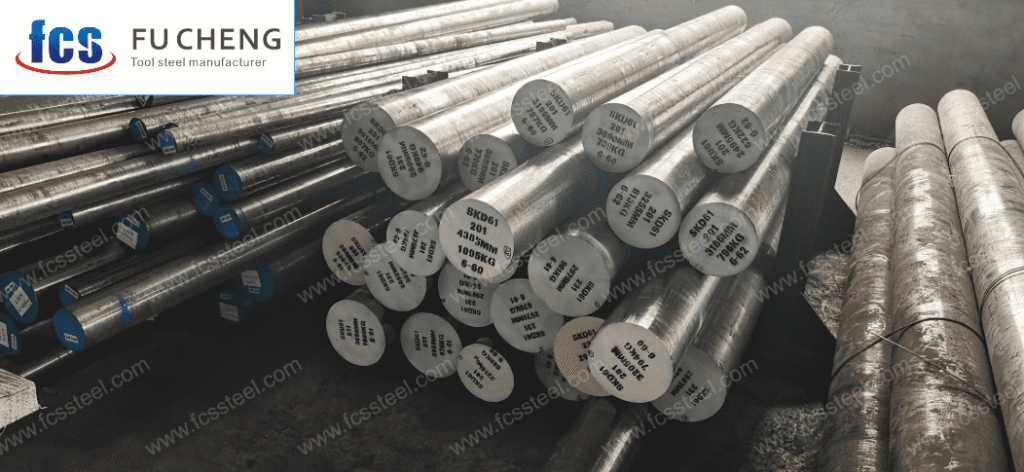
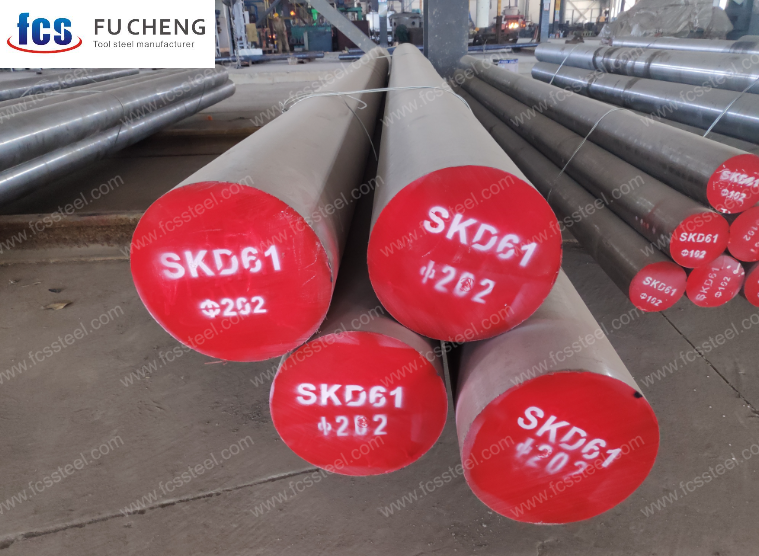
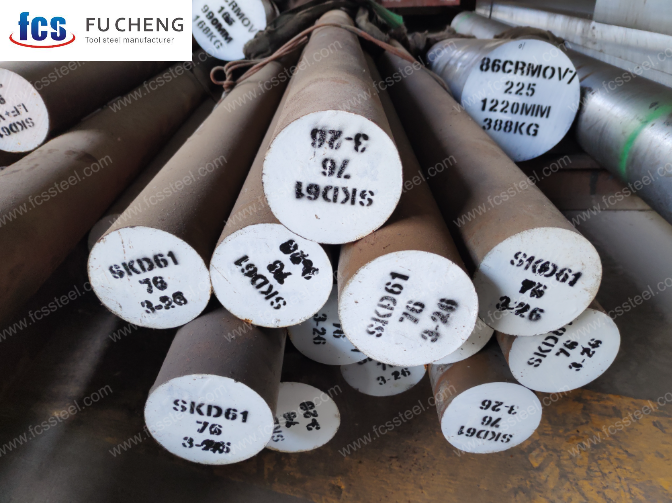
FCS Tool Steel Factory (based in China) is a manufacturer of tool steel, with claimed annual production capacity of ~20,000 tons and long‑term inventory ~1,000 tons. Their product list explicitly includes SKD61 (listed as “SKD61 hot work tool steel”) among their hot work tool steel offerings.
Here’s why they merit attention and how a Thai buyer might engage with them:
Key features
Production scale & inventory: With an output of 20,000 tons/year and inventory of 1,000 tons, they appear capable of servicing large orders and providing responsive supply.
Grade coverage: Products include SKD61, 1.2344, H13 equivalents. They list “SKD61 Hot Work Tool Steel” clearly.
Customisation & full process control: Their site mentions they “produce standard grades such as GB, ASTM, DIN, JIS … chemical composition and specifications can be customized.”
Quality control: They say production goes from material selection → refining → forging → heat treatment → surface treatment → inspection. They also hold ISO9001 certification.
Wholesale / container‑scale deals: They mention “Wholesale sales by containers (20GP: 24‑26T)” on their website.
Technical considerations
Specification check: Ask FCS for the exact composition and whether their “SKD61” corresponds exactly to JIS SKD61 or spec is modified. Their site says JIS SKD61 / H13 / 1.2344 equivalence.
Size/shape availability: Confirm bar diameters, plate thickness/width/length, tolerances. One listing for SKD61 says plate sizes up to 610 mm width, length up to ~5000 mm.
Heat treatment condition: Determine whether the steel arrives annealed, or pre‐hardened, or just as big stock. If you will do your own heat treatment, ensure you’re aware of proper procedures (e.g., annealing at ~840‑860°C, etc).
Certification & traceability: Get the MTR, hardness results, inclusion cleanliness. FCS claims strict QC (surface inspection, microstructure, mechanical properties).
Shipping/logistics: If ordering container loads, check incoterms (FOB China, CIF Thailand), logistics from Chinese port to Thai port, customs and any import duty or VAT in Thailand.
After‐sales support: Ask whether FCS or their regional partner can assist if you have issues (e.g., cracks in moulds, unexpected wear) and whether they can advise heat treatment or lifespan optimisation.
Fit for different Thai buyer profiles
Small mould shop (e.g., 1–2 die sets/year): Probably works with a Thai local distributor (like Leong Jin or S.A.F.) who holds stock in Thailand, quicker turnaround, smaller minimum order.
Medium/large tool shop or trading house: Might directly engage FCS (or coordinate with them via a local partner) for container‑volume SKD61 supply, better pricing, custom sizes.
OEM or mould importer: If you operate regionally (Thailand + ASEAN) and need high‑end SKD61 (for automotive/precision), you’ll value the higher quality/ESR variants that FCS can provide.
Best Practice Tips for Thai Buyers of SKD61
Here are some practical “on the ground” tips that Thai manufacturers/traders often overlook
1.Match the grade to the application
If your mould/die is subject to high thermal shock (e.g., hot‑die casting aluminium at 700‑800 °C, repeated cycles), then SKD61 (hot work) is appropriate.
If it’s a cold‐work application (blanking, cold extrusion) maybe SKD11 (DIN 1.2379) or other cold work grades might be better and cheaper. Don’t default to SKD61 if you don’t need its hot properties (cost may be higher).
One supplier compares SKD61 (H13) vs 1.2379 (cold work) tool steel in terms of use: 1.2344 (SKD61) is for hot work moulds; 1.2379 is for cold work moulds.
Even if the grade is right, steel that has surface cracks, decarburised layer, or inclusions will shorten tool life. Insist on a visual surface inspection, ask for microstructure photographs if possible.
For example FCS mentions surface inspection (free from cracks, folds, oxidised skin, pitting).
3.Heat treatment before you start manufacturing the mould
If you buy SKD61 plate/bar, ensure you know or your supplier knows: annealing, pre‐heating, quenching, tempering steps. For example: Anneal at ~840–860°C, then furnace cool to 500°C, then air‑cool. Hardening: preheat 780–820°C, heat to ~1000–1030°C, then oil/air quench. Tempering at 400‑650 °C depending on target hardness.
If your wholesaler supplies pre‐treated steel, ensure certificate says so.
4.Optimise ordering size for your business
Smaller orders mean higher per‐kg price, more shipping/logistics overhead. If you can coordinate with other projects or other clients to aggregate volume, you can hit better pricing (this is particularly relevant if you import via container).
Remember storage: If you buy bulk SKD61, must store in a condition that avoids moisture/oxidation (especially in Thailand’s humid environment) so surface rust or oxidation doesn’t degrade the steel.
5.Delivery time and customs in Thailand
When importing to Thailand, check whether the wholesaler handles customs, whether you pay duty/VAT, whether you have to clear at Bangkok port/Laem Chabang, and the freight cost to your factory (Rayong, Chonburi, etc).
If you deal with a Thai local distributor, ask whether they hold stock in Thailand (accelerates delivery) or whether they import per order (longer lead time).
For urgent tool work, lead time matters: sometimes local inventory is worth a slightly higher unit cost because downtime is expensive.
6.Re‑sell/distribution model (if you are a trading house)
If you’re in Thailand as a distributor/trader of SKD61, build a network of tool shops who buy small quantities. You can import larger batches (via FCS or other manufacturer) and supply smaller lots domestically. Offer cut‑to‑size, local machining, local stock, fast delivery as your value add.
7.Lifetime cost vs initial cost
Don’t just compare per‑kg price. Consider tool life: if SKD61 from a lower quality supplier (poor hardness, bad inclusions) fails prematurely, your total cost (downtime + remanufacture) is higher. So choose a wholesaler who provides material with good specification and institutionalised QC.
For example, FCS emphasizes high cleanliness (via ESR option) which improves fatigue/thermal‐crack resistance.
Summary
In short: for SKD61 tool steel supply in Thailand, you want a wholesaler who understands both the technical demands of hot‐work tool steel and the logistical/market realities of Thailand. Suppliers like Leong Jin and S.A.F. offer strong local service; manufacturers/wholesalers like FCS Tool Steel Factory offer large volume and customisation.