
Introduction
Precision tooling breaks down mid-production. The damage spreads fast. You get scrapped parts, stopped lines, and bad tolerances. This costs thousands per hour.
German manufacturers know this problem well. They pick one material for their toughest jobs: D6 steel (DIN 1.2436). This covers rolling, threading, and precision die work.
This choice isn’t about tradition. It’s smart engineering based on real performance data.
D6 steel has high carbon and high chromium. This mix creates strong wear resistance. The material also stays stable through heat changes. These features solve six key problems that cause tool failures and expensive downtime.
German manufacturers use this material for good reasons. Understanding these reasons gives you practical knowledge. This knowledge affects your profits.
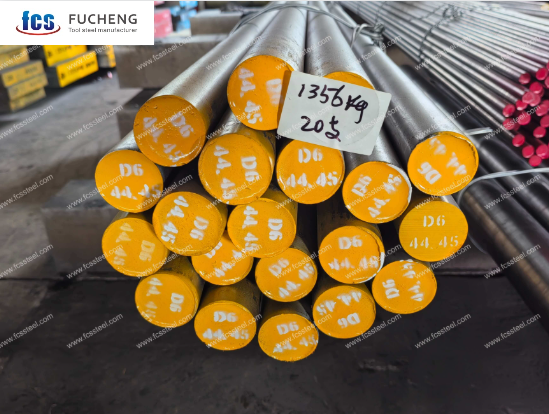
1. D6 Steel’s High Wear Resistance (DIN 1.2436)
D6 steel resists wear because of what’s inside it. Look at the numbers: 2.0–2.2% carbon, 11.5–12.5% chromium, and 0.6–1.3% tungsten. These three elements build a dense carbide network in the steel.
Carbon forms hard carbide particles. Chromium makes these carbides resist wear. Tungsten spreads these carbides evenly through the material. Together, they create the hardness you need in rough work environments.
Through-Hardening for Shape Stability
D6 steel hardens all the way through. Hardness goes deep into thick sections. You won’t get a soft core like case-hardened steels have.
Even hardness cuts down internal stress. Less stress means less warping over time. Your gauges and fineblanking dies stay accurate through years of work.
D6 barely changes size even at high hardness. This makes it good for big cold-work tools. Even tiny shape changes ruin parts.
What You Give Up
D6 fights wear but isn’t as tough. Impact toughness (Izod, unnotched) is 28.0 J. The same hard carbides that stop wear also make the steel break easier under shock.
Don’t use D6 for heavy impacts or vibration. Drop hammers, high-impact punches, or shock-loaded tools need other materials.
D6 needs oil quenching for heat treatment. This is trickier than D2’s air hardening. Shape distortion risk goes up. But for jobs where abrasive wear kills your tools, D6’s results are worth the extra work.
Your tempering temperature sets the final traits. Hotter tempering lowers hardness but adds toughness. German makers pick this setting based on what matters more: maximum wear resistance or some shock tolerance.
2. Resilience Under High Rolling Pressure
Rolling dies take constant crushing pressure. Each cycle forces thousands of pounds into the steel surface. D6 steel handles this better than most toolmakers think.
The big difference? Crushing strength vs. impact strength. D6 gives you 1,320 MPa (191,000 psi) crushing strength after heat treatment. This tells you how much force the steel takes before it bends for good.
Thread rolling and precision dies work under crushing force, not shock. The load grows with each turn. D6’s stiffness at 194 GPa (28,100 ksi) stops dies from bending during these crushing cycles. Less bending means tighter specs stay put.
Why D6 Works for Rolling But Fails Under Impact
German makers split their tool picks. D6 goes into rolling dies, blanking punches, and compression forming tools. Drop hammers or impact tooling? Never.
The reason sits in D6’s structure. High carbon (2.12%) and high chromium (12.00%) create a hard carbide network. These hard carbides spread through the steel. Under steady crushing, they work like tiny pillars. They block surface collapse and steel flow.
Hit D6 with sudden shock? Those same carbides turn into crack starters. Impact strength (Izod unnotched) hits just 28.0 J. S-series shock steels and lower-carbon A-series grades take impacts better. D6 chips or cracks under impact.
This isn’t bad for rolling work. Rolling loads build smooth. Each thread profile forms through controlled pressure, not sudden hits. D6’s deep-hardening means the whole die stays hard through and through, not just the skin.
Tempering Sets the Balance
Tempering defines how D6 steel behaves. Don’t treat this like a standard step. You swap raw hardness for toughness. You need this to handle repeated stress.
German makers stick to specific heat ranges for rolling dies. See why below:
| Tempering Temperature | Hardness (HRC) | Performance Characteristics |
| 100°C (212°F) | ~63 HRC | Maximum Wear Resistance. High brittleness; prone to chipping under pressure. |
| 500–600°C (932–1112°F) | 54–61 HRC | The “Sweet Spot.” Optimal balance for rolling dies. High crushing strength with added toughness. |
| > 600°C (> 1112°F) | ~48 HRC | Maximum Toughness. Increased machinability, but too soft for heavy-duty rolling. |
Most German die shops aim for that 500–600°C range. This keeps the steel hard against wear. Yet, it stays tough. It handles the heavy crushing loads of thread rolling.
Key Step: Always use double tempering. Cool to room temperature between rounds. This dumps internal stress. Without it, your die cracks early. Miss this step? Even the best D6 steel fails.
3. Dimensional Stability in Precision Applications
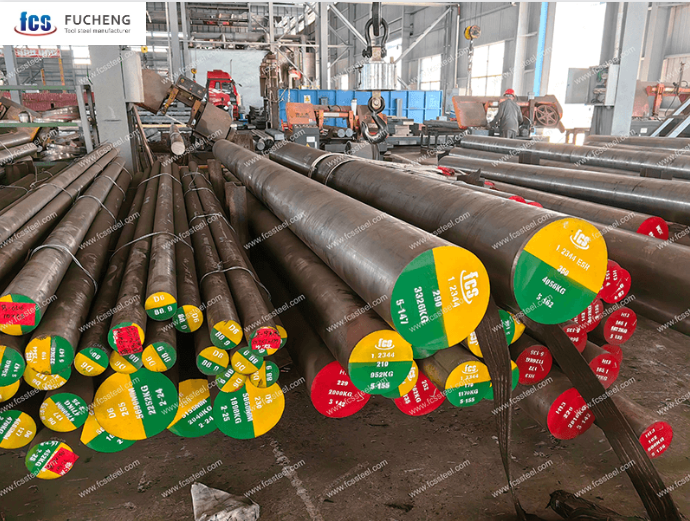
D6 steel changes less than 0.05% in size after heat treatment. Making multi-cavity molds that need 0.01mm precision? This stability matters. Any drift in dimensions ruins the whole batch.
D6’s thermal expansion coefficient: 10.8 × 10⁻⁶ /°C (measured from 21–400°C). That’s the secret. For gauge blocks and high-tolerance tooling, this number drops to ≈10.5 × 10⁻⁶ /°C. Low thermal expansion keeps your mold compensation calculations accurate across different temperatures.
Temperature Stability During Service
D6 stays stable in working environments below 300°C. Even at 300°C tempering, it holds hardness at 58 HRC or higher. This gives you predictable dimensions year after year.
The carbide network spreads out evenly. It fights wear and blocks cracks from spreading. Your molds won’t collapse at corners under repeated impacts. Through-hardening spreads uniform hardness deep into thick sections. This cuts internal stress. Less stress means less warping over time compared to case-hardened steels.
Machining Without Losing Precision
D6 is easy to machine after proper annealing. Yes, it’s extremely hard. The surface stays clean during electrical discharge machining (EDM)—no micro cracks form. Precision mold work needs this. Surface defects spread fast.
That ≤0.05% dimensional stability reduces your mold repair work. Multi-cavity molds needing 0.01mm precision stay accurate longer. You spend less time on corrections.
Comparison: D6 vs. D2 vs. D3 Tool Steels
While D2 is the industry standard and D3 offers a budget-friendly option, D6 stands out where crushing strength and precision stability are non-negotiable. Here is how they stack up in rolling and precision applications:
| Performance Metric | D6 Steel (DIN 1.2436) The Specialist |
D2 Steel The Standard |
D3 Steel The Budget Option |
|---|---|---|---|
| Compressive Strength | Excellent (1,320 MPa) Resists deformation under extreme rolling loads. |
Good Standard balance for general cold work. |
Moderate Prone to deformation under heavy crushing. |
| Wear Resistance | Superior Dense tungsten/carbide network. +40% life vs D2. |
High Good abrasion resistance but wears faster than D6. |
Good Decent initially, but loses edge faster. |
| Dimensional Stability | < 0.05% Change Maintains 0.01mm tolerances in multi-cavity molds. |
Very Good Standard stability, but less consistent than D6. |
Lower Less hardenability; fewer stable dimensions. |
| Impact Toughness | Low (28.0 J) Brittle under shock; creates risks in drop forging. |
Medium Better shock absorption due to less carbon/tungsten. |
Low Similar brittleness to D6 but without the strength. |
| Ideal Application | Thread rolling, precision gauges, high-volume blanking. | General purpose stamping, forming, & cutting. | Short-run tooling, simple shape guides. |
Data sources: Production cycle comparisons and compressive strength tests mentioned in sections 1–3.
4. Machining Complex Die Shapes
D6 steel puts up a fight. That dense carbide network stops wear in use. But it also destroys your cutting tools. You need patience here. Use specific strategies because it cuts much slower than D2. Plan for high cutting forces. Also, expect your tools to wear out faster.
Key Machining Stages
| Material Condition | Hardness | Machining Strategy & Best Practices |
| Annealed | Max 255 HB | Roughing Phase: Remove 80% of material. Using “near-net-shape” techniques here significantly reduces overall costs. |
| Hardened (Low Temp) | ~63 HRC | Grind Only: High brittleness makes this state unsuitable for traditional milling. Edges will chip easily. |
| Hardened (High Temp) | 54–61 HRC | Hard Turning / EDM: The “Sweet Spot” for finishing rolling dies. High precision is achievable at this hardness range. |
4 Rules for Success
Control the Heat: You must oil quench D6. This differs from air-hardened D2. Warping becomes a bigger risk. So, leave extra stock for the final grind.
Watch the Speed: Speeds over 90 m/min kill tool life. Slow it down. This stops crater wear.
Use EDM for Detail: Electrical Discharge Machining handles complex threads best. It stops mechanical stress on that brittle carbide structure.
Plan the Cost: Yes, cutting it costs more upfront. But think about dies running 300,000+ cycles. The lower Total Cost of Ownership (TCO) makes it worth the effort.
5. Cost Efficiency in High-Volume Production
D6 steel costs $7.50–12.00 per kilogram. D2 runs $3.50–6.50. D3 sits at $2.50–4.50. The price gap looks big. But total cost of ownership tells a different story.
German manufacturers track cost per thousand parts, not initial material price. D6’s wear resistance runs 3.0–4.0 times better than D3 steel in high-mineral ceramic tile compaction work. High-volume production sees real savings here.
Real Savings in Automotive Stamping
One automotive door hinge stamping operation saved $75,000 per year in tool replacement costs after switching to D6. High-volume runs show the difference fast. Fewer changeovers mean less downtime. Production keeps moving.
D6 stamping dies last 40% longer than D2 in continuous service. Thread rolling dies and precision punches reach 300,000+ cycles before you need replacements. Standard alloy tools? They fail 40–60% sooner.
Manufacturing Cost Reduction Through Smart Machining
Machine D6 in annealed condition (max 255 HB) before heat treatment. This “near-net-shape” approach cuts manufacturing costs 30–40% compared to hard machining after hardening.
You skip the brutal grinding work on 57+ HRC surfaces. Tool wear drops sharply during roughing operations. The steel reaches final geometry easier. Heat treat to 55–62 HRC afterward. Final grinding touches up key dimensions.
Total Cost Comparison in Compaction Dies
High-mineral ceramic tile compaction shows D6’s sweet spot:
- D3 baseline: Frequent replacements kill your budget
- D2 moderate: 1.5–2.0x wear resistance, acceptable TCO
- D6 optimized: 3.0–4.0x wear resistance, best balance for cost
- Powder metallurgy steels: $50–90+ per kg, 5.0x+ wear resistance, but price seldom justifies the jump
D6 hits the best zone between performance and price. Powder steels perform better but cost too much for most applications. D3 and D2 run cheaper upfront but die faster.
ESR-Grade D6 for Critical Applications
Need better toughness and fatigue resistance? Electroslag remelted (ESR) D6 costs 30–40% more than standard D6. You get reduced inclusions. Heat treatment response gets better. Fatigue life extends further.
German shops spec ESR D6 for critical automotive and aerospace dies. Tool failure here stops expensive production lines. The premium pays off in zero-downtime operations.D6 works best where steady crushing pressure rules and cycle counts climb past 100,000 parts. Millions of cycles make the initial material investment vanish.
6. Alignment with German DIN Standards
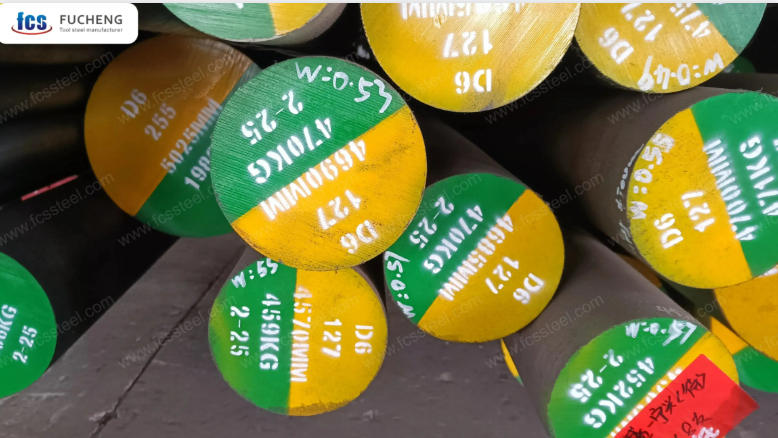
D6 steel meets strict German industrial standards for cold-work tooling. The DIN 1.2436 classification confirms this. The official name X210CrW12 follows DIN EN ISO 4957—Germany’s core spec for tool steels. This standard controls chemical makeup, mechanical properties, and heat treatment needs across European manufacturing.
Chemical Composition Standards
1.2080 (D2) steel. Tungsten boosts wear resistance. It also makes carbides more stable. German specs need this for rolling dies that handle 300,000+ cycles in automotive and precision metalwork.
Phosphorus and sulfur stay below 0.03%. Tight control stops these impurities from causing brittleness. It also prevents cracking during heat treatment. DIN standards enforce this for cold-work tools. Failure means scrapped production runs.
Mechanical Property Requirements
DIN 1.2436 sets strict mechanical requirements for D6 steel, ensuring reliability in rolling, threading, and precision dies.
| Property | Condition | Value | Engineering Notes |
| Hardness | Annealed | ≤ 255 HB | Soft state; ideal for machining complex thread profiles and die cavities prior to heat treatment. |
| Hardness | Hardened | 54–61 HRC | The Rolling Standard: Balanced wear resistance and toughness for high-precision dies. |
| Hardness | Hardened | 62–64 HRC | Maximum Wear: Best for blanking punches and tools facing high-abrasion environments. |
| Tensile Strength | Hardened | 700–800 MPa | High resistance; withstands heavy rolling pressure without plastic deformation. |
| Yield Strength | Hardened | ≥ 600 MPa | Critical threshold that prevents die flexing or “springing” under operational load. |
| Elastic Modulus | Hardened | 210 GPa | High stiffness ensures dimensional stability and tight tolerances under stress. |
Key Takeaways:
Annealed state allows easier pre-machining of complex geometries.
Hardened state balances wear resistance, toughness, and dimensional stability.
German manufacturers select HRC based on application: thread rolling dies at 58–61 HRC, blanking punches at 62+ HRC.
Physical Properties for Precision Work
Density: 7.80 g/cm³ under DIN measurement. This matches design calculations for die weight and center of gravity in automated stamping systems.
Thermal expansion: 10.5 × 10⁻⁶/°C (20–100°C). Low expansion keeps size changes easy to predict during temperature swings in production. Multi-cavity molds need 0.01mm precision. This stability makes it possible.
Thermal conductivity: 24 W/(m·K) lets heat escape during continuous rolling operations. Dies stay cooler. Hardness stays stable longer.
Common Industrial Applications in Germany
DIN 1.2436 leads German cold-work tooling catalogs:
– Thread rolling dies for automotive fasteners and aerospace parts
– Cold stamping dies and punches for low-impact, high-wear forming
– Drawing dies for wire and tube production
– Blanking and shearing tools that cut sheet metal up to 4mm thick
– Impression dies for precision metal forming
– Drill bushings and gauges that need long-term size stability
– Cold heading dies for fastener manufacturing
German automotive suppliers choose DIN 1.2436 for door hinge stamping, bracket forming, and structural component blanking. Precision cutting blade makers use it for industrial cutting systems. These systems process steel, aluminum, and composite materials.
Oil-Hardening Trade-offs
DIN 1.2436 needs oil quenching for full hardness. This creates more size change than air-hardening 1.2080. German manufacturers control this through:
– Precise fixturing during quench
– Controlled cooling rates (oil temperature, agitation)
– Double tempering cycles with room-temperature holds between runs
Tight-tolerance threading dies need final grinding after heat treatment. The steel’s low tempering distortion helps. Dimensions shift very little during stress relief at 500–600°C.
Conclusion
German manufacturers don’t pick D6 steel (DIN 1.2436) just for tradition. The numbers prove it works. You get a high-carbon, high-chromium steel that fights wear hard. Plus, it stays stable through heat cycles. D6 steel for rolling, threading, and precision dies beats the alternatives in tough shops.
You gain five technical strengths: wear resistance, toughness, stability, machinability, and cost. These cut downtime and add tool life. You also lower the cost-per-part on big runs. Your dies hold tolerance for millions of cycles. Competitors are busy scheduling replacements. That gives you a real competitive edge.
Ready to boost your tooling? Get certified DIN 1.2436 from trusted European suppliers. Ask for material tracking and heat treatment papers. Your precision dies need the same standards that German manufacturers specify D6 steel for. Cold forming leaves no room for weak materials.