
In aluminum die casting, mold life directly defines production cost, efficiency, and long-term stability. SKD61 (H13 / 1.2344) remains the industry standard, but modern high-pressure, high-speed HPDC conditions push conventional grades to their limits. Each cycle exposes the steel to 660–700 °C molten aluminum followed by rapid cooling, generating severe thermal shock. This produces micro-cracks, heat checking, and early failure—often around 80,000 shots for standard SKD61.
Chemical attack adds to the damage. Al and Al-Si alloys form Fe-Al intermetallic layers that cause die soldering and surface tearing, while high-velocity aluminum flow accelerates erosion in thin-walled or complex features. These combined mechanisms quickly degrade traditional SKD61.
Standard SKD61 typically achieves 60–80% of the life offered by premium ESR hot-work steels, creating productivity loss and higher replacement cost. Customized SKD61 closes this gap through optimized chemistry, advanced heat treatment, surface hardening, and stress-management strategies. With proper tempering and nitriding, customized SKD61 delivers 80,000–150,000 shots, and when thermal conditions are well controlled, optimized versions can reach up to 420,000 shots before heat checking dominates.
In short: Customization—not standard grades—is what unlocks long-cycle SKD61 performance in demanding HPDC environments.

What “Customized SKD61” Actually Means
Chemical composition (micro-alloying)
- Higher Mo for better temper resistance
- Increased Cr uniformity for oxidation resistance
- Lower S/P for cleaner steel and longer fatigue life
- Optional V/Nb for improved secondary hardening
Processing routes
- ESR (Electro-Slag Remelting)
Better cleanliness → fewer microcracks → longer mold life - VAR (Vacuum Arc Remelting) (premium cases)
Higher toughness and fatigue resistance - Precision-controlled forging ratios
Improves grain flow and fatigue strength in critical zones
Tailored hardness / heat treatment
- Surface hardness 46–48 HRC for erosion resistance
- Core hardness tuned to 38–42 HRC for toughness
- Nitriding or PVD coating planned into the steel treatment path
Custom sizes and pre-machining
- Forged to shape reduces internal stress
- Oversize blocks with customized machining allowance
How Customized SKD61 Improves Mold Life

1. Hardness Optimization: The 50–52 HRC Sweet Spot
Target hardness after tempering controls how well SKD61 fights thermal fatigue. 50–52 HRC strikes the right balance for die casting and forging. Too soft? The steel yields under stress. Too hard? It becomes brittle.
Multi-step tempering hits this hardness level. It also cuts down retained austenite. Each tempering cycle eases internal stress. The result? 0.07–0.08% dimensional expansion instead of random distortion. This tight control cuts finishing work by 15–25%.
Less grinding means less surface damage. Fewer micro-defects mean fewer crack starting points. The mold starts its service life in better shape. This advantage builds over thousands of cycles.
2. Thermal Properties That Fight Heat Checking
SKD61’s thermal conductivity sits at ≈24.3 W/m·K. Better heat flow pulls temperature away from the surface faster. Surface temperature spikes drop. Thermal stress reduces. Heat checking slows down.
The coefficient of thermal expansion runs 11.5–12.4 µm/m·°C. This number predicts thermal stress during fast heating and cooling. Engineers use it to design better cooling channels. Good cooling keeps thermal stress below critical levels.
Room-temperature properties tell part of the story. Elastic modulus reaches ≈224 GPa. Yield strength hits ≈1325 MPa at 0.2% offset. Tensile strength peaks at ≈1500 MPa. These values provide the mechanical base. But high-temperature performance matters more in aluminum die casting.
3. Fatigue Life Data: The Design Foundation
|
Condition |
Stress (MPa) |
Cycles to Failure |
Notes |
|---|---|---|---|
|
Room Temperature |
1100 |
≈2200 |
Uncoated SKD61, baseline |
|
Room Temperature |
600 |
≥106 |
Near infinite life |
|
400 °C |
1000 |
≈2900–3000 |
Operating temperature test |
|
400 °C |
600 |
≥106 |
Near infinite life |
|
500 °C |
1000 |
≈150–465 |
High temperature, high stress |
|
500 °C |
600 |
≥106 |
Moderate stress, long life |
The practical takeaway? Keep local cyclic stress at working temperature ≤600 MPa. Hit this target. You unlock million-cycle potential at operating temperature. Customized SKD61 achieves this through:
-
Better heat treatment that reduces leftover tensile stress
-
Smart mold design that lowers peak thermal stress zones
-
Surface hardening that creates compressive stress layers
4. Advanced Heat Treatment Strategy
Customized heat treatment targets 50–52 HRC with minimal retained austenite. It also aims for near-zero leftover tensile stress. Multi-step tempering is a must. The process locks dimensions to <0.1% distortion. It maintains that key 0.07–0.08% expansion.
Each tempering step has a job. The first drops hardness from as-quenched levels. The second eases deeper internal stress. The third locks in carbide structure. You end up with uniform hardness through the whole mold, not just at the surface.
5. Nitriding: The Life Extension Multiplier
Surface hardening through nitriding after final machining changes mold life. The process pushes nitrogen into the steel surface. This creates a hardened case with compressive stress built in.
Users running high-cycle aluminum HPDC report big gains. Base life of 80,000–150,000 shots extends toward the upper range and beyond with proper nitriding. Some applications push past 200,000 shots with tuned nitriding settings.
The nitrided layer fights die soldering. Those Fe-Al metal phases struggle to form on a nitrogen-rich surface. Wear from erosion drops because surface hardness goes up. Thermal fatigue cracks spread slower through compressive stress zones.
Use Case Examples of Customized SKD61
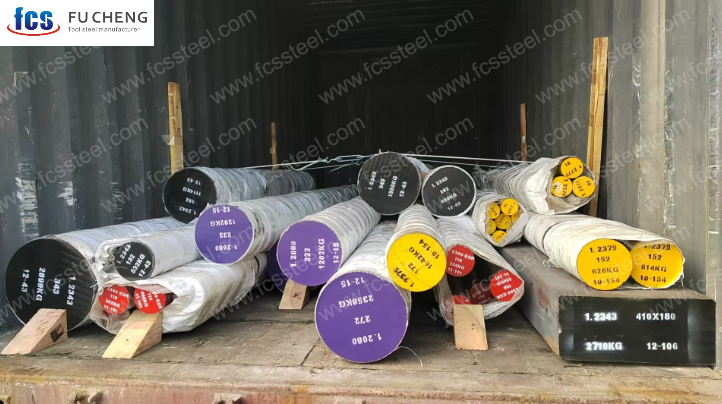
Production floors around the world show that customized SKD61 delivers real gains. These aren’t marketing claims. Automotive plants, forging lines, and die-casting shops document these results. They run millions of cycles under harsh conditions.
Case Studies: Customized SKD61 Performance Data
The following real-world cases from global production floors validate the performance gains of customized SKD61 under demanding working conditions.
1. Automotive Shaft Hot Forging:
Application: Closed-die hot forging of high-strength steel shafts
Material Compared: H11 hot work tool steel
Key Process: ESR refinement, austenitizing at 1020–1050°C, triple tempering at 550–680°C, hardness 50-52 HRC
Key Results:30% increase in die life; stable operation for 500,000 cycles with surface temperatures reaching 600–650°C before major refurbishment; significant reduction in thermal fatigue cracking.
2. Thin-Wall Aluminum Die Casting:
Application: High-pressure die casting of complex thin-wall aluminum automotive parts
Material Compared: Standard H13 steel
Key Process: ESR for uniform carbide distribution, same heat treatment path, nitriding + PVD coating on cavity and gate areas
Key Results:30–40% extension in mold life; reduced surface wear and oxidation; improved dimensional stability and lower scrap rate; extended maintenance intervals.
3. Plant Benchmark:
Material Compared: QDH steel
Application: Comparative mold testing in the same automotive parts plant
Finding: Customized SKD61 fully meets the heat resistance needs of high-temperature die casting zones. However, its wear resistance reaches limits in high-abrasion machining areas.
Performance Data: With SKD61 set as the baseline (1.0) for this application, QDH steel achieved a life ratio of 2.9 (approximately twice that of SKD61).
Key Insight: Customized SKD61 dominates in high-temperature die casting zones. For high-wear areas, switching to more wear-resistant grades like QDH is the optimal strategy. Smart material selection outperforms a one-size-fits-all approach.
Conclusion:
I’ve learned from real production floors that customized SKD61 isn’t just a material upgrade—it’s a business decision that cuts costs and extends mold life where it matters most. The data from automotive forging, die casting, and extrusion lines proves that smart customization delivers measurable returns. For me, the lesson is clear: stop treating tool steel as a commodity and start engineering it for your exact process conditions.