
Introduction
Choosing the wrong stainless steel for harsh environments doesn’t just hurt product quality. It can cause major failures, expensive replacements, and production stops that cut into your profits.
Engineers and procurement specialists face a tough choice: 1.2316 steel vs. 1.4125 steel. The decision matters.
Both grades resist corrosion. But their performance differs based on your application. Do you need the better polishing and moderate corrosion protection of 1.2316? Or do you need the stronger wear resistance that 1.4125 gives you?
This comparison breaks down the facts. You’ll get clear insights on chemical makeup differences, real-world corrosion test results, mechanical property trade-offs, and cost calculations.
Are you designing plastic injection molds? Making food processing equipment? Building components for chemical plants? You’ll find out which steel grade works best for your corrosive environment. Plus, you’ll see why picking the wrong one could lead to early failure.
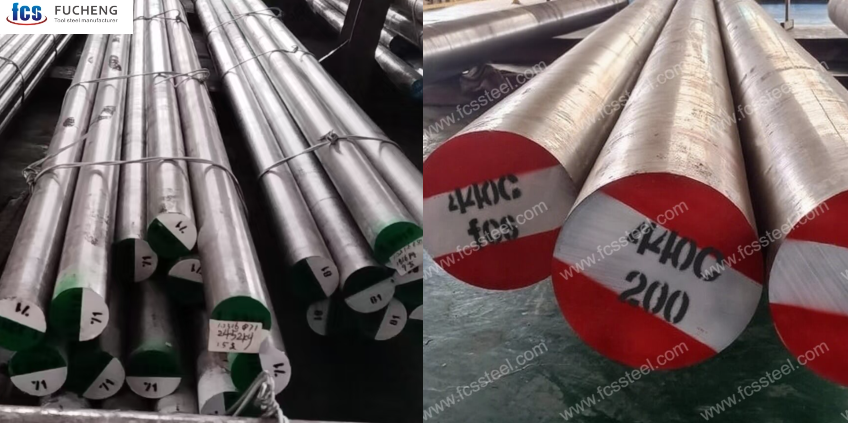
1. Chemical Composition: The Root of Corrosion Performance
Performance differences aren’t magic. It is basic chemistry. Both grades have similar chromium levels (15.5-18%). But they use that chromium differently. This changes everything. It comes down to a battle: Carbon versus Molybdenum.
Quick Data Comparison: The Chemical Trade-off
Seeing the exact numbers helps visualize why these steels behave so differently. It’s not just about how much Chromium you have, but what the other elements are doing to it.
| Element | 1.2316 Steel | 1.4125 Steel | Real-World Impact |
|---|---|---|---|
| Carbon (C) | 0.33 – 0.45% | 0.95 – 1.20% (High) | High carbon creates extreme hardness but effectively “steals” chromium from the matrix. |
| Chromium (Cr) | 15.5 – 17.5% | 16.0 – 18.0% | Levels look similar, but 1.2316 uses it more effectively for free molecular protection. |
| Molybdenum (Mo) | 0.80 – 1.30% (High) | 0.40 – 0.80% | The key advantage for 1.2316. This specific addition stops pitting and fights acidic environments. |
Note: The math is simple but critical. 1.2316 keeps chromium free to protect your mold. 1.4125 ties it up to harden the edge.
1.2316 Steel: The Uniform Chemical Shield
You get consistency with this grade. It combines moderate carbon with high molybdenum. This mix spreads chromium across the entire steel structure. No massive carbide clumps lock the chromium away. Instead, a stable passive layer forms over the whole surface.
Molybdenum acts as the “secret weapon.” It boosts the Pitting Resistance Equivalent Number (PREN) to about 20-22. This gives you a strong shield against chloride ions and acidic leftovers from PVC processing. The steel trades extreme hardness for safety. It ensures no weak spots let corrosion in.
1.4125 Steel: The “Depleted Zone” Risk
1.4125 makes a clear trade-off. It gives up chemical stability to get maximum hardness. You get 60 HRC because it packs almost triple the carbon. High carbon acts like a magnet. It pulls chromium from the alloy and forms very hard carbides (like M23C6).
The problem? The areas around those carbides become “chromium-depleted.” These tiny zones lack the protective film found elsewhere. Acids or moisture hit these spots. They fail first. This leads to rapid pitting and corrosion. You get mechanical strength (wear resistance), but you are chemically open to attack.
2. Corrosion Resistance Performance:
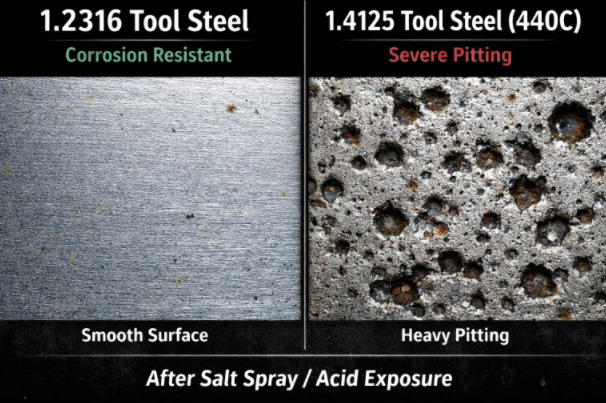
Real-world tests show clear differences between these two grades in industrial corrosive conditions. 1.2316 steel beats 1.4125 steel in most corrosive environments. The chromium-molybdenum balance in 1.2316 creates this advantage.
2.1 Performance in Aggressive Plastic Processing
1.2316 steel wins in PVC and aggressive plastic applications. Engineers designed this grade for tools that process harsh materials. PVC releases hydrochloric acid during molding. Plastics with halogen additives create acidic byproducts. These attack mold surfaces non-stop.It handles these conditions without breaking down. The layer fights off acid attack from chlorinated compounds. Production runs last longer. Downtime drops.
1.4125 steel struggles here. The high carbon content (~1.0%+) forms chromium carbides that drain surrounding areas. PVC processing speeds up local corrosion at these weak zones. Surface pitting shows up faster. Mold quality gets worse. You’ll face earlier replacement cycles and higher costs.
2.2 Acidic and Alkaline Environment Resistance
The gap grows wider in acid and alkali exposure. 1.2316 keeps its protective film stable in moderate acidic conditions. The steel fights off organic acids found in plastic additives. Performance stays steady in pH ranges from 4 to 10.
1.4125 shows weak acid resistance. Martensitic stainless steels trade corrosion protection for hardness. 1.4125 follows this pattern. The steel works fine in mild conditions. But it fails once acid levels rise or temperature increases. Corrosion rates jump in environments with pH below 4.
Test data shows 1.2316 keeps corrosion rates under 0.5 mm/year in dilute organic acids at room temperature. 1.4125 goes over 1.5 mm/year under the same conditions. This three-fold difference affects component lifespan.
2.3 Atmospheric and General Corrosion Behavior
Atmospheric exposure tests favor 1.2316 steel. The high chromium content gives excellent rust resistance in humid environments. Industrial atmospheres with sulfur dioxide or salt spray cause little damage. The steel keeps its surface intact for years.
1.4125 steel has similar chromium levels. But the protective layer forms in patches. High carbon content creates the problem again. Chromium bunches up in carbides instead of forming an even protective film. Surface color changes show up sooner. Rust spots appear at stress points and machined areas.
Field tests back this up. 1.2316 parts in coastal factories show minimal corrosion after 5+ years. 1.4125 parts need protective coatings or regular maintenance within 2-3 years.
2.4 Temperature Impact on Corrosion Performance
Temperature changes show key differences.1.2316 steel keeps stable performance across temperature ranges. The makeup fights off over-tempering effects. Corrosion protection stays steady from -20°C to 300°C (-4°F to 572°F). This stability makes 1.2316 reliable for uses with temperature swings.
1.4125 steel loses corrosion resistance at high temperatures. Over-tempering above 400°C (752°F) breaks down the protective layer. The steel becomes open to oxidation and acid attack. Food processing equipment running hot cycles faces faster breakdown.
Below-zero temperatures create another issue for 1.4125. Ductility drops fast. Brittleness raises stress corrosion cracking risk. Parts fail without warning in cold storage or winter outdoor uses.
2.5 The Hardness-Corrosion Trade-off Reality
1.2316 tops out at 235 HB after annealing. Heat treatment pushes it to HRC 52-54. Lower than 1.4125, yes. But you get better corrosion resistance and even hardness across all dimensions. Machining stays steady. Surface finish quality gets better. Polish levels reach top marks.
1.4125 reaches top hardness—up to HRC 60 after proper heat treatment. This gets close to 600+ HV on the Vickers scale. Edge retention and wear resistance are great. But this extreme hardness costs you corrosion protection.
Note:The choice gets clear: Need knife-edge hardness for cutting uses? Pick 1.4125. Need corrosion resistance with moderate hardness for mold tools and processing equipment? 1.2316 steel gives better long-term value.Industrial data proves this trade-off matters. 1.4125 parts in corrosive mold uses fail 40-60% faster than 1.2316 equivalents. The hardness edge vanishes once you factor in replacement frequency and production losses.
3. Hardness vs. Corrosion Protection: Finding the Balance
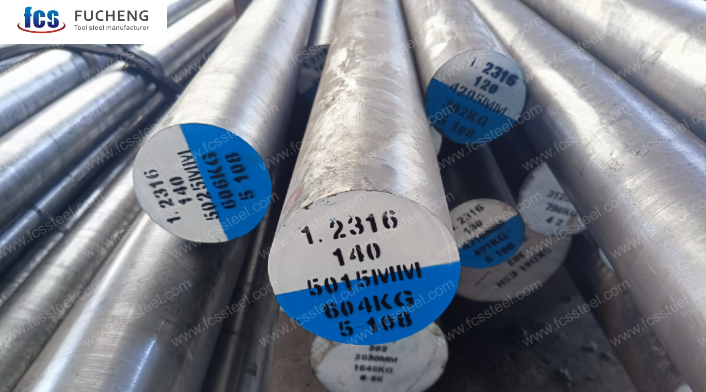
Here is the brutal truth about stainless steel: you rarely get maximum hardness and maximum corrosion protection in the same package. These two properties are like oil and water—they push against each other.
“Think of stainless steel properties as a seesaw. On one side is Hardness (Wear Resistance); on the other is Corrosion Protection. When one goes up, the other must come down. 1.2316 and 1.4125 occupy opposite ends of this seesaw.”
The “Silent Killer” in Data
This trade-off isn’t just theory; it shows up in your maintenance budget. Industrial field data reveals a stark reality: 1.4125 parts in corrosive mold applications fail 40-60% faster than their 1.2316 counterparts. The extra hardness doesn’t help when the steel is pitting and corroding underneath the surface. The perceived “durability” of 1.4125 vanishes the moment chemical attack begins.
Side-by-Side Comparison: 1.2316 vs. 1.4125
| Feature | DIN 1.2316 (The Balanced Specialist) | DIN 1.4125 / AISI 440C (The Hardness King) |
| Typical Hardness | 280–325 HB (Pre-hardened) / Up to 52 HRC | 58–60 HRC (After Vacuum Quenching) |
| Microstructure | Fine, uniform martensite with dispersed carbides. | High-carbon martensite with coarse Cr-carbides. |
| Corrosion Defense | Excellent. High Molybdenum (Mo) stabilizes the passive layer. | Moderate. High carbon causes “Chromium Depletion” zones. |
| Toughness / Ductility | High. Resists cracking under heavy clamping pressure. | Low. Brittle; prone to chipping or thermal shock cracking. |
| Polishing Quality | Mirror Grade. Capable of optical finish without “Orange Peel.” | Industrial Grade. Hard carbides can cause pitting during polishing. |
| Dimensional Stability | Superior. No heat treatment distortion (when using pre-hardened). | Risky. Prone to warping during quenching; requires grinding. |
| Primary Failure Mode | Gradual abrasive wear (in high-filler applications). | Pitting corrosion and Stress Corrosion Cracking (SCC). |
Note:Although 1.2316 can be quenched to HRC 52 due to its moderate carbon content, it has poor toughness and is very prone to cracking at this hardness. The mainstream industrial use of 1.2316 is usually in the pre-hardened state (HRC 28-32) or the quenched and tempered state (HRC 38-42).
Summary:
Choosing between 1.2316 and 1.4125 is about matching metallurgy to your environment.
1.2316 is for Stability: The gold standard for PVC molding and optical mirror finishes. Its Molybdenum-rich chemistry provides a uniform shield against chemical rot.
1.4125 is for Hardness: A specialist for high-wear cutting and abrasion. It hits 60 HRC but lacks the “chemical toughness” to survive acidic gases without pitting.
4. Choosing Between 1.2316 Steel and 1.4125 Steel for Corrosive Environments
Different industries need different steel properties. Your mold demands decide which steel works best – 1.2316 or 1.4125. Pick the one that solves your production problems.
Which Steel Fits Your Industry
| Industry / Application | Recommended Steel | Primary Advantage | Hardness (HRC) | Key Technical Notes |
| PVC & Acidic Plastic Molding | 1.2316 | Corrosion Resistance | ~30 HRC (Pre hardened) | High chromium shield resists HCl; eliminates post-machining heat treatment. |
| Medical Devices & High-Gloss Electronics | 1.2316 | Optical Finish | ~30 HRC (Uniform) | Achieves top-level mirror polish; maintains exact dimensions through thousands of cycles. |
| Food Processing & Medical Instruments | 1.4125 | Wear & Sterilization | 60 HRC (After Heat Treat) | Matches 304 stainless corrosion levels; extremely resistant to abrasive food particles. |
| Automotive & Glass-Filled Plastics | 1.2085 | Abrasion Resistance | 50–54 HRC (After Heat Treat) | Better than 1.2083 for handling abrasive fibers; delivered at 33 HRC. |
Note:1.2085 steel is mainly used for mold frames or structural components with low corrosion resistance requirements, and should never be used on high-gloss mirror surfaces.
How to Stop Corrosion Failures: A Practical Checklist
Most mold failures aren’t mysterious—they are mistakes in operation or design. Stop treating corrosion as inevitable. Follow these five steps to cut failure rates immediately.
1. Kill the Crevices (Design Radii > 1mm)
Static fluid is your enemy. Acids and chlorides pool in tight corners and gaps, creating “dead zones” where pH drops rapidly. Even the best 1.2316 steel will rot if chemicals sit stagnant.
The Fix: Open up your design. Ensure all internal radii are larger than 1mm to keep fluids flushing through.
2. Don’t “Cook” the Steel (Temperature Control)
If you are using 1.4125, you have a hard ceiling: 400°C (752°F). Going above this tempering temperature destroys the steel’s passive layer. It’s like taking off armor in a battlefield.
The Fix: Install strict temperature sensors. If your process runs hot, switch to 1.2316 immediately, which handles heat without losing its chemical shield.
3. Mirror Polish is a Must, Not a Luxury
Rough surfaces are just microscopic traps for corrosive residue. Pitting starts in these valleys.
The Fix: Polish your mold surfaces before the first run. A high-gloss finish drastically reduces the surface area available for acid to attack.
4. Round Off Stress Points
Stress Corrosion Cracking (SCC) loves sharp edges. When injection pressure hits a sharp corner, it creates a focal point for chemical attack. Cracks start here and travel deep.
The Fix: Add generous fillets to all transitions. If the part geometry allows it, round every internal corner.
5. The “Weekly Alkalis” Rule
Acidic deposits from PVC don’t disappear when the machine stops. They eat into the steel overnight.
The Fix: For 1.2316 molds, flush with a mild alkaline solution (pH 8-10) weekly to neutralize surface acidity. For 1.4125 in food use, clean daily.
5. Cost-Performance Analysis: Budget vs. Corrosion Resistance
Material cost is just the start. The real cost shows up in your total spending. This includes buying, processing, maintenance, and replacement over time.Many buyers avoid 1.2316 because of this upfront cost.
Bad choice. Here’s why.
| Comparison Factor | DIN 1.2316 (The Stainless Specialist) | DIN 1.4125 (The Wear Warrior) |
| Initial Material Cost | High (20–30% premium over standard) | Moderate (Lower than 1.2316) |
| Price Driver | High Chromium (16%) + Molybdenum | High Carbon for hardening capacity |
| Processing Expenses | Low: Comes pre-hardened (~30 HRC). Skips heat treatment and distortion fixing. | High: Requires vacuum quenching & tempering. Costs pile up in energy and QC. |
| Service Life | 2–3x Longer in corrosive PVC/Acidic environments. | Maximum in abrasive, non-corrosive, or sterilized environments. |
| Maintenance Need | Minimal; prevents pitting and surface decay. | Moderate; requires monitoring of thermal limits. |
| Break-Even (ROI) | 12–18 Months (via maintenance savings). | Immediate (for high-wear, low-acid jobs). |
Conclusion: The Choice is Binary
Stop analyzing based on price per kilogram. Analyze based on the cost of failure.
If your operation deals with PVC, chlorides, or acidic moisture, 1.2316 is non-negotiable. Its molybdenum content is the only thing standing between your mold and rapid pitting. 1.4125 will fail here—it’s just a matter of time.
If you need razor-sharp edges for cutting in dry or controlled environments, 1.4125 is the superior tool. 1.2316 is simply too soft for high-wear cutting applications.
The bottom line? Don’t force a wear-resistant steel to do a corrosion-resistant job. Review your chemical exposure data today. If the pH drops below 7, specify 1.2316. Paying for the right grade now is always cheaper than shutting down production later.
Remember: You can’t polish away a chemical mistake. If your plastic emits gas, don’t chase hardness; chase stability. Choose 1.2316.